
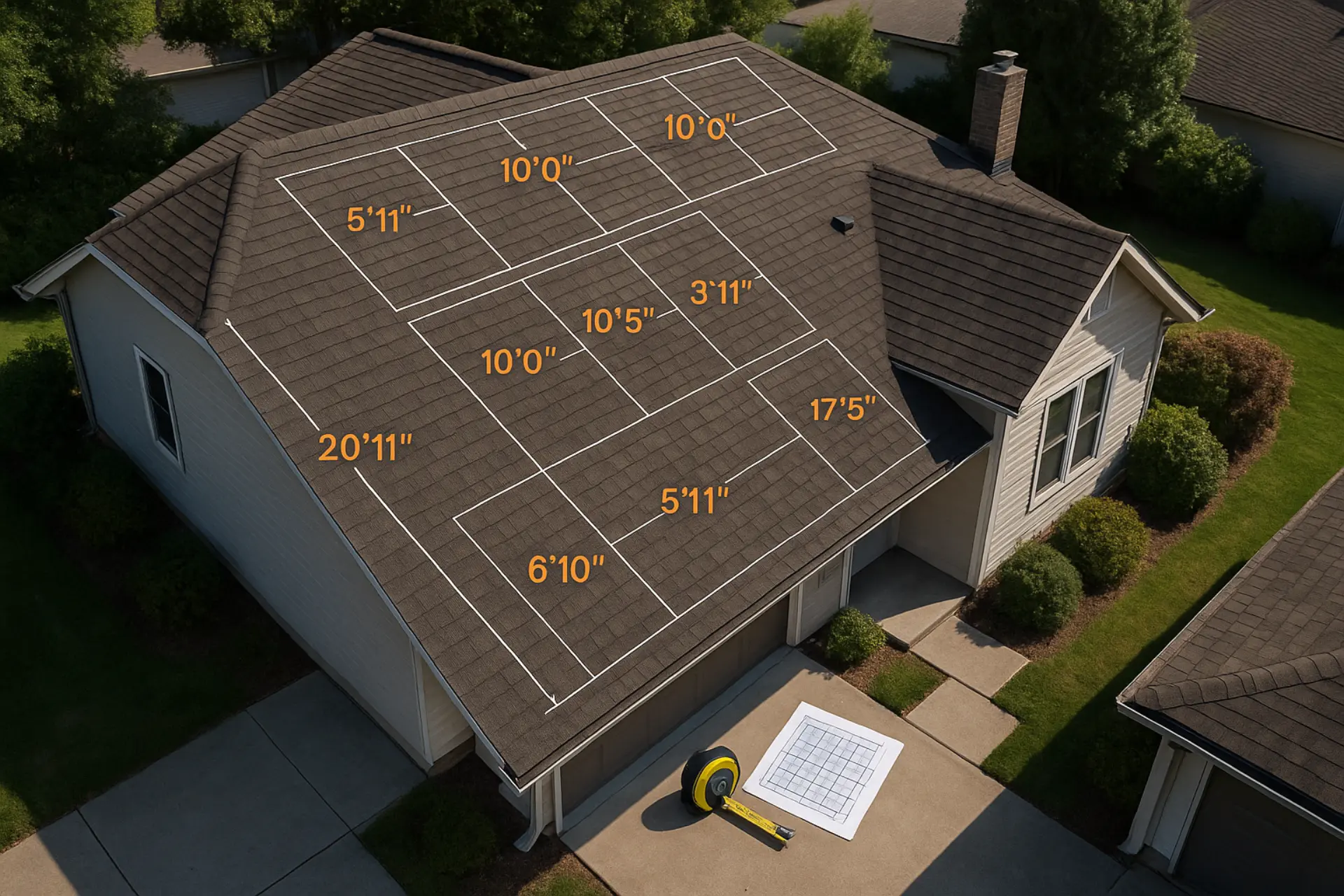
Most homes need 15–30 panels (6–12 kW) based on monthly electric bill and sun hours. A home with a $200/month bill in Massachusetts needs about 24 panels (10 kW).
Avg System Size
7.6 kW
18 panels @ 430W
Avg Cost (MA)
$24,700
before incentives
Annual Production
10,000 kWh
typical Northeast home
Roof Space Needed
~325 sq ft
18 sq ft per panel
Sizing by Monthly Electric Bill
The most accurate way to size a solar system is by your actual electricity usage, not your home size. Here is a quick reference for New England and Mid-Atlantic states:
| Monthly Bill | Annual kWh | System Size | Panels (430W) | Est. Cost (MA) |
|---|---|---|---|---|
| $100 | 4,000 | 3.0 kW | 7 | $9,750 |
| $150 | 6,000 | 4.6 kW | 11 | $14,950 |
| $200 | 8,000 | 6.1 kW | 15 | $19,825 |
| $250 | 10,000 | 7.6 kW | 18 | $24,700 |
| $300 | 12,000 | 9.1 kW | 22 | $29,575 |
| $400 | 16,000 | 12.2 kW | 29 | $39,650 |
Step-by-Step System Sizing Calculation
Let's walk through a real sizing calculation for a Massachusetts homeowner with a $280/month electric bill. Their utility rate is $0.28/kWh, so their annual consumption is:
Calculate annual kWh usage
$280/month × 12 = $3,360/year. $3,360 ÷ $0.28/kWh = 12,000 kWh/year
Determine peak sun hours for your location
Massachusetts averages 4.5 peak sun hours per day. Peak sun hours are the equivalent number of hours per day at 1,000 W/m² irradiance. A location with 4.5 peak sun hours receives the same solar energy as if the sun were at peak intensity for 4.5 hours and completely off for the rest of the day.
Apply the system loss factor
Solar systems lose 15–25% of their theoretical output due to inverter efficiency (96–98%), wiring resistance (2–3%), soiling (2–5%), shading (0–10%), and temperature effects (5–8%). We use a conservative 0.80 factor, meaning the system produces 80% of its nameplate capacity under real-world conditions.
Calculate required system size
System size (kW) = Annual kWh ÷ (Peak sun hours × 365 days × System loss factor). System size = 12,000 kWh ÷ (4.5 hours × 365 × 0.80). System size = 12,000 ÷ 1,314 = 9.13 kW
Convert to panel count
Modern panels are 400–450W. Using 430W panels: 9,130W ÷ 430W = 21.2 panels → 21 panels (9.03 kW system). This homeowner needs 21 panels producing 9 kW to offset 12,000 kWh of annual usage. At Massachusetts pricing of $3.25/W, total system cost is 9,000W × $3.25 = $29,250 before incentives.
The Sizing Formula
Universal Solar Sizing Formula
System size (kW) = Annual kWh usage ÷ (Peak sun hours × 365 × 0.80)
The 0.80 factor accounts for system losses (inverter efficiency, wiring, shading, soiling, temperature). Peak sun hours vary by state: 4.2–4.8 in New England, 5.0–5.5 in NJ/PA, 5.5–6.5 in Texas.
Common Sizing Mistakes: Oversizing and Undersizing
Oversizing: The Excess Production Trap
An aggressive solar salesperson tells you to install a 12 kW system for your 10,000 kWh annual usage because "more solar is always better". You produce 15,000 kWh and use 10,000 kWh, leaving 5,000 kWh excess at year-end true-up.
Excess production value:
$150–$250
instead of $1,400 retail value
You spent an extra $6,500 on the oversized system and got almost nothing in return.
Undersizing: The Winter Shortfall
Another homeowner installs an 8 kW system for 12,000 kWh annual usage to save money upfront. The system produces 10,000 kWh/year, covering 83% of their usage. They still pay $560/year in electric bills ($2,000 usage × $0.28/kWh).
25-year lost savings:
$14,000
vs $6,500 upfront savings
The 2 kW difference would have cost $6,500 upfront but saved $14,000 — a 115% return.
When oversizing makes sense
If you plan to add load — buying an EV next year or installing a heat pump — oversize now to accommodate that future usage. It is much cheaper to install 3 extra panels during the initial installation than to add them later (which requires permitting, scaffolding, electrical work, and often inverter upgrades).
Undersizing also reduces your net metering credits in summer. If you produce 1,200 kWh in June but use 900 kWh, you bank 300 kWh in credits. In December, you produce 400 kWh and use 1,200 kWh, drawing 800 kWh from the grid. Your 300 kWh banked credits cover part of it, but you still buy 500 kWh at retail. A properly sized system would have banked 600 kWh in summer to fully cover winter shortfalls.
How Shading Reduces Effective Panel Count
A single tree shading 3 panels on a string inverter system can reduce the entire string's output by 40–60%. String inverters connect panels in series, so the shadiest panel determines the current for the whole string. If one panel produces 200W instead of 400W due to shade, all panels in that string drop to match it.
Microinverters solve this problem. Each panel has its own inverter, so shading on one panel only affects that panel. If 3 panels are shaded out of 20, you lose 15% production instead of 60%. For roofs with chimneys, dormers, or tree shade, microinverters often justify their 10–15% higher cost by recovering the shaded production loss.
String Inverter with Shading
Microinverters with Shading
When sizing a system for a shaded roof, installers should calculate usable roof area excluding heavy shade zones. If you have 600 sq ft of roof but 200 sq ft is shaded by a chimney and trees, you have 400 sq ft available. At 18 sq ft per panel, that is 22 panels maximum. If the sizing calculation says you need 25 panels, you either need to trim trees, use higher-wattage panels (440W instead of 400W), or accept an undersized system.
Plan for Future Energy Needs
Electric Vehicle
Heat Pump
Hot Water Heat Pump
Pool Pump/Heater
Tip: It is much cheaper to install a larger system now than to add panels later. If you are considering an EV or heat pump in the next 5 years, size your solar to accommodate it.
Seasonal Production Variation
Solar production varies 3–4x between winter and summer. A Massachusetts system producing 1,400 kWh in June might produce only 400 kWh in December. This is due to shorter days (9 hours of daylight vs 15 hours), lower sun angle (sun is 25° above horizon in winter vs 70° in summer), and cloud cover.
This seasonal swing is why annual net metering is essential. Without credit banking, you would overproduce in summer (wasting the excess) and underproduce in winter (buying expensive grid power). With annual net metering, summer overproduction credits roll forward to cover winter shortfalls, and your year-end net consumption is what matters.
When sizing a system, always use annual production estimates, not monthly. A system sized to offset your December usage would produce 3–4x your needs in June, resulting in massive excess credits at true-up. Size for annual offset and let net metering handle the seasonal variation.
Ready to Get a Solar Quote?
Get a free, no-obligation quote from NuWatt Energy. We handle design, permits, and installation.
Roof Factors That Affect Panel Count
- Orientation: South-facing is ideal (100% production). East/west faces produce 80–85%.
- Pitch: 15–40 degrees is optimal for most latitudes. Flat roofs use tilted racking.
- Shading: Trees, chimneys, dormers reduce available space. Microinverters mitigate partial shade.
- Available area: Each panel needs ~18 sq ft. A 10 kW system needs ~400 sq ft of usable roof.
Real-World Example: The Johnson Family
Rhode Island Homeowner
Current Usage
14,769 kWh/yr
$320/month electric bill @ $0.26/kWh
Future Usage (+ Tesla Model Y)
18,769 kWh/yr
+4,000 kWh/year EV charging
Rhode Island has 4.6 peak sun hours. Required system size = 18,769 ÷ (4.6 × 365 × 0.80) = 13.94 kW. Using 430W panels, they need 32.4 panels → 33 panels (14.19 kW system).
Their installer has 500 sq ft of usable south-facing roof. At 18 sq ft/panel, that fits 27 panels. They have two options: (1) Install 27 panels now (11.6 kW) and accept 77% solar offset with the EV, paying $1,700/year for grid electricity, or (2) Install 33 panels now (14.19 kW) using both the south roof and a west-facing section, achieving 100% offset.
They choose option 2. The west-facing panels produce 85% of south-facing panels, so the 6 west panels contribute effectively like 5.1 south panels. Total effective capacity: 27 + 5.1 = 32.1 panels worth of south-facing production = 13.8 kW effective. This covers their 18,769 kWh usage with a small cushion for system degradation.
Get Your Exact Panel Count
Our solar calculator uses your address and electric bill to determine the perfect system size.