
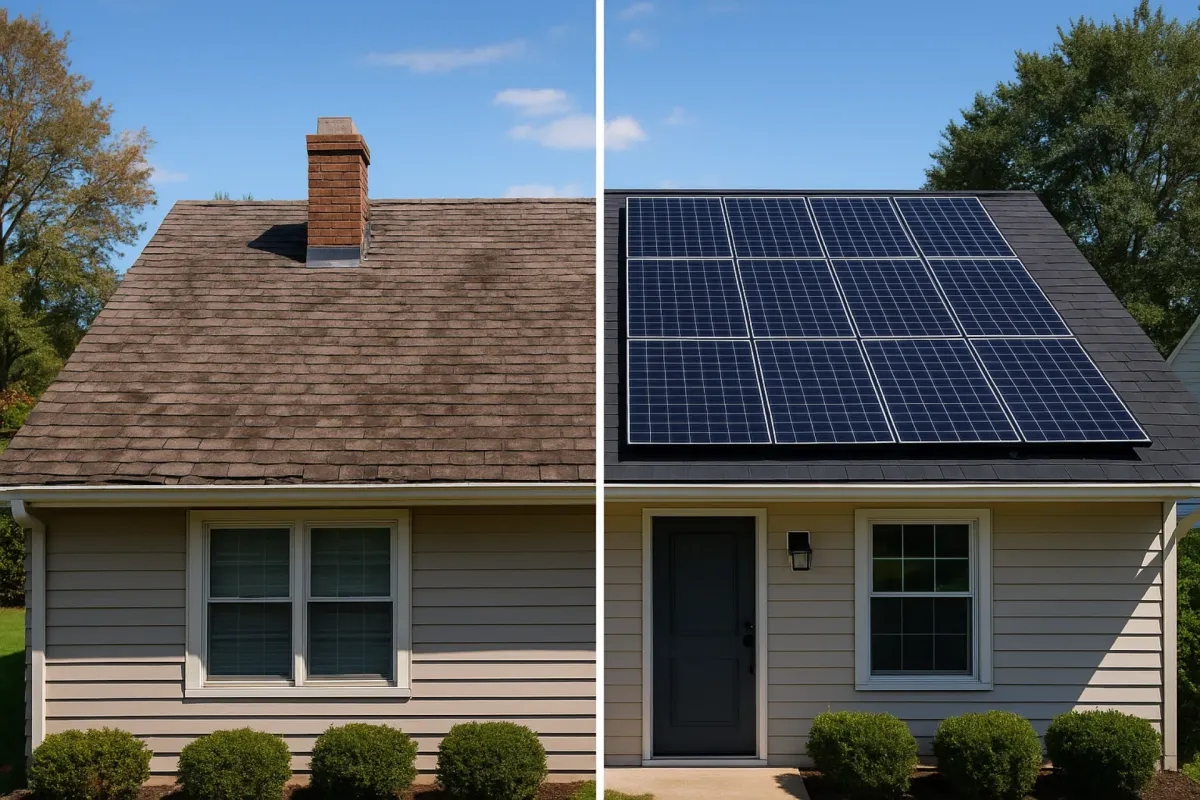
If your roof has less than 10 years of life left, replace it before or during solar installation. Removing and reinstalling panels later costs $2,000–$5,000 and risks warranty issues.
Panel Removal Cost
$3,500
if roof fails early
Roof + Solar Together
Saves $3,500
vs separate projects
Metal Roof Lifespan
40–60 years
outlasts panels
Asphalt Shingle Life
15–30 years
depends on quality
The Solar + Roof Dilemma: A $20,000 Question
You want solar panels. You also know your roof is getting old. Do you install solar now and deal with the roof later? Replace the roof first and delay your solar savings? Or tackle both at once?
This is the single most common question we get from homeowners — and the wrong decision can cost you $3,500–$7,000 in unnecessary expenses. The answer depends on your roof's current age, condition, material type, and your timeline. Let's break down every scenario.
Roof Age Decision Matrix
| Roof Age | Condition | Recommendation |
|---|---|---|
| 0–10 years | Good | Install solar now |
| 10–15 years | Good, no leaks | Get roof inspection first |
| 10–15 years | Some wear | Replace roof + install solar together |
| 15–20 years | Any condition | Replace roof first or simultaneously |
| 20+ years | Any condition | Must replace roof before solar |
Detailed Cost Breakdown: Three Real-World Scenarios
Let's walk through a real example: a homeowner in Massachusetts with a 12-year-old asphalt shingle roof showing minor granule loss but no active leaks. The roof has 8–10 years of life remaining. They want a 10 kW solar system.
Scenario 1: Solar Now, Roof Later
Year 1: Install solar for $32,500
Year 1–8: Generate $28,800 in savings ($3,600/year)
Year 8: Roof fails. Pay $3,500 for panel removal and reinstallation + $15,000 for new roof
The risk: If your roof fails earlier than expected (year 5 instead of year 8), you pay removal costs sooner and lose savings momentum.
Scenario 2: Roof First, Solar Second
Year 1: Replace roof for $15,000
Year 2: Install solar for $32,000
Year 2–25: Generate $86,400 in savings ($3,600/year × 24 years)
The downside: You delay solar savings by one year ($3,600 lost), but you avoid the panel removal fee and the risk of unexpected roof failure.
Scenario 3: Roof + Solar Together (Best Option)
Year 1: Combined project: $15,000 (roof) + $30,500 (solar with coordination discount) = $45,500
Year 1–25: Generate $90,000 in savings
Why it's cheaper: The roofer and solar installer coordinate on permits, scaffolding, and site work. Many solar installers partner with roofing companies and pass the savings to you. You also start earning solar savings immediately and never pay for panel removal.
Cost Comparison: Roof + Solar Timing
- Solar now, roof later: Solar install $32,000 + future removal/reinstall $3,500 + new roof $15,000 = $50,500
- Roof first, then solar: New roof $15,000 + solar install $32,000 = $47,000 (saves $3,500)
- Roof + solar together: Combined project $44,000–$46,000 (saves on labor overlap)
How to Inspect Your Roof Yourself (Before Calling a Pro)
Before paying for a professional roof inspection ($200–$500), do a basic assessment yourself. You can rule out obvious problems and make an informed decision about whether solar is viable now or needs to wait.
What to Look For (From the Ground)
- Granule loss: Check gutters. Excessive granules (like coarse sand) mean deteriorating shingles.
- Curling or buckling: Shingles curling up at corners or buckling means near end-of-life.
- Missing shingles: Obvious gaps or blown-off shingles indicate compromised roof.
- Moss or algae: Dark streaks or green moss signal moisture retention and potential rot.
- Sagging areas: Visible dips or sags indicate structural damage — must address before solar.
What to Look For (In the Attic)
- Water stains: Brown discoloration on underside of roof deck indicates past or active leaks.
- Daylight through the roof: If you see sunlight coming through cracks, your roof has holes.
- Sagging between rafters: Roof deck should be flat. Sagging means compromised structure.
Safety note: Do NOT climb onto your roof. Use binoculars or a drone if you want a closer look. Professional inspectors have safety equipment and insurance.
Insurance and Warranty Implications
Installing solar on an old roof can create unexpected insurance and warranty problems. Here's what you need to know before you commit.
Homeowners Insurance
- Roof age limits: Many insurers refuse to cover roofs older than 20 years or require a professional inspection for roofs 15+ years old. If you install solar on a roof that exceeds your insurer's age limit, they may deny a claim for roof damage — even if the panels weren't involved.
- Increased coverage: Solar panels are considered a home improvement and increase your dwelling coverage. Notify your insurer when you install solar to ensure the panels are covered.
- Leak liability: If a leak occurs at a solar mounting point and your roof was already old, your insurer may argue the damage was due to pre-existing roof failure — not the solar installation. This creates a dispute between your homeowners policy and the solar installer's workmanship warranty.
Solar Installer Workmanship Warranty
Most solar installers offer a 10–25 year workmanship warranty covering leaks caused by their mounting. However, this warranty typically includes a roof age exclusion.
- Typical exclusion language: "Warranty does not cover leaks on roofs older than 15 years or roofs with pre-existing damage."
- What this means: If you install solar on a 12-year-old roof and it leaks in year 3 of your solar system, the installer may inspect and determine the leak was caused by roof failure — not their mounting. You pay for the roof repair AND the panel removal/reinstall.
- Protecting yourself: Get a professional roof inspection before solar installation and provide the report to your installer. If the roof passes, the installer must honor the workmanship warranty regardless of age.
Working with Roofers Who Understand Solar
Not all roofing contractors understand solar requirements. If you're replacing your roof before or during solar installation, make sure your roofer knows what's coming.
What to Tell Your Roofer
- Panel layout: Provide your solar installer's panel layout diagram. The roofer needs to know where panels will be mounted to avoid placing seams or valleys in those areas.
- Mounting method: Specify the mounting system (lag bolts, adhesive mounts, clamps). The roofer may recommend reinforcing rafters in mounting areas.
- Structural load: Solar panels add 2.5–3.5 lbs per square foot. Most roofs handle this easily, but older homes with 2×4 rafters (instead of 2×6) may need reinforcement.
- Ice and water shield: Ask the roofer to install an additional ice/water barrier layer in solar mounting areas. This provides extra leak protection.
Solar-Specific Roofing Upgrades
- Premium underlayment: Upgrade from 15 lb felt to synthetic underlayment (e.g., GAF FeltBuster). It lasts longer and handles the heat from panels better. Cost: +$200–$500.
- Thicker shingles: Architectural shingles (30-year) vs 3-tab shingles (15-year). Solar panels last 25+ years; your roof should too. Cost: +$1,500–$2,500 for a typical home.
- Reinforced decking: If your roof has 1/2" plywood or OSB, consider upgrading to 5/8" in solar mounting areas for better screw holding. Cost: +$500–$1,000.
Ready to Get a Solar Quote?
Get a free, no-obligation quote from NuWatt Energy. We handle design, permits, and installation.
Metal Roof: The Best Option for Solar
Standing seam metal roofs are ideal for solar panels. They last 40–60 years (outlasting your panels), allow clamp-on mounting with no roof penetrations, and are lighter than shingles. The higher upfront cost ($20,000–$35,000) eliminates any re-roofing concerns.
Why Metal Roofs Are Superior for Solar
- No penetrations: Panels attach with clamps that grip standing seams. No holes, no leak risk.
- Easy panel removal: Clamps unbolt in minutes vs extracting lag bolts from shingles.
- Better heat performance: Metal roofs reduce panel temperature by 5–10°C vs asphalt.
- Lifetime alignment: 40–60 year lifespan outlasts your panels.
Metal Roof + Solar: Real Numbers
Compare to asphalt over 30 years:
Asphalt $15K + solar $32K + future re-roof $15K + panel removal $3.5K = $65,500
Metal saves $5,000–$15,000 over 30 years
Shingle Roof Compatibility
- Asphalt (3-tab): 15–20 year life. Replace before solar if over 10 years old.
- Architectural shingles: 25–30 year life. Compatible if in good condition.
- Slate/tile: 50–100 year life. Excellent for solar but requires special mounting hardware.
- Wood shake: Not recommended for solar due to fire risk and maintenance.
When You Should Wait on Solar
Sometimes the smart move is to delay solar — even if you're excited about the savings. Here are the scenarios where waiting saves you money:
Your roof is 18+ years old
You're setting yourself up for a $3,500+ panel removal bill within 5 years.
You have active leaks
Leaks must be repaired before solar. If widespread roof failure, replace the whole roof first.
Roof has less than 8 years life remaining
The math doesn't work. You'll pay for removal before the solar system hits payback.
Planning to sell in 1–3 years
Removing and reinstalling panels during escrow complicates the sale. Replace roof first, then sell.
Get a Roof + Solar Assessment
NuWatt evaluates your roof condition as part of every solar consultation.