
Solar Panels in WinterSnow, Cold & Real Performance Data
Cold weather improves solar panel efficiency. Snow slides off tilted panels. And December through February still produces 15-20% of your annual output. Here is what 2,500+ NuWatt installations across New England have taught us about winter solar performance.
Quick Answer
Solar panels work well in winter. Cold temperatures boost efficiency by 10-15% over summer. Snow typically slides off within 1-2 days. The main limitation is shorter daylight hours (9 vs 15 hours). A well-designed system accounts for seasonal variation, and winter production of 15-20% of annual total is normal and expected.
Why Cold Weather Actually Boosts Solar Efficiency
Solar panels are semiconductors. Like all semiconductors, they perform better in cold temperatures. This is measured by the temperature coefficient — the rate at which output changes per degree of temperature.
Temperature Coefficient Explained
Standard Test Conditions
25°C / 77°F
Panel rated output baseline
Typical Coefficient
-0.3%/°C
Output improves as temp drops
Winter Bonus (0°C / 32°F)
+7.5%
Extra output vs rated specs
On a clear, cold January day at 20°F (-7°C), your panels can actually produce 10% more power per hour of sunlight than they would on a 90°F (32°C) July day. The tradeoff is simply fewer hours of daylight. A January day in Boston has about 9.3 hours of daylight versus 15.3 hours in June.
Hot Summer Day (95°F)
- Panel temp: ~150°F (65°C)
- Efficiency loss: -12%
- Daylight: 15.3 hours
- Net daily output: High (long day overcomes heat loss)
Cold Winter Day (25°F)
- Panel temp: ~35°F (2°C)
- Efficiency gain: +7%
- Daylight: 9.3 hours
- Net daily output: Moderate (short day, but great efficiency)
How Snow Sheds from Solar Panels
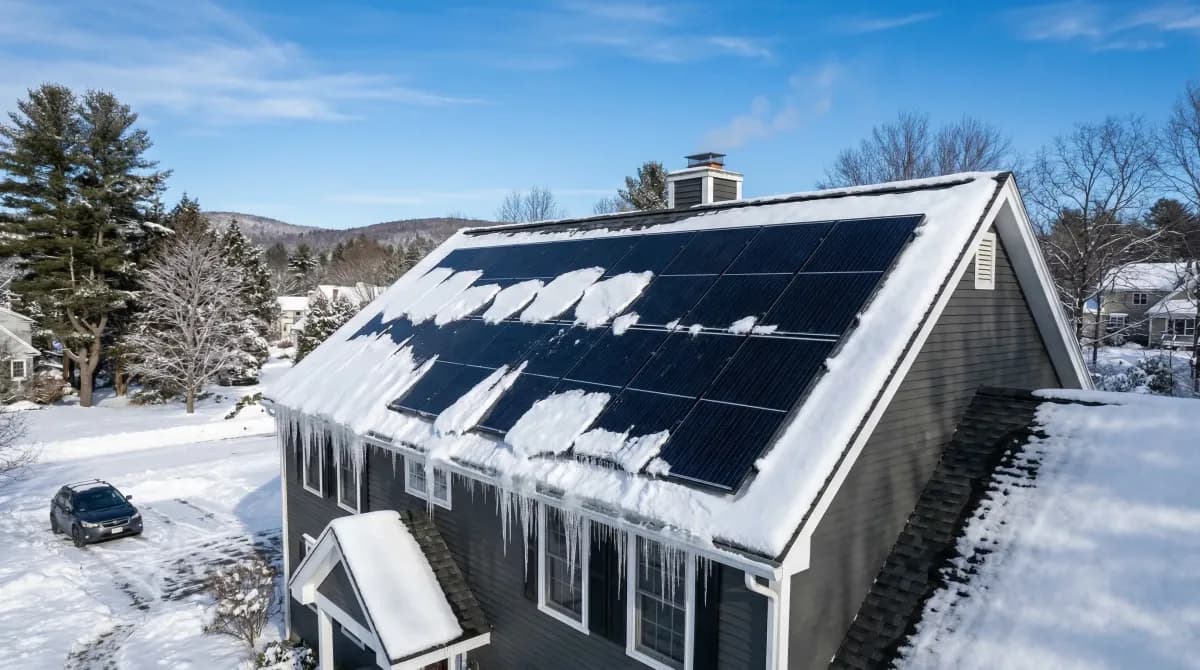
Solar panels are engineered with smooth tempered glass surfaces and are typically installed at 25-40 degrees of tilt. This combination means snow rarely stays on panels for more than 1-2 days.
Why Snow Slides Off
Smooth glass surface
Tempered glass has very low friction. Snow cannot grip the surface the way it sticks to shingles.
Panel tilt angle
Most residential panels are tilted 25-40 degrees — gravity does the work. Steeper pitch = faster shedding.
Dark cell heat absorption
Even under snow, dark solar cells absorb infrared radiation and generate heat that melts the contact layer.
Micro-inverter/optimizer warmth
Electronics on the back of each panel generate small amounts of heat that accelerate bottom-up melting.
Annual Production Loss from Snow
Multiple studies (NREL, Natural Resources Canada) show that snow-related production loss in the Northeast is typically only 2-5% of annual output. This is already factored into production estimates when your system is designed.
2-3%
Coastal NE (Boston, Providence)
3-5%
Inland NE (NH, VT, ME)
5-8%
Heavy snow belt (western MA, CT hills)
Monthly Solar Production: New England Data
This table shows typical monthly production distribution for a residential solar system in the greater Boston area. Data averaged from NuWatt installations across eastern Massachusetts, southern New Hampshire, and Rhode Island (2023-2025).
| Month | % of Annual | Peak Sun Hours | Avg Snow Days |
|---|---|---|---|
| January | 4.5% | 3.2 | 8 |
| February | 5.5% | 3.8 | 7 |
| March | 7.8% | 4.6 | 4 |
| April | 9.2% | 5.3 | 1 |
| May | 10.8% | 5.9 | 0 |
| June | 11.5% | 6.2 | 0 |
| July | 11.2% | 6 | 0 |
| August | 10.5% | 5.6 | 0 |
| September | 8.8% | 4.9 | 0 |
| October | 7.0% | 4.1 | 0 |
| November | 5.0% | 3.4 | 2 |
| December | 4.2% | 2.9 | 6 |
Winter (Dec-Feb)
14.2%
of annual production
Spring + Fall
52.6%
of annual production
Summer (Jun-Aug)
33.2%
of annual production
Snow Removal: Dos and Don'ts
Do
- 1.Let snow slide off naturally. This is the best approach 90% of the time. Panels are designed for it.
- 2.Use a soft foam roof rake (like a Snow Joe) if you must remove snow. Extend from the ground — never climb on the roof in winter.
- 3.Clear snow from the bottom edge only. Once the bottom row is exposed, the rest will sheet off with gravity.
- 4.Consider snow guards if snow sliding off panels creates a hazard (walkways, decks below).
Don't
- 1.Never use metal shovels or tools. These will scratch the glass and void your warranty immediately.
- 2.Never pour hot water on panels. Thermal shock can crack tempered glass. Cold water is also unnecessary.
- 3.Never walk on snowy/icy panels. Extreme fall risk. Panels are slippery when wet or icy even without snow.
- 4.Never use rock salt or ice melt. Chemical residue will coat the glass and reduce production for months.
5 Ways to Maximize Winter Solar Production
Optimize tilt angle for winter
If your system uses adjustable racking, increase tilt by 10-15 degrees for winter (e.g., latitude + 15). This improves winter capture and helps snow slide off faster. Fixed systems are typically designed for year-round optimization.
Keep surrounding trees trimmed
Deciduous trees lose leaves in winter, but branches still cast shadows. Low winter sun angles mean shadows are longer. Trim branches that shade your array, especially on the south and west sides.
Monitor production daily
Use your Enphase, SolarEdge, or other monitoring app to check daily production. If output drops to zero for 3+ days after a storm, the panels may need a gentle brush with a foam rake.
Ensure microinverters/optimizers are functioning
Panel-level electronics (microinverters or power optimizers) allow unshaded panels to produce even when neighboring panels are snow-covered. If one panel is offline, it does not affect the others.
Consider battery storage for winter outages
Winter storms cause the most power outages in New England. A battery backup ensures your solar system continues providing power during grid outages, when you need it most.
Frequently Asked Questions
Do solar panels work in the winter?
Yes, solar panels work in winter. They produce less energy due to shorter days and potential snow cover, but cold temperatures actually improve panel efficiency. A typical New England system generates 15-20% of its annual output during December, January, and February combined. Systems are sized to account for seasonal variation.
Should I remove snow from my solar panels?
In most cases, no. Snow typically slides off tilted panels within 1-2 days due to the smooth glass surface and dark cell heat absorption. Attempting to remove snow risks scratching the panels or voiding your warranty. The exception is a heavy, wet snow (12+ inches) on a low-tilt system during an extended cold snap. If removal is needed, use only a soft foam roof rake designed for solar panels — never metal tools, shovels, or hot water.
How much do solar panels produce in winter vs summer?
In New England, winter months (Dec-Feb) produce about 14-18% of annual output, while summer months (Jun-Aug) produce about 33-35%. However, cold temperatures boost panel efficiency by 10-15% compared to hot summer days. The main limiting factors in winter are shorter days (9 hours of daylight vs 15 hours) and occasional snow cover.
Do solar panels work when covered in snow?
No, solar panels cannot generate electricity when fully covered in snow. However, even a thin layer of snow allows some light through, and the dark panel surface absorbs heat to accelerate melting. Most snow slides off panels within 24-48 hours due to panel tilt (typically 25-40 degrees) and the smooth glass surface. Annual production loss from snow is typically only 2-5% in New England.
Can cold weather damage solar panels?
No. Solar panels are designed to withstand extreme temperatures. Most panels are tested to -40F (-40C) and carry IEC 61215 certification. Cold weather actually improves electrical performance because solar cells are semiconductors — they generate more voltage in cold temperatures. The temperature coefficient for modern panels is about -0.3% per degree Celsius, meaning for every degree below 25C (77F), output improves by 0.3%.
See How Much Solar Produces at Your Address
Our design tool uses satellite imagery and local weather data to estimate year-round production at your specific location — including winter months.
Get My Free Solar Estimate