
Quick Answer
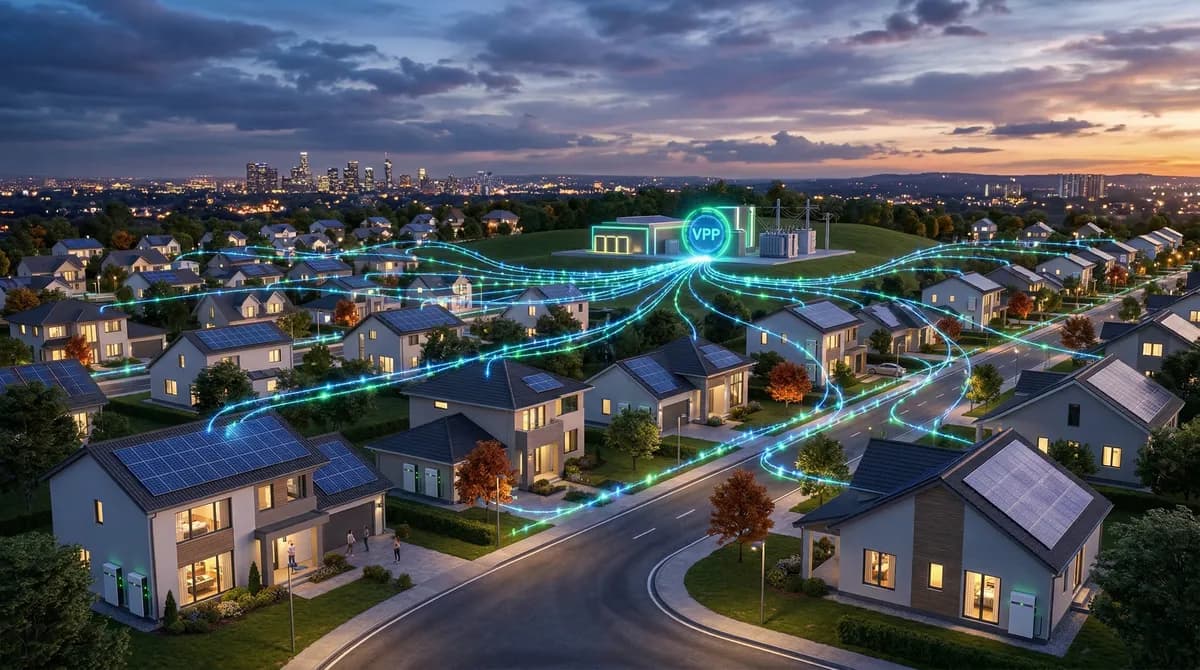
A virtual power plant (VPP) aggregates hundreds or thousands of home batteries to act as a single power plant. When the grid needs extra power during peak demand, your battery discharges and you get paid. In New England, ConnectedSolutions pays $225-$275 per kW per year — meaning a 10 kW battery earns $2,250-$2,750 annually. This revenue cuts battery payback from 15+ years to 6-7 years.
What Is a Virtual Power Plant?
A virtual power plant is exactly what it sounds like: a power plant that doesn't physically exist in one place. Instead of a single massive facility burning fuel to generate electricity, a VPP coordinates thousands of distributed energy resources — primarily home batteries — to deliver the same grid services.
Think of it this way: one home battery is a flashlight. Ten thousand home batteries, coordinated by software, are a stadium spotlight. Individually, they're modest. Together, they can replace a peaker plant that would cost hundreds of millions of dollars to build.
Utilities and grid operators already rely on VPPs to manage peak demand. During the hottest summer afternoons when air conditioners push the grid to its limits, VPPs discharge stored energy from enrolled batteries — reducing the need for expensive, polluting peaker plants that only run a few hundred hours per year.
The key insight for homeowners: the grid is willing to pay you real money for this service. Programs like ConnectedSolutions in New England, Tesla's Virtual Power Plant in Texas and California, and Green Mountain Power's battery program in Vermont all compensate battery owners for participating in demand response events.
How VPPs Work: From Signal to Payment
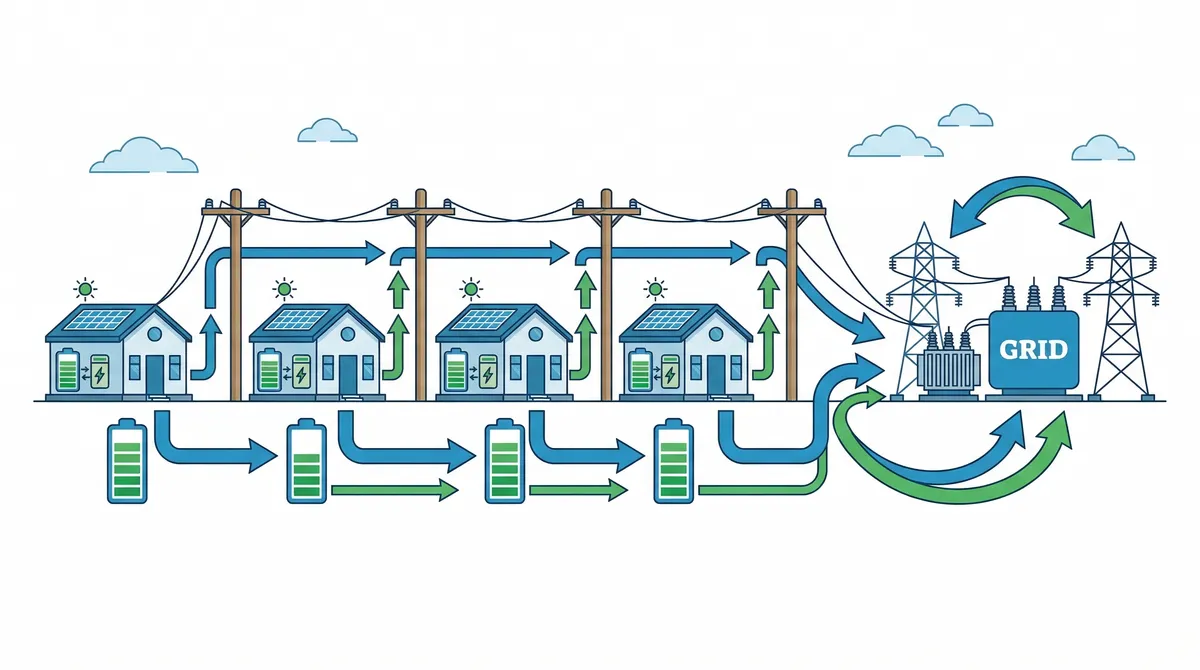
The VPP process is fully automated — you don't have to do anything once enrolled. Here's what happens during a demand response event:
Grid demand spikes
The grid operator (like ISO New England) forecasts a peak demand event — typically a hot summer afternoon when AC usage surges. They signal the need for additional capacity.
Utility dispatches VPP
Your utility (Eversource, National Grid, etc.) sends a dispatch signal to enrolled batteries. This happens automatically through the battery's cloud connection — you typically get a notification on your phone.
Your battery discharges
Your battery discharges stored energy to the grid (or offsets your home's draw, reducing grid load). Events typically last 1-3 hours and happen on weekday afternoons during summer months.
Battery recharges
After the event, your battery recharges from solar panels or the grid during off-peak hours. Most programs reserve 20-30% capacity so you always have emergency backup available.
You get paid
Compensation is typically calculated per kW of enrolled capacity per season. ConnectedSolutions pays $225-$275/kW for summer and $50/kW for winter. Payments arrive as bill credits or direct deposits.
Most VPP programs dispatch batteries 30-60 hours per year— roughly 1-3 hours per event across 15-25 summer events and a handful of winter events. That's less than 1% of your battery's annual availability, yet it generates significant income.
ConnectedSolutions: New England's VPP Program
ConnectedSolutions is the largest residential VPP program in the northeastern United States. Available in Massachusetts, Connecticut, and Rhode Island, it pays battery owners to discharge during peak demand events. The program is operated by the major utilities in each state and has enrolled thousands of batteries since its launch.
Here are the current ConnectedSolutions rates by utility:
| Utility | States | Summer Rate | Winter Rate | 10 kW Annual |
|---|---|---|---|---|
| Eversource | MA, CT | $275/kW | $50/kW | $3,250 |
| National Grid | MA, RI | $225/kW | $50/kW | $2,750 |
| United Illuminating | CT | $225/kW | $50/kW | $2,750 |
| RI Energy | RI | $225/kW | $50/kW | $2,750 |
Important note on kW vs kWh: ConnectedSolutions pays based on power output (kW), not storage capacity (kWh). A Tesla Powerwall 3 has 13.5 kWh of storage but 11.5 kW of continuous power output — so it earns based on 11.5 kW. An Enphase IQ Battery 5P has 5 kWh storage and 3.84 kW output, earning based on 3.84 kW. Higher power output batteries earn more per unit.
VPP Revenue by Battery Size
The annual income from a VPP program depends on your battery's power rating (kW) and your utility's rate. Here's what real batteries earn across ConnectedSolutions programs:
| Battery | Power (kW) | Storage (kWh) | Eversource Annual | NGrid/RI Annual |
|---|---|---|---|---|
| Enphase IQ 5P | 3.84 kW | 5 kWh | $1,248 | $1,056 |
| Enphase IQ 10T | 7.68 kW | 10 kWh | $2,496 | $2,112 |
| Tesla Powerwall 3 | 11.5 kW | 13.5 kWh | $3,738 | $3,163 |
| Franklin aPower2 | 10 kW | 15 kWh | $3,250 | $2,750 |
| sonnenCore+ 10 | 4.8 kW | 10 kWh | $1,560 | $1,320 |
| 2x Tesla Powerwall 3 | 23 kW | 27 kWh | $7,475 | $6,325 |
Revenue calculation: Annual income = (Summer rate x kW) + (Winter rate x kW). For Eversource: ($275 x kW) + ($50 x kW) = $325/kW/year. For National Grid and RI Energy: ($225 x kW) + ($50 x kW) = $275/kW/year. These are actual program rates as of 2026 — not projections.
Other VPP Programs Nationwide
ConnectedSolutions isn't the only VPP program. Several other programs across the country are paying battery owners for grid services:
Tesla Virtual Power Plant
States: Texas, California
Tesla's VPP program enrolls Powerwall owners through the Tesla app. In Texas, participants earned $40-$80 per event during the 2025 summer grid emergencies. California participants receive bill credits for grid support. Tesla's Autobidder platform coordinates over 100,000 Powerwalls nationwide.
Green Mountain Power (VT)
State: Vermont
Green Mountain Power offers Tesla Powerwalls at a discounted rate ($5,500 installed) in exchange for VPP participation. Enrolled batteries provide grid support during peak events. GMP's program has been running since 2017 and is considered a national model for utility-battery partnerships.
OhmConnect / Voltus
States: California, Texas, New York
OhmConnect (now part of Voltus) pays customers to reduce energy usage during peak demand events. While it started with smart thermostats and appliances, it now includes battery dispatch. Earnings vary but typically range from $100-$300/year for thermostat-only participants and higher for battery owners.
Sunrun / Swell Energy
States: California, Hawaii, multiple
Sunrun operates one of the largest residential VPPs, with over 10 GW of contracted battery capacity. Swell Energy (acquired by Sunrun) provides VPP services in California and Hawaii. These programs operate through power purchase agreements with utilities rather than direct homeowner payments.
How VPP Revenue Changes Battery ROI
This is the most important section of this article. VPP revenue completely transforms the economics of home battery storage. Let's compare a typical 10 kW battery (installed cost: $12,500) with and without VPP participation:
Without VPP
- Installed cost$12,500
- Annual energy savings$400-$800
- Annual VPP income$0
- Payback period16-31 years
- 10-year net value-$4,500 to -$6,500
With ConnectedSolutions (Eversource)
- Installed cost$12,500
- Annual energy savings$400-$800
- Annual VPP income (10 kW)$3,250
- Payback period3-4 years
- 10-year net value+$24,000 to +$28,000
The difference is staggering. Without VPP revenue, a home battery is a money-losing proposition on pure economics — you're paying $12,500 for backup power and modest energy savings. That's a perfectly valid choice if you value energy independence and outage protection, but the math doesn't work as an “investment.”
With VPP revenue, the same battery becomes one of the best investments you can make on your home. A 10 kW battery enrolled in Eversource ConnectedSolutions pays for itself in 3-4 years and generates $24,000-$28,000 in net value over 10 years. Even at the lower National Grid rate ($2,750/year), payback drops to 4-5 years with $15,000-$19,000 in 10-year net value.
Which Batteries Qualify for VPP Programs?
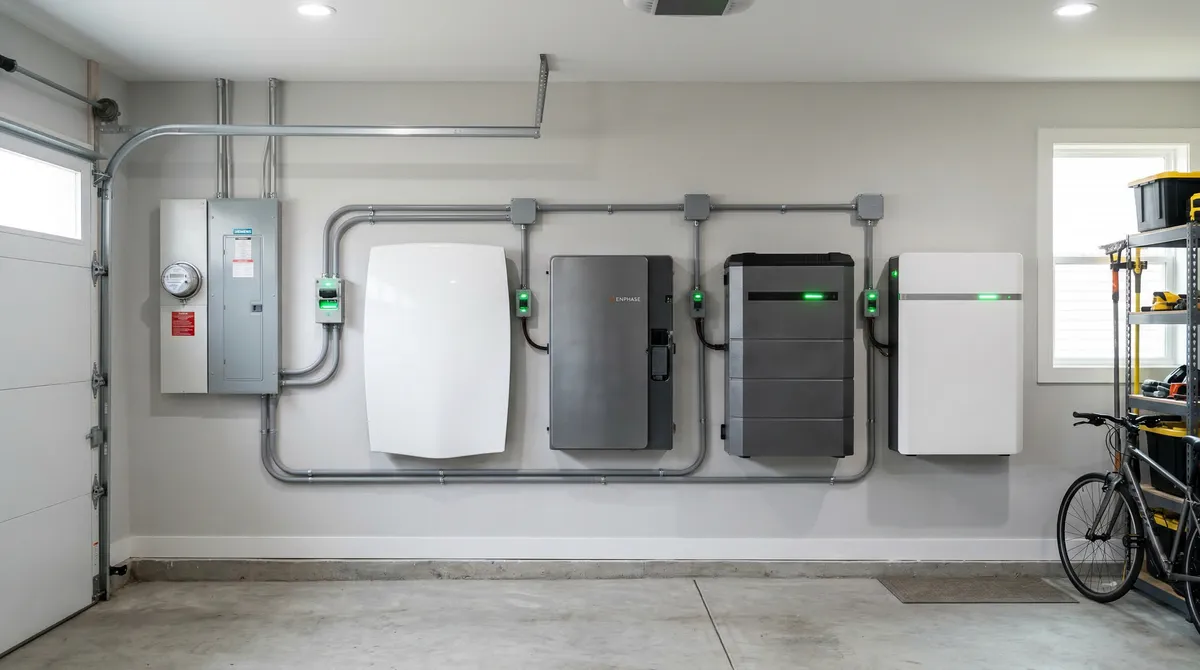
Not every battery qualifies for every VPP program. ConnectedSolutions has a specific list of approved batteries. Here are the current eligible models:
Tesla Powerwall 3
13.5 kWh / 11.5 kW continuous. Best VPP earner due to high power output. $12,500-$14,500 installed.
Tesla Powerwall 2
13.5 kWh / 5 kW continuous. Still eligible but lower power output limits VPP earnings. Being phased out.
Enphase IQ Battery 5P
5 kWh / 3.84 kW. Modular — stack multiple units for higher capacity. $6,000-$8,000 per unit installed.
Enphase IQ Battery 10T
10 kWh / 7.68 kW. Higher capacity Enphase option. $10,000-$13,000 installed.
Franklin aPower2
15 kWh / 10 kW. Excellent VPP earner with high power output and large storage. $13,000-$16,000 installed.
sonnenCore+
10 kWh / 4.8 kW. German-engineered lithium iron phosphate chemistry. 10,000 cycle warranty. $12,000-$15,000 installed.
Pro tip: When choosing a battery specifically for VPP revenue, prioritize power output (kW) over storage capacity (kWh). The Tesla Powerwall 3 earns the most per unit because its 11.5 kW output is the highest among residential batteries. Two Enphase IQ 5P units (7.68 kW combined) cost similar to one Powerwall 3 but earn 33% less in VPP revenue.
How to Enroll in a VPP Program
Enrolling in ConnectedSolutions or another VPP program is straightforward. Here's the process:
Step 1: Install an eligible battery
Work with a ConnectedSolutions-enrolled installer (like NuWatt Energy) who can install an approved battery and handle the enrollment paperwork. The installer must be registered with the program — not every solar installer qualifies.
Step 2: Register with your utility
Your installer submits the enrollment application to your utility (Eversource, National Grid, UI, or RI Energy). This includes your battery specs, location, and permission to dispatch during events. Approval typically takes 2-4 weeks.
Step 3: Automatic dispatch begins
Once enrolled, your battery is part of the VPP. Dispatch happens automatically through the battery's cloud connection. You'll receive notifications before and during events. No manual action required on your part.
Step 4: Get paid
Payments are calculated seasonally (summer: June-September, winter: December-March). Most utilities issue payments as bill credits within 60-90 days of the season ending. Some programs offer direct deposit options.
The entire process from battery installation to first VPP dispatch typically takes 4-8 weeks. If you install in spring, you can be earning revenue by the first summer demand response events.
The Future of Virtual Power Plants
VPPs are growing rapidly. The U.S. Department of Energy estimates that 80-160 GW of virtual power plant capacity could be deployed by 2030 — equivalent to replacing dozens of traditional power plants. Several trends are driving this growth:
- 1.Battery costs continue dropping. Residential battery prices have fallen 40% since 2020. As batteries become more affordable, more homeowners install them, growing the potential VPP fleet.
- 2.Grid stress is increasing. Extreme heat waves, electrification of heating and transport, and data center growth are pushing grid demand to new highs. VPPs provide flexible capacity faster and cheaper than building new power plants.
- 3.More utilities are launching programs. ConnectedSolutions started in Massachusetts and expanded to CT and RI. Similar programs are launching across the country as utilities recognize VPPs as a cost-effective grid resource.
- 4.Vehicle-to-grid (V2G) is coming. Electric vehicles with bidirectional charging (like the Ford F-150 Lightning) can participate in VPPs, dramatically expanding the available battery fleet. A 98 kWh EV battery could earn 5-10x what a home battery earns.
Related Reading
Frequently Asked Questions
What is a virtual power plant (VPP)?
A virtual power plant is a network of distributed energy resources — primarily home batteries — that are aggregated and coordinated to act like a single power plant. When the grid needs extra power during peak demand, the VPP operator sends a signal to enrolled batteries, which discharge stored energy to the grid. Homeowners get paid for participating.
How much can I earn from a virtual power plant program?
Earnings depend on your battery size and program rates. In New England, ConnectedSolutions pays $225-$275 per kW of battery capacity per year. A 10 kW battery earns $2,250-$2,750 annually. A 13.5 kWh Tesla Powerwall 3 (with 11.5 kW power output) can earn $2,530-$3,163 per year.
Does participating in a VPP drain my battery backup?
VPP programs typically only discharge your battery during predictable peak events (summer afternoons, winter evenings) and usually reserve 20-30% capacity for emergency backup. Events are scheduled in advance, and most programs dispatch 30-60 hours per year total. Your battery recharges from solar or the grid between events.
Which batteries work with ConnectedSolutions?
ConnectedSolutions-eligible batteries include Tesla Powerwall 2 and 3, Enphase IQ Battery 5P and 10T, Franklin aPower2, and sonnenCore+. The battery must be installed by a ConnectedSolutions-enrolled installer and registered with your utility (Eversource, National Grid, United Illuminating, or RI Energy).
Is ConnectedSolutions available in my state?
ConnectedSolutions is currently available in Massachusetts, Connecticut, and Rhode Island. Similar programs exist in other states: Tesla Virtual Power Plant operates in Texas and California, Green Mountain Power runs a battery program in Vermont, and OhmConnect offers demand response in California, Texas, and New York.
Do VPP earnings change battery payback period?
Dramatically. Without VPP revenue, a $12,500 battery has a 15-20+ year payback from energy savings alone ($400-$800/year). With ConnectedSolutions at $275/kW (Eversource), a 5 kW battery earns $1,375/year in demand response plus $400-$600 in energy savings — cutting payback to 6-7 years.
Start Earning From Your Battery
Get a free quote for solar + battery installation with ConnectedSolutions enrollment. We'll calculate your projected VPP revenue and total ROI.
Get Your Free Battery Quote