Loading NuWatt Energy...

We use your location to provide localized solar offers and incentives.
We serve MA, NH, CT, RI, ME, VT, NJ, PA, and TX
Loading NuWatt Energy...
NuWatt designs, installs, and manages solar, battery, heat pump, and EV charger systems across 9 states. One company, one warranty, one point of contact.
Get a Free QuoteModel peak shaving savings, CT ESS incentives ($10/kWh priority enrollment + $175-$325/kW-yr performance), TOU arbitrage with Eversource CT and UI rates, and solar+battery stacking for commercial facilities. Demand charges of $8-$20/kW make battery storage a compelling investment.
Demand Charges
$8-$20/kW
Eversource CT & UI
ESS Performance
$275-$325/kW
Years 1-5, per committed kW
TOU Spread
$0.08-$0.11
Peak vs off-peak /kWh
ESS Enrollment
$10/kWh
Priority commercial only
A mid-size Connecticut warehouse on Eversource Rate 35 with 200 kW peak demand can save $12,000-$15,000/year by installing a 75 kW / 300 kWh battery system for peak shaving and TOU arbitrage. Since April 1, 2026 the CT ESS program pays through performance rather than an upfront rebate: $325/kW for years 1-5 and $175/kW for years 6-10 on measured average contribution during Active Dispatch events for a facility under 500 kW of annual peak demand, plus a $10/kWh enrollment incentive for priority commercial projects ($3,000 on a 300 kWh battery). The system also qualifies for the 30% federal ITC plus 100% first-year MACRS bonus depreciation. Budget the $350 non-refundable C&I application fee, and note that solar pairing is not required — standalone batteries qualify.
Enter the numbers from your own utility bill to model your facility.
From your bill (highest 15-minute kW).
From your utility tariff or bill. Example shown — enter your own.
Capped at 40% — real-world peak shaving rarely exceeds this without oversizing the battery.
Peak reduction
50 kW
25% of 200 kW peak
Annual demand-charge savings
$9,000
50 kW × $15/kW-mo × 12
Annual DR revenue (yrs 1-5)
$16,250
50 kW dispatch × $325/kW-yr — CT ESS Active Dispatch performance incentive
Net cost after ITC (30%)
$45,500
$65,000 − $19,500 ITC
Simple payback
1.8 yrs
demand savings + DR revenue
10-year net value
$169,500
cumulative savings + DR − net cost
Estimates only, built entirely from the values you enter — confirm against your utility tariff and a tax professional. Demand-charge savings use your billed peak demand, your demand rate, and your expected peak-shaving fraction. Demand-response revenue uses published Energy Storage Solutions program incentive rates (CT ESS Active Dispatch performance incentive) and requires enrollment plus dispatch participation; actual payments depend on your dispatched performance and are capped here at the capacity your entered battery energy can sustain. Massachusetts and Rhode Island publish different ConnectedSolutions rates for business batteries, and this calculator keeps them separate. The federal ITC (30% base plus site-specific adders) applies to the battery cost; tax-exempt entities use elective (Direct) Pay.
Connecticut commercial electric bills have two major components: energy charges (per kWh consumed) and demand charges (per kW of peak demand). Demand charges are based on your highest 15-minute average power draw during the billing period and can represent 30-50% of the total commercial electric bill. For facilities with spiky load profiles — manufacturing equipment startup, HVAC compressors, EV fleet charging — demand charges are disproportionately expensive relative to actual energy consumed.
Both Eversource CT and United Illuminating (UI) use demand-based rate structures for commercial and industrial customers. Eversource CT demand charges range from $10.47/kW to $18.65/kW depending on the rate class, while UI charges $8.25/kW to $16.50/kW. These charges apply to your single highest peak in the billing cycle — meaning one 15-minute spike on a hot August afternoon can cost hundreds of dollars for the entire month.
Battery energy storage systems (BESS) address this directly through peak shaving: the battery monitors facility load in real time and discharges during peak demand events, reducing the registered peak that determines demand charges. A well-sized battery can reduce peak demand by 20-40%, translating to $2,000-$15,000+ in annual demand charge savings depending on facility size and rate class.
Connecticut's electricity rates are among the highest in the nation, with commercial customers paying an average of $0.221/kWh and blended rates (including demand charges) of $0.27-$0.30/kWh. These high rates make the economics of battery storage particularly compelling in CT compared to most other states. The combination of high demand charges, wide TOU spreads, and generous state incentives creates a uniquely favorable environment for commercial battery investment.
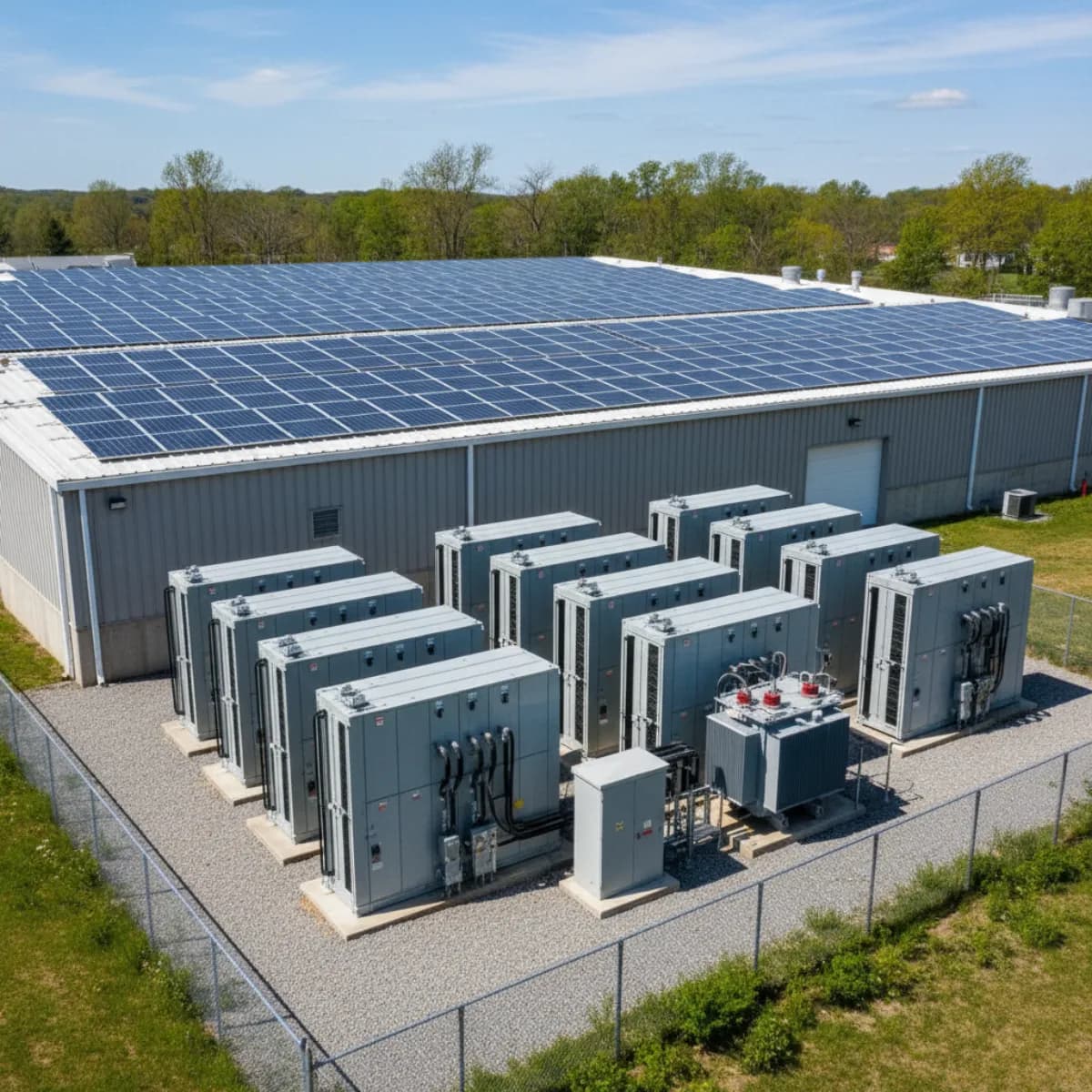
Energy charges are billed per kWh consumed — like paying per gallon of water used. Demand charges are billed per kW of peak draw — like paying for the size of the pipe. A 200 kW peak facility pays $2,964/month in demand charges on Eversource Rate 35, regardless of total kWh consumed. Battery storage shrinks the pipe (peak) without reducing water flow (energy), directly lowering the demand component.
Connecticut has two investor-owned utilities serving commercial customers: Eversource CT (covering most of the state) and United Illuminating (serving the greater Bridgeport and New Haven areas). Each has distinct demand charge structures, TOU windows, and rate classes that affect battery storage ROI. Understanding your specific rate is the first step in sizing a battery system.
| Utility / Rate | Demand Charge | Peak Rate | Off-Peak Rate | TOU Spread |
|---|---|---|---|---|
Eversource CT Rate 30 (Small C&I) | $10.47/kW | $0.28/kWh | $0.18/kWh | $0.10/kWh |
Eversource CT Rate 35 (Medium C&I) | $14.82/kW | $0.26/kWh | $0.16/kWh | $0.10/kWh |
Eversource CT Rate 37 (Large C&I) | $18.65/kW | $0.24/kWh | $0.14/kWh | $0.10/kWh |
United Illuminating (UI) Rate GST (Small C&I) | $8.25/kW | $0.30/kWh | $0.19/kWh | $0.11/kWh |
United Illuminating (UI) Rate GT (Large C&I) | $16.50/kW | $0.27/kWh | $0.17/kWh | $0.10/kWh |
Peak Hours: Mon-Fri 12-8 PM (Jun-Sep), 7-11 AM & 5-8 PM (Oct-May)
Higher demand charges make battery ROI more attractive. Ratchet clause applies.
Peak Hours: Mon-Fri 12-8 PM (Jun-Sep), Variable (Oct-May)
Combined demand + TOU savings make battery storage highly cost-effective.
A key consideration: many Eversource CT commercial rates include a demand ratchet clause, which sets a minimum demand charge based on the highest peak from the prior 11 months. This means one summer spike can inflate demand charges for an entire year. Battery storage eliminates ratchet risk by preventing those peaks from ever being registered with the utility meter.
The Connecticut ESS program, authorized by PURA and administered through the CT Green Bank, remains among the most generous battery storage programs in New England. Solar pairing is not required — the program accepts standalone batteries as readily as solar-plus-storage.
How the money arrives: since April 1, 2026 commercial ESS is a performance-based program. The old upfront capacity payment is gone; value now comes from the Active Dispatch performance incentive paid across a 10-year commitment, plus a small $10/kWh enrollment incentive for priority commercial projects only. Model your project on the ongoing revenue stream, not on a day-one rebate, and budget the $350 non-refundable C&I application fee. For the full commercial breakdown see our CT commercial Energy Storage Solutions guide.
Eligible: Annual peak demand under 500 kW
Structure: $325/kW for years 1-5, then $175/kW for years 6-10
Paid across a 10-year Active Dispatch commitment on measured average kW-AC contribution during events, taken from inverter data rather than nameplate capacity. This is where almost all of the commercial ESS value now sits.
Eligible: Annual peak demand of 500 kW or greater
Structure: $275/kW for years 1-5, then $175/kW for years 6-10
Large facilities earn a slightly lower years 1-5 rate but converge with small and medium C&I at $175/kW from year 6.
Eligible: Priority commercial projects only
Structure: One-time payment at installation
Non-priority commercial projects receive no enrollment incentive. C&I applicants also pay a $350 non-refundable application fee, which residential applicants do not.
PURA restructured ESS in Docket No. 25-08-05, decided December 17, 2025 and effective for enrollment applications submitted on or after April 1, 2026. The declining-block upfront incentive and the Passive Dispatch track were both eliminated for new enrollments. A commercial project that would once have taken a large lump sum at installation now earns through Active Dispatch across ten years instead. Only projects enrolled before April 1, 2026 are grandfathered on the old terms. Practically, that means a commercial battery needs more capital at commissioning than a 2024 or 2025 proposal assumed, and the ESS revenue shows up on the operating side of the model rather than reducing the installed cost.
Peak shaving is the primary value driver for commercial battery storage in Connecticut. The battery continuously monitors facility load through a smart controller and automatically discharges when demand approaches the target peak threshold. This prevents the utility meter from registering a high demand reading, directly reducing the demand charge on the next bill.
The mechanics work in 15-minute intervals matching the utility metering window. When the controller detects facility load trending above the target setpoint (e.g., 140 kW on a 200 kW peak facility), it dispatches battery power to supplement grid supply, keeping the meter reading below 140 kW. The battery recharges during low-demand periods — overnight or during solar production hours — to prepare for the next peak event.
| Peak Reduction | Eversource Rate 30 | Eversource Rate 35 | Eversource Rate 37 | UI Rate GT |
|---|---|---|---|---|
| 25 kW | $3,141 | $4,446 | $5,595 | $4,950 |
| 50 kW | $6,282 | $8,892 | $11,190 | $9,900 |
| 75 kW | $9,423 | $13,338 | $16,785 | $14,850 |
| 100 kW | $12,564 | $17,784 | $22,380 | $19,800 |
| 150 kW | $18,846 | $26,676 | $33,570 | $29,700 |
Time-of-use (TOU) arbitrage is the second major revenue stream for commercial batteries in Connecticut. By charging the battery during low-cost off-peak hours and discharging during expensive peak hours, the battery earns the rate spread on every cycle. This strategy stacks on top of peak shaving — the same battery that reduces demand charges also captures TOU arbitrage value during its daily cycles.
Connecticut TOU windows are seasonal. Summer (June-September): peak hours are Monday-Friday 12-8 PM, coinciding with air conditioning load and ISO-NE system peaks. Winter (October-May): peak hours shift to morning (7-11 AM) and evening (5-8 PM), reflecting heating and lighting demand patterns. Battery controllers automatically adjust charge/discharge schedules to match the seasonal TOU windows.
Assumes 300 daily cycles/year, 90% round-trip efficiency, average $0.10/kWh peak/off-peak spread
100 kWh Battery
$2,700/yr
$225/mo
200 kWh Battery
$5,400/yr
$450/mo
300 kWh Battery
$8,100/yr
$675/mo
500 kWh Battery
$13,500/yr
$1,125/mo
The TOU spread varies by utility and rate class. Eversource CT commercial rates have a spread of $0.08-$0.10/kWh, while United Illuminating spreads are wider at $0.10-$0.11/kWh, making UI territory slightly more favorable for pure arbitrage strategies. However, Eversource CT's higher demand charges mean that the combined demand+TOU value is typically higher in Eversource territory for facilities with significant peak demand.
When paired with solar, TOU arbitrage becomes even more powerful. Solar production peaks during midday, and excess generation that cannot be used on-site can charge the battery for evening discharge during peak TOU hours. This effectively time-shifts solar production from mid-afternoon (when it may exceed facility load) to late afternoon and evening (when TOU rates are highest), capturing maximum value from every kilowatt-hour generated.
The combination of rooftop solar and battery storage creates a synergy that exceeds the sum of its parts. Solar reduces the energy charge component of the bill, the battery reduces the demand charge component, and together they provide TOU arbitrage and ESS Active Dispatch revenue. For Connecticut commercial facilities paying $0.27-$0.30/kWh in blended rates, the combined system addresses every cost driver on the electric bill.
Solar Energy Savings
200 kW x 1,175 kWh/kW x $0.221/kWh
Demand Charge Reduction
60 kW reduction x $14.82/kW x 12 months
TOU Arbitrage
300 kWh x $0.10 spread x 90% efficiency x 300 cycles
ESS Active Dispatch (yrs 1-5)
assumes ~75 kW average measured contribution during events x $325/kW/year, small-medium C&I — actual payments depend on measured performance
Total Annual Value
$95,080/yrThe combined incentive stack is equally compelling. The solar system qualifies for the 30% federal ITC (Section 48/48E), and the battery independently qualifies for the standalone ITC (introduced in the Inflation Reduction Act). The CT ESS incentive applies to the battery, while both components qualify for 5-year MACRS depreciation with 100% first-year bonus depreciation. Connecticut's 6.35% sales tax exemption covers all equipment, and the 100% property tax exemption ensures the investment never increases your property tax assessment.
For facilities considering C-PACE financing through the CT Green Bank, the combined solar+battery system can be financed at 100% with no upfront cost. C-PACE terms of 20-25 years at 5-7% interest result in annual payments significantly below the combined savings, creating positive cash flow from Day 1. The business retains ownership and claims all tax benefits, while the CT Green Bank bears the financing risk.
Proper battery sizing requires interval data analysis, but these representative examples illustrate the economics at three common facility scales. All calculations assume Eversource CT Rate 35 ($14.82/kW demand charge), the $10/kWh priority commercial ESS enrollment incentive, and 30% federal ITC on net cost after that incentive. Annual savings include demand charge reduction and TOU arbitrage. The ESS performance incentive is shown as a rate rather than folded into the payback, because the amount paid depends on your measured average kW-AC contribution during Active Dispatch events.
50 kW peak, 20 kW reduction target
Small/Medium C&I, then $175/kW yrs 6-10, paid on measured average contribution during Active Dispatch events — additional to the payback above.
200 kW peak, 60 kW reduction target
Small/Medium C&I, then $175/kW yrs 6-10, paid on measured average contribution during Active Dispatch events — additional to the payback above.
500 kW peak, 150 kW reduction target
Large C&I, then $175/kW yrs 6-10, paid on measured average contribution during Active Dispatch events — additional to the payback above.
The examples above show simple payback before MACRS depreciation. A C-corporation at the 28.5% combined rate (21% federal + 7.5% CT corporate) captures an additional 28.5% of the net depreciable basis in tax savings. With 100% first-year bonus depreciation (permanent under OBBBA, IRC §168(k)), the entire depreciable basis is deducted in Year 1. Connecticut conforms to federal bonus depreciation, so these savings apply on both state and federal returns. For the mid-size warehouse example, MACRS adds approximately $22,000 in total tax savings, reducing effective payback by 1-2 years. See our CT IRR calculator for a full model including MACRS.
Active Dispatch is the third revenue stream for a commercial battery, beyond demand charge reduction and TOU arbitrage. Your utility calls events, the battery discharges to reduce grid load, and ESS pays on your measured average kW-AC contribution during those events across a 10-year term. A note on terminology: Grid Edge in Connecticut is not a separate dispatch program — it is the designation for homes and businesses on the top 10% of circuits by outage count or duration since July 1, 2012, and it determines the Enrollment Incentive rate, not the dispatch payment.
The dispatch calendar is set by the program. Summer runs June 1 through September 30 with 30 to 60 events; winter runs November 1 through March 31 with 1 to 10 events, up from 1 to 5 under the closed structure. Events last one to three hours within a noon to 9:00 PM window. Payment is based on your measured average kW-AC contribution during called events, read from inverter data, not on the battery's nameplate rating.
Small or Medium C&I
$325/kW
Years 1-5, then $175/kW years 6-10. Annual peak demand under 500 kW.
Large C&I
$275/kW
Years 1-5, then $175/kW years 6-10. Annual peak demand of 500 kW or greater.
Active Dispatch does not conflict with demand charge management. The battery controller prioritizes facility peak shaving during normal operations and shifts to grid dispatch mode only during called events. Since grid stress events often coincide with high facility demand on hot summer afternoons, the battery is usually already positioned to discharge — the performance incentive simply compensates you for doing what peak shaving would have done anyway.
A properly configured commercial battery in Connecticut generates revenue from three independent sources: (1) Demand charge reduction — $3,000-$38,000/year depending on facility size and rate class, (2) TOU arbitrage — $2,700-$13,500/year depending on battery size and cycling, and (3) the ESS Active Dispatch performance incentive, at the per-kW rates above applied to your measured average kW-AC contribution during events. Combined, these streams make commercial battery storage in CT among the most financially attractive in the country.
Source: PURA Docket No. 25-08-05 decision (December 17, 2025); CT Energy Storage Solutions Program Manual revised February 11, 2026. Verified August 3, 2026.
Complete guide to commercial solar in Connecticut: ITC, MACRS, C-PACE, net metering, and utility rate structures.
How C-PACE works in Connecticut: 100% financing for solar+battery, CT Green Bank, 140+ municipalities.
Full IRR/NPV calculator combining ITC, MACRS, net metering, demand savings, and CT tax exemptions.
See your demand-charge savings with solar + storage
We analyze your interval data and demand profile to size the system.
Demand charges are billed based on your peak 15-minute power draw (in kW) during each billing cycle. In Connecticut, Eversource CT charges $10-$19/kW and United Illuminating charges $8-$17/kW depending on your rate class. These charges can represent 30-50% of a commercial electric bill. Battery storage reduces demand charges by discharging during peak usage moments, shaving the peak demand that determines the charge. Even a modest 20% reduction in peak demand can save thousands per month.
Our team will analyze your interval data, model peak shaving savings for your specific utility rate, and calculate the full incentive stack including CT ESS, ITC, and MACRS benefits.