Loading NuWatt Energy...

We use your location to provide localized solar offers and incentives.
We serve MA, NH, CT, RI, ME, VT, NJ, PA, and TX
Loading NuWatt Energy...
NuWatt designs, installs, and manages solar, battery, heat pump, and EV charger systems across 9 states. One company, one warranty, one point of contact.
Get a Free QuoteWhich heating system saves more money, lasts longer, and delivers better comfort? We compare heat pumps against gas, oil, and propane furnaces with real 2026 cost data across 9 states.
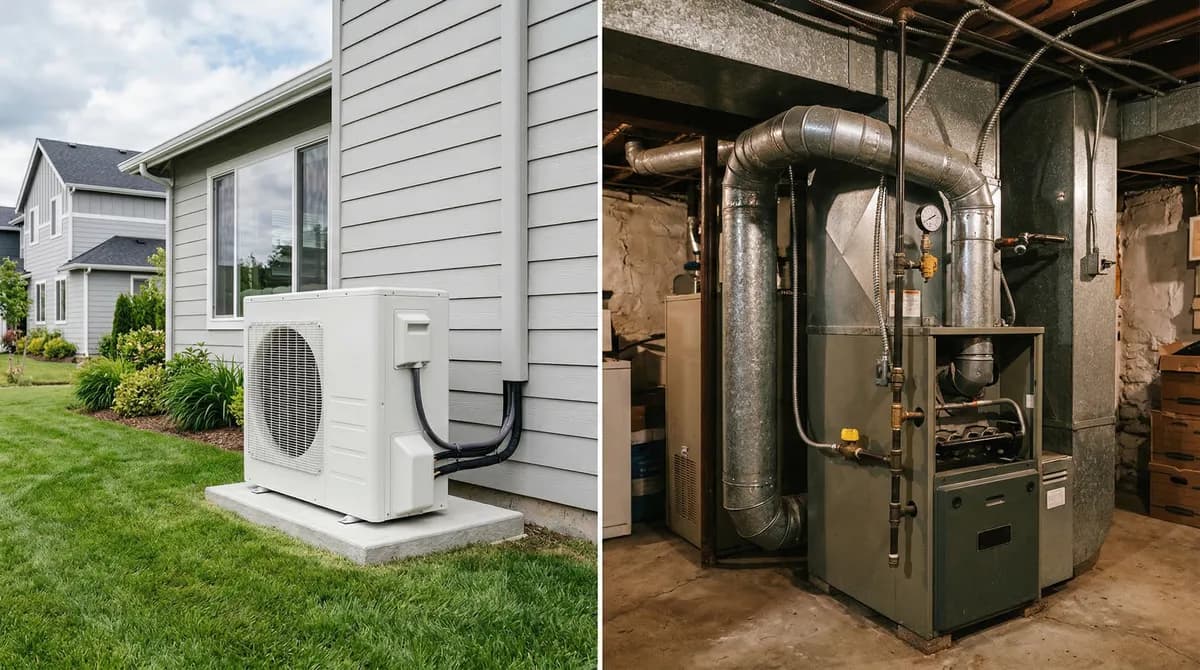
Heat pumps are now more efficient and cheaper to operate than gas furnaces in most of the U.S. A cold-climate heat pump delivers 2-4x more heat energy per dollar spent on electricity compared to a furnace burning gas, oil, or propane. In states with utility rebates ($250-$11,500), payback on the higher upfront cost is typically 4-10 years — and you get air conditioning included at no extra equipment cost.
Costs, efficiency, lifespan, and emissions for a typical 2,000 sq ft home.
| System | Upfront Cost | Annual Operating Cost | Efficiency | Lifespan | CO₂ Emissions |
|---|---|---|---|---|---|
| Heat Pump (Cold-Climate) | $6,500 - $18,000 | $750 - $1,650 | COP 2.0-4.0 (200-400%) | 15-20 years | Low (grid-dependent) |
| Gas Furnace (High-Eff) | $4,500 - $10,000 | $980 | 92-98% AFUE | 15-25 years | 7,800 lbs/year |
| Oil Furnace | $5,000 - $9,000 | $2,143 | 80-87% AFUE | 15-25 years | 11,400 lbs/year |
| Propane Furnace | $4,500 - $9,500 | $2,308 | 85-95% AFUE | 15-20 years | 8,500 lbs/year |
Operating costs assume 60M BTU annual heating demand (typical 2,000 sq ft home). Gas at $1.60/therm, oil at $3.50/gal, propane at $3.25/gal. Heat pump range reflects $0.15-$0.32/kWh electric rates across NuWatt service areas.
A heat pump moves heatrather than creating it. Using a refrigerant cycle (the same principle as your refrigerator, but in reverse), it extracts thermal energy from outdoor air and concentrates it inside your home. Even at 0°F, there is extractable heat energy in the air.
This is why heat pumps achieve a Coefficient of Performance (COP) of 2.0 to 4.0, meaning they deliver 2-4 units of heat for every unit of electricity consumed. At a COP of 3.0, a heat pump is effectively 300% efficient.
Key advantage:
Heat pumps also cool your home in summer by reversing the refrigerant cycle. One system replaces both your furnace and your air conditioner.
A furnace burns fuel (natural gas, oil, or propane) to generate heat. The combustion heats a metal heat exchanger, and a blower fan pushes air across it and into your ductwork. Exhaust gases vent outside through a flue.
Efficiency is measured in AFUE (Annual Fuel Utilization Efficiency). A 92% AFUE furnace converts 92% of fuel energy into heat — the other 8% escapes as exhaust. The best condensing furnaces reach 98% AFUE, but they can never exceed 100%.
Key limitation:
A furnace only heats. You still need a separate air conditioner for summer cooling, which adds $3,500-$7,000 in equipment and installation cost.
The fundamental difference: a furnace converts chemical energy into heat at a maximum ratio of 1:1 (actually less, since some energy escapes as exhaust). A heat pump moves existing heat from outside to inside at a ratio of 2:1 to 4:1. This is why a heat pump using electricity at $0.28/kWh can still cost less to operate than a gas furnace using gas at $1.60/therm in many markets. The heat pump needs to buy less energy because it multiplies every dollar of electricity into 2-4 dollars of heating output.
What a 2,000 sq ft home costs to heat each year across NuWatt service areas. Heat pump costs use HSPF2 10.0 (mid-range cold-climate unit) at each state's average electric rate.
| State | Electric Rate | Heat Pump | Gas Furnace | Oil Furnace | Propane | Best Savings vs |
|---|---|---|---|---|---|---|
| Connecticut | $0.27/kWh | $475 | $980 | $2,143 | $2,308 | $1,833/yr vs Propane |
| Maine | $0.22/kWh | $387 | $980 | $2,143 | $2,308 | $1,921/yr vs Propane |
| Massachusetts | $0.28/kWh | $499 | $980 | $2,143 | $2,308 | $1,809/yr vs Propane |
| New Hampshire | $0.27/kWh | $475 | $980 | $2,143 | $2,308 | $1,833/yr vs Propane |
| New Jersey | $0.26/kWh | $457 | $980 | $2,143 | $2,308 | $1,851/yr vs Propane |
| Pennsylvania | $0.18/kWh | $317 | $980 | $2,143 | $2,308 | $1,991/yr vs Propane |
| Rhode Island | $0.29/kWh | $510 | $980 | $2,143 | $2,308 | $1,798/yr vs Propane |
| Texas | $0.15/kWh | $264 | $980 | $2,143 | $2,308 | $2,044/yr vs Propane |
| Vermont | $0.21/kWh | $369 | $980 | $2,143 | $2,308 | $1,939/yr vs Propane |
Heat pump cost calculated using HSPF2 10.0 and 60M BTU annual heating demand. Gas furnace at 92% AFUE and $1.60/therm national average. Oil at 85% AFUE and $3.50/gal. Propane at 90% AFUE and $3.25/gal. Actual costs vary by local fuel prices and home insulation quality.
The biggest concern homeowners have about heat pumps is cold-weather performance. Here is the reality in 2026: cold-climate heat pumps now operate effectively down to -22°F, handling the vast majority of winter conditions across the entire United States.
The Northeast Energy Efficiency Partnerships (NEEP) maintains the definitive cold-climate heat pump list. Their ccASHP v4.0 specification requires:
These manufacturers offer models rated to -22°F with verified cold-weather performance:
Modern cold-climate heat pumps don't just “survive” extreme cold — they maintain meaningful heating output. The Fujitsu Orion XLTH+ retains 90% of its rated capacity at -15°F and approximately 65% at -22°F. The Mitsubishi FX maintains roughly 76% at 5°F. Even at these reduced outputs, most properly sized systems continue to meet the heating demand without supplemental heat. The days of heat pumps quitting at 25°F are long over.
We believe in honest advice. There are situations where keeping or choosing a furnace is reasonable.
If your gas costs less than $1.00/therm and your electricity exceeds $0.25/kWh, a high-efficiency (96-98% AFUE) gas furnace may cost less to operate. This scenario exists in parts of Pennsylvania and some Midwestern states. However, you still need a separate air conditioner.
If you installed a 96%+ AFUE gas furnace within the last 5 years, it doesn't make financial sense to replace it yet. Wait until it approaches end-of-life (15-20 years), then plan your heat pump transition. In the meantime, consider adding a ductless mini split for supplemental heating and cooling.
If your area regularly sees temperatures below -22°F and you cannot have any backup heat source, a furnace provides more predictable capacity at extreme cold. However, most NuWatt service areas rarely drop below -15°F, making this scenario uncommon in the Northeast and Texas.
The dual-fuel option: Many homeowners choose to keep their existing gas furnace as a backup while installing a heat pump as the primary system. The heat pump handles 90-95% of heating hours (and all cooling), switching to the furnace only during the coldest nights. This configuration delivers the best of both worlds: heat pump efficiency most of the year with furnace reliability as insurance.
State and utility rebates remain the primary financial incentive for heat pump installations in 2026. These programs significantly reduce upfront costs and accelerate payback.
| State | Program | Amount | Notes | Details |
|---|---|---|---|---|
| Massachusetts | Mass Save Whole-Home | Up to $8,500 | $2,650/ton capped. $500 sizing + $500 weatherization bonuses. HEAT Loan 0% APR up to $25K. | State guide |
| Connecticut | Energize CT | $250-$1,000/ton | Standard $250/ton (max $2,500). Energy Optimization $1,000/ton (max $10K). Smart-E heat pump loan 1.99% APR, 5 yr, up to $25K after rebate approval. | State guide |
| Rhode Island | Clean Heat RI | Up to $11,500 | 60% of cost (standard). 100% income-eligible (max $18K). | State guide |
| Maine | Efficiency Maine | $1,000-$3,000/unit | Standard $1K, moderate $2K, low-income $3K per unit. Max 3 units. | State guide |
| New Hampshire | NHSaves | $250-$1,250/ton | Standard $250/ton. Enhanced $1,250/ton (replacing electric resistance). | State guide |
| Vermont | Efficiency Vermont | $475-$2,200/unit | Ductless $475/head, ducted $2,200. GMP income bonus $2K. Cold-climate models only. | State guide |
| New Jersey | NJ Whole Home + Utility | Up to $7,500 + $1,400 | Graduated rebate ($2K base + $200/point). Utility: PSE&G $900, ACE $1,300, RECO $1,400. | State guide |
| Pennsylvania | Act 129 Utility Rebates | $200-$1,700+ | PECO $300 + EAP $500-1,400 stackable. PPL $350-450. FirstEnergy $500. Duquesne $200. | State guide |
| Texas | Utility Rebates | $100-$3,000 | Austin Energy ~$3K (highest). Oncor $600. CPS $100-275/ton. CenterPoint ~$500. No statewide program. | State guide |
Rebate amounts reflect publicly available program details as of March 2026. Income-eligible households may qualify for enhanced rebate tiers. Always verify current amounts with your state program before making purchasing decisions.
A common mistake in cost comparisons is comparing a heat pump to a furnace alone. Since a heat pump provides both heating and cooling, the fair comparison is heat pump vs. furnace plus air conditioner.
Includes: Heating + cooling in one system
Requires: Two separate systems, two maintenance contracts
When compared apples-to-apples (heating + cooling), a mid-range ducted heat pump ($10,000-$14,000) costs roughly the same as a mid-range furnace + AC combination ($10,000-$14,000). The heat pump wins on operating costs ($200-$1,400/year savings), maintenance simplicity (one system vs two), and carbon reduction.
Heating accounts for roughly 30% of a typical home's carbon footprint. Switching fuel types has a significant impact on household emissions.
Heating Oil
11.4k
lbs CO₂/year
Natural Gas
7.8k
lbs CO₂/year
Propane
8.5k
lbs CO₂/year
Electric Baseboard
5.4k
lbs CO₂/year
Heat Pump (NE Grid Avg)
~2,700
lbs CO₂/year (at COP 3.0, NE grid 0.59 lbs/kWh)
A heat pump produces roughly 65% less CO₂ than oil heating, 55% less than propane, and 50% less than electric baseboard resistance heat. Compared to natural gas, emissions drop by approximately 65%. As the electric grid continues to add renewable energy, heat pump emissions will decline further over time — while fossil fuel furnace emissions remain constant.
In most states, yes. A heat pump with a COP of 3.0 delivers 3 units of heat per unit of electricity consumed, making it 200-400% efficient. A gas furnace maxes out at 98% AFUE. In states where electricity costs $0.15-$0.22/kWh (like Maine, Texas, Pennsylvania), a heat pump costs $750-$1,100/year to heat a 2,000 sq ft home vs. $980 for a gas furnace. In states with higher electric rates ($0.27-$0.32/kWh like Massachusetts and Rhode Island), gas and heat pump costs are closer, but heat pumps still provide air conditioning in summer at no additional equipment cost.
Yes. Modern cold-climate heat pumps operate effectively down to -22°F (-30°C). Models from Mitsubishi (FX series), Fujitsu (Orion XLTH+), Carrier (Infinity 38MPRB), and TOSOT maintain meaningful heating output well below 0°F. The NEEP ccASHP v4.0 specification requires COP ≥ 1.75 at 5°F. Thousands of homes across New England now use heat pumps as their primary heat source through harsh winters.
A heat pump typically lasts 15-20 years, while a gas furnace lasts 15-25 years. However, a heat pump replaces both your furnace AND your air conditioner, so you are comparing one system vs two. Air conditioners also last 15-20 years. When you factor in replacing both a furnace and an AC unit over 25 years, the total lifecycle cost often favors the heat pump.
Yes. Ducted heat pumps (like the Carrier Greenspeed, Bosch IDS 2.0, or Daikin FIT) connect directly to your existing ductwork, making them a straightforward replacement for a furnace. If your ductwork is in poor condition or you don’t have ducts, ductless mini splits are an excellent alternative that mount on walls or ceilings without any ductwork.
ROI depends on your current fuel type and electricity rate. Switching from oil heating saves $1,000-$1,400/year, with a payback of 5-10 years. Switching from propane saves $900-$1,500/year with a similar payback. Switching from gas is the tightest case — savings of $100-$500/year in moderate-rate states, with payback of 10-15 years. State rebates ($250-$11,500 depending on location) significantly accelerate payback.
A typical 2,000 sq ft home in the Northeast needs a 3-4 ton heat pump system (36,000-48,000 BTU). In warmer climates like Texas, 2.5-3.5 tons is often sufficient. Proper sizing requires a Manual J load calculation that considers insulation, window area, climate zone, and sun exposure. Oversizing wastes energy and causes short-cycling; undersizing leaves rooms cold on the worst winter days.
For most homes in NuWatt service areas, a properly sized cold-climate heat pump handles 100% of the heating load. However, some homeowners keep an existing furnace as backup for the very coldest nights (below -15°F) or as insurance during ice storms. A dual-fuel setup — heat pump primary with gas furnace backup — is a popular configuration that ensures comfort in any conditions.
Indoor ductless heat pump units operate at 17-25 dB — quieter than a whisper. Ducted heat pumps and furnaces both produce air-handler noise around 40-50 dB. The main difference is the outdoor compressor unit for a heat pump, which runs at 44-55 dB (similar to a quiet conversation). Modern inverter-driven heat pumps are significantly quieter than older models, and the outdoor unit can be strategically placed away from bedrooms.
Like any electric heating system, a heat pump will not operate during a power outage unless you have battery backup or a generator. A gas furnace also requires electricity for its blower motor and controls, so it won’t run without power either. The best solution for outage protection is a battery system (like Tesla Powerwall) paired with a heat pump, which provides both heating and cooling during grid outages.
Yes. The federal Section 25C tax credit expired December 31, 2025 — there is no federal credit for residential heat pumps in 2026. However, heat pumps remain a smart investment because state rebates ($250-$11,500), lower operating costs (especially vs oil and propane), built-in air conditioning, and reduced carbon emissions all contribute to a strong economic case. Payback periods remain 4-10 years in most Northeast states thanks to robust state incentive programs.
Not sure which system is right for your home? Our HVAC specialists will assess your heating needs, calculate your savings vs your current furnace, and recommend the best heat pump system — all at no cost.