Loading NuWatt Energy...

We use your location to provide localized solar offers and incentives.
We serve MA, NH, CT, RI, ME, VT, NJ, PA, and TX
Loading NuWatt Energy...
NuWatt designs, installs, and manages solar, battery, heat pump, and EV charger systems across 9 states. One company, one warranty, one point of contact.
Get a Free Quote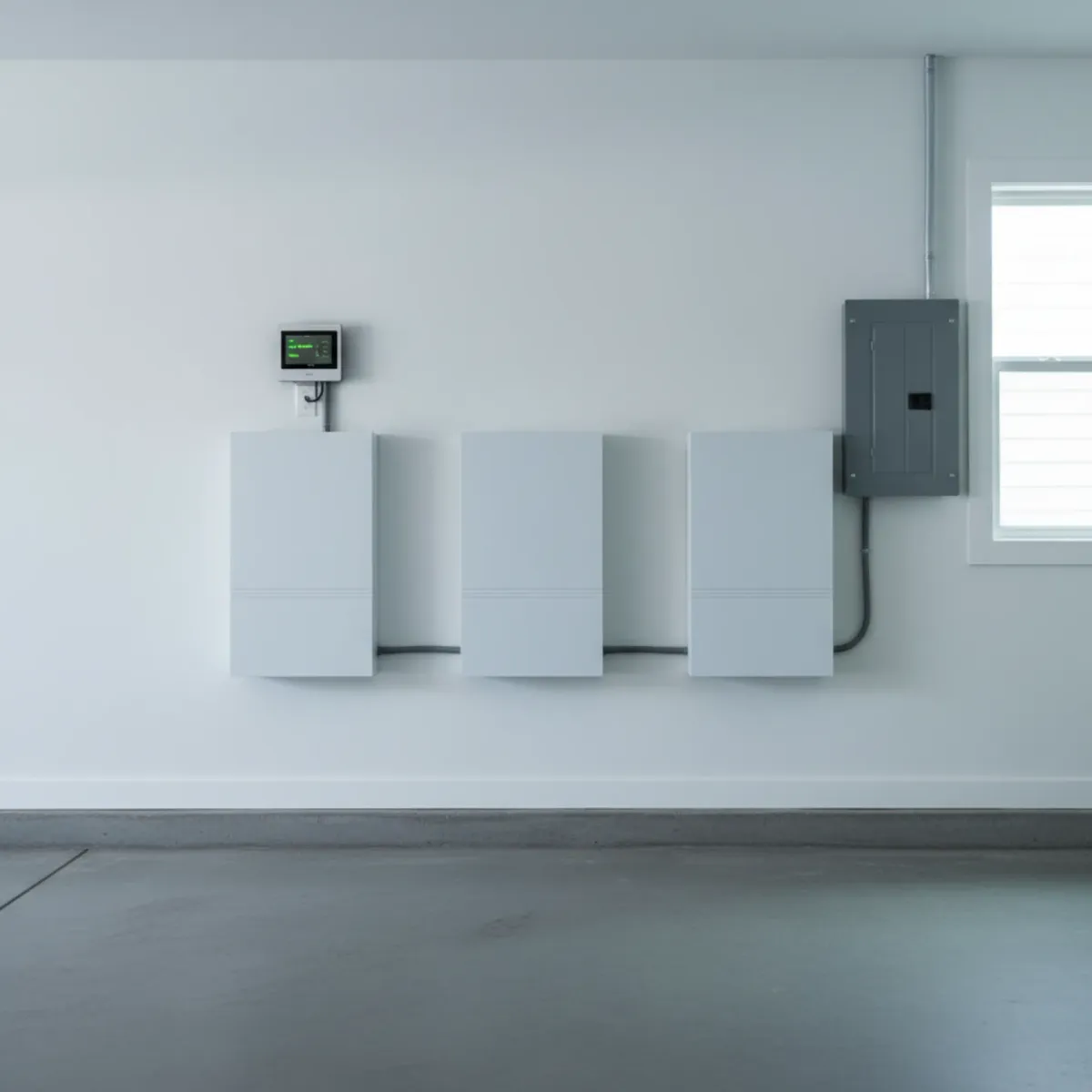
Most homes need 1 to 3 batteries. One for essential loads, two for comfort tier, three or more for whole-home backup. The right answer depends on what you want to keep running during an outage — and for how long. Here is the installer-perspective framework, plus our free sizer to give you a personalized count in 60 seconds.
1 battery
2 batteries
3+ batteries
Quick Answer
Most homes need 1 to 3 home batteries depending on the backup goal. One battery (10-13.5 kWh usable) handles essential loads — refrigerator, well or sump pump, internet, lights, medical devices — for 24-48 hours during a typical outage. Two batteries add comfort tier: HVAC blower, smaller window AC, TV, multiple device charging. Three or more batteries are needed for whole-home backup including central AC, EV charging, electric heat, or extended multi-day outages without solar recharging. The right number depends on (1) your tier goal, (2) your home size, and (3) whether a paired solar array is recharging the bank during daylight.
We use a three-tier load frameworkinstead of vague “days of autonomy” targets. Tiering forces a real decision about what matters: do you want to survive the outage, stay comfortable through it, or run the house as if nothing happened? Each tier has a typical daily energy footprint that translates directly into a battery count.
The framework prevents over-buying (homeowners who oversize to a theoretical 7-day event end up paying for $7K-$15K of capacity they use once a decade) and under-buying (homeowners who only think about kWh capacity but ignore peak surge power — and then trip the system when the well pump kicks on).
Match your resilience goal to a tier. Each tier maps to a typical daily energy footprint and a baseline battery count using a single 13.5 kWh battery (Tesla Powerwall 3 reference). Smaller batteries (Enphase IQ 5P at 5 kWh) scale up proportionally — three 5P units approximately equal one Powerwall on capacity.
Tier 1
Survive the outage — keep the lights on, food cold, pumps running
What runs
Daily energy
3–5 kWh
You need
1 battery
A single 13.5 kWh battery sustains essential loads for 24-48 hours during a typical outage. This is the most common configuration NuWatt installs.
Tier 2
Outage feels normal — add HVAC, entertainment, and convenience
What runs
Daily energy
8–12 kWh
You need
2 batteries
Two 13.5 kWh batteries (27 kWh total) handle comfort tier with capacity to spare. The second battery often pays for itself through daily self-consumption when paired with solar, not just outage backup.
Tier 3
Full house runs as normal — central AC, electric heat, all loads
What runs
Daily energy
20–40 kWh
You need
3+ batteries
Whole-home backup requires 3 or more batteries (40+ kWh total). The system also needs continuous-power headroom for surges — typically 20+ kW peak — which means battery selection matters as much as count.
The NuWatt Battery Sizer asks 4 questions — your home size, your outage profile, your critical loads, and whether you have or plan to add solar — and returns a specific battery count and brand recommendation.
The load-tier framework above answers the “what runs” question. This table adjusts the count for home size and occupancy, since a 1,200 sqft condo has very different load needs than a 3,500 sqft family home.
| Home Size / Household | Essential (Tier 1) | Comfort (Tier 2) | Whole-Home (Tier 3) |
|---|---|---|---|
| Small (under 1,500 sqft) / 1-2 occupants | 1 battery | 1-2 batteries | 2-3 batteries |
| Medium (1,500-2,500 sqft) / 3-4 occupants | 1 battery | 2 batteries | 3 batteries |
| Large (2,500-4,000 sqft) / 4-5 occupants | 1-2 batteries | 2-3 batteries | 3-4 batteries |
| Very large (4,000+ sqft) / 5+ occupants | 2 batteries | 3 batteries | 4+ batteries |
Counts assume 13.5 kWh batteries (e.g., Tesla Powerwall 3). Adjust proportionally for smaller-modular (Enphase IQ 5P, 5 kWh per unit) or larger (FranklinWH aPower 2, 15 kWh per unit). Solar pairing typically reduces required count by 1 battery for the same tier — see Section 5.
Capacity (kWh) determines how long a battery runs. Continuous power (kW) determines how much load it can support at once. Peak/surge power determines whether motor-start loads can even kick on. A battery with too-low peak kW will trip during a well pump or AC compressor startup regardless of remaining kWh — this is the most common sizing mistake homeowners make.
| High-Draw Appliance | Running Watts | Startup Surge | Battery Implication |
|---|---|---|---|
| Refrigerator compressor | 150 W | ~600 W (4x running) | Any modern battery handles this easily |
| Sump pump or well pump | 800-1,000 W | ~2,400-3,000 W (3x running) | All 3 batteries NuWatt installs handle this. Tesla Powerwall 3's 22 kW peak is the most headroom. |
| Central AC compressor (3-ton) | 3,500 W | ~10,500 W (3x running) | Requires a battery with strong peak power. Tesla Powerwall 3 (22 kW peak) handles this single-unit. For other batteries, check the model's specific peak rating against this surge value before sizing. |
| Electric heat pump (4-ton) | 4,000-5,000 W | ~12,000-15,000 W | Tesla Powerwall 3 (22 kW peak) handles this single-unit. For other batteries, check the model's specific peak rating — surge values in this range exceed many residential batteries' continuous output. |
| Level 2 EV charger | 7,200-11,500 W | ~7,200-11,500 W (no surge multiplier) | High sustained draw, not a surge problem. NuWatt's installer guidance: pause Level 2 EV charging during outages unless paired solar is actively producing. Resume normal charging once grid returns. |
Running and surge wattages are typical values for residential equipment. Your specific appliances may vary — confirm with manufacturer nameplate ratings. Battery continuous and peak ratings are manufacturer specifications.
Solar plus battery is a fundamentally different system from battery alone. With solar producing during daylight, your battery only needs to cover overnight loads and any shortfall during a multi-day outage with reduced sun. A home that needs 3 batteries for solo battery backup might need only 1-2 batteries when paired with a properly sized solar array.
The reason: in a typical NuWatt service-territory outage scenario (1-3 days), a 10 kW solar array produces 30-50 kWh of energy per day. That alone covers most household loads during daylight, leaving the battery to only run overnight (8-12 kWh). One battery is enough.
Capacity must cover total daily load × outage duration. A 3-day outage with 12 kWh/day comfort load = 36 kWh needed = 3 batteries. No recharge until grid returns.
Battery only covers overnight load + daytime shortfall. A 3-day outage with 12 kWh/day comfort load and 10 kW solar = ~10-12 kWh nightly capacity needed = 1 battery. Indefinite duration as long as the sun rises.
The sizing question is unchanged — same loads need the same kWh — but the economics differ based on ownership structure in 2026.
Most homes need 1 to 3 batteries depending on the backup goal. One battery (10-13.5 kWh usable) covers essential loads — refrigerator, well or sump pump, internet, lights, medical devices — for 24-48 hours during a typical outage. Two batteries add comfort tier: HVAC blower, smaller window AC, TV, multiple device charging. Three or more batteries are needed for whole-home backup including central AC, EV charging, electric heat, or extended multi-day outages without solar recharging. Use NuWatt's free Battery Sizer to get a personalized count based on your appliances and outage profile.
NuWatt sizes batteries using a three-tier framework. Tier 1 (Essential): refrigerator, freezer, sump or well pump, furnace blower, WiFi, lights, medical devices — typically 3-5 kWh per day, runs on 1 battery. Tier 2 (Comfort): adds TV, laptops, fans, small window AC, multiple device charging — typically 8-12 kWh per day, needs 2 batteries. Tier 3 (Whole-Home): adds central AC, electric heat, EV charging, full-house outlets and lighting — typically 20-40 kWh per day, needs 3 or more batteries. Tiering prevents over-buying while ensuring critical systems survive an outage.
For short outages and modest loads, yes. A 13.5 kWh battery covers essential loads for roughly 24-48 hours. But "whole-house" backup including central AC, electric heat, or EV charging exceeds what one battery can supply continuously. Tesla Powerwall 3 delivers 11.5 kW continuous, which is enough to handle most household loads simultaneously but only for the duration of the kWh capacity. For multi-day outages or homes with high-draw electric loads, you need 2 to 3 or more batteries.
Total capacity (kWh) tells you how long a battery runs. Continuous power (kW) tells you how much load it can support at once. Peak (or surge) power tells you what motor-start loads it can handle in the first few seconds — well pumps, central AC compressors, and freezer compressors all draw 3-5x their running wattage during startup. A battery with insufficient continuous or peak kW will trip during a surge, regardless of how much kWh remains. NuWatt installs Tesla Powerwall 3 (11.5 kW continuous / 22 kW peak), Enphase IQ Battery 10C (7.08 kW continuous), and FranklinWH aPower 2 (10 kW continuous / 15 kW peak) for this reason.
Solar plus battery is a fundamentally different system from battery alone. With solar producing during the day, your battery only needs to cover overnight loads plus the next day's shortfall during multi-day outages. A home that needs 3 batteries for solo battery backup might need only 1-2 batteries when paired with a properly sized solar array, because daylight recharges the bank. NuWatt sizes solar + battery together using your daily kWh consumption, your roof's production potential, and your outage risk profile.
Both approaches work. Fewer big batteries (e.g., 2x FranklinWH aPower 2 = 30 kWh) minimize installation complexity, wall space, and per-kWh cost. More small batteries (e.g., 6x Enphase IQ 5P = 30 kWh) maximize granular expansion, redundancy, and modular start-small flexibility. NuWatt typically recommends Tesla Powerwall 3 or FranklinWH aPower 2 when total kWh is the goal, and Enphase IQ 5P when the homeowner wants to start with essential loads and expand later.
Runtime depends entirely on what loads you run. A single Tesla Powerwall 3 (13.5 kWh) can power: a refrigerator alone for 90+ hours; essentials (fridge + lights + WiFi + furnace blower) for 24-30 hours; whole-home with central AC running intermittently for 8-12 hours. NuWatt's Battery Sizer calculates this for your specific load profile, or see our Battery Runtime by Appliance page for an interactive table.
No, but it changes the economics. Section 25D (the 30% residential clean energy credit) expired December 31, 2025, so cash-purchase batteries no longer receive the federal credit. Third-party-owned batteries (lease or PPA) can still access the commercial §48/§48E credit at 30% if construction begins before July 4, 2026. State and utility programs like Mass Save (MA) and ConnectedSolutions (NE) still apply. The sizing question is unchanged — same loads need the same kWh — but the payback math differs by ownership structure.
Level 2 EV charging draws 7-11 kW continuously, which is most of a battery's output capacity. Charging an EV from a battery during an outage is generally not recommended unless you have 3+ batteries OR a paired solar array recharging during the day. Better practice during outages: pause EV charging, run only essential loads, and use Level 1 (1.4 kW) emergency charging only if needed for short trips. Battery + solar + smart load management is the durable answer for EV households.
NuWatt's installer perspective: right-size for your typical outage and your typical load. Multi-day grid-down events are rare in most NuWatt service territories. Oversizing to handle a theoretical 7-day outage often means installing capacity you will use less than once per decade — capacity that costs $7,000-$15,000 per battery. The exception is solar-paired systems, where extra battery capacity unlocks self-consumption value daily, not just during outages. Run the NuWatt Battery Sizer to see which scenario you are actually in.
NuWatt installs Tesla Powerwall 3, Enphase IQ Battery 5P / 10C, and FranklinWH aPower 2 across MA, CT, NH, RI, VT, ME, NJ, PA, and TX. Free site assessment, load calculation, and itemized quote — sized to your tier, not oversold.
NuWatt Battery Sizer
Free interactive tool — answer 4 questions, get a personalized battery count and load list.
Battery Runtime by Appliance
Interactive table: how long does each battery model run each appliance? 18+ appliances modeled.
Battery Backup Planner
Plan your circuits: what gets backed up, what does not, and how to wire the critical-load panel.
Home Battery Guide 2026
The full guide — chemistry, brands, costs, incentives, and installation process.
Best Home Batteries 2026
NuWatt's top picks: Tesla Powerwall 3, Enphase IQ 5P, FranklinWH aPower 2 — with specs and pricing.
Battery vs Generator (2026)
When a generator beats a battery, when it does not, and when both make sense together.
Outage Resilience Simulator
Simulate a multi-day grid outage with your specific loads and battery configuration.
Solar + Battery Bundles
Paired sizing — how solar daily production changes the battery-count math.
Marcus has designed and overseen 500+ residential solar installations across the Northeast. He specializes in system sizing, panel performance analysis, and production modeling.