Loading NuWatt Energy...

We use your location to provide localized solar offers and incentives.
We serve MA, NH, CT, RI, ME, VT, NJ, PA, and TX
Loading NuWatt Energy...
NuWatt designs, installs, and manages solar, battery, heat pump, and EV charger systems across 9 states. One company, one warranty, one point of contact.
Get a Free QuoteMaine has two utilities, and both are charging more than ever. CMP customers pay $0.27/kWh (up 42% since 2020). Versant customers pay $0.32/kWh (up 52% since 2020). Here is the full breakdown — and what you can do about it.
$0.27
CMP Rate (/kWh)
$0.32
Versant Rate (/kWh)
$245
Avg CMP Bill (/mo)
42-52%
Increase Since 2020
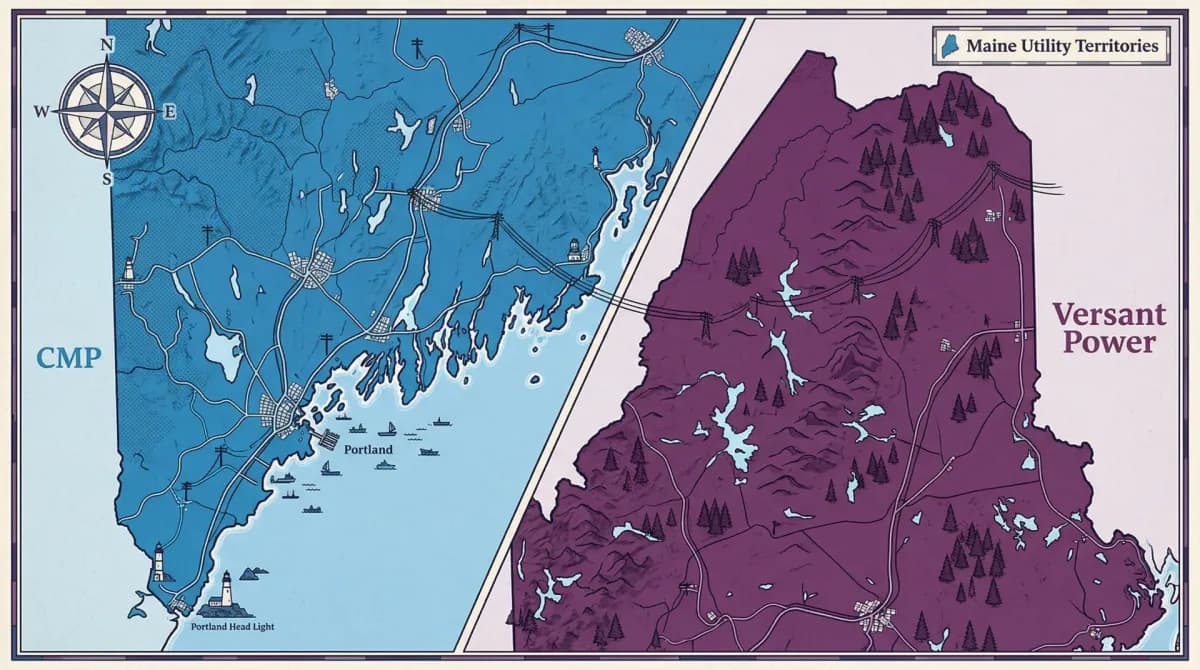
Maine is one of only a handful of states with exactly two investor-owned utilities — and both are foreign-owned. You cannot choose between them; your utility is determined by where you live.
| CMP | Versant | |
|---|---|---|
| Service Territory | Southern & central Maine (~630K customers) | Northern & eastern Maine (~160K customers) |
| Owner | Avangrid (Iberdrola subsidiary) | ENMAX (Calgary-based) |
| All-in Rate (2026) | $0.27/kWh | $0.32/kWh |
| Supply Rate (2026) | 12.72 cents/kWh | 15.97 cents/kWh |
| Avg Monthly Bill | ~$245/mo | ~$260/mo |
| Rate Increase Since 2020 | +42% | +52% |
| Net Energy Billing | 1:1 retail credit | 1:1 retail credit |
| J.D. Power Satisfaction | Below average | Below average |
Serves ~630,000 customers across southern and central Maine. Owned by Avangrid (a subsidiary of Spanish utility Iberdrola). CMP has faced persistent criticism for billing errors, the smart meter rollout debacle, and the failed NECEC transmission corridor. Despite lower rates than Versant, CMP customers have seen a 42% increase since 2020.
Serves ~160,000 customers in northern and eastern Maine. Owned by ENMAX, a Calgary-based Canadian energy company. Versant's supply rate (15.97 cents/kWh) is 25% higher than CMP's. The Bangor-area utility has seen rates climb 52% since 2020. Versant serves Maine's most rural territory, driving higher per-customer infrastructure costs.
Both CMP and Versant rates have climbed relentlessly. The table below tracks supply rates and total all-in rates (supply + delivery) for each utility since 2020.
| Year | Supply | All-In | Change |
|---|---|---|---|
| 2020 | 8.95¢ | 19.1¢ | -- |
| 2021 | 9.89¢ | 20.8¢ | +8.9% |
| 2022 | 10.23¢ | 22.4¢ | +7.7% |
| 2023 | 10.61¢ | 23.6¢ | +5.4% |
| 2024 | 11.13¢ | 24.9¢ | +5.5% |
| 2025 | 10.61¢ | 25.1¢ | +0.8% |
| 2026NOW | 12.72¢ | 27.0¢ | +7.6% |
| Year | Supply | All-In | Change |
|---|---|---|---|
| 2020 | 10.50¢ | 21.1¢ | -- |
| 2021 | 11.22¢ | 22.5¢ | +6.6% |
| 2022 | 12.18¢ | 24.8¢ | +10.2% |
| 2023 | 13.42¢ | 27.1¢ | +9.3% |
| 2024 | 14.65¢ | 29.4¢ | +8.5% |
| 2025 | 15.10¢ | 30.5¢ | +3.7% |
| 2026NOW | 15.97¢ | 32.0¢ | +4.9% |
Maine residents pay 54-83% more than the national average for electricity.
Maine's electricity costs are driven by six structural factors that are unlikely to improve. Understanding these helps explain why rates will continue climbing — and why waiting is the most expensive option.
New England generates ~50% of its electricity from natural gas. Maine sits at the end of constrained pipelines, making wholesale prices among the highest and most volatile in the country. Winter price spikes regularly exceed summer rates by 2-3x.
Maine is investing billions in aging transmission lines and substations. These costs are passed directly to ratepayers through delivery charges. Major projects include the NECEC corridor (cancelled, costs absorbed) and ongoing grid hardening.
Maine has the 4th-lowest population density in the US. Maintaining thousands of miles of rural lines and substations for relatively few customers means higher per-household infrastructure costs than any other New England state.
Maine buys electricity through the ISO New England wholesale market. Capacity market costs, energy prices, and ancillary services all flow through to ratepayers. Forward capacity auction prices have risen steadily since 2022.
Maine is aggressively electrifying heating (60%+ of homes use oil). More heat pumps and EVs mean more grid demand, especially during winter peaks. The grid was not built for this load and upgrades are expensive.
Both Maine utilities are foreign-owned. CMP (Avangrid/Iberdrola, Spain) and Versant (ENMAX, Canada) have faced scrutiny from the ME PUC for billing errors, service quality, and profit extraction. The 2023 Pine Tree Power referendum (narrowly defeated) was driven by this frustration.
The cost of the electricity itself. Set through "standard offer" bids every 6-12 months. This is the volatile component that swings with wholesale natural gas and ISO-NE market prices.
CMP: 12.72¢/kWh | Versant:15.97¢/kWh
Transmission and distribution costs set by the Maine PUC. Covers power lines, substations, transformers, meter reading, and administrative costs. This component rises steadily as infrastructure ages and requires replacement.
CMP: ~14.28¢/kWh | Versant:~16.03¢/kWh
In 2023, Maine voters narrowly defeated a ballot measure to replace CMP and Versant with a consumer-owned utility called Pine Tree Power. The referendum (Question 3) lost 69% to 31% after a $40M opposition campaign funded by Avangrid and ENMAX. Supporters argued public ownership would reduce rates by 15-25%. The issue is expected to return in future elections as rates continue to climb.
Based on 2020-2026 trends, transmission investment plans, and ISO-NE forward market prices, here is what Maine electricity costs are likely to look like over the next five years.
Assumes 3-5% annual increase based on 2020-2026 trend.
Assumes 5-7% annual increase based on 2020-2026 trend.
Over the next 10 years, a CMP customer paying $245/month today will pay an estimated $38,000+ in electricity costs at the current rate increase trajectory. A Versant customer at $260/month faces $43,000+.
Locking in a fixed solar payment today saves you money from month one — and the gap between your fixed payment and rising utility rates grows every year. Every month you wait is another month paying the higher, escalating rate.
Three options for Maine homeowners. Not all are created equal.
LED bulbs, smart thermostats, weatherization, and Efficiency Maine rebates. Good habits that trim your usage.
Reduces your kWh consumption but does not fix the rate problem. When CMP or Versant raises rates again, your bill climbs right back up. A necessary first step but not a long-term solution.
Subscribe to a remote solar farm for bill credits. No panels on your roof.
LD 1777 (2023) reduced compensation for new community solar projects. Billing complaints are widespread. You do not own anything, credits can change, and you have no control. Limited availability in Maine.
$0 down, fixed monthly payment. CMP territory: $245 to $184/mo. Versant territory: $260 to $195/mo. Own panels by year 5.
YOUR panels on YOUR roof with 1:1 NEB credits at the full retail rate. American-made Silfab 440W panels. Fixed payment that never increases while utility rates keep climbing. The gap between your utility bill and solar payment grows every year.
Learn About Propel$245
CMP Bill
$184
Propel Payment
-$61
Monthly Savings
$732/year savings from day one. Grows as CMP raises rates.
$260
Versant Bill
$195
Propel Payment
-$65
Monthly Savings
$780/year savings from day one. Grows as Versant raises rates.
Average monthly electricity bills vary by town based on home size, heating source, and utility territory. Here is what homeowners in your area are paying — and what they could pay with Propel solar.
| Town | Utility | Avg Bill | Propel Payment | Monthly Savings |
|---|---|---|---|---|
| Portland | CMP | $245/mo | $184/mo | $61/mo |
| Bangor | Versant | $260/mo | $195/mo | $65/mo |
| Lewiston | CMP | $230/mo | $173/mo | $57/mo |
| Brunswick | CMP | $240/mo | $180/mo | $60/mo |
| Scarborough | CMP | $250/mo | $188/mo | $62/mo |
| Biddeford | CMP | $235/mo | $176/mo | $59/mo |
| Kennebunk | CMP | $238/mo | $179/mo | $59/mo |
| York | CMP | $242/mo | $182/mo | $60/mo |
Maine electricity rates have risen 42-52% since 2020 and show no signs of slowing down. CMP and Versant customers across the state are locking in fixed solar payments that save 25% from day one — and the savings grow every year. See if you qualify in 60 seconds.