Loading NuWatt Energy...

We use your location to provide localized solar offers and incentives.
We serve MA, NH, CT, RI, ME, VT, NJ, PA, and TX
Loading NuWatt Energy...
NuWatt designs, installs, and manages solar, battery, heat pump, and EV charger systems across 9 states. One company, one warranty, one point of contact.
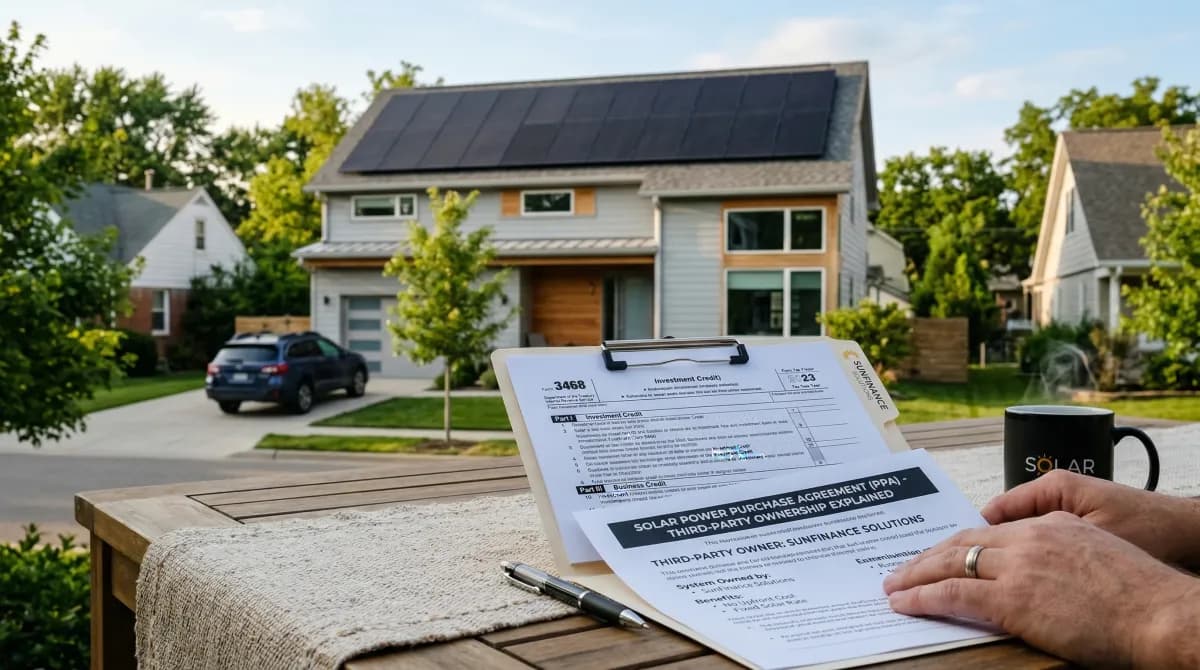
Get a Free QuoteThe residential solar ITC (Section 25D) expired December 31, 2025. Maine homeowners who buy solar with cash or a loan get $0from the IRS. But there is a legal, congressionally-designed path to still access the 30% credit — through third-party ownership under Section 48/48E. And NuWatt Propel is available in Maine.
30%
ITC Rate (Section 48)
$10,065
Example ITC (11 kW)
Jul 4, 2026
Construction Deadline
Available
Propel in Maine
A 64-year-old tax code provision — not a loophole
Section 48 of the Internal Revenue Code has existed since 1962. It provides an Investment Tax Credit (ITC) to the ownerof qualifying energy property — solar panels, wind turbines, battery storage, and other energy systems. The critical word in the statute is “owner.”
For decades, two parallel pathways existed for solar tax credits. Section 25D let individual homeowners claim the ITC on their personal tax return when they purchased solar with cash or a loan. Section 48 let businesses and financing companies claim the ITC when they owned solar systems — including systems installed on residential rooftops through leases and PPAs.
On July 4, 2025, the OBBBA (One Big Beautiful Bill Act) eliminated Section 25D. The homeowner pathway is dead. But Section 48 — the business/TPO pathway — remains active. The begin-construction safe harbor closed July 4, 2026; new starts still qualify if placed in service by December 31, 2027.
This is not a loophole. Congress designed it this way.
Section 48 was created to encourage capital deployment into energy infrastructure. Financing companies invest billions in solar systems, claim the ITC as intended by the tax code, and pass savings to homeowners through lower monthly payments. This mechanism has been reviewed and upheld by the IRS, Treasury, and Congress for over six decades.
Section 48E, created by the Inflation Reduction Act (August 2022), extended the investment tax credit with technology-neutral rules. Together, Sections 48 and 48E provide the legal framework that allows third-party solar financing to continue delivering federal tax benefits — even after Section 25D's expiration.
Two different tax code sections, two different claimants, two very different outcomes in 2026.

| Feature | Section 25D (DEAD) | Section 48/48E (ACTIVE) |
|---|---|---|
| Tax code section | Section 25D | Section 48 / 48E |
| Who claims the credit | Homeowner (on personal return) | System owner / TPO (financing company) |
| IRS form used | Form 5695 | Form 3468 |
| Credit rate | 30% (was) | 30% (still active) |
| Current status | EXPIRED Dec 31, 2025 | ACTIVE (new starts by Dec 31, 2027) |
| Applies to | Cash or loan purchases | Lease, PPA, Propel (TPO models) |
| MACRS depreciation | Not available to homeowners | 5-year property, 100% first-year bonus |
| Domestic content bonus | N/A (credit is dead) | +10% with FEOC-compliant panels |
| Energy community bonus | N/A (credit is dead) | +10% if project in qualifying area |
| Net effect for homeowner | $0 federal benefit | Lower monthly payment via TPO savings |
Tax code section
25D
Section 25D
48/48E
Section 48 / 48E
Who claims the credit
25D
Homeowner (on personal return)
48/48E
System owner / TPO (financing company)
IRS form used
25D
Form 5695
48/48E
Form 3468
Credit rate
25D
30% (was)
48/48E
30% (still active)
Current status
25D
EXPIRED Dec 31, 2025
48/48E
ACTIVE (new starts by Dec 31, 2027)
Applies to
25D
Cash or loan purchases
48/48E
Lease, PPA, Propel (TPO models)
MACRS depreciation
25D
Not available to homeowners
48/48E
5-year property, 100% first-year bonus
Domestic content bonus
25D
N/A (credit is dead)
48/48E
+10% with FEOC-compliant panels
Energy community bonus
25D
N/A (credit is dead)
48/48E
+10% if project in qualifying area
Net effect for homeowner
25D
$0 federal benefit
48/48E
Lower monthly payment via TPO savings
A step-by-step breakdown of how Section 48 tax benefits translate into real savings on your monthly bill.
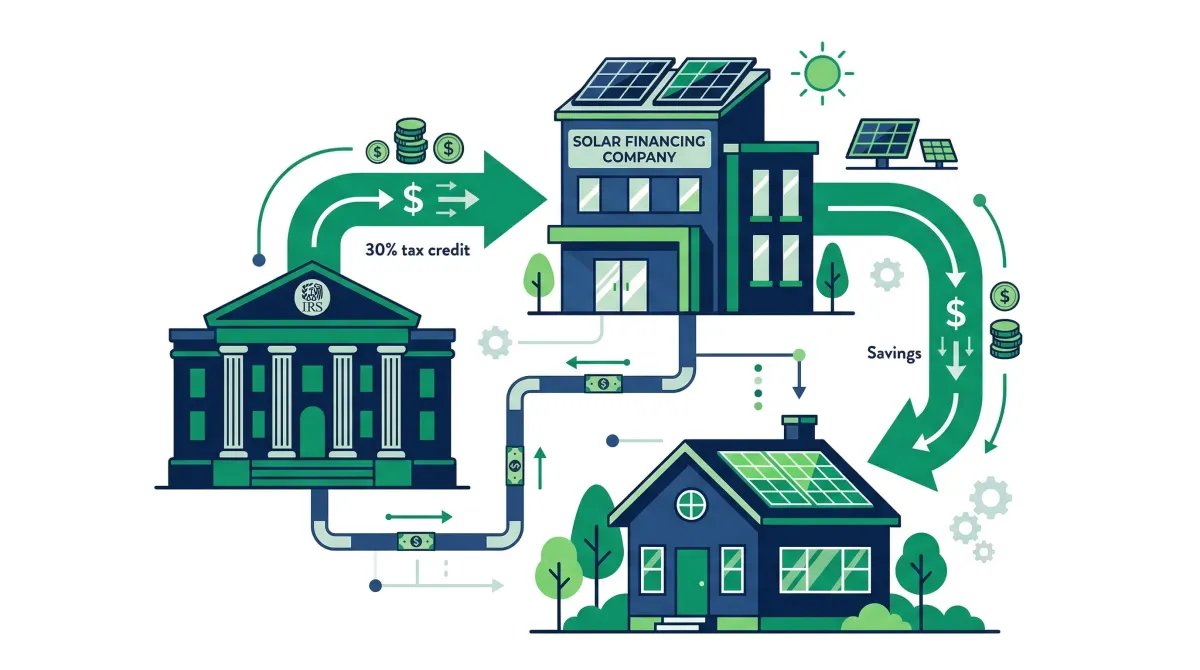
A third-party owner (financing company) purchases a solar system — for example, an 11 kW system at $3.05/W costs approximately $33,550. The TPO owns the panels, inverter, and racking. They contract with an installer (like NuWatt) to mount the system on your roof.
The TPO files IRS Form 3468 and claims the 30% Investment Tax Credit on the system cost. On a $33,550 system, that is $10,065 in federal tax credits. This goes directly to the financing company — not to you, and not to the installer. The critical word in the tax code is “owner.”
The TPO also claims Modified Accelerated Cost Recovery System (MACRS) depreciation. Under OBBBA, solar qualifies for 100% first-year bonus depreciation (permanent), so the full depreciable basis is written off in year one rather than spread over five. On our $33,550 example, MACRS provides roughly $5,300 in tax benefits, realized in year one. This is a commercial tax benefit unavailable to individual homeowners.
The TPO receives approximately $15,365 in combined tax benefits ($10,065 ITC + ~$5,300 MACRS). These savings are baked into your lower monthly lease payment or per-kWh PPA rate. Without Section 48, the TPO would need to charge you significantly more. This is not a loophole — it is the intended mechanism Congress designed to encourage solar deployment at scale.
System Cost
$33,550
25 x Silfab 440W
Section 48 ITC
-$10,065
30% to TPO
MACRS tax value
-$5,300
100% first-year bonus (year 1)
TPO Tax Benefits
~$15,365
Passed to you as savings
Three system sizes showing how Section 48 ITC and MACRS translate to real savings for Maine homeowners. Based on $3.05/W average ME pricing.
Smaller homes, 600–800 sq ft roof
Average ME home, covers full usage
Large homes, heat pump + EV charging
60%+ of Maine homes heat with oil. Section 48 TPO makes the switch affordable.
Maine has the highest oil heating dependencyin the United States. Over 60% of homes rely on heating oil at roughly $3.82/gallon. A typical Maine home burns 700–900 gallons per winter, spending $2,670–$3,440 annually just on heat.
The optimal strategy is a solar + heat pump bundle. A cold-climate heat pump (Efficiency Maine rebates up to $3,000/unit) eliminates most or all oil consumption. But heat pumps increase your electricity bill by $800–$1,500/year. Adding solar through a Section 48 TPO arrangement locks in a rate below CMP or Versant prices, offsetting the increased electric load.
Oil Heating Alone
$3,000+
Annual heating cost
HP + Grid Electric
$1,400+
Increased electric for HP
HP + Solar TPO
$0 net
Solar offsets HP electric
NuWatt Propel makes this bundle accessible at $0 down.
With Propel available in Maine, you can add solar through a TPO arrangement that captures Section 48 ITC + MACRS + the 10% domestic content bonus (using Silfab 440W FEOC panels). Pair it with Efficiency Maine heat pump rebates and you eliminate oil dependency while locking in predictable energy costs.
Not all financing captures the ITC. Here is which options benefit from Section 48 and which do not.
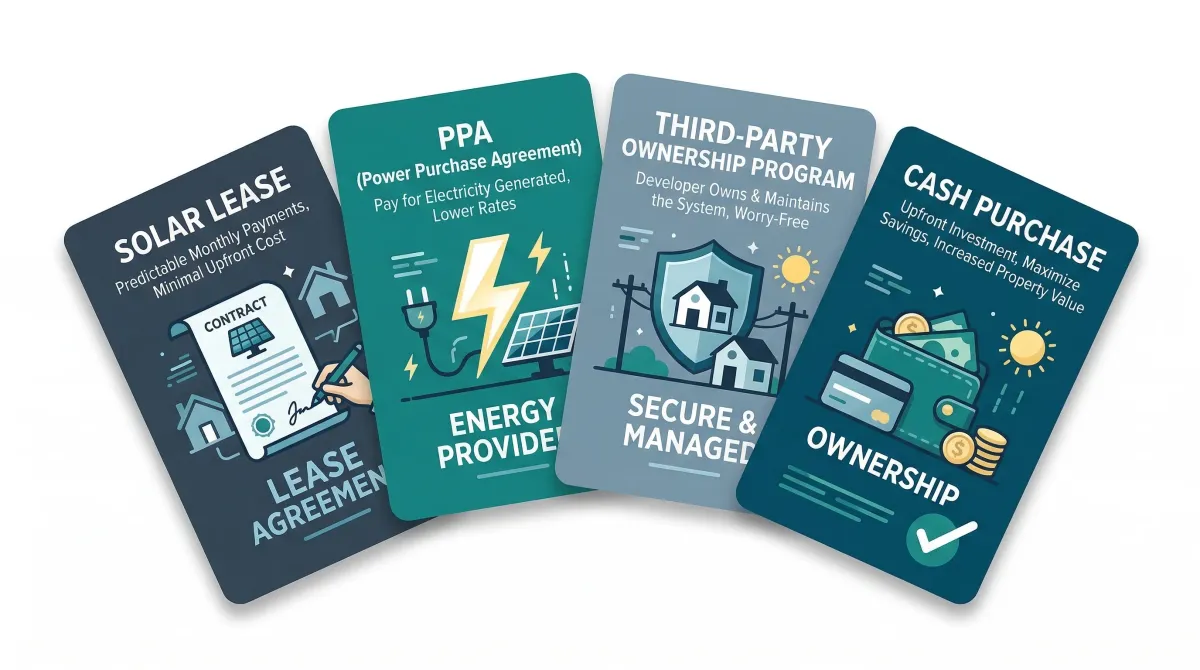
Fixed monthly payment for 20–25 years. The TPO owns the system and claims the 30% ITC + MACRS. You pay a predictable monthly amount that is lower than your current electric bill.
Advantages
Limitations
ME Note: With CMP at ~$0.27/kWh and Versant at ~$0.32/kWh, lease payments below your current bill are achievable from day one.
You pay per kilowatt-hour at a rate lower than your utility rate. The TPO owns the system, claims Section 48 ITC + MACRS, and sells you the power at a discounted rate.
Advantages
Limitations
ME Note: At $0.13–0.17/kWh vs CMP $0.27/kWh, you save 37–52% on solar electricity. Even better against Versant’s $0.32/kWh rate.
NuWatt’s third-party ownership program — available in Maine. The financing company owns the system, claims Section 48 ITC + MACRS + domestic content bonus. Requires FEOC-compliant Silfab 440W panels.
Advantages
Limitations
ME Note: Propel is AVAILABLE in Maine. Silfab 440W (FEOC-compliant) qualifies for the full 30% ITC + 10% domestic content bonus. Maine’s high oil costs make the solar+HP bundle especially compelling.
You own the system outright or finance with a personal/home equity loan. Because you own it, there is NO Section 48 benefit — and Section 25D is dead. You get $0 in federal tax credits.
Advantages
Limitations
ME Note: You own it and get 1:1 NEB credits, but 25D is dead — $0 ITC. The 15–17 year payback in CMP territory is longer without federal incentives.
Not all panels qualify for the full ITC stack. Here is what you need to know.
FEOC stands for Foreign Entity of Concern. Under guidance from the Treasury Department and IRS, solar panels manufactured by or containing critical components from FEOC-designated entities (primarily Chinese-owned companies) face restrictions on certain ITC bonuses.
Standard Section 48/48E credit
FEOC-compliant panels required
Project in qualifying census tract
*50% requires all conditions: FEOC-compliant panels + US labor (domestic content), IRS-designated energy community census tract. Most Maine residential projects qualify for 30-40%. Higher-savings scenarios are address-and-equipment-dependent, not universal.
FEOC Compliance: Safe Harbor Closed July 4, 2026
For projects starting after the safe harbor closed, systems using non-FEOC panels may face additional restrictions beyond losing the domestic content bonus. If you are considering a TPO arrangement, verify that the financing company plans to use FEOC-compliant panels before signing. NuWatt Propel guarantees Silfab 440W FEOC panels on every Maine installation.
Misinformation about the solar tax credit is rampant. Here are the facts.
“Section 48 is a loophole for solar companies.”
Section 48 has been part of the IRS tax code since 1962 — 64 years. It was specifically designed to encourage investment in energy property by providing an ITC to the entity that owns the qualifying system. Congress intentionally structured it so that financing companies could deploy capital into solar at scale. There is nothing hidden, creative, or exploitative about it.
“I get the 30% tax credit directly on my tax return.”
No. With a lease, PPA, or Propel arrangement, the third-party owner (TPO) claims the ITC on their corporate tax return using IRS Form 3468. You benefit indirectly through lower monthly payments or a reduced per-kWh rate. If you want to claim the credit directly, you would need to purchase the system outright — but Section 25D is dead, so you would receive $0.
“Solar leases are always a bad deal.”
This advice was accurate when Section 25D was alive. Homeowners could claim 30% themselves, making cash or loan purchases clearly superior. In 2026, the calculus has changed. With $0 in homeowner tax credits, leases and PPAs that leverage Section 48 can deliver better economics than a loan at 6.99–7.99% APR with no ITC. In Maine, where CMP charges ~$0.27/kWh and Versant ~$0.32/kWh, a PPA at $0.13–0.17/kWh provides significant day-one savings.
“The installer claims the tax credit.”
The installer (contractor) does not claim the ITC. The credit goes to the entity that owns the qualifying energy property — the financing company or TPO. The installer is paid for labor and materials. This is a common misunderstanding that leads homeowners to ask the wrong questions during the sales process.
“I should wait for Congress to bring back Section 25D.”
The OBBBA (One Big Beautiful Bill Act), signed July 4, 2025, eliminated Section 25D with no sunset clause and no scheduled return. There is no pending legislation to restore it. Meanwhile, Section 48/48E itself had a July 4, 2026 begin-construction safe harbor (now closed); new starts generally must be placed in service by December 31, 2027. Waiting risks losing access to both the homeowner credit (already gone) and the most flexible TPO timing (the begin-construction safe harbor has already closed).
“Maine’s high oil prices make solar unnecessary — just switch to a heat pump.”
Heat pumps are excellent for Maine (Efficiency Maine rebates up to $3,000/unit), but they increase your electricity consumption. Solar + heat pump is the optimal pairing: the heat pump slashes your oil bill, and solar offsets the increased electric load. With Section 48 TPO financing, you can add solar at $0 down and lock in a rate below CMP or Versant, making the combined stack highly cost-effective.
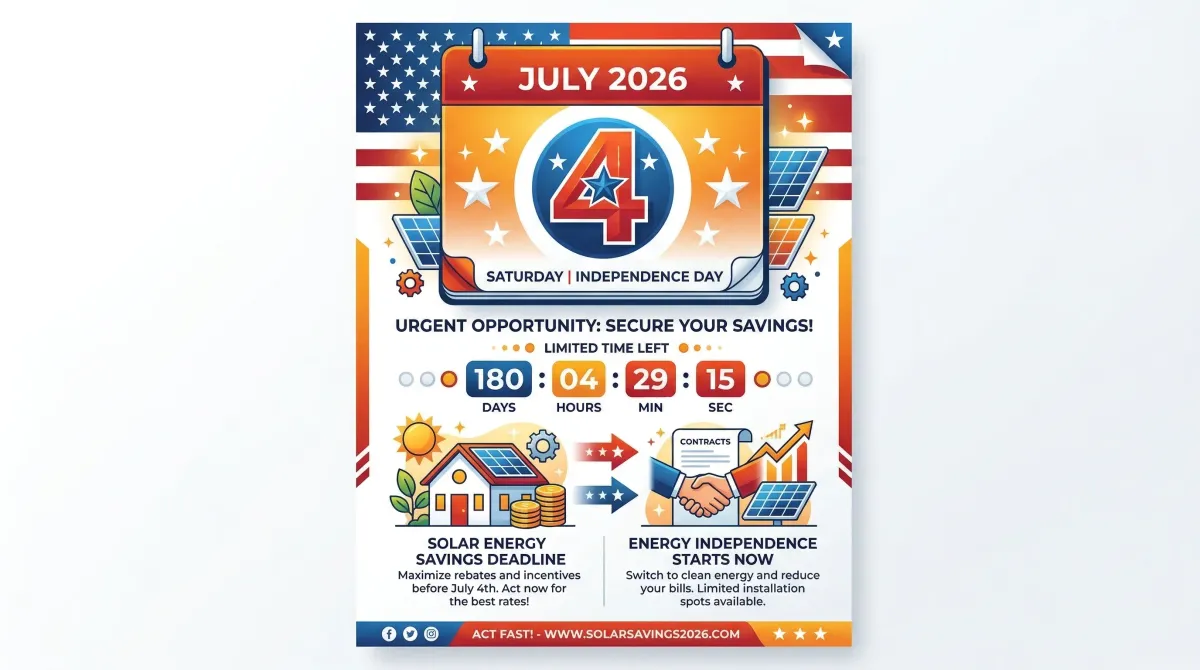
The Section 48/48E begin-construction safe harbor closed July 4, 2026. Here is the timeline every Maine homeowner needs to understand.
Section 48E created with technology-neutral ITC rules. 25D extended through 2032 (at the time).
Residential solar ITC killed immediately. Homeowners who buy with cash or loan receive $0. Section 48/48E given a 1-year grace period.
The first full calendar year with no residential solar ITC. Every cash or loan solar purchase in Maine gets $0 from the IRS.
TPO arrangements (including NuWatt Propel) that began construction (physical work test or 5% safe harbor) on or before July 4, 2026 locked in the full timing pathway, with placement in service allowed through roughly 2030.
Projects that began construction on or before this date locked in the full timing pathway. New TPO starts after this date still qualify for the 30% ITC but generally must be placed in service by December 31, 2027.
Meaningful physical work begins at the project site or at a factory for components specifically designed for the project. Mounting hardware installation, foundation work, or panel manufacturing orders count. Preliminary activities (permits, surveys, engineering) do not.
The taxpayer (TPO) incurs at least 5% of the total project cost before the deadline. On a $33,550 system, that is approximately $1,678 in binding commitments. Equipment orders with non-refundable deposits typically satisfy this test. Continuous construction or continuous efforts must follow.
Practical impact: TPO agreements (including Propel) where the financing company placed equipment orders on or before July 4, 2026 locked in the full timing pathway (placed in service within 4 years). Projects starting now still qualify for the 30% ITC but generally must be placed in service by December 31, 2027.
10 questions we hear most from Maine homeowners about the solar ITC in 2026.
Section 48 is the Investment Tax Credit (ITC) provision that has existed in the IRS tax code since 1962. It provides a tax credit to the owner of qualifying energy property — such as solar panels. Section 25D was the residential energy credit that allowed individual homeowners to claim the ITC on their personal tax return. Section 25D expired on December 31, 2025 (eliminated by the OBBBA). Section 48/48E remains active; the begin-construction safe harbor closed July 4, 2026, and new starts generally must be placed in service by December 31, 2027. The key difference: 48 goes to the system owner (the financing company in a lease/PPA/Propel), while 25D went to the homeowner.
Yes. Propel is available in Maine. It is a third-party ownership (TPO) program where the financing company owns the system and claims Section 48 ITC + MACRS + the 10% domestic content bonus. Propel requires FEOC-compliant Silfab 440W panels. Maine homeowners benefit through lower monthly payments while the TPO captures the full federal tax benefit stack.
Not directly. Section 25D is dead — if you buy solar with cash or a loan, you receive $0 in federal tax credits. However, if you finance through a solar lease, PPA, or NuWatt Propel, the third-party financing company (TPO) claims the 30% ITC under Section 48/48E. The savings are passed to you through lower monthly payments or a discounted per-kWh electricity rate.
Maine’s NEB provides 1:1 retail rate credits for rooftop solar production. When a TPO owns the system (lease, PPA, or Propel), the TPO typically structures the arrangement so the net metering credits flow to the homeowner’s utility bill, while the TPO receives their contracted payment. The 1:1 credit rate makes Maine attractive for TPO providers because the revenue stream is predictable — CMP at ~$0.27/kWh and Versant at ~$0.32/kWh represent strong value.
The IRS defines “begin construction” through two safe harbors: (1) Physical Work Test — meaningful physical work begins at the site (foundation, mounting hardware installation), or (2) Five Percent Safe Harbor — at least 5% of the total project cost has been incurred. For residential TPO systems, meeting this on or before July 4, 2026 (signing a contract and having the TPO place equipment orders) locked in the full timing pathway, with placement in service allowed through roughly 2030. Projects starting now still qualify but generally must be placed in service by December 31, 2027.
Versant territory ($0.32/kWh) provides a larger spread between your utility rate and a TPO’s PPA rate than CMP territory ($0.27/kWh). A PPA at $0.14/kWh saves you $0.18/kWh on every kilowatt-hour in Versant territory vs $0.13/kWh in CMP territory. This makes Section 48 TPO arrangements even more attractive in northern and eastern Maine.
FEOC stands for Foreign Entity of Concern. Under the IRA and subsequent guidance, solar panels manufactured by or containing components from a Foreign Entity of Concern (primarily Chinese-owned companies) may lose eligibility for certain ITC adders, particularly the 10% domestic content bonus. FEOC-compliant panels like the Silfab 440W are manufactured without FEOC components, ensuring eligibility for the full ITC stack. FEOC component-sourcing rules are ongoing.
No. The TPO retains a portion of the tax benefits as profit — this is how the financing model works. However, competition among TPO providers keeps lease and PPA rates low. In Maine, typical PPA rates are $0.12–0.18/kWh compared to CMP’s $0.27/kWh, so homeowners still see significant savings even after the TPO retains its share.
Absolutely. Maine has the highest oil heating dependency in the US (60%+ of homes). A heat pump slashes your heating oil bill, but increases electricity use. Efficiency Maine offers up to $3,000/unit in heat pump rebates (separate from federal solar incentives), making the combined package highly cost-effective.
For projects that began construction on or before July 4, 2026, the 30% ITC is locked in as long as the project is placed in service within the allowed window (roughly through 2030). Projects that begin construction after July 4, 2026 still qualify for the 30% ITC but generally must be placed in service by December 31, 2027. The credit did not disappear when the safe harbor closed.
Comprehensive guide to solar energy in Maine — costs, incentives, and timeline.
Deep dive into lease vs PPA structures, rates, and contract terms for Maine.
Side-by-side financing comparison with 25-year savings projections.
Honest analysis of whether solar still works in Maine without Section 25D.
City-by-city pricing, system sizes, and cost breakdowns across Maine.
How your utility territory affects solar savings, NEB credits, and payback.
40% ITC built in via FEOC-compliant Silfab 440W panels. You own the system. 25-year Concert Loan.
Section 25D is gone. Section 48/48E is still here — and NuWatt Propel is available in Maine. Find out how much you can save with a TPO arrangement that captures the 30% ITC — new starts generally must be placed in service by December 31, 2027.
Free quote • No obligation • NABCEP-certified installers • Silfab 440W FEOC panels • Propel available in Maine