Loading NuWatt Energy...

We use your location to provide localized solar offers and incentives.
We serve MA, NH, CT, RI, ME, VT, NJ, PA, and TX
Loading NuWatt Energy...
NuWatt designs, installs, and manages solar, battery, heat pump, and EV charger systems across 9 states. One company, one warranty, one point of contact.
Get a Free Quote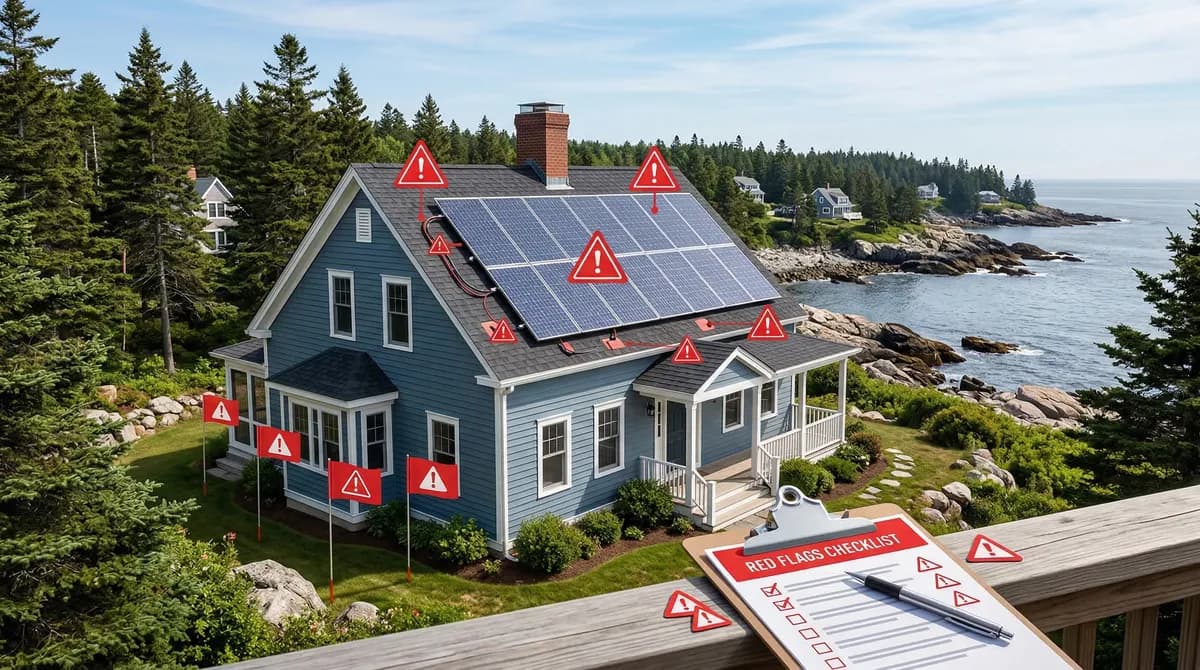
The federal ITC is dead. Efficiency Maine rebates are for heat pumps, not solar. Some companies have not updated their pitch. Others are deliberately misleading Maine homeowners. Here is how to protect yourself before signing anything.
$0
Federal ITC
$3.05/W
Average Cost/Watt
12-17 yr
Payback Period
1:1 Retail
NEB Credit
Section 25D of the Internal Revenue Code was eliminated by the One Big Beautiful Bill Act (OBBBA), signed July 4, 2025. It expired December 31, 2025. Homeowners who purchase solar with cash or a loan receive zero federal tax credits. Section 48/48E remains available for third-party owners (PPA/lease companies) on projects beginning construction before July 4, 2026, but the homeowner does not claim that credit.
Maine’s solar market has unique characteristics that create specific vulnerabilities for homeowners. With 60% of households heating with oil ($3.82/gal) and growing interest in electrification, solar companies often pitch solar as a solution to heating costs — which is misleading unless you also install a heat pump.
The two-utility landscape (CMP at ~$0.27/kWh, Versant at ~$0.32/kWh) creates opportunities for deception. Out-of-state sales organizations may not understand which utility serves your area, leading to inaccurate savings projections. And the Efficiency Maine Trust — known for heat pump rebates — is frequently misrepresented as offering solar rebates.
Solar can still be a strong investment in Maine: NEB provides 1:1 retail credits, property taxes are 100% exempt statewide, and the 5.5% sales tax exemption saves over $1,300 on a typical system. But the payback is 12-17 years — longer than southern states — and companies should be honest about that.
This guide covers the 10 biggest red flags in the 2026 Maine solar market, ME-specific scam patterns, how to verify any company’s credentials, and a complete contract checklist — plus an interactive Red Flag Checker tool.
The #1 red flag in 2026: any Maine solar company that advertises a 30% federal tax credit for homeowners. The residential solar ITC (Section 25D) expired December 31, 2025. It is $0 for homeowners purchasing with cash or a loan. If a company includes this in your savings estimate, they are inflating your projected savings by thousands of dollars.
Other Maine-specific red flags include: claiming Efficiency Maine rebates apply to solar (they are for heat pumps only), inflating production estimates above 1,350 kWh/kW/yr, using the wrong utility rate (CMP ~$0.27 vs Versant ~$0.32), hiding the 12-17 year payback reality, and claiming LD 1777 changed rooftop solar benefits (it only affected community solar).
The only exception: PPA and lease providers can legitimately reference Section 48/48E, because the third-party owner of the system claims that credit. But if a company tells you, the homeowner, that you will receive 30% off your taxes, they are wrong.
These are the warning signs we see most often in the 2026 Maine solar market. If you encounter any of these, proceed with extreme caution.
The federal residential solar ITC (Section 25D) expired December 31, 2025. It is gone. $0 for homeowners. Any company in Maine still advertising a 30% credit is either dangerously uninformed or intentionally deceiving you.
Section 25D of the Internal Revenue Code was eliminated by the One Big Beautiful Bill Act (OBBBA), signed July 4, 2025. For any solar system purchased by a homeowner with cash or a loan in 2026, the federal tax credit is $0.
Maine's solar market is smaller than southern states, which means fewer companies but some out-of-state sales organizations targeting Maine homeowners with outdated marketing. Ads mentioning "30% off" or "government incentives" that reference the ITC are deceptive.
The exception: PPA and lease providers can legitimately reference Section 48/48E, because the third-party system owner (not you) claims that credit. But if a company tells YOU that YOU will receive 30% off your taxes, they are wrong.
“Under which section of the tax code does the residential solar credit exist in 2026?”
Correct answer: It doesn't. Section 25D expired December 31, 2025. If they can't answer this, walk away.
Efficiency Maine offers rebates for heat pumps ($1,000-$3,000 per unit), NOT for solar panels. Some companies deliberately blur this line, claiming "Maine state rebates" for solar when no such program exists.
Efficiency Maine Trust administers heat pump rebates: $1,000/unit (standard), $2,000/unit (moderate-income), and $3,000/unit (low-income), with a maximum of 3 units per household. These rebates are exclusively for ductless and ducted heat pumps.
There is no Efficiency Maine solar panel rebate in 2026. The state's solar incentives are limited to NEB (net metering at 1:1 retail), property tax exemption (100% statewide), and sales tax exemption (5.5%).
If a solar salesperson mentions "Efficiency Maine" or "state rebates" in the context of your solar panel purchase, ask them to show you the specific program page on efficiencymaine.com. It does not exist because the program does not exist.
“Can you show me the Efficiency Maine webpage for the solar panel rebate you are referencing?”
Correct answer: They cannot. Efficiency Maine rebates are for heat pumps only. There is no state rebate for residential solar in Maine.
"Get free solar panels for your home!" With the federal ITC gone, nothing about solar is free. This usually means a lease or PPA where you pay monthly for 20-25 years and never own the system.
In a solar lease or PPA, the third-party company owns your panels. You pay them a monthly fee or per-kWh rate. Over 20-25 years, you will pay $15,000-$35,000+ for a system you never own.
The "free" pitch worked better when homeowners received a 30% ITC. Now that the credit is $0, the economics have shifted. Lease/PPA rates in Maine may be less favorable than before because the TPO company's costs are higher without the residential credit.
If a company describes solar as "free," ask: "Is this a purchase (cash or loan), a lease, or a PPA? Who owns the system?" If they cannot clearly explain the difference, or if they call a lease "free solar," that is deceptive.
“Is this a purchase (cash or loan), a lease, or a PPA? Who owns the system?”
Correct answer: They should clearly state the ownership structure. In a lease/PPA, they own it. In a purchase, you own it. There is no "free" option.
Maine receives 1,200-1,350 kWh per kW per year depending on location. Some companies inflate production estimates to make the payback period look shorter. Northern interior zones receive even less sunlight than coastal areas.
Southern coastal Maine (Portland, Scarborough, Kennebunk) receives approximately 1,300-1,350 kWh/kW/yr. Central Maine (Lewiston, Augusta) receives approximately 1,250-1,300 kWh/kW/yr. Northern Maine (Bangor and north) receives approximately 1,200-1,250 kWh/kW/yr.
Snow cover, shorter winter days, and Maine's northern latitude (43-47 degrees) all reduce annual production compared to states like New Jersey or Massachusetts. A company projecting 1,500+ kWh/kW/yr for a Maine installation is inflating numbers.
Ask the company what specific production modeling software they use (PVWatts, Aurora, Helioscope) and request a printout of the simulation. Legitimate companies can show you the month-by-month production forecast for your exact address.
“What production estimate (kWh/kW/yr) are you using, and can you show me the PVWatts or Aurora simulation for my address?”
Correct answer: A legitimate Maine estimate should be 1,200-1,350 kWh/kW/yr. If they cite higher numbers without a site-specific simulation, the projection is inflated.
Maine has two primary utilities with very different rates: CMP at ~$0.27/kWh (~70% of the state) and Versant at ~$0.32/kWh (~30%). Using Versant rates for a CMP customer inflates projected savings by nearly 20%.
CMP (Central Maine Power) serves approximately 70% of Maine's households at ~$0.27/kWh. Versant Power serves approximately 30% of households (mostly northern and eastern Maine) at ~$0.32/kWh.
The rate difference matters enormously for solar ROI. A 10 kW system producing 12,500 kWh/yr saves approximately $3,375/yr on CMP vs. $4,000/yr on Versant. Over 25 years, that is a $15,625 difference in total savings.
Conversely, some out-of-state sales teams may not understand Maine's utility landscape at all and use national average rates. Always verify that the rate in your proposal matches your actual utility bill.
“What electricity rate are you using in my savings projection? Can you show me where it appears on my actual utility bill?”
Correct answer: They should use YOUR specific utility rate from YOUR bill. CMP customers: ~$0.27/kWh. Versant customers: ~$0.32/kWh. Any other rate is wrong.
Without the federal ITC, Maine solar payback is realistically 12-17 years (12-14 for Versant, 15-17 for CMP). If a company claims under 10 years or avoids discussing payback entirely, they are not being honest about Maine's solar economics.
At $3.05/W average cost and no federal credit, a typical 8 kW Maine system costs ~$24,400. Annual savings depend on your utility: CMP customers save ~$2,700/yr (payback ~15-17 yrs), Versant customers save ~$3,200/yr (payback ~12-14 yrs).
These payback periods are longer than southern states. That does not mean solar is a bad investment in Maine -- the system produces electricity for 25-30 years, delivering strong lifetime ROI. But companies should be honest about the timeline.
If a company shows a payback under 10 years, ask them to walk through every line item. They may be including phantom federal tax credits, inflated production, or unrealistic utility rate escalation assumptions.
“What is the payback period on my system without any federal tax credit? Can you walk me through the math?”
Correct answer: An honest answer for Maine in 2026 is 12-17 years depending on your utility. If they claim under 10 years, ask them to prove it line by line.
"Sign today or lose this price." "This program ends this week." Maine is seeing more door-to-door solar sales, particularly in the Portland metro area and southern coastal communities. State law protects you.
Under Maine law (Title 5 §207), you have a 3-business-day right to cancel any contract signed during a door-to-door sale. If a salesperson asks you to waive this right or sign a waiver, that is likely illegal.
Maine's NEB rates and incentives do not expire on short notice. The property tax exemption and sales tax exemption have no sunset date. There is no legitimate reason to rush your decision on a $20,000+ purchase.
A legitimate company will give you a written quote, encourage you to compare with other installers, and never pressure you to sign on the spot. If someone knocks on your door and insists on an immediate commitment, close the door.
“What specific Maine incentive is expiring, and can you show me the Maine PUC announcement?”
Correct answer: There is no Maine homeowner-facing solar incentive with a near-term expiration. NEB is ongoing. Tax exemptions have no sunset. If they cannot cite a specific date and source, the urgency is manufactured.
Many solar leases include a 2-3% annual price escalator. Your $100/month lease payment becomes $160+/month by year 20. If a company does not clearly disclose the escalator and show Year 1 vs. Year 25 costs, that is a major red flag.
A 2.9% annual escalator on a $100/month lease means you pay $100 in Year 1, $134 in Year 10, $180 in Year 20, and $207 in Year 25. Total over 25 years: approximately $44,500 for a system you never own.
Meanwhile, Maine electricity rates have averaged about 2% annual increases historically. If your lease escalator exceeds the utility rate increase, you may end up paying MORE for leased solar than you would have paid the utility.
Always ask for a lease schedule showing every year's payment. Compare the Year 25 lease payment to what your utility bill would likely be. If the lease is more expensive than the utility by Year 15-20, the lease is a bad deal.
“What is the annual escalator rate? Can you show me a schedule of every year's payment through the end of the lease?”
Correct answer: They should provide a clear year-by-year payment schedule. If the escalator exceeds 2% or they cannot provide this schedule, reconsider the lease.
Some companies claim that LD 1777 reduced net metering benefits for all solar customers. LD 1777 changed rules for community solar projects only. Rooftop solar NEB (Net Energy Billing) still provides 1:1 retail credits.
LD 1777 (passed in 2019) reformed how community solar projects are compensated. It did NOT change rooftop solar net metering. If you install solar on your own roof, you still receive 1:1 retail rate credits through NEB.
Some companies use LD 1777 confusion to create false urgency: "Net metering is changing, sign now before you lose 1:1 credits." For rooftop solar, this is false. Your NEB credits are protected.
If a company references LD 1777 in the context of your rooftop installation, ask them to explain exactly which provision of the law applies to residential rooftop solar. They will not be able to, because LD 1777 applies to community solar.
“Which specific provision of LD 1777 affects my rooftop solar net metering?”
Correct answer: None. LD 1777 applies to community solar, not rooftop installations. Rooftop NEB remains at 1:1 retail. If they cannot explain this distinction, they do not understand Maine solar policy.
The company that sells you the system is not always the company that installs it. Maine has seen out-of-state sales organizations subcontract to local crews, creating warranty and accountability gaps.
Ask directly: "Will your own W-2 employees install my system, or will you subcontract the installation?" If they subcontract, ask for the subcontractor's Maine electrician license number and insurance certificate.
Maine requires solar installers to hold a valid electrician license from the Maine Electricians' Examining Board. Ask for the license number and verify it. No license = do not proceed.
Warranty issues arise when the sales company and installer are different entities. If the sales company closes (common in the solar industry after the ITC changes), the installer may not honor the sales company's warranty commitments. Maine has already seen solar company closures in 2025-2026.
“Will your own employees install my system, or do you subcontract? What is your Maine electrician license number?”
Correct answer: Ideally, the company uses its own licensed crews. If they subcontract, they should provide the sub's Maine license number and confirm warranty responsibility in writing.
These deceptive tactics are especially common in the Maine solar market due to the state’s oil dependence, dual-utility structure, and Efficiency Maine confusion.
Companies conflate Efficiency Maine heat pump rebates ($1K-$3K/unit) with solar incentives. Some say "you qualify for up to $9,000 in Maine rebates" when zero of that applies to solar. Efficiency Maine has no solar panel rebate.
With 60%+ of Maine homes heating with oil ($3.82/gal), some solar companies overstate the connection between solar panels and heating cost savings. Solar panels generate electricity -- they reduce your CMP/Versant bill, not your oil bill, unless you also install a heat pump.
National solar sales companies are increasingly targeting Maine's southern coast (Portland to Kittery). They may not understand CMP vs. Versant territories, Maine permitting requirements, or NEB rules. Red flag: any company without a verifiable Maine electrician license.
Some companies claim LD 1777 reduced rooftop solar benefits and pressure you to "lock in before more changes." LD 1777 only affected community solar, NOT rooftop NEB. Your 1:1 retail credits are protected. This urgency is manufactured.
Not every company is dishonest. Here are the hallmarks of a trustworthy Maine solar installer.
Shows the real cost of your system without a 30% tax credit line item. Explains clearly that the residential ITC expired in 2025.
Uses site-specific modeling (PVWatts, Aurora, or Helioscope) showing 1,200-1,350 kWh/kW/yr for Maine, not inflated national averages.
Offers cash, solar loan (with transparent dealer fee disclosure), PPA/lease, and explains the pros and cons of each option honestly.
Provides their Maine license number upfront. Licensed, insured, and bonded in Maine. Verifiable through the Electricians' Examining Board.
Offers a comprehensive 25-year warranty on panels, inverters, and workmanship. Backs it with a Maine presence, not just a corporate HQ in another state.
Handles all municipal permitting, utility interconnection, and NEB registration. You should not have to manage Maine paperwork.
Dealer fees are one of the least understood aspects of solar financing in 2026. When a solar company partners with a lending institution, the lender offers the company a choice of loan products. Lower-APR loans come with higher dealer fees. The company selects the loan product, and the dealer fee is added to your loan principal.
For example, a company might offer you a “1.49% APR solar loan.” Sounds great. But the dealer fee might be 30%. On a $24,400 Maine system, you are actually financing $31,720. Your monthly payment and total interest cost reflect that $31,720 balance, not the $24,400 value of your system.
The math is revealing: at 1.49% APR on $31,720 over 25 years, you pay $37,750 in total. At 6.99% APR on $24,400 from a Maine credit union over 15 years, you pay $39,530 in total but pay it off 10 years sooner. The “low APR” loan often costs you more in practice when you factor in the time value of money.
| Loan Type | APR | Dealer Fee | Amount Financed | Term | Total Cost |
|---|---|---|---|---|---|
| Installer loan (low APR) | 1.49% | 30% | $31,720 | 25 yr | $37,750 |
| Installer loan (mid APR) | 4.99% | 15% | $28,060 | 20 yr | $44,350 |
| Maine credit union loan | 6.99% | 0% | $24,400 | 15 yr | $39,530 |
| Cash purchase | N/A | 0% | $24,400 | N/A | $24,400 |
Based on a $24,400 Maine system (8 kW at $3.05/W). Actual rates vary by lender and credit score. Payments do not include NEB savings.
Trust but verify. These free resources let you independently confirm everything a Maine solar company tells you.
File complaints about deceptive solar sales practices
Visit resource →Solar interconnection, NEB rules, and utility oversight
Visit resource →Verify heat pump rebate eligibility (not solar)
Visit resource →Check company ratings, reviews, and complaint history
Visit resource →Before signing anything, make sure the contract covers every item on this list. Missing items are a red flag — especially NEB enrollment and permit responsibility.
Solar leases and PPAs are relevant in Maine because of the ITC situation and the state’s relatively high electricity rates. Here is the honest breakdown.
Bottom line: A solar PPA or lease is not inherently a red flag in Maine. It is a legitimate financing structure where the third-party owner benefits from the commercial ITC and passes savings to you. The red flag is when a company confuses you about who receives the tax credit. If they say you will claim 30% on your taxes through a lease, that is false. The leasing company claims it.
Here is what honest pricing looks like in Maine — with no phantom tax credits inflating the savings.
Average Cost per Watt
$2.91 - $3.19/W
Installed, before incentives
Typical 8 kW System
$23,280 - $25,520
No federal tax credit
Payback Period
12 - 17 Years
CMP (longer) vs Versant (shorter)
NEB (Net Energy Billing)
1:1 retail rate credit
~$2,700-$3,200/yr (8 kW)
Property Tax Exemption
100% exempt statewide
~$400-600/yr saved
Sales Tax Exemption
5.5% saved on equipment
~$1,340 one-time (8 kW)
CMP Electricity Rate
~$0.27/kWh (and rising)
Higher rates = faster payback
Versant Electricity Rate
~$0.32/kWh (and rising)
Best solar ROI in Maine
System Lifespan
25-30 years
Produces long after payback
Maine has strong consumer protection laws. If you encounter a dishonest solar company, these agencies can help.
Regulates solar interconnection, NEB program, utility billing, and CMP/Versant oversight in Maine.
Phone: 207-287-3831
Handles consumer complaints, contractor fraud, and enforcement of Maine’s Unfair Trade Practices Act.
Phone: 1-800-436-2131
Administers heat pump rebates (NOT solar). Contact them to verify any claims about “Efficiency Maine solar rebates.”
Web: efficiencymaine.com
Maine Unfair Trade Practices Act (5 M.R.S.A. §207)
Under Maine law, misrepresenting the federal tax credit to sell solar constitutes an “unfair or deceptive act or practice in the conduct of any trade or commerce.” Homeowners who were deceived may be entitled to actual damages plus attorney fees and costs. If a company told you that you would receive a 30% federal tax credit on a 2026 purchase, consult an attorney.
Had a consultation with a Maine solar company? Answer these questions to assess their trustworthiness. Your risk score updates in real time.
Answer each question based on your experience with a solar company. Your risk assessment updates in real time.
Did the company tell you that you will receive a 30% federal tax credit on your solar purchase?
Did they claim you can get Efficiency Maine rebates for solar panels?
Did they describe the solar system as "free" without clearly explaining it is a lease or PPA?
Did they estimate your system will produce more than 1,350 kWh per kW per year?
Did they promise savings based on a rate that does not match your utility (CMP ~$0.27/kWh vs Versant ~$0.32/kWh)?
Did they avoid mentioning the payback period, or claim payback under 10 years?
Did they pressure you to sign today or within 24-48 hours, especially during a door-to-door visit?
Did they offer a lease or PPA without clearly disclosing the annual price escalator?
Did they claim that LD 1777 changed your rooftop solar net metering benefits?
Is the company name on the contract different from the crew that will install the system?
Understanding the history helps you recognize when a Maine company is referencing outdated information versus deliberately misleading you.
2006-2019
Section 25D at 30%
The residential ITC was established at 30% with multiple extensions. This is the era most sales materials still reference.
2020-2022
Scheduled step-down to 26%
The ITC began its original phase-out schedule before the IRA intervened.
Aug 2022
IRA restores 30% through 2032
The Inflation Reduction Act extended the 30% residential ITC through 2032. Many Maine companies updated their marketing.
Jul 4, 2025
OBBBA signed into law
The One Big Beautiful Bill Act repealed the IRA's residential clean energy credits, including Section 25D.
Dec 31, 2025
Section 25D expires
The residential solar ITC officially expired. Maine homeowners purchasing with cash or loan receive $0 in federal tax credits.
Jul 4, 2026
Section 48/48E construction deadline
Third-party owners (PPA/lease companies) must begin construction before this date to claim the commercial ITC. Does not affect homeowner cash/loan purchases.
Print this list or save it on your phone. Ask every company every question. Compare the answers.
Does your quote include any federal residential tax credit?
Good: No. Section 25D expired December 31, 2025.
Red flag: Yes, you'll get 30% back.
What production estimate (kWh/kW/yr) are you using for my location?
Good: 1,200-1,350 kWh/kW/yr based on site-specific modeling.
Red flag: 1,500+ kWh/kW/yr / National average / No specific number.
What is the cash price of my system?
Good: Clear number, matches system size at $2.91-$3.19/W.
Red flag: We only offer financed pricing.
Which utility rate are you using in my savings projection?
Good: Your rate from your CMP/Versant bill: ~$0.27 or ~$0.32/kWh.
Red flag: National average / Wrong utility / Can't say.
What is your Maine electrician license number?
Good: Provides number immediately. Verifiable through the Examining Board.
Red flag: We're licensed in [other state] / We're applying.
Can you provide five local Maine references?
Good: Yes, with names, towns, and permission to contact.
Red flag: We have reviews online / We're new to Maine.
Who handles permitting, interconnection, and NEB enrollment?
Good: We handle everything. It's included in the price.
Red flag: You'll need to handle some of that yourself.
Will your own employees install the system, or do you subcontract?
Good: Our W-2 crews install. Here is their Maine license.
Red flag: We use independent contractors / Can't say.
What happens if I want to cancel after signing?
Good: You have 3 business days (Maine law for door-to-door). Full refund of deposit.
Red flag: Non-refundable deposit / No cooling-off period.
What is the realistic payback period without any federal tax credit?
Good: 12-17 years for Maine, depending on CMP vs. Versant.
Red flag: Under 10 years / Vague answers / "It pays for itself."
Ask them: "Under which section of the Internal Revenue Code does the residential solar tax credit exist in 2026?" The correct answer is that it does not exist. Section 25D expired on December 31, 2025 under the OBBBA. Any company advertising a 30% residential tax credit in 2026 is either uninformed or deliberately misleading you. The only remaining federal solar credit is Section 48/48E for commercial and third-party system owners (PPA/lease providers), which the homeowner does not claim.
No. Efficiency Maine rebates are exclusively for heat pumps: $1,000 per unit (standard), $2,000 per unit (moderate-income), and $3,000 per unit (low-income), with a maximum of 3 units. Efficiency Maine does NOT offer rebates for solar panel installations. If a solar company tells you that Efficiency Maine will subsidize your solar panels, they are either confused or lying.
Yes. The residential solar investment tax credit (Section 25D) was eliminated by the One Big Beautiful Bill Act (OBBBA), signed into law on July 4, 2025. It expired December 31, 2025. Homeowners who purchase solar with cash or a loan receive $0 in federal tax credits. Section 48/48E still exists for commercial and third-party ownership structures (PPAs and leases), but the credit goes to the system owner, not the homeowner.
Ask these five questions: (1) What is the cash price of my system without any federal tax credit? (2) What production estimate are you using per kW, and is it based on my specific roof and location? (3) What is your Maine electrician license number? (4) Can you provide five local Maine references? (5) Do you handle all permitting, interconnection, and NEB enrollment? Any hesitation or evasion on these questions is a red flag.
Maine requires solar installers to hold an electrician license. You can verify licenses through the Maine Electricians' Examining Board. Also check their Better Business Bureau ratings, and search the Maine Attorney General's consumer complaint database. The Maine PUC can confirm whether a company is properly registered for solar installations.
Solar panels in Maine cost $2.91 to $3.19 per watt installed in 2026, with an average of $3.05/W. A typical 8 kW system costs $23,280 to $25,520. There is no federal residential tax credit to reduce these costs. Maine incentives include NEB (1:1 retail net metering), 100% property tax exemption statewide, and 5.5% sales tax exemption on solar equipment. Payback is 12-17 years depending on your utility (CMP vs Versant).
NEB (Net Energy Billing) is Maine's net metering program. For rooftop solar, you receive 1:1 retail rate credits for excess electricity sent to the grid. This means every kWh you export is worth the full retail rate (~$0.27/kWh for CMP, ~$0.32/kWh for Versant). LD 1777 changed rules for community solar but did NOT affect rooftop NEB. Any company claiming LD 1777 hurt rooftop solar is wrong.
Yes, door-to-door solar sales are legal in Maine, but companies must comply with Maine's consumer protection laws (Title 5 §207). You have a 3-business-day right to cancel any contract signed during a door-to-door sale. If a salesperson pressures you to waive this right or sign immediately, that is both a red flag and likely illegal under Maine law.
Yes. File a complaint with the Maine Attorney General Consumer Protection Division at 1-800-436-2131 or online at maine.gov/ag. You can also contact the Maine Public Utilities Commission (207-287-3831) and Efficiency Maine Trust. If a company misrepresents the federal tax credit, that may constitute fraud under Maine's Unfair Trade Practices Act (5 M.R.S.A. §207).
Yes, solar leases and PPAs are still legitimate in 2026. The third-party system owner can claim the Section 48/48E commercial ITC of up to 30% on projects beginning construction before July 4, 2026. The company passes some savings to you through a below-retail electricity rate. The key: you do not own the system, you do not receive NEB credits directly, and you cannot claim any tax credits yourself. Legitimate lease/PPA companies will explain this clearly. Watch for hidden escalator clauses.
Complete overview of solar in Maine after the ITC expiration.
Read guideCity-by-city pricing breakdown with accurate 2026 data.
Read guideCompare utility rates and understand their impact on solar ROI.
Read guideCompare all financing options with honest 2026 numbers for Maine.
Read guideIs solar still worth it in Maine without the federal ITC?
Read guideHow NEB works, LD 1777 impact, and 1:1 retail credits.
Read guideNo phantom tax credits. No Efficiency Maine confusion. No inflated production estimates. Just honest pricing with NEB savings, tax exemptions, and every Maine incentive calculated accurately.