Loading NuWatt Energy...

We use your location to provide localized solar offers and incentives.
We serve MA, NH, CT, RI, ME, VT, NJ, PA, and TX
Loading NuWatt Energy...
NuWatt designs, installs, and manages solar, battery, heat pump, and EV charger systems across 9 states. One company, one warranty, one point of contact.
Get a Free Quote
If you are an Eversource MA customer with limited income, multiple state and utility programs can cut your electricity costs through solar energy -- even if you rent, even without a federal tax credit.
Massachusetts uses Area Median Income (AMI) to determine eligibility for enhanced solar programs. The two main thresholds are 60% AMI (for the most generous benefits) and 80% AMI (for standard income-eligible programs). You may also qualify automatically if you participate in assistance programs like SNAP, MassHealth, LIHEAP, or fuel assistance.
| Household Size | 60% AMI (Enhanced) | 80% AMI (Standard) |
|---|---|---|
| 1 person | $54,360 | $72,480 |
| 2 persons | $62,160 | $82,880 |
| 3 persons | $69,900 | $93,200 |
| 4 persons | $72,500 | $96,700 |
| 5 persons | $82,680 | $110,240 |
*Approximate 2025-2026 HUD thresholds for the Boston-Cambridge-Newton metro area. Western MA thresholds may differ.
Automatic qualification: If you receive SNAP, MassHealth, LIHEAP, fuel assistance, or RAFT, you typically qualify for income-eligible solar programs without further income verification.
The single biggest financial advantage for income-eligible Eversource customers is the SMART 3.0 low-income adder. Where standard residential systems receive $0.03/kWh, income-eligible households receive $0.06/kWh -- exactly double -- paid every month for 20 years on top of net metering credits.
Standard SMART Rate
$0.03/kWh
~$288/yr on 8 kW system
Low-Income SMART Rate
$0.06/kWh
~$576/yr on 8 kW system
Over the full 20-year SMART term, a typical 8 kW Eversource system producing ~9,600 kWh/year earns $11,520 at the low-income rate vs. $5,760 at the standard rate -- an extra $5,760 in guaranteed income that dramatically accelerates payback.
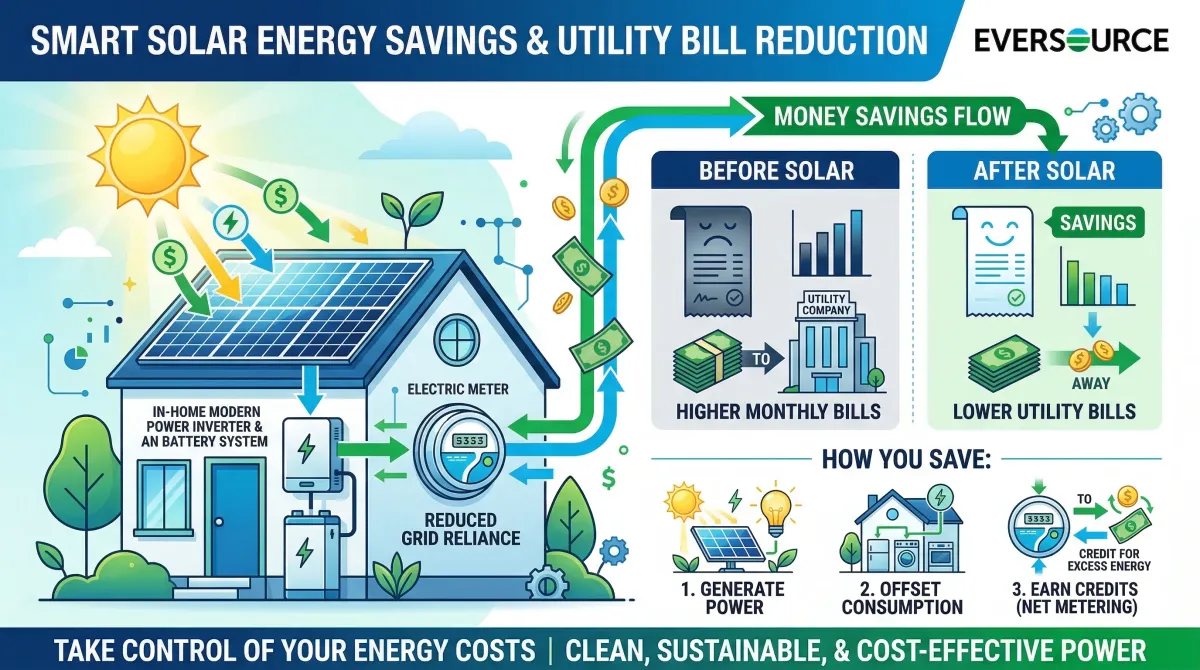
Income-eligible Eversource customers can stack multiple programs for maximum solar savings.
If you rent, live in an apartment, or have a roof that is not suitable for panels, community solar is your best path to solar savings. You subscribe to a share of a local solar farm and receive bill credits directly on your Eversource statement.
No panels on your roof, no permits, no construction
Guaranteed bill credits reduce your monthly Eversource bill
Most plans allow you to cancel with 30-90 days notice
Income-eligible customers are prioritized in Massachusetts community solar programs. At Eversource’s rate of $0.38/kWh, even a 15% bill credit translates to meaningful savings -- roughly $50-80 per month for average households.
Before going solar, income-eligible Eversource customers should take advantage of Mass Save weatherization. The program provides free insulation, air sealing, and no-cost home energy assessments for qualifying households. Reducing your energy waste first means you need a smaller (cheaper) solar system to offset your bill.
A certified technician evaluates your home's energy use, identifies air leaks, and recommends improvements -- all at no cost.
Income-eligible households receive 100% coverage for attic, wall, and basement insulation plus air sealing. No co-pay required.
Enhanced rebates on heat pump water heaters, efficient HVAC systems, and smart thermostats help you reduce electricity demand further.
After weatherization, your reduced energy usage means a smaller, cheaper solar system covers more (or all) of your remaining bill.
Eversource’s ConnectedSolutions program pays you to share stored battery energy during peak demand events. This is available to all Eversource customers with a qualifying battery, regardless of income level -- but it stacks powerfully with income-eligible solar benefits.
Summer Rate
$275/kW
Dispatched June-September
Winter Rate
$50/kW
Dispatched December-March
A 10 kWh battery with 5 kW output earns roughly $1,625/year ($1,375 summer + $250 winter). Combined with SMART 3.0 low-income payments and net metering credits, this creates three distinct revenue streams from a single solar-plus-battery system.
The residential solar tax credit (Section 25D) expired at the end of 2025 -- homeowners who buy systems outright receive $0 in federal tax credits. However, the commercial ITC (Section 48E) remains available for third-party-owned (TPO) systems through at least mid-2026.
Here is what matters for income-eligible households: when a TPO financing company installs solar on a qualifying low-income property, the company can claim a 10-20% low-income adder on top of the 30% base ITC. That larger credit often translates to lower lease/PPA rates for the homeowner, making TPO solar especially attractive for income-eligible Eversource customers.
Regardless of your income level, Massachusetts provides two important tax exemptions for solar installations that remain fully in effect in 2026:
Solar panels are exempt from property tax assessments for 20 years. Your home value increases but your property taxes do not. This applies to all Massachusetts homeowners.
Solar equipment and installation are exempt from the 6.25% state sales tax. On a $24,000 system, that saves roughly $1,500 at the point of purchase.
Review the AMI thresholds above or confirm you participate in a qualifying assistance program (SNAP, MassHealth, LIHEAP, fuel assistance).
Call Eversource at 1-866-527-7283 or visit MassSave.com to schedule a free home energy assessment. Get insulation and air sealing done first.
Request quotes from SMART-approved installers. Ask specifically about income-eligible pricing and the $0.06/kWh SMART low-income rate.
If rooftop is not an option, contact community solar providers serving Eversource territory. Income-eligible customers are prioritized for enrollment.
If you add a battery, register with Eversource's ConnectedSolutions program to earn $275/kW summer + $50/kW winter demand response payments.
Most enhanced programs use Area Median Income (AMI) thresholds. The SMART 3.0 low-income adder requires household income at or below 60% AMI. Standard income-eligible programs generally use 80% AMI. For a family of four in the Boston metro, 60% AMI is roughly $72,500 and 80% AMI is roughly $96,700. Eligibility can also be established through participation in programs like SNAP, MassHealth, or LIHEAP.
Yes. Community solar is specifically designed for renters and anyone who cannot install rooftop panels. Income-eligible Eversource customers enrolled in community solar typically receive guaranteed bill credits of 15-20%, with no upfront cost, no installation, and no long-term commitment required. You simply sign up and receive a lower electric bill.
The SMART 3.0 low-income rate is $0.06/kWh, paid on top of net metering credits for 20 years. For a typical 8 kW system producing about 9,600 kWh per year, that is an extra $576 annually or $11,520 over the full 20-year SMART term. This is double the standard residential SMART rate of $0.03/kWh.
No. The residential solar Investment Tax Credit (Section 25D) expired on December 31, 2025. Homeowners who purchase solar systems in 2026 receive $0 in federal tax credits. However, third-party-owned (TPO) systems installed by financing companies may still benefit from the commercial ITC (Section 48E), which can include a 10-20% low-income adder. This is why leases and PPAs from TPO providers may offer especially competitive rates for income-eligible households.
It depends on the program. Rooftop solar installations generally require homeownership. However, community solar, ConnectedSolutions (battery demand response), and Mass Save weatherization are all available to renters. Community solar is the most accessible path for renters who want to reduce their electricity costs through solar energy.
Answer a few quick questions about your Eversource account and household to see which programs you can stack for maximum savings.
Check Your Eligibility