Loading NuWatt Energy...

We use your location to provide localized solar offers and incentives.
We serve MA, NH, CT, RI, ME, VT, NJ, PA, and TX
Loading NuWatt Energy...
NuWatt designs, installs, and manages solar, battery, heat pump, and EV charger systems across 9 states. One company, one warranty, one point of contact.
Get a Free QuoteThat cloud of steam from your outdoor unit is not a fire, a malfunction, or a reason to panic. It is the defrost cycle doing exactly what it is designed to do. Here is how it works in Massachusetts winters.
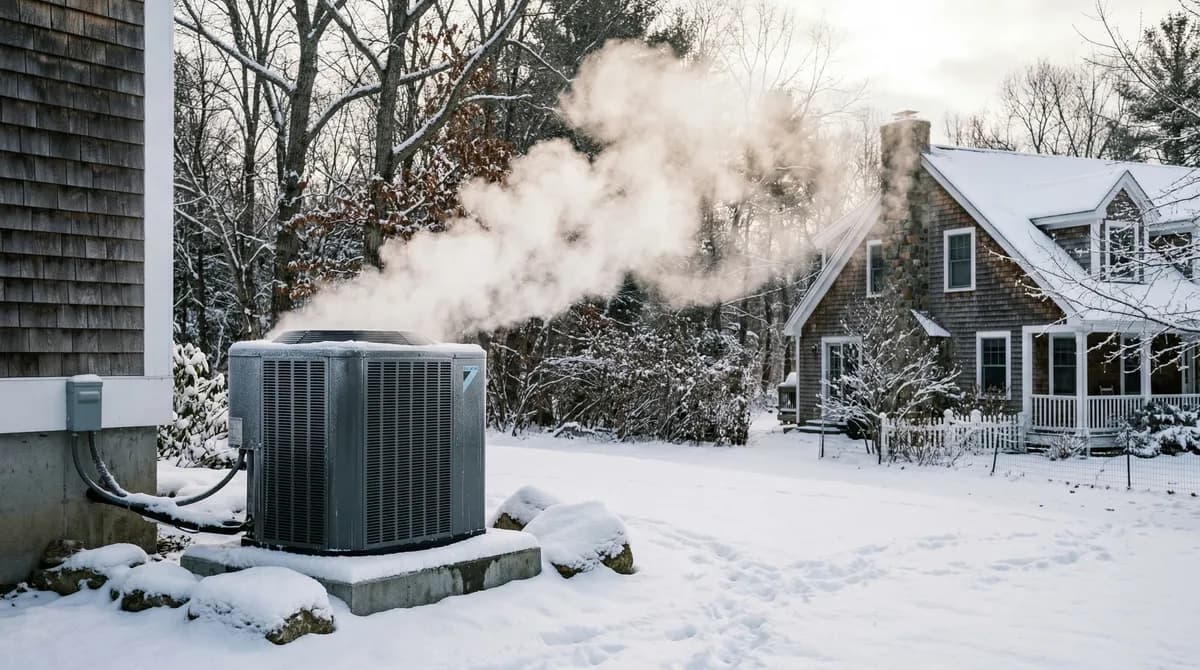
If you see steam, water vapor, or a mist cloud coming from your outdoor heat pump unit during cold weather, your system is working correctly. This is the defrost cycle — an automated process where the heat pump briefly reverses operation to melt frost that builds up on the outdoor coil. It happens every 30-90 minutes in cold weather and lasts 2-10 minutes. No action is needed.
Scroll down to learn exactly how the defrost cycle works, what to expect during Massachusetts winters, and the specific warning signs that indicate a real problem versus normal operation.
Understanding why frost is inevitable helps you know why the defrost cycle exists.
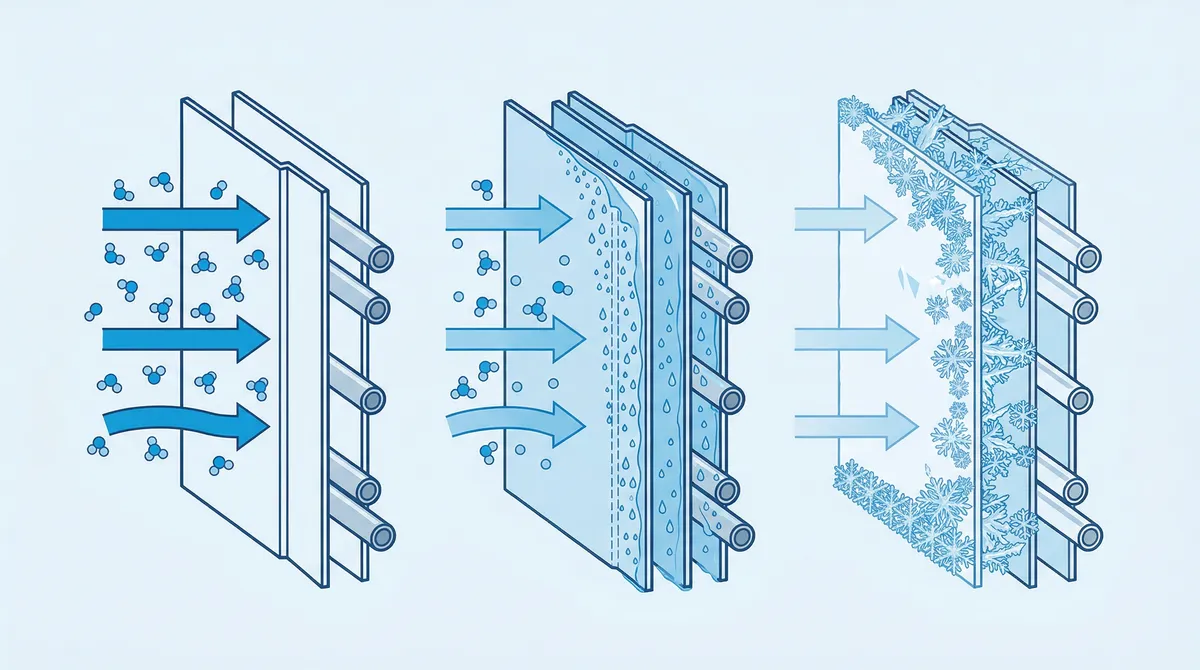
A heat pump works by extracting heat from outdoor air — even when it is cold. The outdoor coil (evaporator in heating mode) operates at a temperature below the outdoor air temperature to absorb heat energy from the air passing over it.
When outdoor temperatures drop below about 40 degrees F, the coil surface temperature drops below the dew point of the surrounding air. Moisture in the air condenses on the coil fins — just like water droplets forming on a cold glass in summer.
When the coil surface is below 32 degrees F, that condensed moisture freezes into frost or ice. The frost layer acts as insulation, reducing the coil's ability to absorb heat from the air. Left unchecked, ice would completely block airflow through the coil, and the heat pump would lose all heating capacity.
This is why every heat pump has a defrost system — it is not optional. Without defrost, no air-source heat pump could operate in Massachusetts winters.
The entire process takes 2-10 minutes and is fully automated. Here is what happens inside your heat pump.
Sensors on the outdoor coil monitor temperature and pressure. When frost accumulates enough to reduce airflow and efficiency, the defrost board triggers the cycle.
Most systems use a combination of a coil temperature sensor (typically triggers below 30-32 degrees F) and a timer. Some advanced units use demand-defrost — they only run defrost when sensors confirm ice is actually present, which saves energy.
The heat pump temporarily switches to cooling mode. Hot refrigerant gas flows through the outdoor coil instead of the indoor coil, melting ice from the inside out.
This is why the outdoor fan stops during defrost — the system needs the hot gas to melt ice, not blow cold air across it. The reversing valve is a solenoid-operated component that redirects refrigerant flow in seconds.
Hot refrigerant rapidly melts the frost layer. The resulting water evaporates on contact with the warm coil, creating a visible cloud of steam or water vapor.
This is the "scary" part that alarms homeowners. The steam cloud can be dramatic — especially in below-freezing air where the vapor condenses immediately. You may also hear hissing or gurgling sounds as refrigerant flows in the reversed direction. This is all normal.
While in defrost, the outdoor unit cannot heat your home. Most systems briefly activate backup electric resistance heat strips or a gas furnace to maintain indoor comfort.
This "auxiliary heat" activation is automatic and temporary — typically 2-10 minutes. Your thermostat may briefly display "Aux" or "EM Heat." If this only happens during defrost cycles, it is completely normal. If aux heat runs constantly for 30+ minutes, that indicates a separate issue.
Once ice is cleared, the reversing valve switches back to heating mode, the outdoor fan restarts, and normal operation resumes. The whole process takes 2-10 minutes.
The system ramps back up to full heating output within 1-2 minutes after defrost ends. In cold, humid Massachusetts conditions, this cycle repeats every 30-90 minutes. More frequent in wet snow or freezing rain, less frequent in dry cold.
All of these observations are normal during a defrost cycle. No action is required.
Hot refrigerant melts ice on the coil. The resulting water instantly evaporates in cold air, creating a visible steam cloud. Can look alarming but is completely normal.
The fan is intentionally stopped during defrost so the hot gas can melt ice efficiently rather than blowing cold air across the coil.
Melted ice has to go somewhere. Water dripping from the bottom of the unit during or just after defrost is expected. Ensure the drain path is clear so water does not pool and refreeze.
In defrost mode, the system reverses to "cooling" briefly. Your indoor unit may blow air that is not as warm for 2-10 minutes. Backup heat usually compensates, but you may notice a slight dip.
Refrigerant changing flow direction through the reversing valve makes audible sounds. This is normal during the transition in and out of defrost mode.
Backup electric resistance heat kicks in temporarily to keep your home warm while the outdoor unit is in defrost. If this clears within 10-15 minutes, it is normal.
How often your heat pump defrosts depends on temperature and humidity — not on a fixed timer in most modern systems.
| Weather Condition | Defrost Frequency | Cycle Duration | Normal? |
|---|---|---|---|
| Dry cold (below 15 degrees F) | Every 60-120 min | 2-5 min | Normal |
| Moderate cold (15-32 degrees F) | Every 30-60 min | 3-7 min | Normal |
| Wet snow (30-40 degrees F) | Every 20-40 min | 5-10 min | Normal |
| Freezing rain / ice storm | Every 15-30 min | 5-10 min | Normal |
| Above 40 degrees F | Rarely / never | N/A | Normal |
| Any condition — constant (10-15 min intervals) | Continuous | 10+ min each | Call a Pro |
These signs indicate a defrost system failure, refrigerant issue, or mechanical problem. Do not ignore them — they get worse and more expensive over time.
Likely cause: Failed defrost board, bad defrost sensor/thermostat, or stuck reversing valve. The system cannot initiate defrost, so ice accumulates.
Action: Call your HVAC installer within 24 hours. Continued operation with a fully iced unit damages the compressor.
Likely cause: Possible low refrigerant charge — the system does not have enough hot gas to melt ice quickly. Can also indicate a restricted metering device or faulty defrost termination sensor.
Action: Schedule a service call within 1-2 days. A technician needs to check refrigerant levels and defrost components.
Likely cause: Blocked airflow (leaves, snow, debris around unit), dirty outdoor coil, or defrost timer/board malfunction causing premature triggering.
Action: First, clear all debris and ensure 18 inches of clearance around the unit. If the problem persists after clearing, call a technician.
Likely cause: This indicates low refrigerant, a restriction in the system, or severely reduced airflow from a clogged filter. Indoor icing is never related to the normal defrost cycle.
Action: Turn off the system and call a technician immediately. Indoor icing can cause water damage when it melts.
Likely cause: Defrost control board failure, disconnected or broken coil temperature sensor, or electrical issue preventing the reversing valve from switching.
Action: Call for service within 24-48 hours. A system running without defrost loses efficiency rapidly and risks compressor damage.
Likely cause: The system may be stuck in defrost or the outdoor unit is not returning to heating mode properly. Can also mean the heat pump itself is undersized or has low refrigerant.
Action: If aux heat runs for more than 30 consecutive minutes outside of a defrost cycle, call your installer. You are paying electric resistance rates.
If your defrost cycle is not working correctly, here are the five most common culprits — from cheapest to most expensive to fix.
A refrigerant leak reduces the amount of hot gas available for defrost. The system cannot generate enough heat to melt ice quickly, leading to prolonged or ineffective defrost cycles.
Fix: Technician performs a leak search, repairs the leak, and recharges the system. Refrigerant is not "used up" — if levels are low, there is a leak.
The electronic board that manages defrost timing and initiation can fail. When it does, the system either never enters defrost (ice accumulates) or gets stuck in defrost (constant aux heat).
Fix: Board replacement — typically $150-400 for parts, plus labor. Brand-specific boards (Mitsubishi, Fujitsu, Daikin) must match the unit model.
A temperature sensor mounted on the outdoor coil tells the system when ice has formed and when it has melted. A faulty sensor gives false readings, causing defrost to run too often, too long, or not at all.
Fix: Sensor replacement — usually $50-150 for the part. Requires a technician to verify with a multimeter and calibrate.
If the outdoor unit cannot pull air through the coil, ice forms faster than defrost can remove it. Leaves packed in the base pan, snow drifts, and even tall grass can cause this.
Fix: Clear all debris. Maintain 18 inches of clearance on all sides. After storms, brush snow away from the unit. This is the most common — and cheapest — fix.
The reversing valve switches refrigerant flow between heating and cooling (defrost) modes. If it sticks or the solenoid coil fails, the system cannot switch to defrost mode at all.
Fix: Reversing valve replacement is a major repair — $300-800+ for parts and labor. Often worth it on newer systems, but on units older than 12-15 years, consider full replacement.
Massachusetts weather presents unique challenges for heat pump defrost. Here is what to expect for each winter condition.
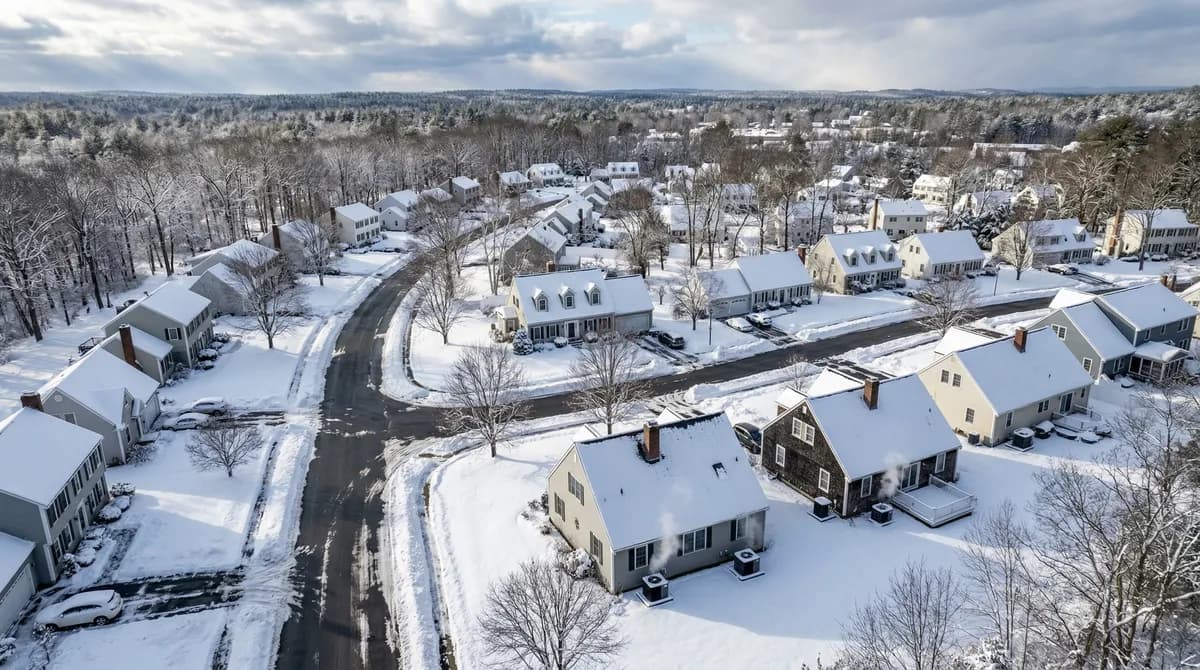
Heavy wet snow can pack around and bury the outdoor unit within hours. Snow load on top of the unit can block the fan discharge. Defrost cycles increase dramatically.
What to do: Clear snow from the top and all sides of the unit during and after the storm. Do not let snow reach the top of the unit. Use a soft broom — never a shovel near the coil fins.
Freezing rain creates a solid ice shell on the outdoor coil that is much harder to melt than frost. Defrost cycles run longer and more frequently. This is the hardest condition for any heat pump.
What to do: In severe icing, the system may struggle. If ice completely encases the unit and defrost cannot clear it within 30 minutes, temporarily turn the unit off and pour lukewarm (not hot) water over the coil. Restart once ice is cleared.
Temperatures just above freezing with high humidity create the MOST frost buildup. The air holds more moisture than at 10 degrees F, so the outdoor coil accumulates ice faster.
What to do: Expect more frequent defrost cycles (every 20-40 minutes) during these conditions. This is normal and not a sign of malfunction. Energy use will be slightly higher during these periods.
Cold but dry air produces less frost on the coil. Defrost cycles are less frequent — every 60-120 minutes. However, the heat pump works harder to extract heat from very cold air.
What to do: Less defrost maintenance needed. Main concern shifts from ice to heat output — the system may use more backup heat in extreme cold. Ensure backup heating (resistance strips or gas) is functional.
Coastal Massachusetts combines cold, high humidity, and salt exposure. Salt accelerates coil corrosion and can foul the outdoor fins, reducing airflow and worsening ice buildup.
What to do: Rinse the outdoor coil with fresh water 2-3 times per winter if you are within 1 mile of the coast. Salt buildup is the hidden killer of coastal heat pump systems. Consider units with coated coils (Blue Fin or Gold Fin).
Outdoor coil fins are thin aluminum — easily bent or punctured. Damaged fins block airflow permanently and require expensive coil replacement ($500-1,500+).
Thermal shock can crack the copper tubing or loosen brazed joints, causing a refrigerant leak. Use lukewarm water only if needed — body temperature or slightly above.
The unit MUST breathe. Covers trap moisture and block airflow, causing ice to form faster. They also prevent the defrost cycle from working. Heat pump outdoor units are engineered for outdoor exposure.
Minimum 18 inches of clearance is required on all sides, 24 inches preferred. A tight fence or enclosure restricts airflow and makes ice problems worse.
The defrost cycle is a normal, automated process. Interrupting it by power-cycling the unit prevents ice from being cleared and can confuse the defrost control board.
Clear plants, debris, and stored items. In winter, clear snow after every storm. The unit needs unrestricted airflow to operate efficiently and defrost properly.
Use a soft broom or your hands to brush snow off the top and sides. Do not let snow pile above the unit height. If snow drifts against the unit, push it back at least 2 feet.
Ice melt from defrost needs to drain away from the base. If the unit sits in a low spot where water pools and refreezes, it creates a permanent ice dam. Consider elevating the unit on a stand (recommended in MA — 4-6 inches minimum above expected snow line).
The base pan collects meltwater during defrost. If it clogs with leaves or ice, water backs up into the unit. A quick visual check after storms prevents this.
A clogged indoor filter restricts airflow, which can cause the system to work harder and trigger more frequent defrost cycles. Clean or replace filters every 1-3 months.
In Massachusetts, mounting the outdoor unit 4-6 inches above grade (or above expected snow depth) is best practice. This prevents ground-level ice dams and snow burial. Many installers do this by default in New England.
Your thermostat showing "Aux" or "EM Heat" during defrost is expected. Here is how to tell when it crosses from normal to concerning.
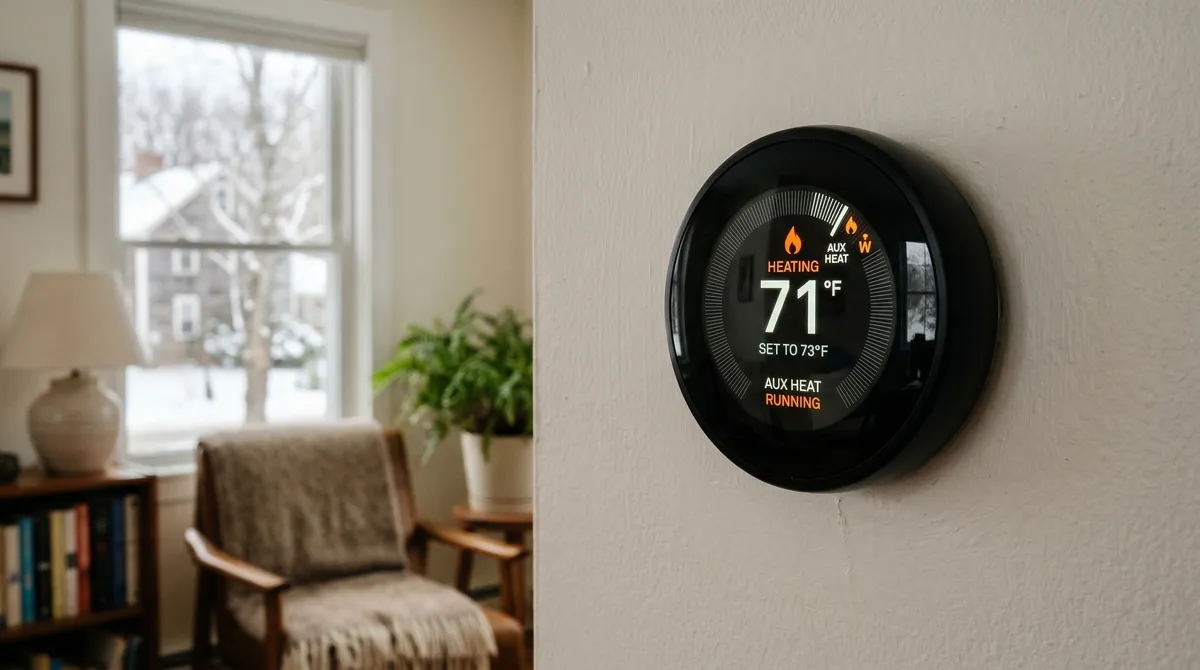
Cost impact: Auxiliary electric resistance heat costs 2-3x more per hour than heat pump operation. A system stuck on aux heat at Massachusetts electricity rates ($0.38–$0.42/kWh) can add $250-500/month to your bill compared to normal heat pump operation. If you suspect constant aux heat, check your thermostat and call your installer.
If your heat pump outdoor unit is fully iced over and defrost is not clearing it, NuWatt Energy can diagnose the issue. We service Mitsubishi, Fujitsu, Daikin, and all major brands across Massachusetts.