Loading NuWatt Energy...

We use your location to provide localized solar offers and incentives.
We serve MA, NH, CT, RI, ME, VT, NJ, PA, and TX
Loading NuWatt Energy...
NuWatt designs, installs, and manages solar, battery, heat pump, and EV charger systems across 9 states. One company, one warranty, one point of contact.
Get a Free Quote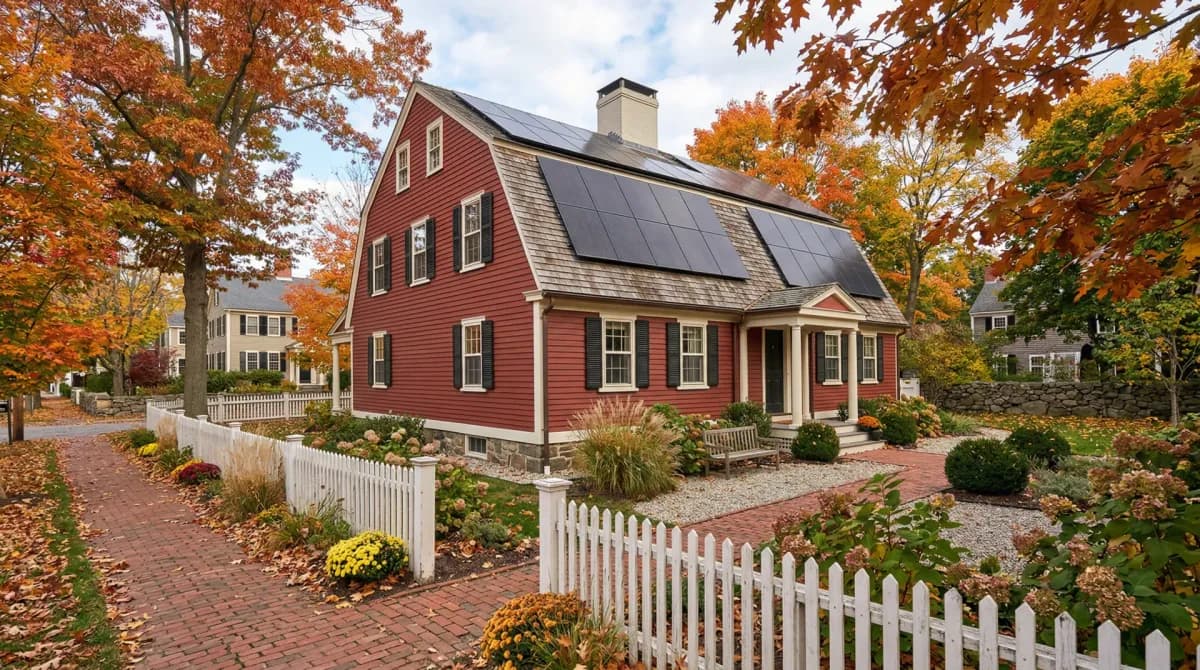
Yes, you can install solar panels on your historic home. Massachusetts law protects your right to solar energy — even in the most architecturally regulated neighborhoods. Here is exactly how the HDC approval process works and the design strategies that get approved.
2026 Reality: The 30% federal solar tax credit (Section 25D) expired December 31, 2025. All cost figures on this page reflect $0 federal credit for homeowner cash/loan purchases. Full details
Massachusetts law protects your right to solar energy, even in historic districts.
Massachusetts General Laws Chapter 40C allows Historic District Commissions (HDCs) to regulate the appearance of solar installations — but they cannot prohibit solar. The Solar Access Law (Chapter 40A, Section 3) further limits any municipal body from unreasonably restricting solar energy systems. The key is working with your HDC early, understanding what they can and cannot require, and designing your system to minimize visual impact. The vast majority of well-prepared applications in Massachusetts historic districts are approved.
MA Historic Districts
200+
Local districts statewide
Approval Rate
~90%
For well-prepared applications
Added Cost
$500-2K
For HDC-compliant design
Timeline
6-12 wks
From HDC contact to approval
No zoning ordinance or bylaw in Massachusetts may prohibit or unreasonably regulate the installation of solar energy systems. This applies to municipalities, HDCs, and planning boards alike. Any restriction must be narrowly tailored to protect a legitimate public interest (like historic preservation) without effectively banning solar.
Chapter 40C gives HDCs authority to review changes to the exterior of buildings visible from public ways. This includes solar panels. However, the commission must balance historic preservation with the property owner's rights, including the right to use solar energy. A blanket ban on solar panels is not consistent with this balance and can be challenged through the Attorney General or the courts.
Not all historic designations are equal. Understanding the difference is the first step.
Check your property deed, contact your town clerk, or search your town's assessor database. You can also search the Massachusetts Historical Commission's online database (MACRIS) at mhc-macris.net. If your property shows a local historic district designation under Chapter 40C, you will need HDC approval for exterior solar. If it only shows National Register listing, no HDC review is required.
Understanding the boundaries of HDC authority is critical to a successful application.
Require panels to be installed on roof planes not visible from the public way
Specify mounting methods (flush-mount vs. tilted rack)
Require all-black panels and frames to reduce visual contrast
Request color-matched conduit and wiring concealment
Require a visibility analysis or mock-up before approval
Set maximum array size visible from the street
Outright prohibit solar panel installation on your property
Require setbacks so extreme that solar becomes economically impractical
Override the MA Solar Access Law (Chapter 40A, Section 3)
Deny an application without a public hearing and stated reasons
Impose conditions that reduce system output by more than 10% (AG guideline)
Block ground-mount systems that are not visible from the public way
The Massachusetts Attorney General's office has the authority to review HDC decisions that may unreasonably restrict solar installations. In past cases, the AG has intervened when HDCs imposed conditions that reduced system output by more than approximately 10% or effectively made solar economically impractical. If you believe your HDC is overstepping its authority, you can file a complaint with the AG's Consumer Protection Division.
Follow these six steps to navigate the HDC process efficiently and maximize your chances of approval.
Check whether your property is in a local historic district (regulated by an HDC under Chapter 40C) or only listed on the National Register of Historic Places. National Register listing alone does not restrict solar — only local districts have regulatory authority. Your town clerk or assessor can confirm your status.
Pro tip: Search your town's name plus "historic district commission" online, or call your building department.
Many Massachusetts HDCs have adopted specific solar guidelines since 2015. Some towns — like Cambridge, Somerville, and Salem — have streamlined review processes for solar. Others have no written solar policy, meaning the HDC reviews each application on a case-by-case basis. Request a copy of your HDC's design guidelines before you begin.
Pro tip: If your town has no solar-specific guidelines, that can work in your favor — there are fewer formal requirements to meet.
This is the single most important step. Most HDCs allow (and encourage) informal pre-application consultations. Bring preliminary roof plans, photos of proposed panel placement, and examples of panel aesthetics (all-black modules, flush-mount systems). This meeting lets you understand the commission's priorities before you invest in a formal application.
Pro tip: Bring your installer to this meeting. An experienced installer who has worked in historic districts can address technical questions on the spot.
A complete HDC application for solar typically requires: a site plan showing panel placement, manufacturer specs for panels and mounting hardware, a visibility analysis (photos from key public vantage points showing where panels will and will not be visible), color samples for panels and racking, and a written project narrative explaining how your design respects the historic character of the neighborhood.
Pro tip: Include a "before and after" photo simulation. HDC members are visual thinkers — showing them exactly what the installation will look like from the street dramatically increases approval rates.
HDC hearings are open to the public. You (or your installer) will present the project. Commissioners may ask questions or request modifications. Common conditions include shifting panels to a less visible roof plane, using specific panel colors, or adding screening elements. Most well-prepared applications are approved in one hearing — typically a 30-60 day process from submission to decision.
Pro tip: Be flexible on minor modifications. If the HDC asks you to shift panels from the front roof to the rear, agreeing readily often gets you a faster approval with fewer conditions.
If the HDC denies your application, you have several options. First, request a written explanation of the denial reasons and resubmit with modifications that address each concern. Second, appeal to the Massachusetts Attorney General's office — the AG has intervened in cases where HDCs imposed unreasonable restrictions on solar access. Third, file an appeal in Superior Court under Chapter 40C, Section 12A, arguing that the HDC's decision is unreasonable.
Pro tip: The MA AG's office has sided with homeowners in multiple HDC disputes. A letter from the AG citing the Solar Access Law often resolves the issue without litigation.
These five approaches are proven to work across Massachusetts historic districts — from progressive Cambridge to strict Nantucket.
Install panels on the rear roof plane, which is not visible from the public way. This is the easiest path to HDC approval and avoids most aesthetic objections. In Massachusetts, south-facing roofs produce the most energy, but east and west exposures still generate 75-85% of maximum output. If your rear roof faces east or west, a slightly larger array compensates for the reduced per-panel production.
Standard solar panels have silver frames and visible grid lines that can stand out against dark roofing. All-black panels (black frames, black backsheet, dark cells) blend significantly better with slate, asphalt, and dark roofing materials. Manufacturers like REC, Silfab, and Canadian Solar all offer all-black modules at a modest premium.
Standard roof-mount solar uses racking that tilts panels at an angle for optimal sun exposure, creating a visible profile from the street. Flush-mount systems attach panels flat against the roof surface, reducing visual impact to nearly zero from ground level. Production loss is minimal on roofs already pitched at 25-45 degrees — which covers most New England construction.
If your historic roof is the issue — whether visibility, structural limitations, or an HDC that will not approve roof-mounted panels — a ground-mount system in your backyard is an excellent alternative. Ground-mounts are typically not regulated by HDCs if they are not visible from the public way. They also allow optimal tilt angle and easier maintenance.
For the most architecturally sensitive properties — think slate roofs on Beacon Hill or cedar shingle homes on Nantucket — building-integrated photovoltaics replace roofing material entirely. Solar roof tiles (like GAF Energy Timberline Solar) mimic traditional roofing while generating electricity. BIPV costs more per watt but may be the only option for the strictest HDCs.
Real examples of how different MA districts handle solar applications — from the most permissive to the most restrictive.
Strict — but solar installed successfully
One of the most architecturally significant districts in the country. The Beacon Hill Architectural Commission has approved rear-roof installations and BIPV on a case-by-case basis. Front-facing panels are effectively prohibited. All-black, flush-mount systems on non-street-facing roof planes have been approved.
Progressive — many successful installations
Salem's HDC has been among the most solar-friendly in Massachusetts. The city adopted solar-specific guidelines in 2018 and has approved dozens of residential installations. Rear and side-facing roof panels are routinely approved. All-black panels are strongly recommended but not always required.
Progressive — streamlined process
Cambridge Historical Commission has a dedicated solar review process. The city's climate goals have influenced HDC policy toward faster approvals. Flush-mount, all-black systems on any roof plane are generally approved. Ground-mount systems in rear yards are approved without HDC review in most cases.
Moderate — case-by-case review
Concord's Historic Districts Commission reviews each solar application individually. The town has multiple districts (center, main street, etc.) with different sensitivities. Rear-facing installations are typically approved. Street-visible installations require detailed visibility analysis and all-black panel systems.
Strictest in the state — but solar still possible
Nantucket's Historic District Commission covers the entire island and is the most restrictive in Massachusetts. However, even Nantucket has approved solar installations — primarily rear-roof, flush-mount, all-black systems and ground-mount arrays screened by landscaping. BIPV (solar shingles) that match cedar shake aesthetics have the highest approval rate on Nantucket.
Moderate — design guidelines available
Newburyport's HDC has published design standards that specifically address solar installations. The commission generally approves rear-facing and non-street-visible systems with all-black modules. The established guidelines make the process more predictable than towns without written solar policies.
HDC-compliant design typically adds $500-2,000 to a standard residential solar installation. Here is the breakdown.
| Item | Cost Range | Notes |
|---|---|---|
| All-black panel upgrade | $330 - $770 | $0.03-0.07/W premium for 11kW system |
| Flush-mount racking | $0 - $300 | Minimal premium; standard on most pitched roofs |
| HDC application fee | $0 - $150 | Varies by town; many charge nothing |
| Visibility analysis/photo simulation | $100 - $500 | Professional rendering if required |
| Design consultation (architect) | $200 - $800 | Only if HDC requires professional plans |
| Color-matched conduit/wiring | $100 - $400 | Concealment of visible wiring runs |
| Ground-mount alternative | $1,650 - $3,300 | $0.15-0.30/W premium for 11kW system |
| BIPV (solar shingles) | $14,740 - $36,740 | $4.50-6.50/W vs. $3.16/W standard — replaces roofing |
Most HDC-compliant installations add $500-2,000 for all-black panels, application fees, and visibility analysis. Ground-mount and BIPV are alternative approaches for difficult cases. All costs based on an 11 kW system at Massachusetts average pricing.
An extra $500-2,000 on a $34,760 system represents a 1.4-5.8% increase. Over 25 years, a typical Massachusetts solar system saves approximately $147,000 in electricity costs and SMART income. The HDC premium adds roughly 1-3 months to your payback period — from approximately 7.8 years to 8.0 years. The long-term financial case for solar in a historic district is virtually identical to a standard installation.
Use our calculator to see your specific numbers — based on your utility, system size, and financing choice. All calculations reflect $0 federal ITC. For historic district installations, add $500-2,000 for HDC-compliant design elements.
Estimate your solar return on investment with SMART income, net metering credits, ConnectedSolutions, and MA tax benefits.
Federal Residential Solar Tax Credit (Section 25D) Expired
Homeowners who purchase solar with cash or a loan receive $0 in federal tax credits. Section 25D expired December 31, 2025.
Eastern MA (Boston, South Shore, Cape Cod, MetroWest, Western MA)
Electric Rate
$0.36/kWh
Net Metering
1:1 retail credit (Class I ≤25 kW)
SMART 3.0 Rate
$0.03/kWh
Interconnection
2-4 weeks typical
20-year exemption — solar adds $0 to your property tax
Payback Period
5.7
years
25-Year Savings
$148,618
total
Monthly Benefit
$461
per month
Estimates based on average 2026 MA solar pricing, SMART 3.0 $0.03/kWh residential flat rate, 1:1 retail net metering, 6.25% sales tax exemption, 20-year property tax exemption, and 15% state tax credit (max $1,000). Section 25D residential ITC expired Dec 31, 2025 — $0 federal tax credit for cash/loan purchases.
Common questions about installing solar in Massachusetts historic districts.
In most Massachusetts historic districts, ground-mount solar systems that are not visible from the public way do not require HDC approval. However, rules vary by town. Some HDCs regulate all exterior changes, including backyard structures. Check your specific town's Chapter 40C bylaws or call your HDC before proceeding. If your ground-mount is screened by existing fencing, landscaping, or structures, you have a strong case that HDC review is not required.
National Register listing alone does not give any local commission the power to regulate your solar installation. The National Register is a federal designation that only restricts federally funded projects. If your property is on the National Register but NOT in a local historic district established under Chapter 40C, you can install solar without HDC review — you only need standard building and electrical permits. Many homeowners in National Register districts do not realize this distinction.
Massachusetts law significantly limits HOA authority over solar. Chapter 40A, Section 3 (the Solar Access Law) states that no zoning ordinance or bylaw shall prohibit or unreasonably regulate the installation of solar energy systems. While this primarily targets municipal regulations, Massachusetts courts have applied its principles broadly. Your HOA may impose reasonable aesthetic requirements (all-black panels, specific mounting), but it cannot effectively prohibit solar or impose conditions that make installation economically impractical.
Building-integrated photovoltaics (BIPV) like GAF Energy Timberline Solar or CertainTeed Solstice are the most aesthetically compatible option for strict historic districts. Solar shingles integrate directly into your roof, replacing standard roofing material. They look similar to architectural asphalt shingles from the street. The tradeoff: BIPV costs $4.50-6.50 per watt compared to $3.16/W for standard panels. However, since BIPV replaces your roofing, you offset the cost of a roof replacement ($8,000-15,000 for a typical home). BIPV has the highest HDC approval rate across all Massachusetts historic districts.
The typical timeline for HDC solar approval in Massachusetts is 4-8 weeks from application submission to decision. This includes: 1-2 weeks for administrative review and scheduling, a public hearing (most HDCs meet monthly), and a decision issued at or shortly after the hearing. If you include the pre-application meeting (strongly recommended), add 2-4 weeks. If modifications are requested, the process may extend another 2-4 weeks for resubmission. In total, plan for 6-12 weeks from first contact with the HDC to final approval.
If denied, you have three paths: (1) Revise and resubmit — address the specific concerns cited in the denial. This is the fastest and cheapest option. (2) Contact the Massachusetts Attorney General's office — the AG has intervened in HDC disputes where solar access was unreasonably restricted. The AG can issue an advisory opinion or take enforcement action. (3) File a Superior Court appeal under Chapter 40C, Section 12A. The court reviews whether the HDC's decision was arbitrary, capricious, or exceeded its authority. Legal action typically costs $5,000-15,000 but has a strong success rate when the HDC imposed objectively unreasonable conditions.
No. Multiple studies — including research from the Lawrence Berkeley National Laboratory — show that solar panels increase home values by approximately $15,000-25,000 for a typical residential system, regardless of whether the home is in a historic district. Massachusetts law provides a 20-year property tax exemption for solar, meaning your property taxes do not increase from the added value. In historic districts specifically, a well-designed solar installation (rear-facing, all-black, flush-mount) has no documented negative impact on property values or neighborhood character assessments.
Yes. Several Massachusetts solar installers have specific experience with HDC applications. When choosing an installer for a historic district project, ask: How many HDC applications have you completed? What is your approval rate? Can you provide references from historic district customers? Do you handle the HDC application process? An experienced installer will prepare your visibility analysis, attend the HDC hearing with you, and know which design strategies work best for your specific commission. NuWatt has completed installations in multiple Massachusetts historic districts and handles the full HDC application process.
Dive deeper into specific topics with our other MA solar guides.
Detailed cost breakdown by system size, panel tier, and city.
Read guideHonest pricing with $0 federal credit. What you actually pay.
Read guideProperty tax and sales tax exemptions for solar in Massachusetts.
Read guideCompare financing options with real 2026 numbers.
Read guideHow SMART works, current rates, adders, and enrollment.
Read guideNuWatt has installed solar in multiple Massachusetts historic districts. We prepare your HDC application, attend the hearing, and design systems that get approved the first time. Get a free assessment for your historic property.