Loading NuWatt Energy...

We use your location to provide localized solar offers and incentives.
We serve MA, NH, CT, RI, ME, VT, NJ, PA, and TX
Loading NuWatt Energy...
NuWatt designs, installs, and manages solar, battery, heat pump, and EV charger systems across 9 states. One company, one warranty, one point of contact.
Get a Free Quote
What homeowners and builders need to know about the Specialized Opt-in Code — solar-ready roofs, heat pump HVAC, EV-ready garages, and the future of Massachusetts construction.
The Specialized Opt-in Code points to two specific HERS Index targets — the residential energy performance benchmark used statewide. The exact target depends on whether the home will use any combustion fuel:
Required when any combustion appliance (gas range, gas fireplace, gas dryer, fuel-fired boiler, etc.) is present. Tighter than HERS 45 because the fuel use itself counts against the score.
The path most builders pick under the Specialized Opt-in Code. No combustion appliances on the gas meter, heat-pump HVAC and water heating, induction cooking. Pairs cleanly with the solar-ready and EV-ready requirements.
Either path also requires a HERS rater on the project, a final blower-door test (1.5 ACH50), and the solar-ready / EV-ready checklist below. Apr 2026 note: HERS rater availability has tightened across the Boston metro — schedule the rough-in inspection at framing, not at finish.
The Massachusetts Specialized Opt-in Code(commonly called the “net-zero-ready code”) is the state's most aggressive building energy code tier. Adopted by 100+ municipalities including Boston, Cambridge, and Brookline, it requires all new residential construction to include:
This adds $5,000-$15,000 to new construction costs but saves $30,000-$60,000+ in lifetime operating costs and increases resale value by 3-8%.
Massachusetts has three tiers of building energy codes. Each municipality chooses which tier to adopt beyond the mandatory base code.
| Feature | Base Building Code | Stretch Energy Code | Specialized Opt-in Code |
|---|---|---|---|
| Also Known As | IECC 2021 / 780 CMR | Appendix RC / 225 CMR 22.00 | Municipal Opt-in / Net-Zero-Ready |
| Applies To | All MA municipalities by default | 300+ municipalities (~90% of new construction) | 100+ municipalities (Boston, Cambridge, Brookline, Newton, etc.) |
| Solar-Ready Roof | Not Required | Not Required | Required |
| Heat Pump Required | Not Required | Not Required | Required |
| EV-Ready Garage | Not Required | Not Required | Required |
| Electrical Panel | 200A minimum | 200A minimum | 200A+ with spare capacity for future loads |
| Insulation | Standard (R-21 walls, R-49 attic) | Enhanced (R-25 walls, R-60 attic) | High-performance (R-30 walls, R-60+ attic) |
| Air Sealing | 3.0 ACH50 | 2.0 ACH50 | 1.5 ACH50 or lower |
IECC 2021 / 780 CMR
All MA municipalities by default
Appendix RC / 225 CMR 22.00
300+ municipalities (~90% of new construction)
Municipal Opt-in / Net-Zero-Ready
100+ municipalities (Boston, Cambridge, Brookline, Newton, etc.)
A net-zero-ready home is designed so that adding solar panels is the only step needed to reach net-zero energy consumption. Every other system is already electrified and optimized.
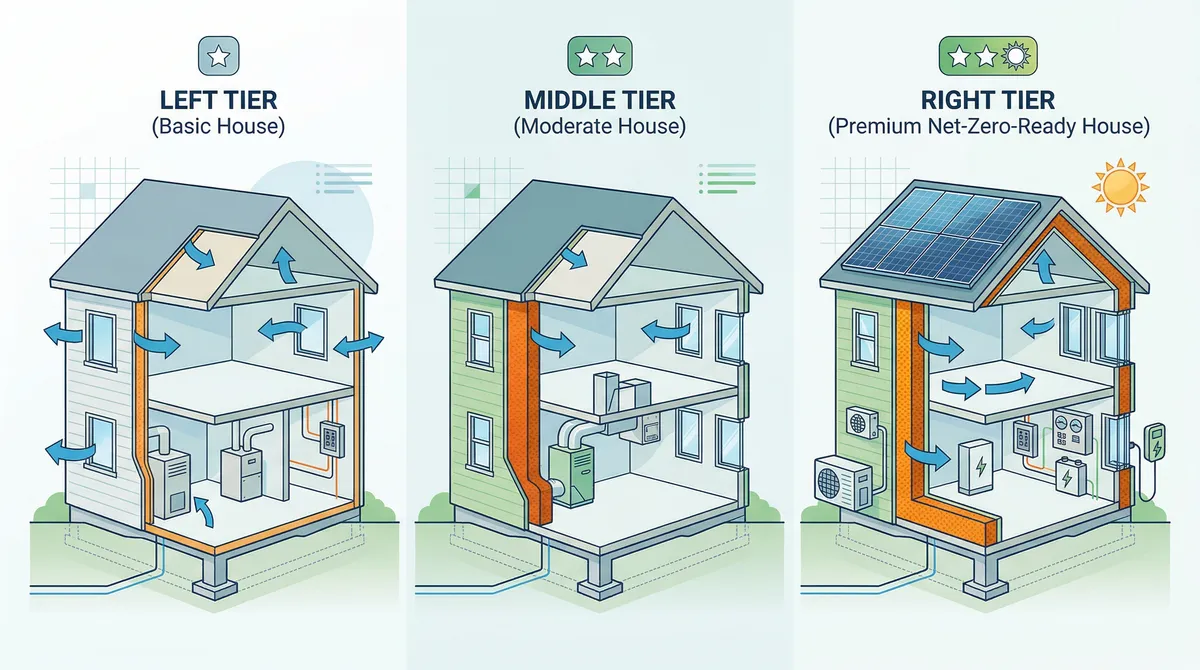
The three tiers of Massachusetts building energy codes, from base to net-zero-ready.
Over 100 Massachusetts municipalities have adopted the Specialized Opt-in Code. Here are some of the largest and most notable.
Largest city, BERDO synergy
Net Zero Action Plan 2035
Early fossil-fuel-free advocate
Climate Action Plan leader
Dense urban electrification
Net Zero by 2050 goal
Sustainable Lexington
Municipal light + green building
Pioneer Valley climate leader
College town, high adoption rate
Municipal light + code
Compact urban development
The full list is maintained by the Massachusetts Department of Energy Resources (DOER). Contact your local building department to confirm which code tier applies to your project. The list is updated regularly as more municipalities vote to adopt.
The Specialized Code adds $5,000-$15,000 to new construction — but every dollar is recovered through lower operating costs, rebates, and higher resale value.
| Upgrade Category | Additional Cost | Lifetime Savings | Notes |
|---|---|---|---|
| Heat Pump HVAC (replaces gas furnace) | $3,000 - $7,000 | $15,000 - $30,000 | Includes both heating and cooling. Mass Save rebates apply. |
| Solar-Ready Roof (conduit, junction box, structural) | $1,500 - $3,000 | $2,000 - $5,000 | Saves $3K-$5K vs. retrofit when solar is later installed. |
| EV-Ready Garage (240V outlet, conduit, panel space) | $500 - $1,500 | $1,000 - $3,000 | Saves $2K-$4K vs. retrofit. The Section 30C credit expired June 30, 2026; wiring EV-ready during construction still avoids costly retrofit. |
| Heat Pump Water Heater (replaces gas tank) | $1,500 - $3,000 | $4,000 - $8,000 | Uses 1/3 the energy of gas. Mass Save offers up to $1,250. |
| Enhanced Insulation & Air Sealing | $2,000 - $4,000 | $8,000 - $15,000 | 25-30% lower heating/cooling bills. Required for 1.5 ACH50. |
| Upgraded Electrical Panel (200A+ with spare capacity) | $500 - $1,500 | Avoids $3,000-$5,000 retrofit | Handles solar, EV, heat pump, and future loads. |
| Total Range | $9,500 - $20,000 | $30,000 - $66,000+ | Gas infrastructure elimination offsets $5K-$10K of added cost |
By going all-electric, builders eliminate $5,000-$10,000 in gas piping, gas meter installation, gas appliance venting, and gas line trenching. This means the true net cost of code compliance is often $0-$5,000 — not the headline $5K-$15K figure.
If you are buying or building in a Specialized Code municipality, solar is the logical next step. The code makes installation faster, cheaper, and more effective.
The Specialized Code mandates heat pump HVAC in all new residential construction. Here is what that means for builders and buyers.
A phase-by-phase guide for builders and contractors working in Specialized Code municipalities.
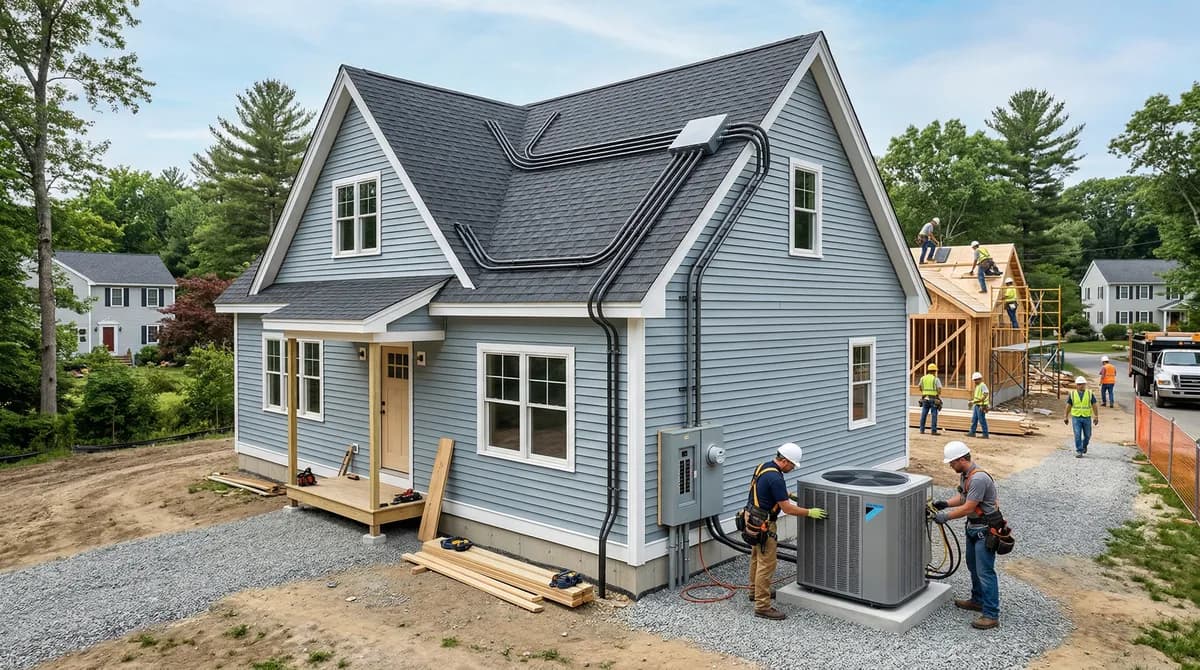
A net-zero-ready home includes solar conduit, heat pump HVAC, and EV-ready wiring during construction.
Buying a home built to the Specialized Code is not just about compliance — it is a significant financial and comfort advantage.
Heat pump HVAC + enhanced insulation = 40-60% lower heating/cooling costs vs. code-minimum homes. Average savings of $1,500-$2,500/year.
Pre-installed conduit and structural support save $3,000-$5,000 when you add panels. No attic access issues, no roof penetration surprises.
A 240V outlet in the garage means $300-$500 for a charger instead of $2,000-$4,000 for full electrical work. Ready for any EV.
Net-zero-ready homes sell for 3-8% more than code-minimum equivalents. Energy-efficient features are now a top-3 buyer priority in MA.
With no gas infrastructure, your home is immune to future fossil fuel restrictions. Boston and Brookline already have natural gas ban frameworks.
Tight air sealing (1.5 ACH50) + heat pumps = even temperatures, better humidity control, and quieter operation than forced-air gas systems.
Even in Specialized Code municipalities, Mass Save rebates apply to qualifying equipment. Builders and homeowners can stack these incentives.
Up to $50,000 at 0% APR for 7 years through Mass Save. Covers heat pumps, insulation, heat pump water heaters, and weatherization. Available to both new construction and retrofits.
HEAT Loan GuideHouseholds at or below 80% Area Median Income qualify for 100% of insulation costs and enhanced heat pump rebates through Mass Save income-eligible programs.
Income-Eligible ProgramsAdd a battery to your solar-ready home and earn $225-$275/kW annually through the ConnectedSolutions demand response program.
ConnectedSolutions GuideWhen you add solar to your net-zero-ready home, the SMART program pays $0.03/kWh for 20 years ($0.06/kWh for low-income). New construction qualifies.
SMART Program GuideThe Specialized Code requires EV-ready wiring. The federal Section 30C credit expired June 30, 2026, but building EV-ready during construction still avoids a costly retrofit.
The Section 30C credit was up to $1,000 (30% of cost) for residential EV charger installation, covering equipment and installation labor.
Expired June 30, 2026 — no longer available for chargers placed in service after that date.
The Specialized Opt-in Code is the most aggressive tier of Massachusetts building energy codes. Adopted by 100+ municipalities including Boston, Cambridge, and Brookline, it requires all new residential construction to include solar-ready roofs, heat pump HVAC, EV-ready garages, and enhanced insulation. The goal is to make homes "net-zero-ready" so adding solar panels later completes the path to net-zero energy use.
Over 100 municipalities have adopted the Specialized Opt-in Code as of 2026, including Boston, Cambridge, Brookline, Newton, Somerville, Arlington, Lexington, Concord, Northampton, Amherst, Wellesley, and Watertown. The full list is maintained by the MA Department of Energy Resources (DOER). Check with your local building department if you are unsure.
The Specialized Opt-in Code typically adds $5,000-$15,000 to new construction costs, depending on home size and design. This includes the heat pump HVAC system (offset by eliminating gas infrastructure), solar-ready roof preparation, EV-ready wiring, and enhanced insulation. However, these features reduce lifetime operating costs by $30,000-$60,000+ and increase resale value.
Solar-ready means the roof is structurally designed to support solar panels, with pre-installed conduit from the roof to the electrical panel, a junction box in the attic, and a south-facing area of at least 300 sq ft reserved for panels. This saves $3,000-$5,000 vs. retrofitting solar-ready infrastructure after construction.
In municipalities that have adopted the Specialized Opt-in Code, yes. All new residential construction must use heat pump technology for primary HVAC. This means air-source or ground-source heat pumps rather than gas furnaces or boilers. The Stretch Code (adopted by 300+ towns) does not require heat pumps but incentivizes them through energy performance targets.
The Stretch Code (adopted by ~300 municipalities, ~90% of new construction) sets enhanced energy efficiency targets but does not mandate specific equipment. The Specialized Opt-in Code (100+ municipalities) goes further by requiring heat pump HVAC, solar-ready roofs, EV-ready garages, and tighter air sealing (1.5 ACH50 vs 2.0). The Specialized Code makes homes net-zero-ready.
The Specialized Opt-in Code primarily applies to new residential construction and substantial additions. Minor renovations, like-for-like replacements, and small additions generally follow the Base Code or Stretch Code requirements. However, major gut renovations that trigger full code compliance may need to meet Specialized Code requirements in adopted municipalities.
Yes. Mass Save rebates apply to new construction equipment in most cases. Heat pump HVAC systems qualify for up to $8,500 in standard Mass Save rebates, heat pump water heaters up to $1,250, and insulation up to $4,000. These rebates can offset 30-60% of the incremental compliance costs. The HEAT Loan program also offers 0% APR financing for qualifying equipment.
Current pricing for solar installation in Massachusetts.
Read guideMass Save rebates, HEAT Loan, and income-eligible programs.
Read guideComplete guide to electrifying your Massachusetts home.
Read guideEarn $225-$275/kW with battery demand response.
Read guide$0.03/kWh for 20 years from the state solar incentive.
Read guideNuWatt builder partnerships for solar new construction.
Read guideWhat the MA stretch code requires for solar-ready homes.
Read guideLocal permitting and setback rules for home batteries.
Read guideThe all-electric building demonstration and what it means.
Read guideEversource & National Grid networked geothermal in MA.
Read guideNuWatt partners with builders and homeowners across Massachusetts. Whether you need solar installation on a new net-zero-ready home or a complete electrification retrofit, we can help.