Loading NuWatt Energy...

We use your location to provide localized solar offers and incentives.
We serve MA, NH, CT, RI, ME, VT, NJ, PA, and TX
Loading NuWatt Energy...
NuWatt designs, installs, and manages solar, battery, heat pump, and EV charger systems across 9 states. One company, one warranty, one point of contact.
Get a Free QuoteThe residential solar ITC (Section 25D) expired December 31, 2025. Massachusetts homeowners who buy solar with cash or a loan get $0from the IRS. But there is a legal, congressionally-designed path to still access the 30% credit — through third-party ownership under Section 48/48E.

30%
ITC Rate (Section 48)
$10,230
Example ITC (11 kW)
Jul 4, 2026
Begin-Construction Safe Harbor
A 64-year-old tax code provision — not a loophole
Section 48 of the Internal Revenue Code has existed since 1962. It provides an Investment Tax Credit (ITC) to the ownerof qualifying energy property — solar panels, wind turbines, battery storage, and other energy systems. The critical word in the statute is “owner.”
For decades, two parallel pathways existed for solar tax credits. Section 25D let individual homeowners claim the ITC on their personal tax return when they purchased solar with cash or a loan. Section 48 let businesses and financing companies claim the ITC when they owned solar systems — including systems installed on residential rooftops through leases and PPAs.
On July 4, 2025, the OBBBA (One Big Beautiful Bill Act) eliminated Section 25D. The homeowner pathway is dead. But Section 48 — the business/TPO pathway — remains active. Projects that began construction before July 4, 2026 locked in the most flexible timing; later starts still qualify if placed in service by December 31, 2027.
For Massachusetts homeowners, this means the only path to federal solar tax benefits in 2026 is through third-party ownership — a solar lease, PPA, or a program like NuWatt Propel (coming soon to MA). Massachusetts is NuWatt's largest market, and TPO-financed solar pairs especially well with the state's SMART 3.0 program and high electric rates.
Expired Dec 31, 2025. Cash or loan buyers get $0 federal tax credit.
30% ITC for TPO-owned systems. Projects that began construction by July 4, 2026 locked in the full credit timing.
Projects that began construction by July 4, 2026 locked in the full credit timing; later starts still qualify if placed in service by Dec 31, 2027. Start your TPO assessment early to keep the timeline comfortable.
What changed and what still works for MA homeowners

| Feature | Section 25D | Section 48/48E |
|---|---|---|
| Tax code section | Section 25D | Section 48 / 48E |
| Who claims the credit | Homeowner (on personal return) | System owner / TPO (financing company) |
| IRS form used | Form 5695 | Form 3468 |
| Credit rate | 30% (was) | 30% (still active) |
| Current status | EXPIRED Dec 31, 2025 | ACTIVE (projects that began construction by Jul 4, 2026 kept full timing) |
| Applies to | Cash or loan purchases | Lease, PPA, Propel (TPO models) |
| MACRS depreciation | Not available to homeowners | 5-year accelerated + 100% first-year bonus |
| Domestic content bonus | N/A (credit is dead) | +10% with FEOC-compliant panels |
| Energy community bonus | N/A (credit is dead) | +10% if project in qualifying area |
| Net effect for homeowner | $0 federal benefit | Lower monthly payment via TPO savings |
Source: IRS Code Sections 25D, 48, and 48E. OBBBA signed July 4, 2025.
Follow the ITC from installation to your monthly bill

A third-party owner (financing company) purchases a solar system — for example, an 11 kW system at $3.10/W costs approximately $34,100. The TPO owns the panels, inverter, and racking. They contract with an installer (like NuWatt) to mount the system on your roof.
The TPO files IRS Form 3468 and claims the 30% Investment Tax Credit on the system cost. On a $34,100 system, that is $10,230 in federal tax credits. This goes directly to the financing company — not to you, and not to the installer. The critical word in the tax code is “owner.”
The TPO also claims Modified Accelerated Cost Recovery System (MACRS) depreciation. Under OBBBA, 100% first-year bonus depreciation is permanently restored, so the entire depreciable basis is expensed in year one. On our $34,100 example, MACRS provides roughly $6,100 in additional tax benefits. This is a commercial tax benefit unavailable to individual homeowners.
The TPO receives approximately $16,330 in combined tax benefits ($10,230 ITC + ~$6,100 MACRS). These savings are baked into your lower monthly lease payment or per-kWh PPA rate. Without Section 48, the TPO would need to charge you significantly more. This is not a loophole — it is the intended mechanism Congress designed to encourage solar deployment at scale.
On an 11 kW system at $3.10/W ($34,100), the TPO captures approximately $16,330 in combined federal benefits ($10,230 ITC + ~$6,100 MACRS). These savings are passed to you as lower lease or PPA payments. Add SMART 3.0 revenue ($0.03/kWh for 20 years) and the TPO economics in Massachusetts are among the best in the country.
Three system sizes at $3.10/W — MA average installed cost
18 panels
8 kW System
$3.10/W
Best for: Smaller homes, condos, 600–800 sq ft roof
25 panels
11 kW System
$3.10/W
Best for: Average MA home, covers full usage
32 panels
14 kW System
$3.10/W
Best for: Large homes, EV charging, heat pump
Estimates based on MA average $3.10/W installed cost, 1,200 kWh/kWp annual production, and 30% ITC. PPA rates compared to Eversource $0.38/kWh and National Grid $0.42/kWh. MACRS assumes 100% first-year bonus depreciation on the ITC-reduced basis at a 21% tax rate. Actual figures vary by installer, roof orientation, and contract terms.
Compare your options in the post-25D landscape
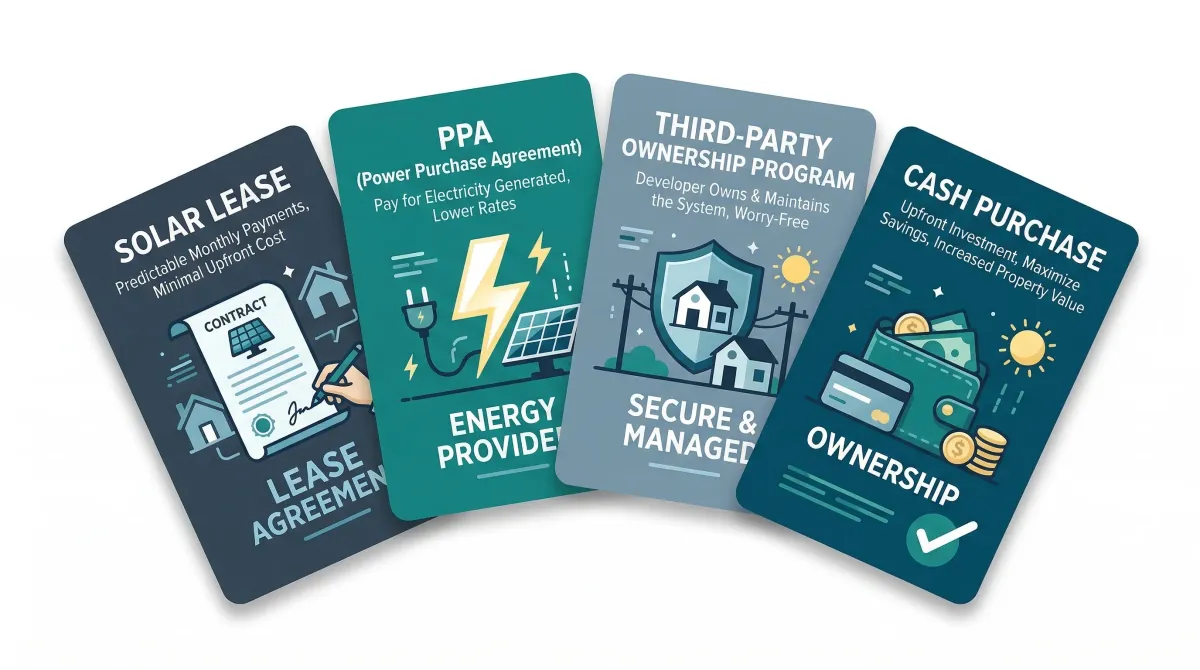
Fixed monthly payment for 20–25 years. The TPO owns the system and claims the 30% ITC + MACRS. You pay a predictable monthly amount that is lower than your current electric bill.
Advantages
Drawbacks
Massachusetts Note
TPO-owned systems can enroll in SMART 3.0 and receive $0.03/kWh for 20 years, helping keep lease rates low.
You pay per kilowatt-hour at a rate lower than your utility rate. The TPO owns the system, claims Section 48 ITC + MACRS, and sells you the power at a discounted rate.
Advantages
Drawbacks
Massachusetts Note
At $0.12–0.18/kWh vs Eversource $0.38/kWh or National Grid $0.42/kWh, you save 52–71% on solar electricity from day one.
NuWatt’s third-party ownership program is coming soon to Massachusetts. The financing company owns the system, claims Section 48 ITC + MACRS + domestic content bonus. Requires FEOC-compliant Silfab 440W panels.
Advantages
Drawbacks
Massachusetts Note
Propel is currently available in ME and TX. Massachusetts launch is planned — contact NuWatt for updates and to join the waitlist.
You own the system outright. Because you own it, there is NO Section 48 benefit — and Section 25D is dead. You get $0 in federal tax credits. Solar loans in MA are typically 6–8% APR.
Advantages
Drawbacks
Massachusetts Note
The Mass Solar Loan program ended in 2020. Current solar loans are market rate at 6–8% APR. You own it, but 25D is dead — $0 ITC.
The combination that makes MA one of the best TPO markets in the country
Massachusetts' SMART (Solar Massachusetts Renewable Target) program is a state production incentive that pays solar system owners per kilowatt-hour of electricity produced. In SMART 3.0, the residential rate is $0.03/kWh for systems up to 25 kW, paid for 20 years. TPO-owned systems are eligible to enroll.
When a TPO finances a system on your roof, they receive three revenue streams:
$10,230
Section 48 ITC
30% of $34,100 (11 kW)
~$6,100
MACRS Depreciation
100% first-year bonus depreciation
~$7,920
SMART 3.0 Revenue
$0.03/kWh x 13,200 kWh x 20 yrs
Combined, the TPO receives approximately $24,250 in tax benefits and incentive revenue on an 11 kW system. This is why MA lease and PPA rates can be competitive even in the post-25D landscape. The TPO has strong economics; you get low monthly payments or per-kWh rates well below utility prices.
Misinformation costs Massachusetts homeowners thousands
“Section 48 is a loophole for solar companies.”
Section 48 has been part of the IRS tax code since 1962 — 64 years. It was specifically designed to encourage investment in energy property by providing an ITC to the entity that owns the qualifying system. Congress intentionally structured it so that financing companies could deploy capital into solar at scale. There is nothing hidden, creative, or exploitative about it.
“I get the 30% tax credit directly on my tax return.”
No. With a lease, PPA, or Propel arrangement, the third-party owner (TPO) claims the ITC on their corporate tax return using IRS Form 3468. You benefit indirectly through lower monthly payments or a reduced per-kWh rate. If you want to claim the credit directly, you would need to purchase the system outright — but Section 25D is dead, so you would receive $0.
“Solar leases are always a bad deal.”
This advice was accurate when Section 25D was alive. Homeowners could claim 30% themselves, making cash or loan purchases clearly superior. In 2026, the calculus has changed. With $0 in homeowner tax credits, leases and PPAs that leverage Section 48 can deliver better economics than a loan at 6–8% APR with no ITC. In Massachusetts, where electric rates are $0.38–0.42/kWh, a PPA at $0.12–0.18/kWh provides significant day-one savings.
“The installer claims the tax credit.”
The installer (contractor) does not claim the ITC. The credit goes to the entity that owns the qualifying energy property — the financing company or TPO. The installer is paid for labor and materials. This is a common misunderstanding that leads homeowners to ask the wrong questions during the sales process.
“I should wait for Congress to bring back Section 25D.”
The OBBBA (One Big Beautiful Bill Act), signed July 4, 2025, eliminated Section 25D with no sunset clause and no scheduled return. There is no pending legislation to restore it. Meanwhile, Section 48/48E has a key timing milestone: projects that began construction by July 4, 2026 locked in the full credit timing, while projects that start later still qualify if placed in service by December 31, 2027. Waiting risks losing access to both the homeowner credit (already gone) and the most flexible TPO window.
“SMART payments replace the need for a tax credit.”
SMART 3.0 provides $0.03/kWh for residential systems (≤25 kW) over 20 years. On an 11 kW system producing 13,200 kWh/year, that is about $396/year or $7,920 over 20 years. Helpful, but it does not replace the $10,230 ITC + $6,100 MACRS that a TPO captures under Section 48. The two stack — TPO systems can enroll in SMART, keeping lease/PPA rates even lower.
How the Section 48/48E begin-construction window played out

July 4, 2025
OBBBA signed into law
Section 25D eliminated. Residential solar ITC drops to $0 for homeowners.
December 31, 2025
Section 25D officially expires
Cash and loan solar purchases receive $0 federal tax credit starting January 1, 2026.
July 4, 2026
Section 48/48E begin-construction safe harbor
Projects that began construction (5% safe harbor or physical work test) on or before this date locked in the full credit timing. Projects that start later still qualify if placed in service by December 31, 2027.
July 4, 2026
FEOC compliance milestone
For projects beginning construction after this date, panels with Foreign Entity of Concern components lost domestic content bonus eligibility.
Now
Later starts still qualify
Projects that begin construction now still receive the 30% ITC if placed in service by December 31, 2027. Equipment orders + permitting take 8–12 weeks; Eversource/National Grid interconnection adds 4–8 weeks.
July 4, 2030
Placed-in-service deadline
Projects that began construction before July 4, 2026 must be completed and placed in service within 4 years.
Projects that began construction (5% safe harbor or physical work test) on or before July 4, 2026 locked in the most flexible Section 48/48E timing and can be placed in service through roughly 2030. Projects that begin construction now still qualify for the 30% ITC but generally must be placed in service by December 31, 2027. In Massachusetts, permit-to-interconnection timelines average 12\u201316 weeks and Eversource interconnection reviews alone take 4\u20138 weeks, so start your TPO assessment early. Massachusetts is NuWatt's largest market — demand is strong.
Section 48/48E for Massachusetts homeowners
Section 48 is the Investment Tax Credit (ITC) provision that has existed in the IRS tax code since 1962. It provides a tax credit to the owner of qualifying energy property — such as solar panels. Section 25D was the residential energy credit that allowed individual homeowners to claim the ITC on their personal tax return. Section 25D expired on December 31, 2025 (eliminated by the OBBBA). Section 48/48E remains active: projects that began construction by July 4, 2026 locked in the full credit timing, while projects that start later still qualify if placed in service by December 31, 2027. The key difference: 48 goes to the system owner (the financing company in a lease/PPA), while 25D went to the homeowner.
Not directly. Section 25D is dead — if you buy solar with cash or a loan, you receive $0 in federal tax credits. However, if you finance through a solar lease, PPA, or a program like NuWatt Propel (coming soon to MA), the third-party financing company (TPO) claims the 30% ITC under Section 48/48E. The savings are passed to you through lower monthly payments or a discounted per-kWh electricity rate.
TPO-owned systems installed on residential rooftops can enroll in SMART 3.0 and receive the $0.03/kWh incentive for 20 years. The SMART payment typically goes to the system owner (the TPO), but the TPO factors this revenue into lower lease or PPA rates for the homeowner. This is one of the reasons MA is attractive for TPO financing — the combination of Section 48 ITC, MACRS, and SMART revenue allows competitive pricing.
Interconnection timelines in Massachusetts typically run 4–8 weeks after installation is complete. Eversource and National Grid review applications, inspect the system, and install a bi-directional meter. TPO systems go through the same interconnection process as homeowner-owned systems. The TPO or installer (NuWatt) handles the paperwork. Because interconnection and permitting add several months, sign your TPO contract early — projects beginning construction now still qualify for the 30% ITC if placed in service by December 31, 2027.
The IRS defines “begin construction” through two safe harbors: (1) Physical Work Test — meaningful physical work begins at the site (foundation, mounting hardware installation), or (2) Five Percent Safe Harbor — at least 5% of the total project cost has been incurred. For residential TPO systems, this typically meant signing a contract and having the TPO place equipment orders on or before July 4, 2026. Projects must be placed in service within 4 years of beginning construction.
FEOC stands for Foreign Entity of Concern. Under the IRA and subsequent guidance, solar panels manufactured by or containing components from a Foreign Entity of Concern (primarily Chinese-owned companies) may lose eligibility for certain ITC adders, particularly the 10% domestic content bonus. FEOC-compliant panels like the Silfab 440W are manufactured without FEOC components, ensuring eligibility for the full ITC stack. The FEOC compliance deadline was July 4, 2026.
Yes. Propel is live in Massachusetts now, alongside Maine, Texas, Rhode Island, and Connecticut. Propel uses the same TPO structure this guide describes — the third-party owner claims the Section 48E ITC + MACRS + domestic content bonus — and specifically requires FEOC-compliant Silfab 440W panels. You can prequalify online with a soft credit check from the Massachusetts Propel page.
It depends on your financial situation. Cash purchase gives the highest 25-year savings (you own the system and keep all net metering credits and SMART payments) but requires $25,000–45,000 upfront with no federal tax credit. TPO (lease/PPA) provides $0 down with immediate savings — a PPA at $0.14/kWh vs National Grid $0.42/kWh saves you money from month one. If you have $35,000+ in liquid capital and plan to stay in your home 10+ years, cash may be better. Otherwise, TPO is the stronger choice in the post-25D landscape.
There are two pathways. Projects that began construction on or before July 4, 2026 locked in the full 30% ITC timing and can be placed in service through roughly 2030. Projects that begin construction after July 4, 2026 still qualify for the 30% ITC, but generally must be placed in service by December 31, 2027. Beginning construction by the July 4, 2026 milestone preserved the most flexible placed-in-service window.
Yes, but it depends on the TPO agreement. If the TPO installs a battery alongside the solar system, the system can enroll in ConnectedSolutions (Eversource $275/kW summer + $50 winter, National Grid $225/kW + $50). The ConnectedSolutions revenue may go to the TPO or be shared with the homeowner, depending on the contract. Unitil does not participate in ConnectedSolutions. Always review TPO contract terms regarding battery DR revenue.
Comprehensive guide to solar energy in Massachusetts — costs, incentives, SMART, and timeline.
Deep dive into lease vs PPA structures, rates, and contract terms for Massachusetts.
Side-by-side financing comparison with 25-year savings projections.
Honest analysis of whether solar still works in MA without Section 25D.
City-by-city pricing, system sizes, and cost breakdowns across Massachusetts.
SMART 3.0 rates, capacity blocks, and how to maximize incentive payments.
Track launch timing and join the Massachusetts waitlist for NuWatt's upcoming ownership-focused offer.
Massachusetts has the highest electric rates in the region. Section 48/48E lets you access the 30% federal solar tax credit through TPO financing — and projects that began construction by July 4, 2026 locked in the most flexible credit timing. NuWatt is MA's largest market. Get a free solar assessment today.
No obligation. Includes roof analysis, system design, and financing comparison.