Loading NuWatt Energy...

We use your location to provide localized solar offers and incentives.
We serve MA, NH, CT, RI, ME, VT, NJ, PA, and TX
Loading NuWatt Energy...
NuWatt designs, installs, and manages solar, battery, heat pump, and EV charger systems across 9 states. One company, one warranty, one point of contact.
Get a Free Quote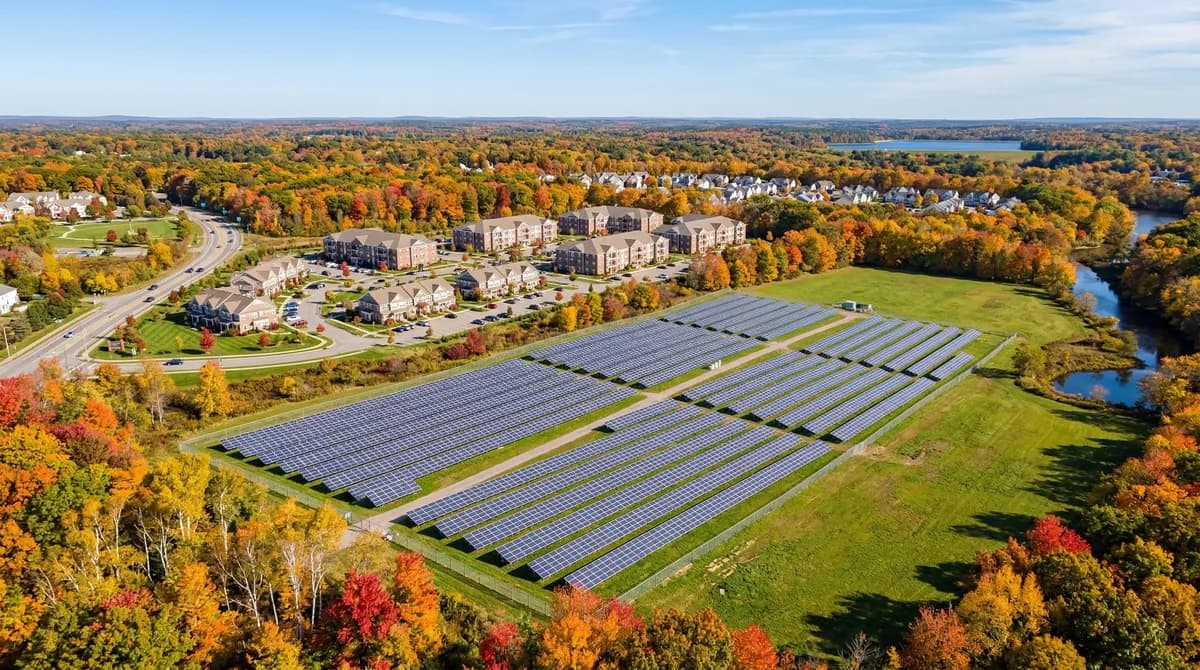
You do not need a roof to go solar in Massachusetts. Community solar saves 10-20% on your bill with zero installation. Condo owners have legal rights to install panels. Here is every option available to you in 2026.
Yes, you can benefit from solar without owning a roof. Massachusetts has one of the strongest community solar markets in the country with 100+ active solar farms. Renters and condo owners subscribe for $0 upfront, save 10-20% on their electric bill, and can cancel anytime. Condo owners who want rooftop panels have legal protections under MGL Chapter 184 solar easement law, and condo associations can use virtual net metering to share a rooftop system among all unit owners.
Subscribe to a share of a local solar farm. Credits appear on your utility bill. No installation, no roof access needed.
Condo association installs shared solar system. Net metering credits are allocated proportionally to unit owners.
Install panels on your dedicated roof area. Requires condo association approval. MGL Chapter 184 protects your right.
Plug-in solar panel kits (e.g., Jackery, EcoFlow) for balconies/patios. Limited savings but fully portable.
Community solar is the simplest path to solar savings if you cannot install panels. Massachusetts has been a national leader in community solar since the Green Communities Act (2008), and the SMART program has accelerated growth with its community shared solar adder.
How it works: A solar farm is built in your utility territory. You subscribe to a share of the farm's output. The electricity generated creates net metering credits on your utility bill. You buy those credits at a discount (typically 10-20% below retail), saving money every month with zero upfront cost and no long-term contract.
With MA electric rates running $0.38-$0.42/kWh (among the highest in the nation), even a 10% savings on a $200/month bill means $240/year back in your pocket — with no installation, no maintenance, and no risk.
Community shared solar adder applies to qualifying SMART-enrolled community solar projects.
Search EnergySage or MA community solar marketplaces for projects in your utility territory. There are 100+ active solar farms across Massachusetts.
Community solar credits are utility-specific. You must be an Eversource, National Grid, or Unitil customer. Your subscriber organization must be in the same utility territory.
Sign up with zero upfront cost. Most subscriptions are month-to-month with no long-term contract. Some offer guaranteed savings rates (e.g., 10-15% discount on credits).
Solar farm generates electricity and sends credits to the utility. Your electric bill shows net metering credits reducing your charges. You pay the subscription operator a discounted rate.
Typical savings: 10-20% on your electric bill. No maintenance, no roof access, no installation. Cancel anytime if you move or find a better deal.
If you own a condo in Massachusetts, you have more solar options than you might think. State law provides legal protections for solar access, and virtual net metering allows condo associations to share a single solar system among all unit owners.
Massachusetts law allows property owners to create solar easements — legal agreements that protect your access to sunlight. A condo owner can negotiate a solar easement with the association to prevent future obstructions to their panels.
While MA does not have a specific "solar access" statute like California or Arizona, courts have consistently ruled that HOAs and condo associations cannot unreasonably restrict solar panel installation. Aesthetic requirements (color, placement) are generally allowed; outright bans are not enforceable.
MA law (Green Communities Act, 2008) allows condo associations to install a shared solar system and allocate net metering credits to individual unit owners. This means the condo board can install panels on common area roofs and distribute the savings to all owners.
Condo associations can enroll shared solar systems in the SMART 3.0 program, earning $0.03/kWh for 20 years. The community shared solar adder (+$0.05/kWh) may apply to qualifying projects, increasing total incentives.
Even if community solar is not for you, Mass Save offers substantial energy savings programs available to renters. These programs reduce your energy consumption — which reduces your bill regardless of where your electricity comes from.
Income-eligible renters (earning up to 80% of area median income) can receive free energy assessments, weatherization, insulation, and appliance upgrades. The landlord must consent to physical modifications, but many landlords welcome free efficiency improvements that increase property value.
Free Home Energy Assessment
All renters (with landlord consent)
Free LED Bulbs & Smart Thermostats
All renters
Insulation & Weatherization (75-100% off)
Income-eligible renters
Appliance Rebates
All renters (heat pump water heater, etc.)
ConnectedSolutions Battery Revenue
Renters (if landlord installs battery)
Yes. As a renter, your best option is community solar. You subscribe to a share of a local solar farm and receive credits on your electric bill, saving 10-20%. There is no installation on your rental, no upfront cost, and you can cancel if you move. Massachusetts has one of the most developed community solar markets in the country with 100+ active projects.
You subscribe to a portion of a solar farm in your utility territory (Eversource, National Grid, or Unitil). The farm generates electricity and sends net metering credits to the utility. Those credits appear on your bill, reducing your charges. You pay the community solar operator a discounted rate for those credits — typically 10-20% less than what the credits are worth. No panels on your roof, no installation, no maintenance.
Yes. Condo associations can install solar on common-area roofs and use virtual net metering to allocate credits to individual unit owners. The association handles installation costs and can enroll in the SMART 3.0 program for additional income ($0.03/kWh for 20 years). This requires a vote of the condo board or association membership, depending on your bylaws.
Massachusetts courts have generally held that HOAs and condo associations cannot unreasonably restrict solar installations. While MA does not have a specific solar access statute, MGL Chapter 184 allows solar easements, and courts have been solar-friendly. An HOA can impose reasonable aesthetic requirements (panel color, placement on less visible roof faces) but cannot outright ban solar panels.
Typical community solar savings in Massachusetts are 10-20% on your electric bill. For a household using 700 kWh/month at $0.38/kWh (about $263/month), that translates to $26-$53/month in savings, or $312-$636 per year. There is no upfront cost and no long-term commitment — most subscriptions are month-to-month.
No. Mass Save income-eligible programs are available to renters as well as homeowners. Income-eligible renters can receive free energy assessments, weatherization, insulation, and appliance rebates. The landlord must consent to any physical modifications to the property, but many Mass Save benefits are available regardless of ownership status.
Virtual net metering allows the electricity generated by a solar system at one location to be credited to electric accounts at other locations. For condos, this means a solar array on the building roof can generate credits that are split among unit owners. The credits appear as line items on each owner electric bill. This is different from community solar, which uses off-site solar farms.
If you move within the same utility territory (e.g., from one Eversource town to another), most community solar subscriptions transfer seamlessly. If you move to a different utility territory or out of state, you will need to cancel your subscription. Most community solar agreements in MA are month-to-month with no cancellation fees.
Full guide to MA community solar programs and enrollment.
How renters and condo residents subscribe with no rooftop.
Side-by-side comparison of community solar vs. rooftop panels.
Your legal rights for solar in HOA/condo communities.
Current pricing for rooftop solar in Massachusetts.
If you own your home or condo unit, NuWatt can design a solar system customized for your property. Renters: explore community solar options with zero upfront cost.