Loading NuWatt Energy...

We use your location to provide localized solar offers and incentives.
We serve MA, NH, CT, RI, ME, VT, NJ, PA, and TX
Loading NuWatt Energy...
NuWatt designs, installs, and manages solar, battery, heat pump, and EV charger systems across 9 states. One company, one warranty, one point of contact.
Get a Free Quote
A heat pump water heater uses just 1,500-2,000 kWh/year -- offset entirely by 4-5 solar panels. Stack the $750 Mass Save rebate + SMART 3.0 income for the most cost-effective hot water system in Massachusetts.
A heat pump water heater (HPWH) uses 1,500-2,000 kWh/year -- about 60-70% less than a standard electric water heater. In Massachusetts, just 4-5 additional solar panels (1.8-2.3 kW) fully offset this consumption. After the $750 Mass Save rebate and 0% HEAT Loan, total annual savings are $400-$600/year -- payback in 3-5 years. Federal tax credits (25C and 25D) are expired as of 2026.
A heat pump water heater is the single most cost-effective electrification upgrade for a Massachusetts home. Pairing it with solar panels makes your hot water effectively free.
A HPWH with COP 3.5 uses just 1,500-2,000 kWh/year. A standard electric resistance water heater uses 4,500-5,500 kWh for the same hot water. That is 60-70% less electricity.
At Massachusetts solar production rates (1,200 kWh/kW/year), just 4-5 additional 440W panels (1.8-2.3 kW) fully offset your HPWH consumption. Adds $3,000-$4,000 to your solar install.
Instant rebate on qualifying HPWHs (UEF 2.0+). Income-eligible households get free installation. Remaining cost finances at 0% via HEAT Loan.
When bundled with solar, your electrician is already on-site. Adding a 240V HPWH circuit during solar electrical work costs less than a standalone visit.
HPWHs extract heat from ambient air, producing cool, dry air as a byproduct. In a Massachusetts basement, this free dehumidification saves $20-$40/month in summer.
Your additional solar panels earn $0.03/kWh for 20 years through the SMART program. That is ~$720 in lifetime income from panels that also eliminate your hot water bill.
A HPWH works like a refrigerator in reverse -- it extracts heat from surrounding air and transfers it to your water tank.
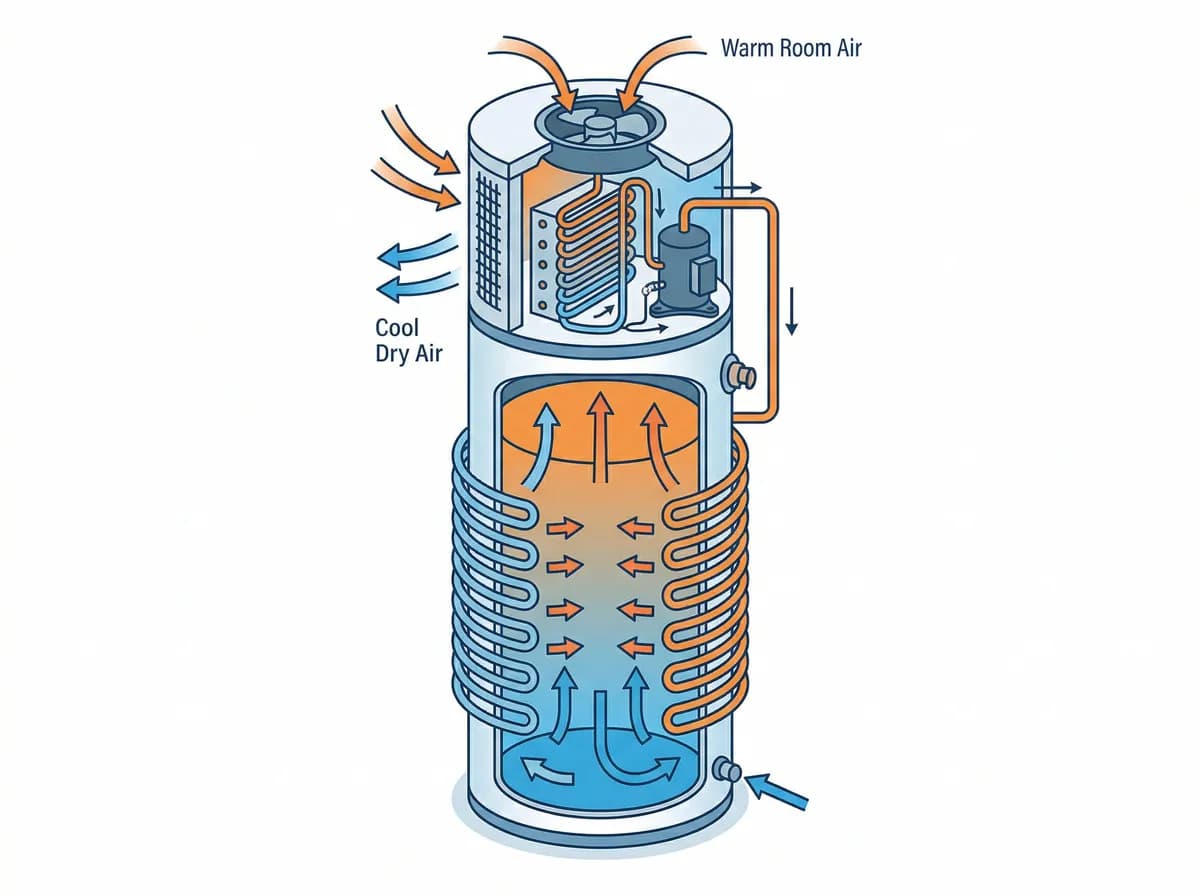
A fan at the top pulls room air across an evaporator coil. The air temperature in a typical MA basement (45-65F) provides plenty of heat energy.
Refrigerant (R-134a) in the evaporator coil absorbs heat from the air and evaporates into a gas, even at relatively low temperatures.
The compressor pressurizes the refrigerant gas, raising its temperature to 120-140F -- hot enough to heat your water.
The hot refrigerant flows through a condenser coil wrapped around the water tank, transferring heat to the water. The refrigerant cools and cycles back.
The HPWH exhausts cool, dehumidified air back into the room. In summer, this is free AC and dehumidification. In winter, it adds a minor heating load.
1 kWh of electricity produces 1 kWh of heat. 100% efficient but wastes no ambient energy. Uses 4,500-5,500 kWh/year.
1 kWh of electricity produces 3.5 kWh of heat. 350% efficient by moving heat from air to water. Uses 1,500-2,000 kWh/year.
Combustion losses mean only 82% of gas energy heats water. Plus fossil fuel costs and venting requirements.
All models below meet Mass Save requirements (UEF 2.0+) and qualify for the $750 rebate. Prices include equipment only -- installation adds $800-$1,500.
Best overall — highest COP, best smart features
Most widely available — strong contractor familiarity
Budget-conscious choice with solid reliability
Premium quality — quietest HPWH on the market
Match your household size to the right HPWH tank and the number of additional solar panels needed to offset its electricity consumption.
| Household Size | HPWH Tank | Annual kWh | Extra Panels | Added Solar |
|---|---|---|---|---|
| 1-2 people | 50 gallon | 1,200 kWh | 3 panels | 1.3 kW |
| 2-3 people | 65 gallon | 1,500 kWh | 4 panels | 1.8 kW |
| 3-4 people | 65 gallon | 1,800 kWh | 5 panels | 2.1 kW |
| 4+ people | 80 gallon | 2,000 kWh | 5 panels | 2.3 kW |
HPWHs have slower recovery rates than gas water heaters (2-3 hours for full tank vs 30-40 minutes). When in doubt, choose the 80-gallon model. The larger tank acts as a thermal battery -- heat water during the day with solar, use it in the evening. The efficiency gain from heat pump mode means the 80-gallon costs only $10-$15 more per year to operate than the 50-gallon.
Most Massachusetts homes have unfinished basements that are ideal for heat pump water heaters. The cool air exhaust is a feature, not a bug.
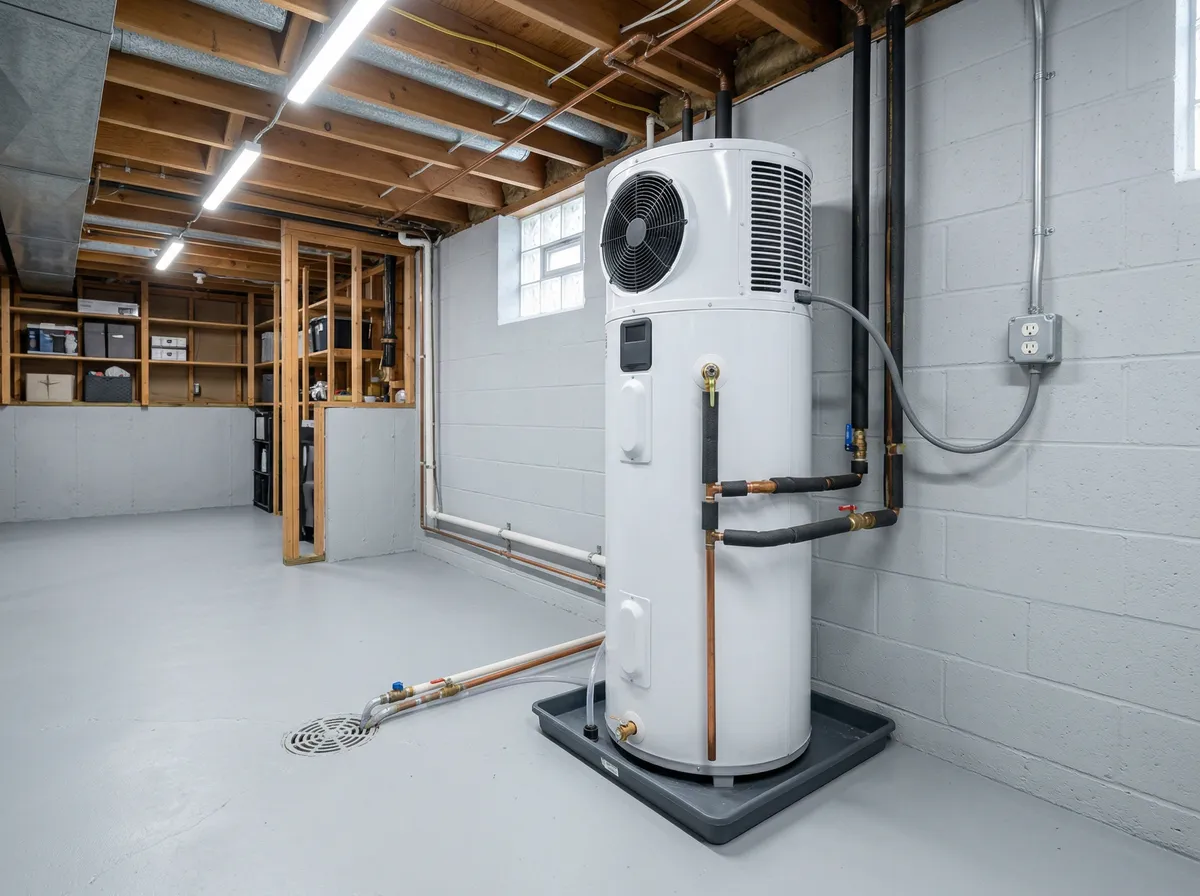
The HPWH exhausts cool, dehumidified air into your basement. This provides free air conditioning and dehumidification -- saving $20-$40/month you would otherwise spend on a standalone dehumidifier. Your basement stays dry and comfortable.
In winter, the HPWH extracts heat from basement air, making it cooler. This slightly increases your space heating load. The net impact is small: about $30-$50 more per year on heating -- far less than the $350+ you save on water heating electricity. Net positive by 10x.
MA basements maintain 45-65F year-round -- well within the HPWH operating range (40-120F). The unit rarely needs to use its backup electric resistance element. In truly cold snaps, the backup element activates briefly but adds minimal cost.
Before scheduling a HPWH installation, verify these requirements at your planned installation location.
Standard basement or garage works. Cannot be installed in a small closet — needs ambient air volume to extract heat from.
Same as an electric dryer outlet. Most homes already have capacity, but panel space must be verified during assessment.
HPWHs produce condensation (like an AC unit). Needs a floor drain or condensate pump. Most MA basements have floor drains.
HPWHs work best in 40-120F ambient air. Unheated MA basements (45-65F year-round) are ideal. Below 40F, backup element kicks in.
Most HPWHs are taller than standard water heaters (60-65" plus connections). Check ceiling height at installation location.
Same connections as your existing water heater. Direct replacement in most cases. Expansion tank may be required by local code.
How does a solar-paired HPWH compare to tankless gas, standard electric, and solar thermal? Here is the honest breakdown for Massachusetts homeowners.
Massachusetts incentives are designed to stack. When you bundle a HPWH with solar panels, you access programs from both the Mass Save and solar incentive ecosystems.
| Incentive | Value |
|---|---|
HPWHMass Save HPWH Rebate | $750 |
HPWH0% HEAT Loan | Up to $25,000 |
SolarSMART 3.0 (solar) | $0.03/kWh x 20 yr |
SolarNet Metering (solar) | 1:1 retail rate |
SolarMA State Tax Credit | $1,000 max |
SolarSales Tax Exemption | 6.25% saved |
SolarProperty Tax Exemption | 20 years |
ExpiredSection 25D (federal) | $0 |
ExpiredSection 25C (federal) | $0 |
Estimated Combined Annual Savings (HPWH + Solar Offset)
$400 - $600/year
HPWH electricity savings ($350-$500) + SMART 3.0 income (~$36/yr for 4-5 panels) + dehumidifier savings ($100-$200/yr)
What the solar + HPWH bundle actually costs in Massachusetts, before and after incentives.
| Component | Cost Range |
|---|---|
| HPWH Equipment (65-gal Rheem ProTerra) | $1,600-$2,400 |
| HPWH Installation | $800-$1,500 |
| Mass Save HPWH Rebate | -$750 |
| Solar Addition (4-5 panels, 1.8-2.3 kW) | $3,000-$4,000 |
| Net Bundle Cost | $4,650-$7,150 |
The HPWH portion ($1,650-$3,150 after rebate) qualifies for Mass Save's 0% HEAT Loan (up to $25,000, terms up to 7 years). Sample monthly payments on a $2,000 balance:
With combined savings of $400-$600/year, the bundle pays for itself quickly:
Solar thermal (roof-mounted hot water collectors) was the original “solar water heating” approach. In 2026, solar PV panels + HPWH is the clear winner.
| Factor | Solar PV + HPWH | Solar Thermal |
|---|---|---|
| Upfront Cost | $4,650-$7,150 | $6,000-$10,000 |
| Maintenance | Near zero (no fluids) | Glycol replacement every 3-5 yr |
| Roof Space | Shared with home solar | Separate collector system |
| SMART Income | $0.03/kWh x 20 years | Not eligible |
| Mass Save Rebate | $750 (HPWH) | $0 |
| Federal Credit (2026) | $0 (25D expired) | $0 (25D expired) |
| Powers Other Loads | Yes (any electrical load) | No (hot water only) |
| Winter Performance | HPWH works year-round | Reduced output in cold |
Full details on the $750 Mass Save rebate for heat pump water heaters.
The complete whole-home electrification bundle. Solar, heat pump, battery.
$0.03/kWh for 20 years on residential solar installations.
Finance your HPWH at 0% interest through Mass Save participating lenders.
$3.00-$3.40/W installed. No federal ITC. See complete pricing.
The complete playbook for going all-electric in Massachusetts.
A heat pump water heater uses 1,500-2,000 kWh per year. In Massachusetts, with 1,200 kWh/kW annual solar production, you need 4-5 additional 440W panels (1.8-2.3 kW) to fully offset your HPWH electricity consumption. This adds roughly $3,000-$4,000 to your solar installation cost.
Mass Save offers a $750 instant rebate for qualifying heat pump water heaters (UEF 2.0 or higher) in 2026. Income-eligible households can get a HPWH installed for free (100% covered). The remaining cost after the rebate qualifies for 0% HEAT Loan financing through Mass Save.
Yes. At Massachusetts electric rates ($0.36-$0.39/kWh), a HPWH saves $350-$500/year compared to a standard electric water heater. With the $750 Mass Save rebate and 0% HEAT Loan, payback is 3-5 years. When paired with solar panels, your HPWH operating cost drops to near zero.
Massachusetts basements are ideal for HPWHs. They maintain 45-65F year-round (within the 40-120F operating range), have ample air volume (700+ cubic feet needed), and usually have floor drains for condensate. The cool air exhaust is a bonus in summer (free dehumidification) and only a minor heating load increase in winter.
COP (Coefficient of Performance) measures energy efficiency. A COP of 3.5 means the unit produces 3.5 units of heat for every 1 unit of electricity consumed. Standard electric water heaters have a COP of ~1.0 (100% efficient). A HPWH with COP 3.5 is 350% efficient — it moves heat from the air rather than generating it, using 60-70% less electricity.
Yes, and it is recommended. When your solar installer is already running electrical work for panels, adding a HPWH circuit costs less than a standalone installation. You save on permit costs, crew mobilization, and electrical panel work. NuWatt installs both as a single coordinated project.
Sizing guide: 50 gallons for 1-2 people, 65 gallons for 2-3 people, 80 gallons for 4+ people. HPWHs have slower recovery rates than gas water heaters, so sizing up is recommended. When in doubt, choose the 80-gallon — the efficiency gain from heat pump mode makes the larger tank cost-effective to operate.
Solar thermal (roof-mounted hot water collectors) was popular before solar PV became affordable. In 2026, solar PV panels + HPWH is the better choice: PV panels are cheaper per kWh, require less maintenance (no glycol loops), earn SMART 3.0 income, and the same panels power your entire home — not just hot water. Solar thermal also competes for roof space with PV panels.
No. The Section 25C energy efficiency tax credit expired December 31, 2025 under the OBBBA. There is no federal tax credit for heat pump water heaters in 2026. Your primary incentive is the Mass Save $750 rebate plus 0% HEAT Loan financing. The federal 25D solar ITC also expired — no federal credits for residential solar either.
A Massachusetts homeowner switching from a standard electric water heater to a solar-powered HPWH saves $400-$600 per year. The HPWH itself saves $350-$500/year in electricity, and the 4-5 additional solar panels generate $50-$100/year in SMART 3.0 income. Combined with net metering credits, your hot water cost drops to effectively $0.
Get a custom quote for solar panels + heat pump water heater installation. One crew, one permit, one project -- maximum savings.
Federal 25D and 25C tax credits expired December 31, 2025. Mass Save $750 HPWH rebate active. SMART 3.0 active.