Loading NuWatt Energy...

We use your location to provide localized solar offers and incentives.
We serve MA, NH, CT, RI, ME, VT, NJ, PA, and TX
Loading NuWatt Energy...
NuWatt designs, installs, and manages solar, battery, heat pump, and EV charger systems across 9 states. One company, one warranty, one point of contact.
Get a Free Quote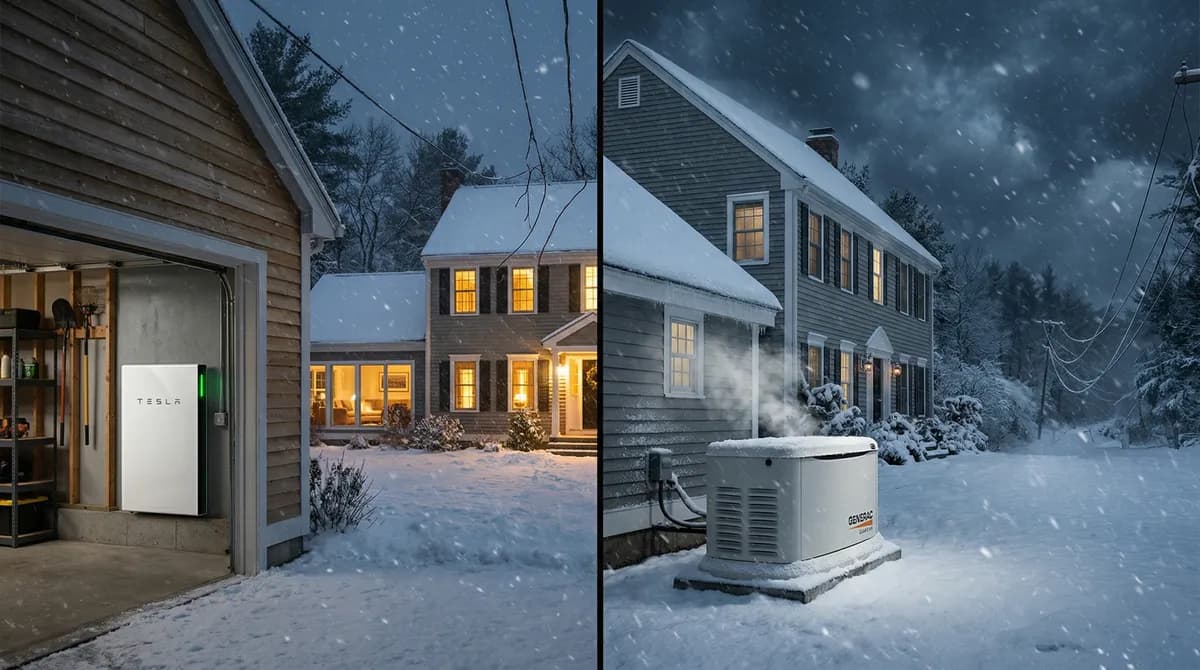
Massachusetts experiences 2-5 major outage events per year from nor'easters, ice storms, and summer thunderstorms. A solar battery earns $747/year through ConnectedSolutions while providing silent, zero-emission backup. A standby generator offers unlimited runtime at $800-$1,550/year in ongoing costs. Here is how to choose the right backup power solution for your home.
A comprehensive head-to-head analysis for Massachusetts homeowners. Battery wins 10 factors, generator wins 5, and 1 are a tie.
| Factor | Solar Battery | Generator | Winner |
|---|---|---|---|
| Installed costPortable gen starts at $1,700 installed | $7,500-$18,000 | $1,700-$15,000 | Generator |
| Annual fuel/energy cost | $0 (solar-charged) | $500-$1,500/yr | Battery |
| Annual maintenance | $0 | $150-$400/yr | Battery |
| ConnectedSolutions revenueGenerators cannot earn demand response $ | $433-$747/yr | $0 | Battery |
| Runtime (no sun/fuel) | 8-24 hrs per charge | Unlimited w/ fuel supply | Generator |
| Self-recharging | Yes (solar panels) | No (needs fuel delivery) | Battery |
| Noise level | Silent (0 dB) | 65-80 dB (lawnmower) | Battery |
| CO poisoning risk | Zero | Yes (outdoor placement required) | Battery |
| Emissions | Zero | CO, CO2, NOx, particulates | Battery |
| MA permit complexity | Electrical only | Electrical + gas/fuel + noise | Battery |
| Whole-home capable | 1-2 units needed | Yes (20kW+ standby) | Generator |
| Resale value impactZillow/Redfin data for MA | +$5,000-$10,000 | +$3,000-$5,000 | Battery |
| Grid independence | Partial (daily cycling) | Full (during outage only) | Tie |
| Lifespan | 10-15 years | 15-25 years | Generator |
| Daily utility savings | Yes (peak shaving/TOU) | None | Battery |
| Insurance discountGenerator discounts more widely available | Some insurers (5-10%) | Most insurers (5-15%) | Generator |
| Overall Score | 10 factors | 5 factors | 1 tie |
All three systems qualify for ConnectedSolutions enrollment with Eversource and National Grid.
Most MA homeowners — whole-home backup with ConnectedSolutions
Homeowners who want modular expansion or already have Generac products
Homes with Enphase microinverters or budget-phased installation
From budget portable units to whole-home standby systems. Natural gas availability varies by region (see below).
The upfront price is just the beginning. Fuel, maintenance, revenue, savings, and resale value tell the full story.
Despite a higher upfront cost, the Tesla Powerwall 3 has a lower 10-year total cost of ownership than a standby generator. ConnectedSolutions revenue ($7,470), peak shaving savings ($4,000), and higher resale value ($7,500) more than offset the $2,000 upfront premium. The standby generator accumulates $11,750 in fuel and maintenance costs while earning $0 in revenue.
Understanding load management is the key to right-sizing your backup system. Here are typical MA home loads ranked by priority. Critical loads total 3.0 kW; adding high-priority loads brings it to 5.1 kW.
| Appliance | Watts | Priority | Note |
|---|---|---|---|
| Heat pump (3-ton, eco mode) | 2,500W | critical | Winter heating — non-negotiable in MA |
| Refrigerator/freezer | 200W | critical | Food preservation |
| LED lighting (10 bulbs) | 100W | critical | Safety + navigation |
| Wi-Fi router + modem | 25W | critical | Emergency communications |
| Phone/laptop chargers | 100W | high | 4 devices |
| Sump pump | 800W | high | Coastal/low-lying MA homes |
| Garage door opener | 550W | medium | One cycle |
| Well pump | 1,200W | high | If no municipal water |
| Electric dryer | 5,000W | low | Battery cannot sustain |
| EV charger (Level 2) | 7,200W | low | Use Level 1 during outage |
| Central AC / heat pump cooling | 3,500W | medium | Summer storms |
| Medical equipment (CPAP/O2) | 150W | critical | Life safety |
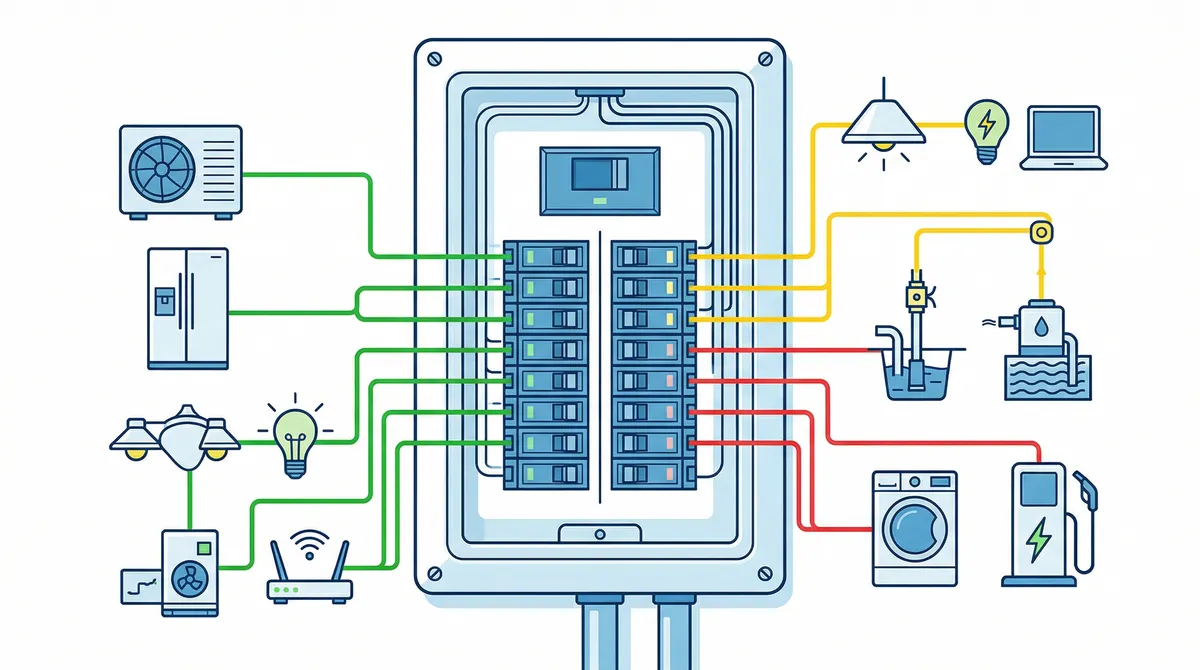
A critical loads panel isolates your highest-priority circuits so your battery only powers what matters. Ideal for single-battery installations.
Powers every circuit in your home simultaneously. Required for large loads like electric dryers, EV chargers, and well pumps.
This is the decisive advantage for batteries in Massachusetts. Generators cannot participate in demand response and earn $0. Batteries earn money whether or not there is an outage.
Generators cannot participate in ConnectedSolutions or any demand response program. They sit idle 99% of the year, consuming fuel during testing and maintenance. Over 10 years, a generator costs you $8,000-$15,500 in fuel and maintenance while a battery earnsyou $6,870-$7,470. That is a $15,000-$23,000 financial swing in the battery's favor.
Generator fuel type depends on your location. Natural gas provides unlimited runtime but is not available everywhere. Propane requires tank storage and delivery, which can be delayed during storms.
National Grid + Eversource gas. Most homes have natural gas lines. Standby generator on NG is viable.
National Grid gas covers most of the North Shore. Some coastal areas propane-only.
Suburban areas have gas. Coastal towns (Duxbury, Marshfield) often propane or oil only.
No natural gas infrastructure on Cape Cod or Islands. Propane tanks only. Winter delivery can be delayed in storms.
Worcester and surrounding towns have Eversource gas. Rural areas are propane/oil.
Springfield/Holyoke have gas. Most rural western MA is propane or oil. Long propane delivery times in storms.
During major nor'easters, propane delivery trucks may not be able to reach your home for 2-5 days. If your propane tank runs out during an extended outage, your generator is useless. This is a critical disadvantage in Cape Cod, western MA, and other propane-dependent areas. Solar batteries recharge from sunlight regardless of road conditions or fuel supply chains.
For homeowners who want both ConnectedSolutions revenue and unlimited-runtime insurance, the hybrid approach delivers the best of both worlds.
Most MA outages last 4-12 hours. A single Powerwall 3 covers these silently while earning ConnectedSolutions revenue year-round. No fuel needed, no noise, no CO risk.
For rare multi-day outages (December ice storms, August hurricane remnants), a portable or standby generator provides unlimited runtime. Use only when battery capacity is exhausted.
Wire both through a single automatic transfer switch. Battery activates instantly (milliseconds). If battery depletes, generator starts automatically. Zero gaps in power.
Battery earns $747/yr in ConnectedSolutions + $400/yr in peak shaving. Generator sits idle 99% of the time but provides insurance-like peace of mind for extended events.
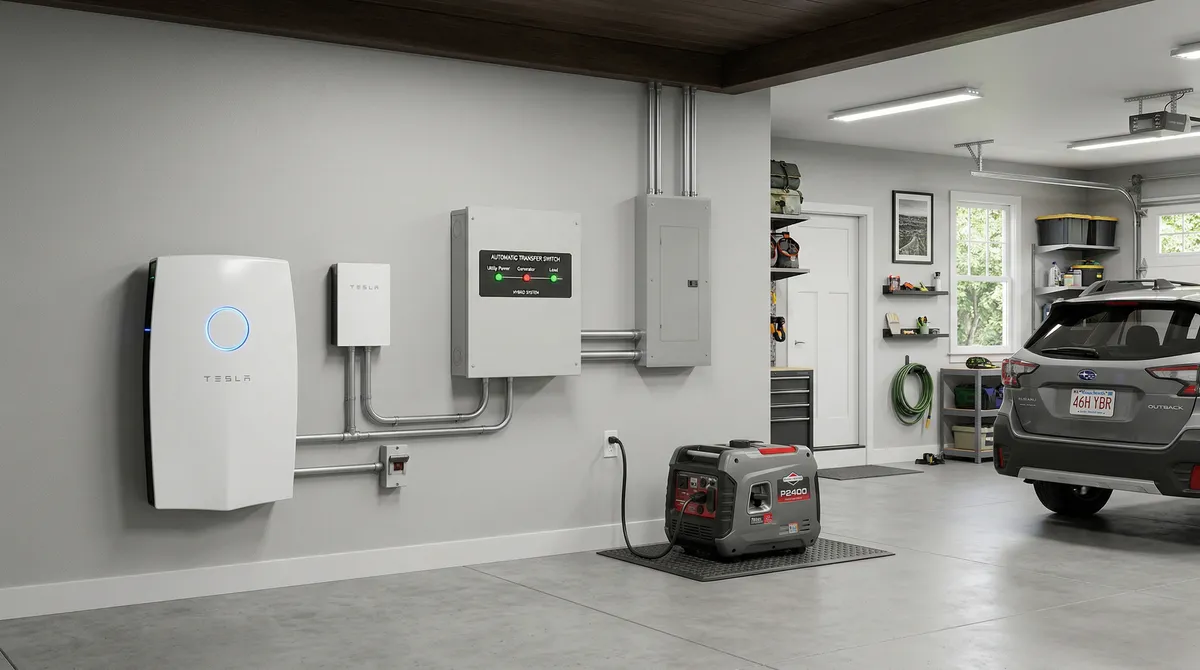
The battery pays for itself through ConnectedSolutions + peak shaving. The generator is pure insurance at $2,000 for peace of mind during the 1-2 extended outages per decade.
Many Massachusetts insurance carriers offer premium discounts for backup power systems. Generator discounts are more widely available today, but battery discounts are growing rapidly.
Tip:Contact your insurance agent before installation. Ask specifically about backup power discounts — many agents do not proactively mention them. Provide documentation of your professionally installed system including model, capacity, and automatic transfer switch details. Some MA carriers (MAPFRE, Plymouth Rock) have specific programs for homes in hurricane/nor'easter zones.
Use this decision framework based on your situation.
Typical outages are 4-12 hours. Battery covers these silently, earns $747/yr from ConnectedSolutions, and adds $7,500 to home value. Natural gas available but unnecessary.
No natural gas infrastructure. Propane delivery unreliable in storms. Solar battery recharges from sunlight regardless of road conditions. Battery is the most reliable option in these areas.
Battery handles 90% of outages and earns ConnectedSolutions revenue. Generator provides unlimited runtime for rare 48+ hour events. Best of both worlds.
Never rely on a single backup system for medical equipment. Battery provides instant, clean power. Standby generator with automatic transfer switch provides unlimited runtime. Both must be professionally installed.
A $1,700 portable generator provides emergency backup today. Save for a battery over 2-3 years. Install solar + battery together to reduce costs and maximize ConnectedSolutions revenue.
All-electric homes draw 15-25 kW during outages. A single battery is not enough. Two Powerwalls (27 kWh) handle most loads. A standby generator adds unlimited runtime for whole-home coverage.
What is the best backup power option for Massachusetts homes in 2026?
For most Massachusetts homeowners, a solar battery like the Tesla Powerwall 3 ($11,000-$13,500 installed) is the best backup power option in 2026. It provides silent, zero-emission backup for typical 4-12 hour outages, earns $747/year through ConnectedSolutions demand response, saves $400/year through peak shaving, and requires zero maintenance. A standby generator ($8,000-$15,000) makes sense for homes in rural areas prone to multi-day outages or properties without natural gas. The hybrid approach — battery for daily use plus generator for extended outages — provides the most comprehensive protection.
How does a Tesla Powerwall 3 compare to a Generac standby generator?
The Tesla Powerwall 3 ($11,000-$13,500) provides 13.5 kWh of storage with 11.5 kW continuous output, earns $747/year through ConnectedSolutions, operates silently, requires no fuel or maintenance, and recharges from solar panels. A Generac Guardian 24kW standby generator ($8,000-$12,000) provides unlimited runtime with fuel, runs your entire home including large appliances, but costs $800-$1,550/year in fuel and maintenance, produces 67 dB of noise, emits exhaust, and earns nothing from demand response. Over 10 years, the Powerwall's total cost of ownership is lower due to $11,470 in earned revenue and savings.
Can ConnectedSolutions pay for a solar battery in Massachusetts?
ConnectedSolutions significantly reduces the net cost of a battery. Eversource pays $275/kW summer + $50/kW winter. A Tesla Powerwall 3 (11.5 kW enrolled) earns approximately $747/year. Over the 10-year warranty period, that is $7,470 in demand response payments. Combined with ~$400/year in peak shaving savings ($4,000 over 10 years) and a $7,500 resale value increase, the total 10-year financial benefit is approximately $18,970 — exceeding the $12,000 average installed cost. National Grid ConnectedSolutions pays $225/kW summer, earning about $687/year.
What is a critical loads panel and do I need one?
A critical loads panel (also called a backup subpanel) is a separate electrical panel that contains only the circuits you want powered during an outage — typically heat pump, refrigerator, lights, Wi-Fi, and medical equipment. It is required when your battery cannot power your entire home simultaneously. A Tesla Powerwall 3 with its 11.5 kW output can back up most homes without a subpanel (whole-home backup). Smaller batteries like a single Enphase IQ 5P (3.84 kW) require a critical loads panel. Your installer configures this during installation.
Is natural gas available for generators everywhere in Massachusetts?
No. Natural gas availability varies significantly across Massachusetts. Greater Boston and metro areas have extensive natural gas infrastructure (National Grid, Eversource gas). However, Cape Cod has no natural gas at all — only propane tanks. Many rural areas in western and central MA also lack gas lines. In these areas, propane generators require tank storage (250-500 gallons for multi-day backup) and delivery, which can be delayed during major storms. This is a significant advantage for solar batteries, which recharge from sunlight regardless of fuel delivery logistics.
Does a solar battery or generator increase home resale value in MA?
Both increase resale value, but batteries have a larger impact. According to Zillow and Redfin data, homes with solar battery storage in Massachusetts sell for $5,000-$10,000 more than comparable homes. Standby generators add $3,000-$5,000. The battery premium is higher because buyers value the combination of backup power, ConnectedSolutions revenue stream, daily utility savings, and zero ongoing costs. A transferable ConnectedSolutions enrollment is particularly attractive to MA buyers familiar with the program.
What is the hybrid battery-generator approach?
The hybrid approach combines a solar battery (for daily use and short outages) with a generator (for extended multi-day outages). The battery activates instantly during outages, runs silently, earns ConnectedSolutions revenue year-round, and handles the 90% of MA outages lasting under 12 hours. If the battery depletes during a rare multi-day event, the generator starts automatically via an integrated transfer switch. This approach costs $15,000-$25,000 total but provides the most comprehensive backup while maximizing financial returns. Some MA insurance carriers offer 10-20% premium discounts for hybrid systems.
Do Massachusetts insurance companies offer discounts for backup power?
Yes. Most MA insurance carriers (Amica, Plymouth Rock, MAPFRE, Liberty Mutual) offer 5-15% premium discounts for professionally installed standby generators with automatic transfer switches. Fewer carriers currently offer battery-specific discounts (3-10%), but this is expanding as adoption grows. Progressive and Nationwide are among carriers recognizing solar batteries. Hybrid systems (battery + generator) can qualify for the highest discounts (10-20%) from premium carriers like Chubb and PURE. Always ask your agent specifically about backup power discounts and document your installation.
How long do power outages last in Massachusetts?
Massachusetts averages 2-5 major outage events per year, primarily from nor'easters (October-April), hurricane remnants (August-September), and ice storms (December-February). Average outage duration is 5-8 hours, but major storms can cause 24-72 hour outages in some areas. Coastal towns, heavily treed neighborhoods, and areas with older infrastructure experience longer restoration times. Eversource and National Grid serve different territories with different restoration speeds. A 13.5 kWh battery covers most outages; a generator or hybrid system is recommended for areas prone to 48+ hour events.
What size battery do I need for backup power in Massachusetts?
For essential loads backup (heat pump eco mode + fridge + lights + Wi-Fi + phones): one Tesla Powerwall 3 (13.5 kWh) provides 10-16 hours. For whole-home backup including sump pump and well pump: two Powerwall 3 units (27 kWh) provide 12-20 hours. For all-electric homes with heat pump, EV, and electric cooking: three units (40.5 kWh) or equivalent. Solar panels recharging during daylight extend all these runtimes significantly. Size for overnight coverage (8-12 hours without sun) as a baseline.
NuWatt installs Tesla Powerwall 3, Generac PWRcell, and Enphase IQ 5P battery systems across Massachusetts. We handle ConnectedSolutions enrollment, permits, and interconnection. Hybrid battery + generator installations also available.
Tesla Certified Installer · NABCEP-certified · ConnectedSolutions enrollment included