Loading NuWatt Energy...

We use your location to provide localized solar offers and incentives.
We serve MA, NH, CT, RI, ME, VT, NJ, PA, and TX
Loading NuWatt Energy...
NuWatt designs, installs, and manages solar, battery, heat pump, and EV charger systems across 9 states. One company, one warranty, one point of contact.
Get a Free Quote
The federal residential solar tax credit (Section 25D) died on December 31, 2025. New Hampshire's state rebate was already repealed in 2024. That is a lot of lost incentive value. But NH still has 4 programs that make solar financially compelling — and the highest electricity rates in the country are the real driver. Here is the honest, complete picture.
The federal residential solar tax credit (Section 25D) expired December 31, 2025. New Hampshire's state solar rebate was permanently repealed by SB 303 in 2024. Homeowners who buy solar with cash or a loan receive $0 in federal or state incentives. However, New Hampshire still has 4 mechanisms that make solar a strong investment:
Bottom line: An 8 kW system at $3.03/W costs $24,240 with no federal or state offset. Over 25 years, NEM savings + property tax exemption generate approximately $80,800 in total value. Payback: ~7.9 years. Not as fast as Massachusetts (7-9 years), but still a solid return driven by New Hampshire's high electricity rates.
Before we cover what still works, let's be honest about what's gone. Many solar websites still list these as available for NH homeowners. They are wrong.
Homeowners who purchase solar with cash or a loan receive $0 in federal tax credits. This was 30% in 2025. Now it is zero. The OBBBA killed the residential ITC.
SB 303 permanently repealed the NH Renewable Energy Fund rebate program that offered $0.20/W up to $1,000. There is no state solar rebate in NH and no plan to reinstate one.
The $2,000 heat pump tax credit and $1,200 insulation/efficiency credit are both dead. These were separate from the solar ITC and also expired under the OBBBA.
New Hampshire lost more than most states when the federal ITC expired, because NH already had fewer state incentives to begin with. Unlike Massachusetts (which has SMART 3.0, ConnectedSolutions, a state tax credit, and dual tax exemptions), NH never had a performance-based incentive or battery demand response program. The loss of the 25D credit and the 2024 SB 303 repeal mean NH homeowners now pay full price for solar with no upfront offsets. The case for solar in NH rests on high electricity rates, strong NEM 2.0 policy, and property tax exemption.
The federal credit was the big loss. The state rebate was already gone. But the 4 remaining programs all survived — and they are the ones that matter for long-term value.
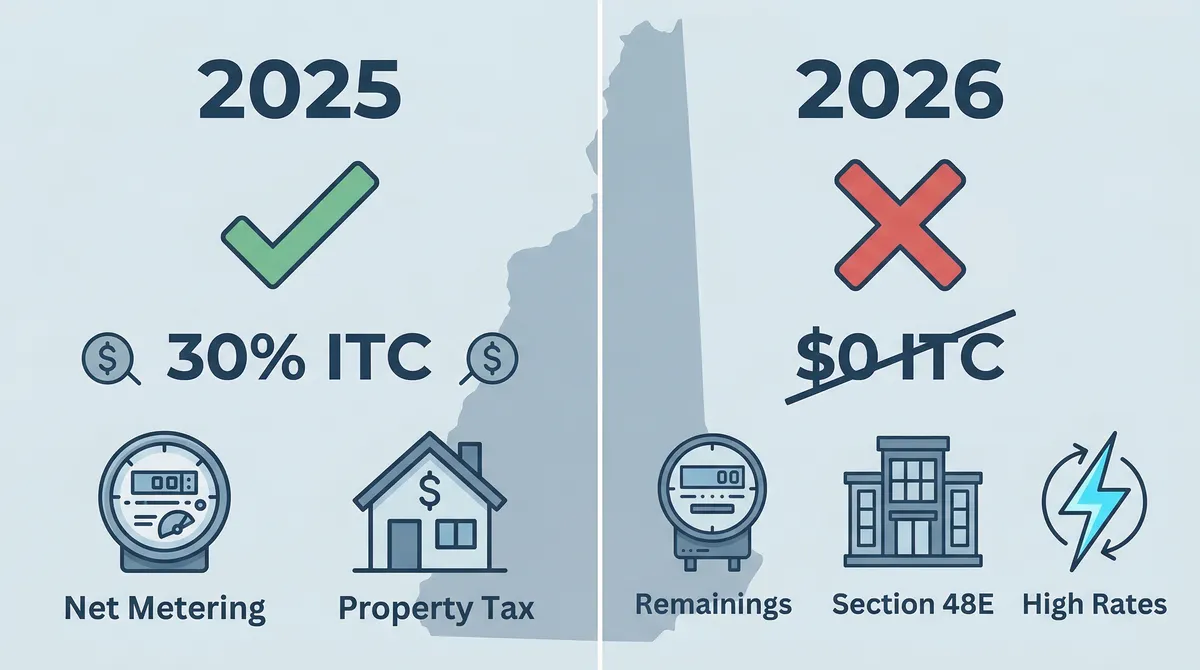
| Incentive Program | 2025 | 2026 | Status |
|---|---|---|---|
| Federal Tax Credit (25D) | 30% of system cost (~$7,272) | $0 — Expired Dec 31, 2025 | Expired |
| NH State Solar Rebate | Already repealed (SB 303, 2024) | $0 — Permanently repealed | Expired |
| NEM 2.0 Net Metering | utility-specific component credit, locked through 2041 | utility-specific component credit, locked through 2041 | Active |
| Property Tax Exemption (RSA 72:62) | 100% exempt (where adopted) | 100% exempt (where adopted) | Active |
| No State Sales Tax | 0% — NH advantage | 0% — NH advantage | Active |
| Section 48E (Lease/PPA) | 30%+ for third-party owner | 30%+, new starts by Dec 31, 2027 | Active |
| Section 25C (Heat Pump) | $2,000 heat pump credit | $0 — Expired Dec 31, 2025 | Expired |
| Community Power (CPCNH) | 40%+ of NH customers | 40%+ of NH customers | Active |
The federal 25D credit was worth approximately $7,272 on a typical 8 kW system. That is a real loss. Combined with the repealed state rebate ($1,000), NH homeowners lost about $8,272 in incentive value compared to buying solar in early 2025. But NEM 2.0 savings and property tax exemption generate $92,500+ in lifetime value for the same system. The math still works — it just takes about 2 years longer to pay back.
Net Energy Metering (NEM) 2.0 is the foundation of solar economics in New Hampshire. When your panels produce more electricity than you use, the excess flows to the grid and you receive bill credits. Unlike Massachusetts (which offers 1:1 retail for small systems), NH NEM 2.0 credits are utility-specific and must be derived from the current tariff.
Credits = 100% supply + 100% transmission + 25% distribution
The resulting credit varies by utility and rate period; it is not a fixed statewide percentage. Credits roll over monthly. Cash out at the $100 threshold.
Under PUC Docket DE 16-576, NEM 2.0 rates are guaranteed through 2041. This gives you 15 years of protected NEM credits if you install in 2026. As electricity rates rise (they have increased 25%+ over the past 3 years in NH), the absolute dollar value of your credits increases too.
Many solar companies in NH incorrectly tell customers they will receive "full retail rate" net metering. That is wrong. NH NEM 2.0 uses utility-specific tariff components. We build estimates from the current tariff rather than a fixed percentage.
Read our complete NH net metering guide for full utility-by-utility breakdown
Based on 9,400 kWh annual production (8 kW system), 70% self-consumed at retail rate, 30% exported at the listed residential reference. *NHEC uses its first 2,000-kWh export tier; additional exports receive $0.1218/kWh. Eligible Unitil small customer-generators taking Default Service receive a tariff-derived $0.20625/kWh; competitive-supplier terms differ.
Under RSA 72:62, New Hampshire municipalities can vote at town meeting to exempt solar energy systems from property tax assessment. Solar panels add value to your home, but in towns that adopt RSA 72:62, that added value is not taxed.
Based on average NH property tax rate. Your actual savings depend on your town's mill rate and assessment methodology.
Some cities (Dover, Laconia, Rochester) have NOT adopted RSA 72:62. Check your town's status
New Hampshire has no state sales tax — period. Solar equipment, installation labor, batteries, inverters — all tax-free automatically. This is not a special solar exemption; it is an inherent advantage of living in NH.
While neighboring states exempt solar from sales tax, NH's 0% rate applies to everything — so there is no risk of an exemption being repealed.
In states without solar sales tax exemptions, a 6-7% sales tax on a $24,240 system adds $1,450-$1,700 to the cost. In NH, this is never a concern.
More importantly, as other states face budget pressures, solar sales tax exemptions could be repealed. NH's no-sales-tax stance is constitutional and extremely unlikely to change.
The residential ITC (Section 25D) is dead. But the commercial ITC (Section 48/48E) is still alive. The begin-construction safe harbor closed July 4, 2026, but new starts still qualify for the 30% credit if the system is placed in service by December 31, 2027. When you sign a solar lease or PPA, the third-party financing company owns the system and claims the 30%+ ITC. They pass the savings to you through lower monthly payments.
July 4, 2026 was the Section 48E begin-construction safe harbor, not an expiration. Projects that began construction on or before that date locked in the full timing pathway (placed in service through roughly 2030). New lease/PPA starts still qualify for the 30% credit, but the system generally must be placed in service by December 31, 2027 — a tighter build schedule.
Read our complete NH lease vs. PPA vs. cash comparison | Section 48 homeowner guide
The Community Power Coalition of New Hampshire (CPCNH) allows 50+ towns to aggregate electricity purchasing at competitive rates, often 5-15% below utility default. This is not a direct solar incentive, but it matters for solar economics.
Select your utility and system size to see your total lifetime value from all remaining NH incentives. No federal credit included — this is real, post-ITC math.
See how New Hampshire incentives combine — honest numbers, no ITC
First-Year Savings
$2,963
NEM + property tax
25-Year Net Savings
$72,509
after $24,240 system cost
Payback Period
8.2 years
then pure savings
25-Year Savings Breakdown
Why NEM credits are utility-specific, not 100%
NH NEM 2.0 credits cover 100% of supply + 100% of transmission, but only 25% of distribution charges. For Eversource, that works out to $0.1996/kWh (69% of the $0.29/kWh retail rate). These terms are locked through January 1, 2041 under Docket DE 16-576.
Estimates based on NH averages ($3.03/W, 1,175 peak sun hours/yr, 2.5% annual rate escalation). Actual values depend on system design, shading, and utility rate changes. Federal residential ITC (Section 25D) expired Dec 31, 2025 — no federal credit is included. NH state solar rebate was repealed by SB 303 (2024).
We believe in honesty. New Hampshire has fewer solar incentives than most of its neighbors. Here is how they stack up.
| State | Avg Rate | Net Metering | State Incentives | Payback | Rating |
|---|---|---|---|---|---|
| Massachusetts | $0.30 | 1:1 retail (≤10 kW) | SMART 3.0, ConnectedSolutions, state credit, dual tax exemptions | 7-9 yrs | Best |
| Rhode Island | $0.29 | tariff-specific renewable credit | Clean Heat RI, REF rebate, REG program, tax exemptions | 8-10 yrs | Very Good |
| Connecticut | $0.29 | 1:1 retail (≤25 kW) | PURA NEM, sales tax exempt, Green Bank loans | 8-10 yrs | Good |
| New Hampshire(You) | $0.27 | utility-specific component credit | Property tax exempt (local), no sales tax | 9-11 yrs | Fair |
| Maine | $0.27 | 1:1 retail | Efficiency Maine rebates, 1:1 NEM, tax exemptions | 12-15 yrs | Fair |
NH has fewer incentives, but the fundamentals are strong. Electricity rates are 48% above the national average and rising. NEM 2.0 is locked through 2041 — that is regulatory certainty most states cannot match. No sales tax is permanent. And the property tax exemption has broad adoption. Solar in NH is a rate-driven investment, not an incentive-driven one. That is actually more sustainable long-term.
Here is the honest math for a typical New Hampshire solar installation in 2026, with zero federal or state rebates factored in.
July 4, 2026 was a begin-construction safe harbor, not an expiration. Projects that began construction on or before it locked in the longer timing pathway; new lease/PPA starts still qualify for the 30% ITC but generally must be placed in service by December 31, 2027.
New Hampshire electricity rates have increased significantly over the past 3 years. Every rate increase makes your solar investment more valuable because it increases the value of your NEM credits. With NEM 2.0 locked through 2041 and rates trending up, the real payback period may be shorter than our 9.5-year estimate.
This is a major regulatory advantage. Many states are actively reducing net metering benefits (see California NEM 3.0). NH has locked NEM 2.0 rates through 2041 via PUC order. Installing now gives you 15 years of guaranteed NEM credits — the longest protection period in the region.
Solar panel and inverter costs have been declining steadily. Even with 2026 tariffs causing some upward pressure, the long-term trend is lower hardware costs. A system that costs $3.03/W today may cost $2.75-$2.85/W in 2027, further improving payback — though waiting means missing the July 2026 Section 48E lease deadline.
New Hampshire has 4 active solar incentive mechanisms in 2026: NEM 2.0 net metering (a utility-specific share of the retail rate, locked through 2041), property tax exemption under RSA 72:62 (~66% of towns, saving ~$584/year), no state sales tax (0% on all purchases including solar), and Section 48E commercial ITC for lease/PPA systems (30%+, with new starts qualifying if placed in service by December 31, 2027). The federal residential 25D credit is $0, and the state solar rebate was repealed by SB 303 in 2024.
No. The federal residential solar tax credit (Section 25D) expired December 31, 2025. Homeowners who buy solar with cash or a loan receive $0 in federal tax credits. However, lease/PPA companies that own the system can still claim Section 48E (30%+) — projects that began construction on or before July 4, 2026 locked in the full credit timing, and new starts still qualify if placed in service by December 31, 2027 — passing savings to you via lower monthly payments.
Yes. SB 303, signed into law in 2024, permanently repealed the New Hampshire state solar rebate program, which had offered $0.20/W up to $1,000. There is no state solar rebate available in New Hampshire in 2026, and there are no plans to reinstate it.
NH NEM 2.0 credits are NOT 1:1 retail rate. The formula is 100% of supply charges + 100% of transmission charges + 25% of distribution charges. The resulting credit is utility-specific and must be derived from the current tariff. Credits roll over monthly and can be cashed out at a $100 threshold. The NEM 2.0 formula is locked through January 1, 2041, under PUC Docket DE 16-576.
Under RSA 72:62, New Hampshire towns can vote to exempt solar energy systems from property tax assessment. Approximately 66% of NH municipalities (about 200 of 300+) have adopted this exemption. For a typical 8 kW system, the exemption saves approximately $584/year in property taxes. You must verify your specific town has adopted RSA 72:62 at town meeting.
The average payback period for solar in New Hampshire is approximately 7.9 years without any federal tax credit (8 kW at $3.03/W in Eversource territory, with the RSA 72:62 property tax exemption). This is driven by high electricity rates ($0.2906-$0.3120/kWh all-in), NEM 2.0 credits (a utility-specific share of retail value), no state sales tax, and property tax exemption in most towns. After payback, you get 15+ years of near-free electricity.
Indirectly, yes. When you sign a lease or PPA, the third-party financing company owns the system and claims the Section 48E commercial ITC (30%+; projects that began construction on or before July 4, 2026 locked in the full credit timing, and new starts still qualify if placed in service by December 31, 2027). They pass savings to you through lower monthly payments. You do not file anything on your tax return. This is the only way to access any federal solar tax benefit in 2026.
Solar value in NH depends on the customer's current utility tariff, supplier, export credit, site production, system cost, load shape, and local tax treatment. NuWatt does not publish a statewide 25-year savings promise from an average rate.
Massachusetts has significantly more solar incentives than New Hampshire. MA has SMART 3.0 ($0.03/kWh for 20 years), ConnectedSolutions battery payments ($225-$275/kW), a state income tax credit ($1,000), 1:1 net metering for small systems, plus sales and property tax exemptions. NH has NEM 2.0 using a utility-specific component credit, property tax exemption (local option), and no sales tax. MA offers roughly $40,000+ more in lifetime incentive value. However, NH installation costs are slightly lower ($3.03/W vs $3.15/W).
The Community Power Coalition of New Hampshire (CPCNH) allows 50+ towns (40%+ of NH customers) to aggregate electricity purchasing at competitive rates, often 5-15% below utility default. Solar customers in CPCNH towns still use their utility for delivery and NEM credits. CPCNH may slightly reduce NEM credit value (supply component could be lower) but it reduces your overall electricity bill, which means your solar savings still hold strong.
The average cost of solar in New Hampshire in 2026 is $3.03 per watt installed. For a typical 8 kW residential system, that is approximately $24,240 before any incentives. Costs range from $2.80/W to $3.30/W depending on your location, installer, panel brand, and roof complexity. There is no federal tax credit or state rebate to offset this cost for cash/loan purchases.
NEM 2.0 rates are guaranteed through January 1, 2041, under PUC Docket DE 16-576. After 2041, the NH Public Utilities Commission will determine new net metering rules. Solar panels typically last 25-30 years, so systems installed in 2026 will be protected for the first 15 years. The post-2041 framework is unknown, but systems will still produce electricity for self-consumption regardless of net metering policy.
Complete guide to going solar after the 25D ITC expired.
NEM 2.0 formula, utility-by-utility rates, rollover rules.
RSA 72:62 property tax exemption and no-sales-tax advantage.
How financing choice affects your incentives and total ROI.
How the commercial ITC works for lease/PPA customers.
Current pricing by city, installer, and panel brand.
Utility rate and NEM comparison for solar customers.
Why bundling maximizes your electricity offset.
Complete New Hampshire solar guide with all resources.
The federal credit is gone and the state rebate was repealed. But NH's high rates, NEM 2.0, and property tax exemption still deliver a ~9.5-year payback. Get a free, no-pressure estimate with honest numbers.