Loading NuWatt Energy...

We use your location to provide localized solar offers and incentives.
We serve MA, NH, CT, RI, ME, VT, NJ, PA, and TX
Loading NuWatt Energy...
NuWatt designs, installs, and manages solar, battery, heat pump, and EV charger systems across 9 states. One company, one warranty, one point of contact.
Get a Free QuoteNH lacks a dedicated income-eligible solar program, but real pathways exist. Section 48 TPO provides $0-down solar through third-party ownership, community solar works for renters, and NH CAP agencies connect eligible households to weatherization and energy assistance. Here is what actually works in 2026.
2026 Reality: The 30% federal solar tax credit (Section 25D) expired December 31, 2025. NH also has no state solar rebate (SB 303 repealed it in 2024). Income-eligible households receive $0 in direct solar credits. Section 48 TPO is your primary pathway. Full details
Since NH has no state solar income program, eligibility depends on which pathway you pursue. Federal energy assistance programs use the Federal Poverty Level (FPL), while Section 48 TPO and community solar are available to everyone.
NH CAP agencies use Federal Poverty Level (FPL) guidelines for energy assistance, weatherization, and LIHEAP. These programs help reduce your energy burden before and alongside solar.
| Household | 100% FPL | 150% FPL | 200% FPL |
|---|---|---|---|
| 1 person | $15,060 | $22,590 | $30,120 |
| 2 persons | $20,440 | $30,660 | $40,880 |
| 3 persons | $25,820 | $38,730 | $51,640 |
| 4 persons | $31,200 | $46,800 | $62,400 |
| 5 persons | $36,580 | $54,870 | $73,160 |
| 6 persons | $41,960 | $62,940 | $83,920 |
LIHEAP: 200% FPL. WAP: 200% FPL. 2025-2026 guidelines. LIHEAP provides $300-$2,800/year in fuel assistance.
May also qualify if enrolled in:
Unlike energy assistance programs, these solar pathways have no income requirements. They are especially valuable for households that need $0-down options.
No-income-requirement options:
Key reality: NH is one of the least generous states for income-eligible solar. No state rebate, no state adder, no dedicated LMI program. Section 48 TPO (PPA/lease) is your strongest option for $0-down solar with immediate savings.
Contact your regional CAP agency for energy assistance, weatherization referrals, and connection to solar programs. Or call 2-1-1 NH for referrals.
While NH has no state solar incentive, four pathways help income-eligible households access solar energy. The strongest option is Section 48 TPO for $0-down rooftop solar.
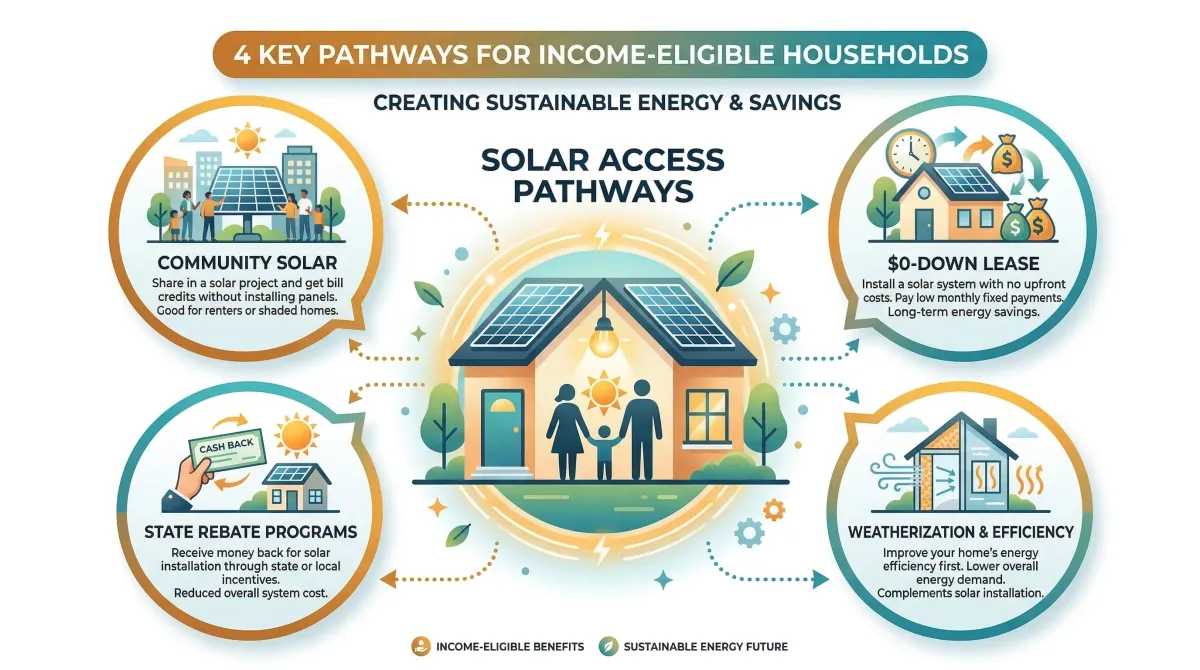
The primary pathway for income-eligible NH households. A third-party system owner installs solar on your roof at $0 upfront, claims the 30% commercial ITC under Section 48/48E, and passes savings through as lower monthly lease or PPA payments. You save on your electric bill from day one without any capital investment.
Eligibility
Available to all NH homeowners regardless of income. Especially valuable for income-eligible households who cannot afford a cash purchase.
How to Access
Request quotes from solar installers offering lease or PPA options. The installer partners with a financing company that owns the system and claims the 30% ITC.
Example Value
For a 9 kW system: typical PPA rate of $0.12-$0.16/kWh vs. utility rate of $0.27/kWh. Net savings of $1,100-$1,500/year with $0 upfront.
Subscribe to a share of a local solar farm without any rooftop installation. Receive bill credits on your utility statement each month. Available to renters, condo owners, and homeowners with shaded roofs. Some NH community solar programs offer LMI carve-outs with enhanced savings.
Eligibility
Any Eversource, Liberty, Unitil, or NHEC customer with an active account. No credit check or income requirement for basic subscriptions.
How to Access
Search for NH community solar projects accepting subscribers in your utility territory. Sign a subscription agreement with no upfront cost.
Example Value
For a $200/month electric bill: 10% savings = $240/year. Some LMI programs offer up to 20% discount on subscription fees.
Over 40% of NH electricity customers now participate in Community Power programs through the CPCNH. Some community power plans offer lower default rates and renewable energy options that pair well with solar. While not solar-specific, reduced electricity costs improve the economics for income-eligible households considering solar.
Eligibility
Residents in CPCNH-participating municipalities. You are automatically enrolled unless you opt out.
How to Access
Check if your municipality participates in CPCNH at communitypower.nh.gov. You may already be enrolled.
Example Value
CPCNH rates vary by municipality but have historically been 1-5% below default utility rates, saving $30-$150/year on a typical bill.
New Hampshire Community Action Program (CAP) agencies provide energy assistance, bill payment help, and can connect income-eligible households to weatherization and solar programs. CAP agencies administer LIHEAP fuel assistance ($300-$2,800/year), Weatherization Assistance Program (WAP), and can refer to solar opportunities.
Eligibility
Household income at or below 200% Federal Poverty Level (FPL) for LIHEAP. WAP eligibility at 200% FPL. Varies by program.
How to Access
Contact your regional CAP agency directly. NH has six regional agencies covering all counties. Call 2-1-1 NH for referrals.
Example Value
LIHEAP: $300-$2,800/year fuel assistance. WAP: $7,000-$10,000 average weatherization value per home. Reduces energy burden before solar.
Illustrative savings for an income-eligible New Hampshire household with average residential electricity use. Your actual savings depend on your home, your roof, and your utility.
Average residential electric bill for a typical New Hampshire household paying full retail rates to the utility.
Solar covers roughly 85% of household consumption; remainder is utility minimum charges and grid-pull on cloudy stretches.
25-year figure assumes a 3% annual electric-rate increase, consistent with EIA historical residential rate trends in New Hampshire. Income-eligible program coverage can reduce or eliminate upfront cost; savings begin immediately at system turn-on.
NH solar costs $2.83-$3.23 per watt in 2026. An average 9 kW system runs $25,470-$29,070 before incentives. With no state rebate and no federal ITC for homeowners, here is what income-eligible households actually face.
Full system cost with zero direct incentives. NH has no sales tax, which is a small advantage. Property tax exemption saves money ongoing but does not reduce purchase price.
10,350 kWh x ~$0.20/kWh effective NEM rate (~69% of $0.292 Eversource retail)
$27,270 x 2.0% avg rate (in ~66% of towns that adopted)
1-5% below default utility rate in participating towns
NEM credits + property tax savings + CPCNH savings. Simple payback: approximately 9-9.5 years for cash purchase. 25-year value: $73,875-$76,875.
| System Size | Cost Range | Annual NEM Credits | Simple Payback |
|---|---|---|---|
| 5 kW | $14,150-$16,150 | $1,322/yr | 10.2-11.7 yr |
| 7 kW | $19,810-$22,610 | $1,852/yr | 10.2-11.7 yr |
| 9 kW | $25,470-$29,070 | $2,381/yr | 10.2-11.7 yr |
| 11 kW | $31,130-$35,530 | $2,910/yr | 10.2-11.7 yr |
| 13 kW | $36,790-$41,990 | $3,439/yr | 10.2-11.7 yr |
Costs based on $2.83-$3.23/W range. Annual production assumes 1,150 kWh/kW NH average. NEM credits at ~69% retail (~$0.20/kWh effective). No sales tax in NH.
With Section 25D expired and no NH state rebate, homeowners pay the full system cost for cash and loan purchases. But Section 48 TPO creates a $0-down option that is particularly valuable for income-eligible households.
While Section 25D (homeowner ITC) is dead, Section 48/48E (commercial ITC) remains active. Its begin-construction safe harbor closed July 4, 2026, but new starts still qualify if placed in service by December 31, 2027. When you sign a PPA or lease, the third-party system owner claims the 30% ITC and passes the savings through as lower monthly payments. In NH, this is the single most important pathway for income-eligible households.
Typical NH PPA rate: $0.12-$0.16/kWh vs. utility rate of $0.25-$0.27/kWh. Immediate savings with zero capital investment. Section 48 Homeowner Guide
Without a state-subsidized loan program (like CT Green Bank), NH homeowners rely on standard solar loans. Rates range from 6-9% APR depending on credit. Income-eligible households should strongly consider PPA/lease over loans since there is no ITC to offset loan payments.
| Term | Typical APR | Monthly ($27K) |
|---|---|---|
| 5 years | 6.0-7.0% | $522-$535 |
| 10 years | 6.5-7.5% | $307-$321 |
| 15 years | 7.0-8.5% | $243-$266 |
| 20 years | 7.5-9.0% | $217-$243 |
Standard solar loan rates. No state-subsidized loan program in NH. Consider PPA/lease instead if you lack the ITC benefit. Cash vs Loan vs Lease in NH
NH has no sales tax and no state income tax, which eliminates two potential incentive pathways. The property tax exemption is the only state-level tax benefit for solar.
Towns that adopt RSA 72:62 at town meeting exempt solar from property tax assessment. About 66% of NH towns have adopted it. Solar does NOT increase your property tax.
25-year value: ~$13,625. Check with your town assessor.
New Hampshire has no state sales tax. This means you pay no sales tax on solar equipment or installation regardless. Not an incentive per se, but an advantage vs. states with 6-7% sales tax.
Compared to MA (6.25%) or ME (5.5%), NH saves $1,500-$1,700 on a 9 kW system just by having no sales tax.
NH has no state income tax on wages/salary. This means there is no state income tax credit pathway for solar (unlike states like NY or SC that offer state solar tax credits).
No income tax means no state tax credit is possible.
Bottom line for NH: The RSA 72:62 property tax exemption is your only state tax benefit. Verify your town has adopted it. If not, consider petitioning at the next town meeting. Full NH Solar Tax Guide
If rooftop solar is not an option -- because you rent, live in a condo, have heavy tree shading, or cannot afford installation -- community solar offers a path to solar savings with zero equipment on your property.
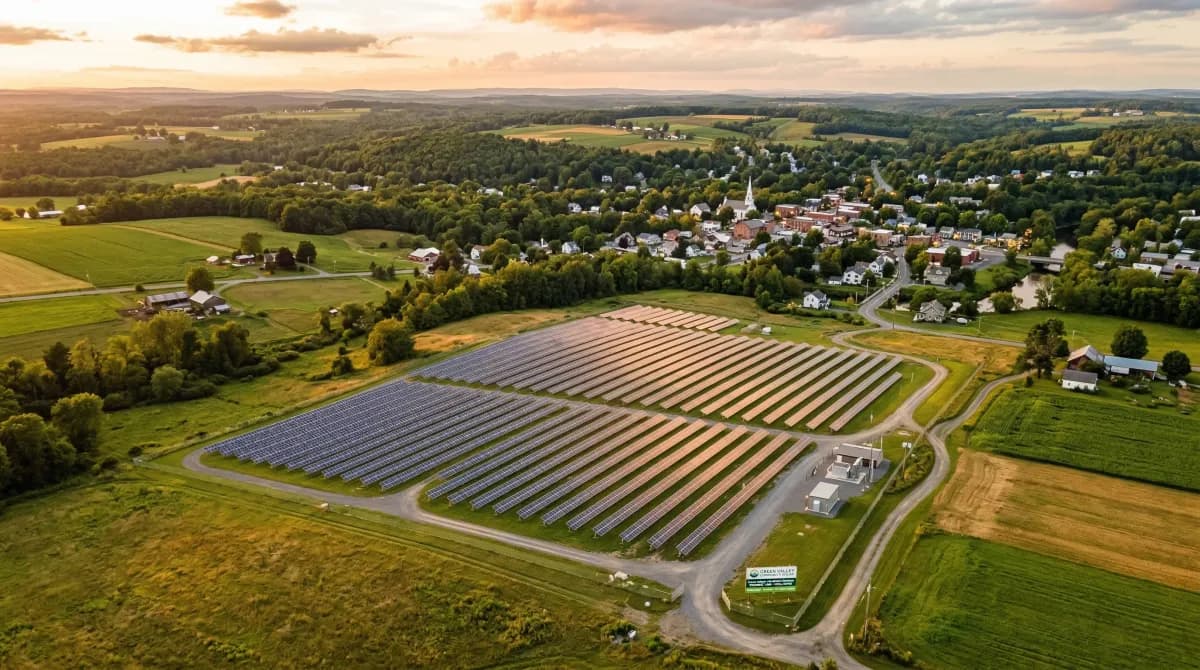
Subscribe to a local solar project
Sign up for a share of a community solar farm in your utility territory.
Solar farm generates electricity
The off-site solar installation feeds clean electricity into the grid.
Receive bill credits
You receive bill credits on your Eversource, Liberty, Unitil, or NHEC statement for your share.
Save on your electric bill
Your subscription fee is lower than the credits you receive -- net savings of 5-15%.
NH community solar is growing but still has fewer options than neighboring MA or RI. Check availability in your utility territory regularly as new projects come online.
Follow these five steps to access solar as an income-eligible household in New Hampshire. Start with energy assistance and work through to solar installation.
Determine your household income relative to Federal Poverty Level guidelines. If you are at or below 200% FPL, contact your regional NH CAP agency for energy assistance and weatherization referrals. Even if you are above the threshold, Section 48 TPO and community solar are available to all income levels.
If income-eligible, your local CAP agency can help with LIHEAP fuel assistance, WAP weatherization (insulation, air sealing), and referrals to solar programs. Complete weatherization before solar to reduce your energy needs and maximize solar savings. Call 2-1-1 NH for your regional agency.
Request quotes from at least three solar installers. Specifically ask about PPA and lease options where the third-party owner claims the Section 48 ITC. Compare the PPA rate (typically $0.12-$0.16/kWh) against your current utility rate ($0.25-$0.27/kWh). Also ask about community solar if your roof is not ideal.
Verify whether your municipality has adopted RSA 72:62 solar property tax exemption. About 66% of NH towns have adopted it. If your town has not, consider petitioning at the next town meeting. The exemption prevents your property tax from increasing when solar is installed.
System is installed and your installer submits NEM 2.0 interconnection paperwork to your utility. Net metering credits at approximately 69% of retail rate begin once the system is producing electricity. For PPA/lease systems, the third-party owner handles all utility paperwork.
2-1-1 NH
211nh.org
Referrals to all NH assistance programs
NH PUC (Net Metering)
puc.nh.gov
NEM 2.0 questions and complaints
CPCNH
communitypower.nh.gov
Community power program info
Common questions about solar options for income-eligible households in New Hampshire for 2026.
No. Unlike states such as Connecticut (RRES adder) or Massachusetts (SMART low-income adder), NH does not have a state-funded income-eligible solar incentive. The state solar rebate was repealed by SB 303 in 2024. The primary pathway for income-eligible NH households is Section 48 TPO (lease/PPA), where a third-party owner claims the 30% commercial ITC and you benefit from lower monthly payments with $0 upfront.
No. The federal residential solar tax credit (Section 25D) expired December 31, 2025 for all homeowners regardless of income. There is $0 federal credit for cash or loan solar purchases. The only way to indirectly benefit from a federal credit is through a PPA or lease, where the third-party system owner claims the 30% commercial ITC under Section 48/48E. Its begin-construction safe harbor closed July 4, 2026, but new starts still qualify if placed in service by December 31, 2027. This benefit is passed through as lower PPA/lease payments.
Section 48/48E allows commercial entities to claim a 30% Investment Tax Credit on solar installations. When you sign a solar PPA or lease, the third-party system owner claims this credit and passes the savings through as lower monthly payments. For income-eligible NH households, this means $0 upfront cost and immediate bill savings. The PPA rate (typically $0.12-$0.16/kWh) is well below utility rates ($0.25-$0.27/kWh). The Section 48 begin-construction safe harbor closed July 4, 2026; new starts place in service by December 31, 2027.
Yes. Renters can subscribe to community solar with no rooftop installation and no upfront cost. You receive bill credits on your utility statement for your share of production from an off-site solar farm. You just need an active utility account with Eversource, Liberty, Unitil, or NHEC. Some community solar programs offer enhanced savings for LMI subscribers.
NH Net Metering 2.0 credits solar production at approximately 69% of the retail rate (100% supply + 100% transmission + 25% distribution). This is not 1:1 but is still valuable. For a 9 kW system producing 10,350 kWh/year at $0.27/kWh retail, annual NEM credits are approximately $2,380. These rates are locked through 2041. For PPA/lease systems, the third-party owner receives the NEM credits and factors them into your lower PPA rate.
The Weatherization Assistance Program (WAP) provides free home energy improvements for income-eligible NH households (at or below 200% FPL). Services include insulation, air sealing, heating system repair/replacement, and health and safety measures. Average value is $7,000-$10,000 per home. Complete weatherization before solar installation to reduce your energy needs and maximize solar savings. Contact your regional NH CAP agency to apply.
Yes. The RSA 72:62 solar property tax exemption is available in approximately 66% of NH towns that have adopted it at town meeting. It prevents your property tax from increasing when solar is installed. This benefits all homeowners regardless of income level. For a $30,000 solar installation in a town with a 2% tax rate, that is $600/year in avoided property tax increases. Check with your town assessor to verify adoption.
The Community Power Coalition of NH (CPCNH) allows municipalities to aggregate electricity purchasing for residents. Over 40% of NH customers now participate. While CPCNH does not directly fund solar installations, lower default electricity rates improve the economics of solar by reducing your baseline cost. Some community power programs are exploring solar-specific initiatives for LMI households. Check communitypower.nh.gov for your municipality.
The NH state solar rebate was repealed by SB 303 in 2024. There is no state-funded rebate for residential solar installations in NH. Combined with the expiration of the federal Section 25D ITC in December 2025, NH solar economics now rely on NEM 2.0 credits (~69% retail), property tax exemption (RSA 72:62 in ~66% of towns), and Section 48 TPO for $0-down options. Despite no rebates, NH solar payback is approximately 9.5 years due to high electric rates ($0.27/kWh average).
Timeline varies by pathway. For PPA/lease (Section 48 TPO): 2-4 months from first quote to producing solar. Includes site assessment (1-2 weeks), contract signing, permitting (2-4 weeks), installation (1-3 days), and utility interconnection (4-8 weeks). For community solar: subscriptions can begin within 1-2 billing cycles. If pursuing WAP weatherization first, add 2-3 months for the CAP agency process. Plan for 4-6 months total if combining weatherization with solar.
NH Solar Guide 2026
Complete overview of solar programs, costs, and incentives in NH.
NH Solar Panel Cost 2026
Detailed cost breakdown by city and system size.
Section 48 Homeowner Guide
How third-party ownership makes solar $0 down in NH.
NH Community Solar
No-rooftop solar option for renters and condos.
Cash vs Loan vs Lease in NH
Side-by-side financing comparison for every budget.
Solar Without the Tax Credit
Why NH solar still works even without the 25D ITC.
NH may lack a state solar program, but Section 48 TPO, community solar, and energy assistance programs create real pathways to affordable solar. Get a personalized assessment of your options today.
Free, no-obligation assessment. We will help you find the best solar pathway for your situation.