Loading NuWatt Energy...

We use your location to provide localized solar offers and incentives.
We serve MA, NH, CT, RI, ME, VT, NJ, PA, and TX
Loading NuWatt Energy...
NuWatt designs, installs, and manages solar, battery, heat pump, and EV charger systems across 9 states. One company, one warranty, one point of contact.
Get a Free Quote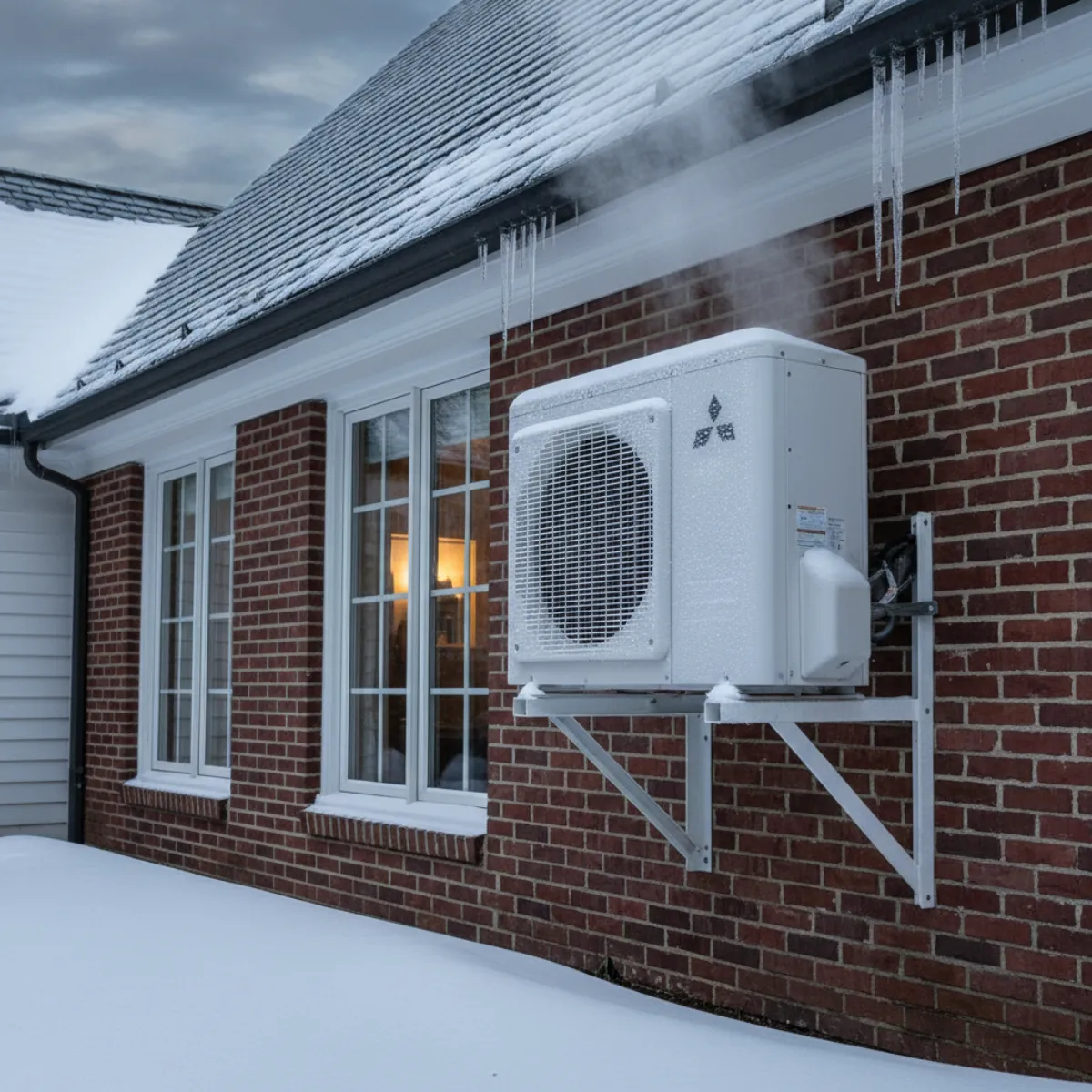
“Do heat pumps work in New Jersey winters?” — It’s the #1 question NJ homeowners ask. The answer: modern cold climate heat pumps maintain full capacity at 5°F and keep heating to -22°F. Here’s the real performance data for NJ’s climate zones.
Quick Answer
Modern cold climate heat pumps operate efficiently down to -13°F to -20°F, well below NJ's design temperatures (10-18°F depending on region). Top models for NJ include Mitsubishi Hyper-Heat, Daikin Aurora, and Bosch IDS 2.0, which maintain 75-80% rated capacity at 5°F.
Heat pump sizing starts with your design temperature — the coldest outdoor temperature your system must handle. NJ spans two ASHRAE climate zones, which means heat pump requirements differ significantly from North to South:
Coldest NJ region. Higher elevations (Sussex Co.) can see -5°F. Dual fuel recommended unless building envelope is tight.
Mix of 4A and 5A zones. Most homes work well with cold climate heat pumps. Dual fuel optional.
Ocean moderates temperatures. Mildest NJ zone. All-electric heat pump works well. Salt air corrosion requires coastal-rated outdoor units.
Moderate climate. All-electric heat pump viable for most homes. Closest NJ region to Philadelphia climate data.
What does “design temperature” mean?It’s the outdoor temperature that your area drops to or below for only 1% of winter hours (about 22 hours per heating season). Your heat pump must provide 100% of your home’s heating load at this temperature. For the other 99% of winter hours, NJ temperatures are warmer — and your heat pump runs more efficiently.
Standard heat pumps from 10 years ago struggled below 30°F. Modern cold climate heat pumps (ccHPs) use three key technologies that make them fundamentally different:
Instead of cycling on/off, ccHPs modulate compressor speed from 20% to 120%+ of rated capacity. When it’s cold, the compressor ramps up. When mild, it idles at low speed. This delivers steady heat and avoids the efficiency losses of constant cycling.
EVI uses a secondary refrigerant circuit to inject vapor into the compressor at mid-pressure. This increases heating capacity at low temps by 20–30%. It’s the key technology that lets Mitsubishi Hyper-Heat maintain full output at 5°F.
Old heat pumps ran timed defrost cycles every 60–90 minutes, wasting energy. Modern ccHPs use demand-based defrost — sensors detect actual frost buildup and defrost only when needed. This can reduce defrost energy loss by 50% or more.
We install all four of these brands in NJ. Here’s how they perform at the temperatures that matter for New Jersey homeowners:
MUZ-FS series / SUZ-KA | Ductless & ducted
Most proven cold-climate brand in NJ. Maintains full rated capacity down to 5°F. Market leader in North NJ installations.
DZ20VC /DERA series | Ducted central
Best low-temperature rating (-20°F). Side-discharge design fits tight NJ suburban lots. Strong choice for full gas-replacement in any NJ zone.
BOVA series | Ducted central
Best ducted central replacement for existing forced-air systems. Integrates easily with any gas furnace brand for dual-fuel setups. Popular in Central NJ.
25VNA024/036/048 | Ducted central
Highest HSPF2 in our lineup. Integrates natively with Carrier Infinity furnaces for seamless dual-fuel. Strong premium pick for North NJ.
Here’s what it actually costs to heat a typical 2,000 sq ft NJ home per hour with a cold climate heat pump at NJ electric rates (~$0.18/kWh), based on a 3-ton system:
| Outdoor Temp | COP | Cost/Hour | Context |
|---|---|---|---|
| 47°F (mild winter day) | 3.8 | $0.47 | Peak efficiency — 280% more efficient than gas |
| 35°F (typical NJ winter) | 3 | $0.60 | Still 200% more efficient than resistance heat |
| 25°F (cold NJ night) | 2.4 | $0.75 | Comparable to gas furnace operating cost |
| 17°F (design temp, Central NJ) | 2 | $0.90 | Still 100% more efficient than resistance heat |
| 5°F (extreme cold snap) | 1.7 | $1.06 | Slightly more expensive than gas but rare in NJ |
| -5°F (polar vortex, rare) | 1.3 | $1.38 | Backup heat may engage; occurs <1% of NJ heating hours |
A 96% AFUE gas furnace costs about $0.85–$1.10/hour to heat the same home at NJ gas rates (~$1.20/therm). A heat pump is cheaper at any outdoor temp above ~20°F, which covers roughly 85–90% of NJ heating hours.
Electric baseboard or space heaters cost $1.80/hour to produce the same heat (COP = 1.0). Even at 5°F, a cold climate heat pump is 50–130% cheaper than electric resistance.
This is the most important decision NJ homeowners face. The right choice depends on your NJ region, home characteristics, and risk tolerance:
Best annual savings: $800–$1,400/yr vs. gas
Best annual savings: $600–$1,200/yr vs. gas-only
Our recommendation for NJ:If you’re in Zone 4A (Central, Shore, or South NJ) and your home has reasonable insulation, an all-electric cold climate heat pump is the smarter long-term play. If you’re in Zone 5A (North NJ) or your home has significant air leakage, dual fuel gives you 80–90% of the savings with a reliable safety net. Either way, a properly sized cold climate heat pump will cut your heating bills by 40–65%.
Misinformation about heat pump cold-weather performance persists. Here are the most common myths we encounter from NJ homeowners, with data-backed responses:
Myth: “Heat pumps don't work below freezing”
FALSEReality: Modern cold climate heat pumps maintain full heating capacity down to 5°F (Mitsubishi) or -5°F (Carrier). They continue producing useful heat to -13°F to -22°F. NJ rarely drops below 5°F even in North Jersey.
Myth: “Heat pumps are just expensive space heaters when it's cold”
FALSEReality: Even at 5°F, a cold climate heat pump delivers a COP of 1.5–2.3, meaning it produces 1.5–2.3 units of heat per unit of electricity. A resistance heater (space heater) has a COP of exactly 1.0. So even in NJ's coldest weather, a heat pump is 50–130% more efficient than resistance heat.
Myth: “You'll need backup heat in NJ”
MOSTLY FALSEReality: For most NJ homes (ASHRAE 4A): not necessarily. A properly sized cold climate heat pump can handle NJ design temperatures of 14–18°F as sole heat source. For North NJ (ASHRAE 5A, design temp 10°F), backup heat provides a comfort margin but modern ccHPs can operate as primary heat.
Myth: “Your electric bill will double in winter”
MISLEADINGReality: A typical NJ home spending $2,400/yr on gas heating switches to roughly $1,000–$1,600/yr in electricity for a heat pump at NJ rates (~$0.18/kWh). Your electric bill goes up, but your gas bill drops to near zero. Net savings: $800–$1,400/yr.
Myth: “Heat pumps are too noisy for NJ suburban neighborhoods”
FALSEReality: Modern variable-speed heat pumps run at 55–65 dB at full capacity (normal conversation level) and 40–45 dB at low capacity (quieter than a refrigerator). NJ noise ordinances typically set 65 dB limits at property lines. A heat pump at the side of your house is well within code.
To qualify for maximum NJ rebates, your heat pump must meet NJ Clean Energy’s cold climate performance standards. Here are the current thresholds:
Section 25C expired Dec 31, 2025 — no federal heat pump tax credit in 2026
All four models in our recommended lineup exceed NJ Clean Energy requirements. Your NuWatt installer will verify compliance and handle the rebate application paperwork.
Yes. Modern cold climate heat pumps (ccHPs) are specifically engineered for mid-Atlantic and northeastern climates. The Mitsubishi Hyper-Heat maintains 100% heating capacity at 5°F, and the Carrier Infinity continues heating to -22°F. NJ's design temperatures (10–18°F depending on region) are well within the operating range of current ccHP technology. Thousands of NJ homes are already heated exclusively by heat pumps.
New Jersey spans two ASHRAE climate zones. North NJ (Bergen, Passaic, Sussex, Warren, Morris counties) falls in Zone 5A with a heating design temperature of 10°F. The rest of NJ (Central, Shore, and South) falls in Zone 4A with design temperatures of 14–18°F. Zone 4A covers most of the NJ population.
At typical NJ winter temperatures (25–35°F), expect a COP of 2.4–3.0 from a cold climate heat pump. At NJ design temperatures (10–18°F), COP ranges from 2.0–2.8. Even at 5°F during extreme cold snaps, modern ccHPs maintain a COP of 1.5–2.3. For context, a gas furnace equivalent COP is approximately 0.9–0.95, and electric resistance heat is 1.0.
It depends on your NJ region and home. For South NJ and Shore (Zone 4A, design temp 14–18°F), all-electric heat pumps work well for most homes. For North NJ (Zone 5A, design temp 10°F), dual fuel is a pragmatic choice — especially if you already have a gas furnace in good condition. NJ gas at ~$1.20/therm is cheap enough that the economic penalty of gas backup on the coldest days is minimal.
In a dual-fuel system, the switchover point (balance point) is typically set at 25–35°F. Above that temperature, the heat pump runs exclusively. Below it, the gas furnace takes over. For all-electric systems, backup electric resistance strips activate when the heat pump can't meet demand — typically below 5–10°F in NJ. With properly sized cold climate units, backup heat activates less than 2–5% of annual heating hours.
No. The Section 25C energy efficiency tax credit expired December 31, 2025. There is no federal tax credit for heat pumps in 2026. NJ state incentives remain available: NJ Clean Energy Whole Home rebates up to $7,500, plus utility rebates from PSE&G (up to $900), JCP&L ($500–$1,000), and ACE (up to $1,300).
Yes. NJ Clean Energy requires heat pumps to meet ENERGY STAR cold climate criteria for maximum rebates: HSPF2 ≥ 9.0 and EER2 ≥ 10.0 for ducted systems, or HSPF2 ≥ 9.5 and SEER2 ≥ 16.0 for ductless. All four models in our recommended lineup (Mitsubishi, Daikin, Bosch, Carrier) exceed these requirements.
Cold climate heat pumps cost $12,000–$22,000 installed in NJ for ducted central systems, or $4,000–$8,000 for single-zone ductless. After NJ Whole Home rebates ($2,000–$7,500) and utility rebates ($500–$1,300), net cost ranges from $5,000–$18,000. See our NJ heat pump cost guide for detailed pricing by system type and region.
Work directly with NuWatt's NJ heat pump team for Manual J heat load calculations and properly sized cold climate systems for your specific NJ zone.
Get Free Quotes