Loading NuWatt Energy...

We use your location to provide localized solar offers and incentives.
We serve MA, NH, CT, RI, ME, VT, NJ, PA, and TX
Loading NuWatt Energy...
NuWatt designs, installs, and manages solar, battery, heat pump, and EV charger systems across 9 states. One company, one warranty, one point of contact.
Get a Free Quote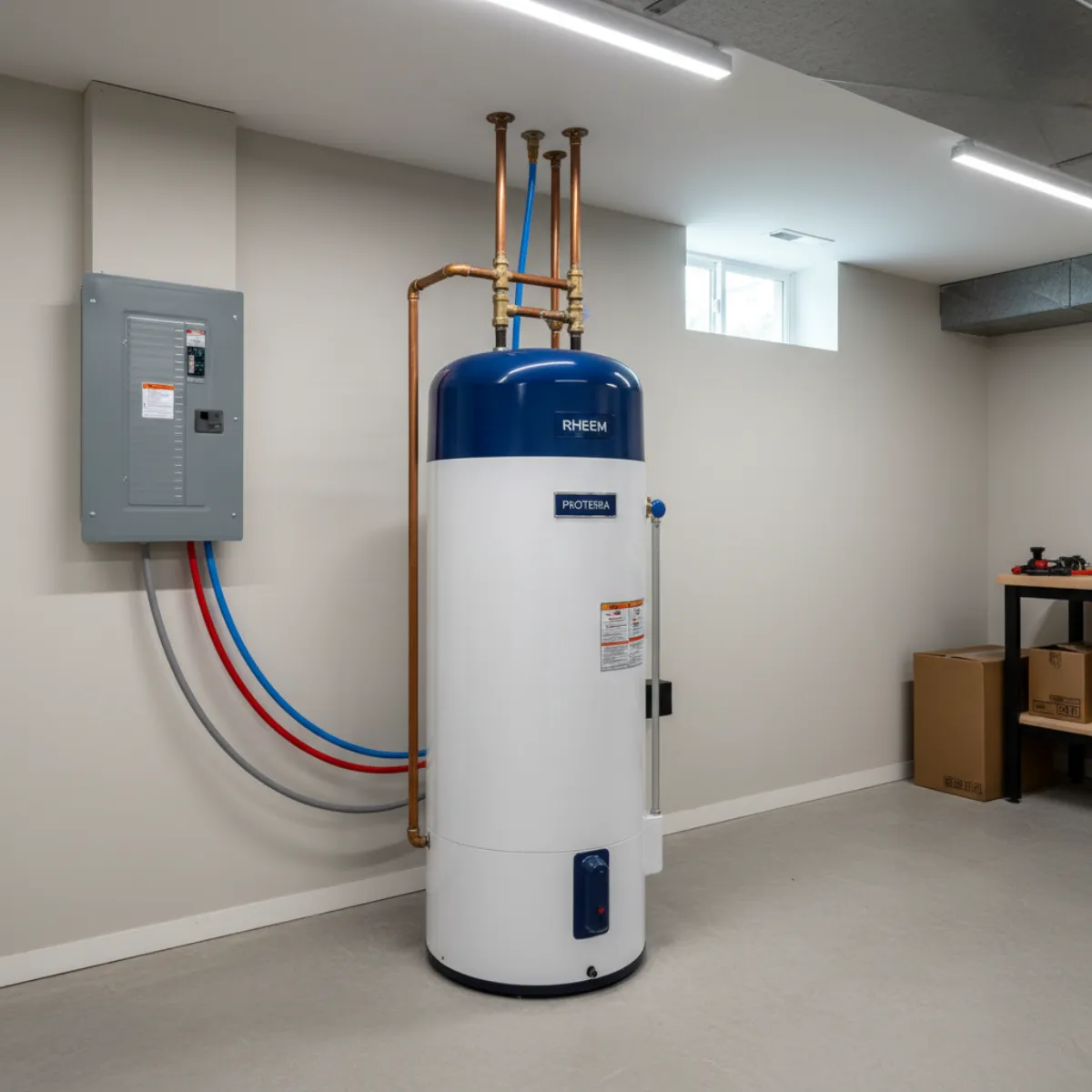
A heat pump water heater (HPWH) uses 60–70% less energy than a conventional electric tank and costs $200–$400 less per year to run. New Jersey’s basements are ideal for HPWHs, and state rebates up to $1,000 make the payback even faster. Here’s everything NJ homeowners need to know before buying.
Quick Answer
A heat pump water heater in NJ costs $2,500-$4,500 installed and saves $200-$400 per year compared to a standard electric tank. NJ Clean Energy offers $500-$1,000 in rebates, and utilities like PSE&G and JCP&L provide additional rebates. Top brands include Rheem ProTerra, AO Smith Voltex, and Bradford White AeroTherm.
A heat pump water heater doesn’t generate heat directly like a gas burner or electric resistance element. Instead, it uses a small compressor and refrigerant cycle to move heat from the surrounding air into the water tank — the same principle as an air-source heat pump or a refrigerator running in reverse.
A fan draws warm ambient air across an evaporator coil filled with cold refrigerant. The refrigerant absorbs heat from the air, even at temperatures as low as 40°F.
A compressor pressurizes the refrigerant, dramatically increasing its temperature to 120–140°F. This is where the small amount of electricity is used.
The hot refrigerant passes through a condenser coil wrapped around the water tank, transferring its heat to the water. The refrigerant cools and the cycle repeats.
The efficiency advantage:For every 1 kWh of electricity consumed, a HPWH produces 3–4 kWh of water heating energy (UEF of 3.0–4.0+). A conventional electric tank produces just 0.9 kWh per kWh consumed. That’s a 300–400% efficiency advantage — which translates directly to lower NJ electric bills.
New Jersey’s housing stock is actually well-suited for heat pump water heaters. Here’s why your NJ basement may be the perfect location:
Consistent basement temperatures
NJ basements typically maintain 50–65°F year-round thanks to below-grade insulation from the earth. This is well within the 40–120°F optimal range for HPWHs. Even in January, NJ ground temperatures at basement depth stay around 45–50°F.
Free dehumidification
HPWHs pull moisture from basement air as a byproduct of operation — typically 3–8 gallons per day. NJ basements are notorious for dampness, especially in summer. Many NJ homeowners report eliminating their standalone dehumidifier after installing a HPWH, saving an additional $50–$100/year in dehumidifier electricity.
Ample space
HPWHs need 700–1,000 cubic feet of ambient air. A typical NJ basement (even a small 600 sq ft basement with 7-foot ceilings = 4,200 cubic feet) far exceeds this requirement. NJ homes built in any era — from 1920s rowhouses to 2020s colonials — usually have adequate basement space.
Existing infrastructure
NJ basements already have water supply lines, drain access, and often a 240V circuit from a previous electric water heater. Gas-heated homes may need a new circuit, but the plumbing infrastructure is typically in place.
One caveat: unheated garages
If your water heater is in an attached but unheated garage (common in some South NJ ranch-style homes), winter temperatures can drop below 40°F. In these locations, the HPWH will fall back to electric resistance mode more often, reducing savings. Consider insulating the garage or relocating to the basement.
Here’s what each water heater type costs to run annually in New Jersey, based on average NJ electricity rates of ~$0.18/kWh and gas rates of ~$1.50/therm for a family of four:
| Water Heater Type | Annual Cost | Annual Energy | CO2 (lbs/yr) |
|---|---|---|---|
| Electric Resistance Tank | $650/yr | 4,500 kWh | 3,150 |
| Gas Storage Tank | $380/yr | 250 therms | 2,900 |
| Heat Pump Water Heater | $195/yr | 1,080 kWh | 760 |
Save $455/yearswitching from an electric resistance tank to a HPWH. At a net installed cost of $2,000–$3,500 (after rebates), payback is 4–7 years.
Save $185/yearswitching from gas. Gas-to-HPWH conversions cost more ($300–$800 electrical work), so payback is longer at 7–12 years. Best combined with other electrification upgrades.
We’ve installed all three of these brands in NJ homes. Here’s our honest assessment based on real installations across PSE&G, JCP&L, and ACE territories:
Model: XE50T10HD50U1 | 50 gal
Equipment Cost
$1,800–$2,400
Installed Cost (NJ)
$3,200–$4,500
First Hour Rating
67 gal
Pros
Cons
Best for: NJ homeowners who want best efficiency and smart controls
Model: HSEP-50 series | 50/66/80 gal
Equipment Cost
$1,500–$2,200
Installed Cost (NJ)
$3,000–$4,200
First Hour Rating
67 gal
Pros
Cons
Best for: Larger NJ families needing 66 or 80 gallon capacity
Model: RE2H50R10B-1NCWT | 50/65/80 gal
Equipment Cost
$1,400–$2,000
Installed Cost (NJ)
$2,800–$4,000
First Hour Rating
68 gal
Pros
Cons
Best for: NJ homeowners who want pro-installed quality at a lower price point
HPWH sizing depends on household size, peak demand patterns, and NJ basement conditions. Heat pump mode recovery is slower than gas (about 8–10 gallons per hour vs. 40+ for gas), so you typically need a larger tank than you’d choose for gas:
| Household Size | Gas Tank Size | HPWH Size | Notes |
|---|---|---|---|
| 1–2 people | 30–40 gal | 50 gal | 50 gal is smallest HPWH available |
| 2–3 people | 40–50 gal | 50 gal | Standard choice for most NJ homes |
| 3–4 people | 50 gal | 50–66 gal | 66 gal if heavy simultaneous use |
| 4–5 people | 50 gal | 66–80 gal | AO Smith Voltex 66 or 80 gal models |
| 5+ people | 75 gal | 80 gal | Or dual 50 gal units in large NJ homes |
NJ basement temperature tip:HPWHs recover faster in warmer ambient air. NJ basements that run 55–65°F allow the heat pump to maintain its rated efficiency year-round. If your basement is unfinished and drops below 50°F in winter, consider sizing up one tank size for adequate hot water during the coldest months.
The federal Section 25C tax credit expired December 31, 2025. There is no federal tax credit for heat pump water heaters in 2026. However, NJ state and utility rebates remain strong:
Section 25C expired Dec 31, 2025 — no federal HPWH credit in 2026
For qualifying Energy Star heat pump water heaters with UEF >= 2.0. Income-based tiers available through NJ Comfort Partners.
Instant rebate on qualifying models purchased through PSE&G marketplace or participating contractors in PSE&G territory.
Mail-in or instant rebate for JCP&L customers. Must be installed by licensed NJ plumber.
Available for customers switching from gas to HPWH. Stacks with NJ Clean Energy rebate.
A HPWH counts toward your Total Energy Savings (TES) percentage in the Whole Home program, potentially increasing your whole-home rebate up to $7,500.
PSE&G customer installing a Rheem ProTerra 50 gal:
At $455/year savings vs. electric tank, payback = ~6 years. With 15+ year HPWH lifespan, that’s 9+ years of free savings.
HPWH installation in New Jersey has specific requirements that differ from a standard tank swap. Here’s what your installer needs to address:
240V / 30A dedicated circuit. Most NJ homes with electric water heaters already have this. Gas-to-HPWH conversions typically need a new circuit pulled.
Minimum 700–1,000 cubic feet of ambient air space. A 10x10 basement room or larger. NJ basements usually exceed this easily.
HPWHs produce 3–8 gallons of condensate per day. Needs floor drain, condensate pump, or drain line to laundry sink.
Best performance in 40–120°F environments. NJ basements typically stay 50–65°F year-round — ideal for HPWH operation.
NJ requires a licensed master plumber for water heater installations. NuWatt partners with NJ-licensed plumbing contractors.
Most NJ municipalities require a plumbing permit for water heater replacement. Typically $50–$150. Your installer should pull this.
Roughly 70% of NJ homes heat water with natural gas. If you’re switching from gas to a HPWH, here are the additional considerations:
New 240V/30A circuit required
Gas water heaters run on 120V or no electricity at all. A HPWH needs a dedicated 240V/30A circuit. Cost: $300–$800 depending on panel distance and capacity.
Panel capacity check
NJ homes built before 1990 often have 100-amp or 150-amp panels. Adding a 30A circuit may push you close to capacity. If you are also adding a heat pump HVAC or EV charger, a panel upgrade ($2,000–$4,000) may be needed.
Gas line cap and ventilation
The gas line to the old water heater must be properly capped by a licensed plumber. If the gas water heater used atmospheric venting, the old vent pipe can be removed or repurposed.
Condensate management
Gas tanks produce no condensate. A HPWH produces 3–8 gallons/day. Your plumber must install a condensate drain line or pump — not optional in NJ.
Despite the conversion costs, many NJ homeowners switch from gas to HPWH as part of a broader electrification strategy — especially when paired with solar panels and a heat pump HVAC system. See our NJ electrification bundle guide for how to sequence these upgrades.
A common concern: “Will a HPWH work in a cold NJ basement in January?” The answer is yes, and NJ basements are actually better than most locations:
| Season | Typical NJ Basement Temp | HPWH COP | Performance |
|---|---|---|---|
| Summer (Jul–Sep) | 65–75°F | 3.5–4.0 | Peak efficiency + max dehumidification |
| Fall/Spring | 55–65°F | 3.0–3.5 | Strong heat pump mode |
| Winter (Dec–Feb) | 50–58°F | 2.5–3.0 | Good — heat pump still dominant |
| Cold snap (below 45°F) | 45–50°F | 2.0–2.5 | Reduced but still 2x electric resistance |
Key takeaway: even in the worst-case NJ basement scenario (45°F during a polar vortex), a HPWH still operates at roughly 2x the efficiency of a conventional electric resistance tank. The unit has a backup electric element for extreme demand, but in a properly sized installation, it rarely activates.
New Jersey has strict requirements for water heater installations. Do not skip these — unlicensed work can void your warranty, insurance, and resale compliance:
All water heater installations in New Jersey must be performed by a licensed master plumber (N.J.A.C. 13:32-1). This applies to both replacement and new installations. Your installer must have an active NJ Master Plumber License number. DIY installation is not legal.
Most NJ municipalities require a plumbing permit for water heater replacement. Cost: $50–$150 typically. Your plumber should pull the permit and schedule the inspection. In some NJ towns (Newark, Jersey City, Trenton), the inspection process takes 1–2 weeks.
Gas-to-HPWH conversions requiring new 240V circuits need a separate electrical permit. A licensed NJ electrician must perform the wiring. Expect an additional $100–$200 for the electrical permit and inspection.
A heat pump water heater costs $3,000–$5,500 fully installed in New Jersey in 2026, including the unit, labor, and any electrical work. The unit itself runs $1,400–$2,400 depending on brand and capacity. After NJ Clean Energy rebates ($500–$1,000) and utility rebates ($200–$750), your net cost could be as low as $1,500–$3,500.
NJ homeowners save $200–$400 per year compared to electric resistance tanks, and $150–$250 per year compared to gas tanks. At NJ electricity rates of ~$0.18/kWh, a HPWH uses roughly 1,000–1,200 kWh annually vs. 4,000–4,500 kWh for an electric tank. Payback period is typically 4–7 years after rebates.
Yes — NJ basements are actually ideal. Most NJ basements stay 50–65°F year-round due to ground temperature insulation, well within the optimal 40–120°F operating range for HPWHs. In fact, a HPWH provides free dehumidification as a side benefit, pulling 3–8 gallons of moisture from basement air daily. Many NJ homeowners report noticeably drier basements after installation.
No. The Section 25C energy efficiency tax credit expired December 31, 2025. There is no federal tax credit for heat pump water heaters purchased in 2026. However, NJ state and utility rebates remain active: NJ Clean Energy offers $500–$1,000, plus utility-specific rebates from PSE&G, JCP&L, and NJNG.
Yes, but it requires electrical work. Gas-to-HPWH conversions in NJ typically need a new 240V/30A dedicated circuit installed ($300–$800 for electrical work). You will also need a condensate drain solution. The gas line can be capped. If your electrical panel is already full, you may need a subpanel or panel upgrade — see our NJ electrical panel upgrade guide.
The Rheem ProTerra is the best overall pick for NJ with the highest efficiency (4.07 UEF) and smart leak detection. For larger families needing 66 or 80 gallon tanks, the A.O. Smith Voltex offers the widest size range. For the best value, the Bradford White AeroTherm (contractor-installed only) delivers solid performance at a lower price point. All three brands qualify for NJ Clean Energy rebates.
Modern HPWHs produce 45–55 dB — about the same as a refrigerator or quiet dishwasher. The A.O. Smith Voltex is one of the quietest at 49 dB. Since most NJ installations are in basements, the sound is rarely noticeable on living floors. If your HPWH is in a utility closet on a living floor, consider the Rheem ProTerra which has a dedicated quiet mode.
Yes. New Jersey requires a licensed master plumber for all water heater installations. DIY water heater installation is not legal in NJ. Your installer must pull a plumbing permit from your municipality (typically $50–$150). If electrical work is needed, a licensed NJ electrician must handle the circuit installation separately.
NuWatt partners with NJ-licensed plumbing contractors who specialize in heat pump water heater installations. We handle the NJ Clean Energy and utility rebate paperwork for you.
Get Free Quotes