Loading NuWatt Energy...

We use your location to provide localized solar offers and incentives.
We serve MA, NH, CT, RI, ME, VT, NJ, PA, and TX
Loading NuWatt Energy...
NuWatt designs, installs, and manages solar, battery, heat pump, and EV charger systems across 9 states. One company, one warranty, one point of contact.
Get a Free Quote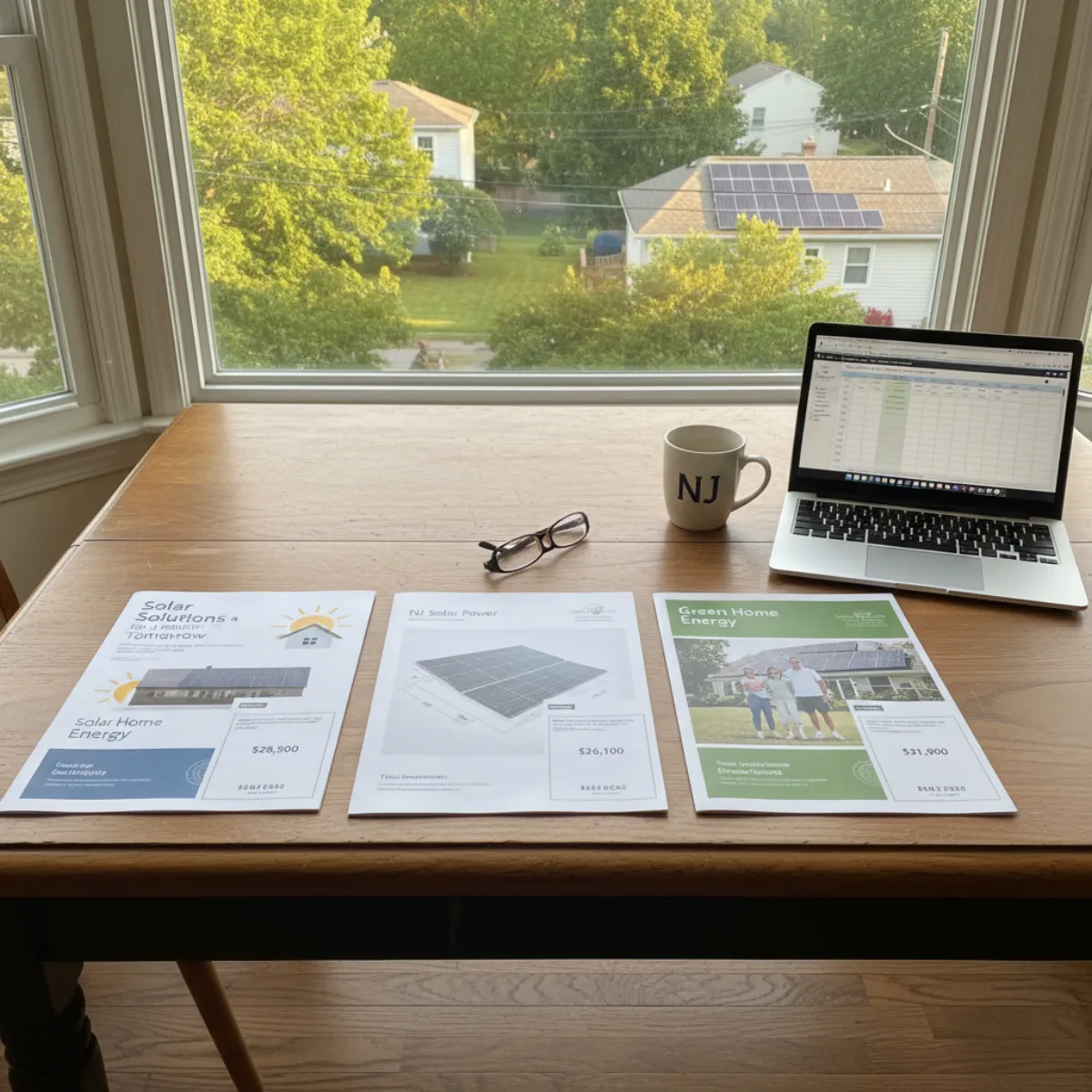
12 evaluation criteria to compare NJ solar installers objectively. From NABCEP certifications and ADI expertise to pricing transparency and warranty terms -- the definitive framework for making a confident decision.
Quick Answer
Compare NJ solar installers on 12 criteria: services offered (solar-only vs bundled), NJ experience, NABCEP certification, warranty terms, equipment brands, financing options, NJ incentive expertise, local office presence, review scores, project management, monitoring support, and pricing transparency. Always get at least 3 quotes.
NJ has over 200 active solar installation companies. Some are excellent. Some are mediocre. Some are actively deceptive. Without a structured framework, most homeowners default to comparing price alone -- and the cheapest quote is rarely the best value over a 25-year system lifetime.
The federal 25D residential tax credit expired December 31, 2025. This changes the solar buying landscape in NJ significantly. Without the 30% federal credit reducing your cost, every dollar of the installation price matters more. But so does every detail of design quality, warranty coverage, and incentive expertise. A company that saves you $1,500 upfront but fails to enroll you in ADI properly costs you $16,000+ over 15 years in lost SREC-II income.
This 12-point framework evaluates installers across every dimension that matters for NJ homeowners in 2026. Print it, bring it to consultations, and score each company objectively.
Solar only vs. bundled solar + heat pump + battery + EV charger
Solar-only companies cannot coordinate heat pump loads, battery backup, or EV charger integration. In NJ, where full electrification unlocks the most incentives (SREC-II + Whole Home + utility rebates), a company that offers all services under one roof provides better system design and lower total cost. Ask: "Do you install heat pumps and batteries with your own licensed crew, or do you subcontract?"
NJ-Specific: NJ Whole Home rebate (up to $7,500) requires BPI-certified assessment of the whole home. Companies offering only solar cannot provide this.
Years operating in NJ, number of NJ installations, local office presence
NJ has 565 municipalities with different permitting processes, four utility territories with different interconnection rules, and unique incentive programs (ADI/SREC-II, Whole Home, utility rebates). A company that installed 500 systems in California has zero NJ experience. Ask: "How many systems have you installed in my specific town and utility territory?"
NJ-Specific: PSE&G, JCP&L, ACE, and RECO each have different interconnection timelines, net metering rules, and rebate programs. Township-level permit knowledge saves weeks.
NABCEP, NJ HIC (Home Improvement Contractor), BPI, manufacturer certifications
NABCEP certification is the gold standard for solar installation quality. NJ requires a Home Improvement Contractor (HIC) registration for any residential work over $500. BPI certification is required for NJ Whole Home rebate eligibility. Manufacturer certifications (Enphase, SolarEdge, Tesla) ensure proper equipment installation. Ask: "Can I see your NABCEP certificate and NJ HIC registration number?"
NJ-Specific: NJ Attorney General actively enforces HIC requirements. Installing without proper HIC registration can void your contract and any warranty claims.
Workmanship warranty (installer), panel warranty, inverter warranty, production guarantee
Equipment warranties (panels: 25 years, inverters: 12-25 years) come from manufacturers and are the same regardless of installer. The differentiator is the installer workmanship warranty -- their guarantee on labor, roof penetrations, wiring, and mounting. Also evaluate whether they offer a production guarantee with financial compensation for underperformance.
NJ-Specific: In NJ, a production guarantee should account for ADI/SREC-II income loss, not just electricity cost. Ask specifically about ADI compensation.
Panel brands, inverter options, battery choices, equipment tiers
Companies offering only one equipment brand may be pushing whatever they have in stock or whatever earns them the highest margin. A quality installer offers 2-3 panel tiers (premium, mid-tier, value), microinverter and string inverter options, and multiple battery brands. This allows you to match equipment to your budget and performance goals.
NJ-Specific: NJ heat and humidity mean temperature coefficient matters. Ask about panels with low temperature coefficients for better summer performance.
Cash, solar loan, PPA, lease -- and the terms of each
With the federal 25D residential tax credit expired as of 2026, financing becomes more important. Cash purchases provide the best ROI but require upfront capital. Solar loans spread the cost but watch for dealer fees (often 15-25% added to the loan amount). PPAs and leases mean you do not own the system and cannot claim ADI income. Understand what each option truly costs over 25 years.
NJ-Specific: NJ has strong ADI income ($85.00/MWh for 15 years) that offsets the loss of the federal credit. But you only receive ADI if you own the system -- PPAs/leases give the ADI to the third-party owner.
ADI/SREC-II enrollment, net metering, tax exemptions, Whole Home rebate filing
NJ has one of the most complex incentive landscapes in the US. Your installer should handle all incentive applications as part of the project: ADI enrollment through the SuSI platform, net metering application to your utility, sales tax exemption documentation, property tax exemption filing with your township, and Whole Home rebate application if applicable.
NJ-Specific: Ask: "Do you handle ADI enrollment? Have you filed Whole Home rebate applications? How many successful ADI enrollments have you completed?" Companies new to NJ often fumble the ADI process.
Physical office in NJ, W-2 installation crews (not subcontracted)
A company with a physical NJ office and W-2 employees (not 1099 subcontractors) provides better accountability. If your system needs service in year 5, a local office means a 1-2 day response time rather than a 2-4 week wait for a traveling crew. W-2 crews are trained on company standards; subcontractors bring varying quality.
NJ-Specific: NJ covers a large geographic area. A company based in North NJ may have poor coverage for South NJ shore installations, and vice versa. Ask about crew coverage for your specific area.
Google reviews, BBB rating, SolarReviews, EnergySage, Yelp
Check reviews across multiple platforms, not just one. Look for patterns: repeated complaints about communication, billing disputes, or delayed projects are red flags. A company with 4.5+ stars and 100+ reviews across multiple platforms demonstrates consistent quality. Be wary of companies with very few reviews or reviews that seem templated.
NJ-Specific: Check the NJ Division of Consumer Affairs complaint database for any formal complaints filed against the company.
Dedicated project manager, timeline communication, change order process
Ask about their project management process before signing. Do you get a dedicated project manager? How are timeline updates communicated? What happens if there is a permit delay? How are change orders handled? A well-organized company has a documented process; a disorganized one will say "we will figure it out as we go."
NJ-Specific: NJ permitting can be unpredictable (3 days to 6+ weeks depending on municipality). A good project manager proactively communicates permit status rather than leaving you in the dark.
Monitoring platform, alert system, annual checkups, service response time
After installation, you track your system performance through the manufacturer monitoring platform (Enphase Enlighten, SolarEdge, etc.). Ask which platform is included, whether the installer offers an optional active monitoring service, and what their service response time is when you report an issue.
NJ-Specific: Monitoring is essential for ADI income verification. Your production data must be reportable through the SuSI platform. Ask how monitoring data connects to your ADI enrollment.
Itemized quotes, no hidden fees, clear price per watt, financing terms disclosed
A transparent quote shows: system size (kW), number and brand of panels, inverter type and brand, price per watt, total system cost, itemized adders (panel upgrade, critter guard, ground mount, etc.), and financing terms with APR and total cost of borrowing. If a company will not provide an itemized quote, that is a red flag.
NJ-Specific: NJ solar costs $2.65-$3.10/watt installed in 2026 (before incentives, federal credit expired). Prices significantly above $3.25/watt or below $2.50/watt warrant scrutiny.
Use this worksheet to score each installer you are evaluating. Rate each criterion 1-5 and compare totals across your quotes.
| Criterion | Weight | Company A | Company B | Company C |
|---|---|---|---|---|
| 1. Services Offered | x2 | __/5 | __/5 | __/5 |
| 2. NJ-Specific Experience | x2 | __/5 | __/5 | __/5 |
| 3. Certifications | x2 | __/5 | __/5 | __/5 |
| 4. Warranty Terms | x2 | __/5 | __/5 | __/5 |
| 5. Equipment Offered | x1 | __/5 | __/5 | __/5 |
| 6. Financing Options | x2 | __/5 | __/5 | __/5 |
| 7. NJ Incentive Expertise | x2 | __/5 | __/5 | __/5 |
| 8. Local Office and Crew Coverage | x1 | __/5 | __/5 | __/5 |
| 9. Review Scores Across Platforms | x1 | __/5 | __/5 | __/5 |
| 10. Project Management Process | x1 | __/5 | __/5 | __/5 |
| 11. Monitoring and Post-Install Support | x1 | __/5 | __/5 | __/5 |
| 12. Pricing Transparency | x2 | __/5 | __/5 | __/5 |
| TOTAL (High = x2 weight) | __/80 | __/80 | __/80 | |
Score each criterion 1-5. Multiply "High" priority criteria by 2. Maximum score: 80. A score below 50 suggests significant gaps worth investigating further.
NJ's four major utility territories each operate differently:
Ask each installer: "How many installations have you completed in my utility territory?" An installer experienced with PSE&G may struggle with JCP&L's different interconnection process.
Each of NJ's 565 municipalities manages its own building department. Some have online portals with 3-5 day turnaround. Others require in-person submissions and take 4-6 weeks. An experienced local installer knows which towns are fast, which require extra documentation, and how to navigate each building department effectively.
Getting multiple quotes is essential, but comparing them properly is equally important. Ensure each quote specifies the same system size range, similar equipment tier, and comparable warranty terms. A $26,000 quote with Tier-2 equipment and a 10-year workmanship warranty is not comparable to a $29,000 quote with Tier-1 equipment and a 25-year workmanship warranty with a production guarantee.
Use this framework to evaluate every installer on your list -- including NuWatt. We welcome the comparison because we score well on every criterion. Get your free quote and see how we stack up.