Loading NuWatt Energy...

We use your location to provide localized solar offers and incentives.
We serve MA, NH, CT, RI, ME, VT, NJ, PA, and TX
Loading NuWatt Energy...
NuWatt designs, installs, and manages solar, battery, heat pump, and EV charger systems across 9 states. One company, one warranty, one point of contact.
Get a Free Quote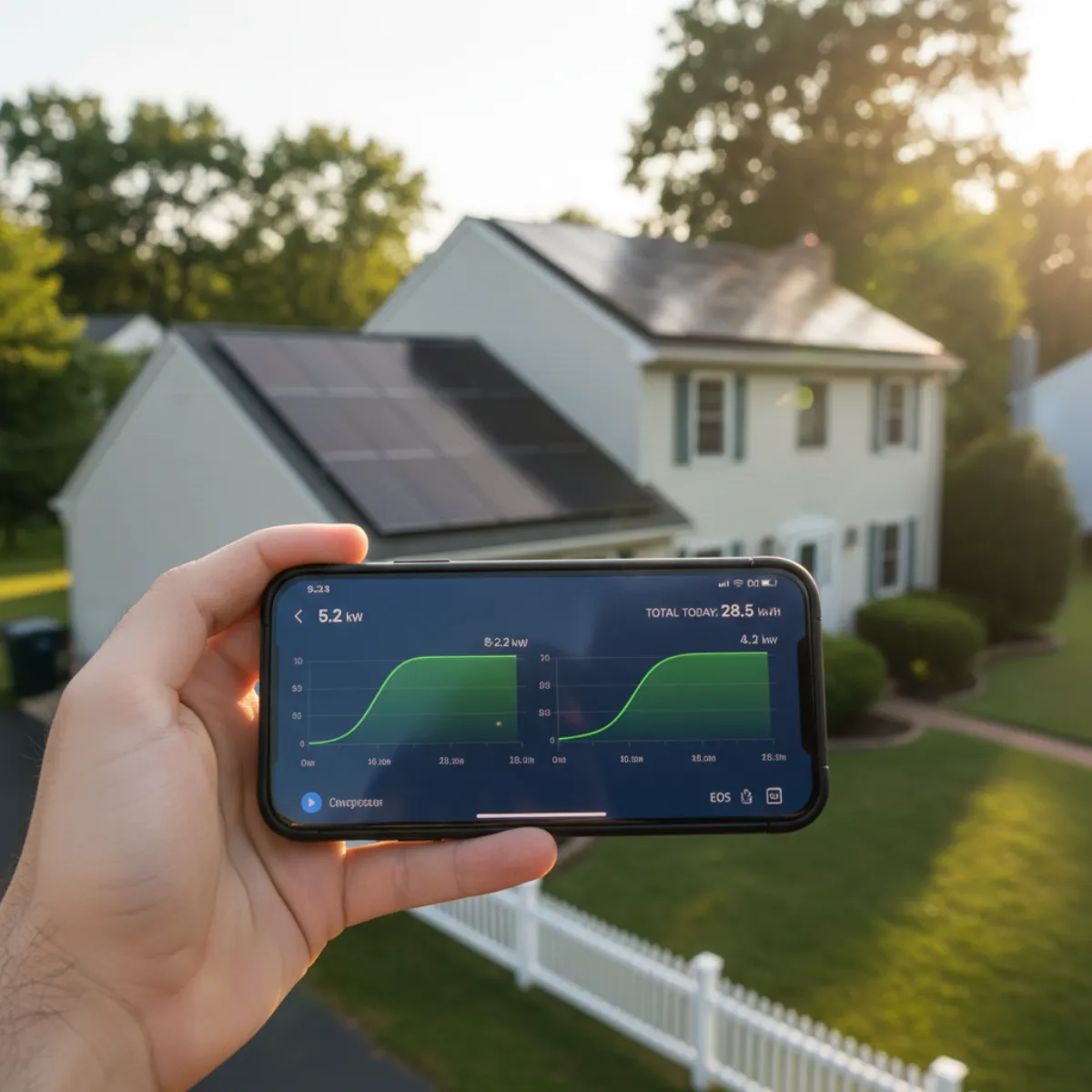
How to track your NJ solar production, verify your ADI income, catch problems before they cost you money, and maximize your system's 25-year performance. Platform comparisons, NJ production benchmarks, and troubleshooting guide included.
Quick Answer
NJ solar monitoring platforms track daily production, per-panel performance, and grid export. Enphase Enlighten provides panel-level monitoring, SolarEdge offers optimizer-level tracking, and the Tesla app shows Powerwall charge cycles. NJ homeowners should verify ADI production through GATS metering — monitoring catches underperformance before it costs you ADI income.
In most states, solar monitoring is a nice-to-have. In NJ, it is a financial necessity. Here is why NJ homeowners have more at stake when it comes to production tracking.
NJ's ADI (Administratively Determined Incentive) pays you $40-$80 per MWh based on actual, metered production. Unlike fixed-rate rebates, your ADI income is directly proportional to how much electricity your panels produce. A system producing 10% below its potential loses $500-$1,000 in ADI income over 15 years. Monitoring catches underperformance early.
At $0.18-$0.26/kWh, every kWh your system fails to produce costs you more than in cheaper-rate states. A single failed microinverter on one panel that goes undetected for a year costs an NJ homeowner $45-$65 in lost savings — plus $8-$15 in lost ADI income. Panel-level monitoring catches this immediately. System-level monitoring might never catch it.
NJ uses the PJM-GATS system to track production for ADI credit generation. Your monitoring platform should closely match GATS readings. If there is a discrepancy, you may be generating electricity but not receiving ADI credits. Monitoring lets you cross-reference your production data with GATS to ensure every MWh is counted and compensated.
An 8 kW system in Middlesex County had a string inverter with no panel-level monitoring. Two panels were producing 40% below normal due to a cracked junction box for 14 months before the homeowner noticed their electric bills were higher than expected. Total cost of undetected failure: approximately $180 in lost electricity savings and $35 in lost ADI income — $215 total. With panel-level monitoring, this would have been detected in the first day and covered under warranty.
Your monitoring platform is usually determined by your inverter choice. Here is what each platform offers and which is best for NJ homeowners.
Enphase
Best for: Panel-level monitoring, shade detection, comprehensive analytics
SolarEdge
Best for: Optimizer-level monitoring with string inverter economics
Tesla
Best for: Tesla Powerwall owners, whole-home energy management
Sense (third-party)
Best for: Whole-home energy auditing, device-level consumption tracking
This is the single most important monitoring decision for NJ homeowners. Panel-level monitoring shows individual panel performance; system-level only shows total output.
Available with Enphase microinverters or SolarEdge with power optimizers. Shows production from each individual panel in real-time.
Available with basic string inverters (no optimizers). Only shows total system output — the sum of all panels combined.
Panel-level monitoring is essential for NJ homes. With ADI income tied to actual production and NJ electricity rates among the highest in the nation, the cost of undetected panel failures is higher in NJ than almost any other state. The $0.10-$0.25/W cost premium for microinverters or optimizers pays for itself in avoided production losses and easier ADI verification. Every NuWatt NJ installation includes panel-level monitoring as standard.
Here are the specific metrics every NJ solar owner should monitor regularly, ranked by importance.
Your primary indicator of system health. NJ systems should produce 25-45 kWh/day for an 8 kW system depending on season. Summer: 35-45 kWh/day. Winter: 15-25 kWh/day. A sudden drop below these ranges indicates a problem.
Year-over-year comparison eliminates seasonal variation. Your system should produce within 5% of last year's same-month output (accounting for weather). A consistent decline exceeding normal degradation (0.3-0.5%/year) signals an issue.
Look for any panel producing more than 10% below its neighbors in the same orientation. Some variation is normal, but consistent underperformers need investigation. In NJ, even a single underperforming panel costs $45-$80/year in lost savings + ADI income.
Track your solar offset percentage. If you designed for 90% offset but are only achieving 70%, either production is low or consumption has increased. This directly affects your electricity bill savings and net metering credits with PSE&G, JCP&L, or ACE.
NJ provides full retail net metering. Track how many kWh you export to the grid — this is money in your pocket. If exports suddenly decrease while production stays the same, your consumption may have increased (new appliance, EV charging, etc.).
Compare to your installer's production estimate and your production guarantee (if applicable). NJ systems should produce 1,200-1,350 kWh/kW/year. This number also determines your annual ADI income — verify it matches your GATS records.
Use these benchmarks to evaluate whether your NJ system is performing as expected. Numbers are based on NJ irradiance data, typical roof orientations, and real installation performance data.
| Metric | Expected Range | Notes |
|---|---|---|
| Annual Production | 1,200-1,350 kWh/kW | NJ average; varies by county and shade |
| Peak Summer Month (July) | 150-180 kWh/kW | Best production month in NJ |
| Low Winter Month (December) | 60-80 kWh/kW | Shortest days, lowest sun angle |
| Spring/Fall Average | 110-130 kWh/kW | Good production, moderate temperatures |
| First-Year Performance Ratio | 80-87% | Actual vs theoretical based on irradiance |
| NJ Capacity Factor | 14-17% | Percent of maximum possible output achieved |
Expect 1,200-1,280 kWh/kW/year. Higher latitude, more winter cloud cover, and dense suburban tree canopy reduce production slightly. Systems in PSE&G territory.
Expect 1,250-1,320 kWh/kW/year. Moderate latitude with good sun exposure. Mix of PSE&G and JCP&L territories. Monmouth coast gets slightly more sun.
Expect 1,280-1,350 kWh/kW/year. Lower latitude, more open lots, and less tree canopy boost production. Mix of PSE&G and ACE territories. Best production in the state.
NJ's ADI program requires production metering through PJM-GATS. Here is how to make sure every kWh you produce counts toward your ADI income.
Revenue-grade production meter (ANSI C12.20 compliant) or inverter-based metering accepted by your utility
PJM-GATS account registration and initial setup
ADI/SuSI program enrollment through the NJ Board of Public Utilities
Connection between your production meter and GATS reporting
Documentation of your system's GATS account number
Explanation of how ADI credits are aggregated and paid
Compare your monitoring app's monthly production to GATS-reported production — they should be within 2-3% of each other
Verify ADI credits are being generated monthly in your GATS account (or through your aggregator)
Check that your ADI payments match the credits generated at the current ADI rate
Keep records of any production outages (inverter errors, grid outages) that affect GATS readings
If you add a battery, ensure the production meter only counts solar generation (not battery discharge)
Report any metering discrepancies to your installer within 30 days
Here are the most common monitoring alerts NJ homeowners encounter and what to do about each one.
Likely Cause: Partial shade from tree, chimney, or vent pipe
Action: Check shade analysis at different times of day. Trim trees if possible. With microinverters, this panel does not affect others.
Likely Cause: Microinverter failure or loose DC connection
Action: Contact installer for warranty service. Enphase microinverters have 25-year warranty. This is visible only with panel-level monitoring.
Likely Cause: Inverter issue, meter problem, or grid curtailment
Action: Check inverter error codes. Verify utility meter is running. Contact installer if inverter shows fault codes. If using a string inverter, one failed optimizer can reduce entire string output.
Likely Cause: Seasonal variation (normal) or soiling (dirt/pollen)
Action: Compare to same month last year. NJ production drops 30-40% from July to December — this is normal. If year-over-year decline exceeds 2-3%, schedule cleaning or inspection.
Likely Cause: Net metering not properly configured or consumption increase
Action: Check with your utility (PSE&G, JCP&L, or ACE) that bidirectional meter is installed and net metering is active. Review consumption monitoring — has usage increased?
Likely Cause: Battery backup reserve set too low or undersized battery
Action: Increase backup reserve percentage. If you need whole-home backup, you may need additional battery capacity. Check if TOU dispatching is draining battery before peak hours.
If you have a battery storage system (Enphase IQ Battery, Tesla Powerwall, or similar), monitoring adds additional metrics that affect your NJ solar ROI.
Current battery percentage. Track your typical SOC pattern — it should charge during peak solar hours (10am-3pm) and discharge during evening peak rates (4pm-9pm). If your battery never reaches 100%, your solar array may be undersized or your consumption is too high during production hours.
Most batteries are rated for 4,000-6,000 cycles. One cycle = full charge to full discharge. At one cycle per day, that is 10-16 years of battery life. Track your monthly cycle count to estimate remaining battery lifespan and plan for replacement.
If your battery dispatches during peak hours (common with PSE&G time-of-use rates), track how much you save by avoiding peak-rate grid purchases. NJ TOU peak rates can be 30-50% higher than off-peak. A well-programmed battery can save $200-$500/year in TOU arbitrage.
Most NJ homeowners set a 20-30% backup reserve that the battery will not discharge below, ensuring power during grid outages. Monitor that this setting has not been changed by software updates. NJ storms (including nor'easters) make backup reserve essential.
How much energy you get back compared to what you put in. Modern batteries achieve 90-96% round-trip efficiency. If your efficiency drops below 85%, the battery may need service. Track this monthly in your monitoring app.
If your battery participates in a Virtual Power Plant program (available through some NJ utilities), track VPP dispatch events and compensation. These programs pay you for allowing the utility to draw from your battery during grid stress events.
Do not rely on manually checking your app every day. Set up these alerts once and let the system notify you when something needs attention.
Most NJ solar systems include free monitoring through the inverter manufacturer's app — Enphase Enlighten, SolarEdge Monitoring Portal, or Tesla App. Your installer sets up your account during commissioning. You can view real-time and historical production data on your phone or computer. For systems without built-in monitoring, a Sense Energy Monitor ($349) can be added to any system.
In NJ, expect 1,200-1,350 kWh per kW of installed capacity per year. An 8 kW system should produce 9,600-10,800 kWh annually. A 10 kW system should produce 12,000-13,500 kWh. South Jersey (closer to latitude 39°) typically produces 5-8% more than North Jersey (closer to latitude 41°). Production varies by shade, roof orientation, and panel efficiency.
NJ's ADI program uses the PJM-GATS (Generation Attribute Tracking System) to track production. Your system must have a revenue-grade meter (typically built into your inverter or a separate production meter installed by your utility). GATS automatically records production monthly. You can verify your ADI credits are being generated by logging into the GATS portal or checking with your ADI aggregator. Your monitoring app production numbers should closely match GATS readings.
The most common cause is partial shading — a tree branch, chimney shadow, or roof vent that blocks sunlight during part of the day. Other causes include a failed microinverter, loose wiring connection, bird droppings, or a manufacturing defect. Panel-level monitoring (Enphase or SolarEdge with optimizers) makes it easy to identify which panel is underperforming. System-level-only monitoring cannot detect individual panel issues.
Panel-level monitoring is strongly recommended for NJ homes. NJ's suburban landscape means most roofs have some shading from trees, neighboring structures, or roof features. Panel-level monitoring catches individual panel failures, shade issues, and soiling problems that system-level monitoring misses. Since ADI income depends on actual production, catching a failed panel early can save $50-$100/year in lost ADI income alone.
In Enphase Enlighten: go to Settings > Alerts and enable notifications for production threshold, system errors, and communication issues. In SolarEdge: go to the Monitoring Portal > Admin > Alerts and set thresholds for underperformance. Most platforms let you set daily/weekly production summaries, immediate fault alerts, and underperformance notifications. We recommend setting an alert if daily production drops below 60% of expected for 3+ consecutive days.
Yes. All major battery systems (Enphase IQ Battery, Tesla Powerwall, SolarEdge batteries) include remote monitoring through their apps. You can track state of charge, charge/discharge cycles, backup reserve level, and energy dispatched during TOU peak hours. For NJ homeowners participating in demand response programs, battery monitoring also tracks VPP (Virtual Power Plant) dispatch events.
Production monitoring tracks how much electricity your solar panels generate. Consumption monitoring tracks how much electricity your home uses. Together, they show your net energy position — whether you are exporting to the grid (earning net metering credits) or importing from the grid (paying your utility). Both are important for optimizing your NJ solar ROI. Most modern monitoring platforms include both, but you may need a consumption CT (current transformer) installed at your main panel.
Every NuWatt NJ installation includes panel-level monitoring, ADI enrollment, production guarantees, and a dedicated app walkthrough. We set up your monitoring so you can track every kWh and every dollar from day one.