Loading NuWatt Energy...

We use your location to provide localized solar offers and incentives.
We serve MA, NH, CT, RI, ME, VT, NJ, PA, and TX
Loading NuWatt Energy...
NuWatt designs, installs, and manages solar, battery, heat pump, and EV charger systems across 9 states. One company, one warranty, one point of contact.
Get a Free Quote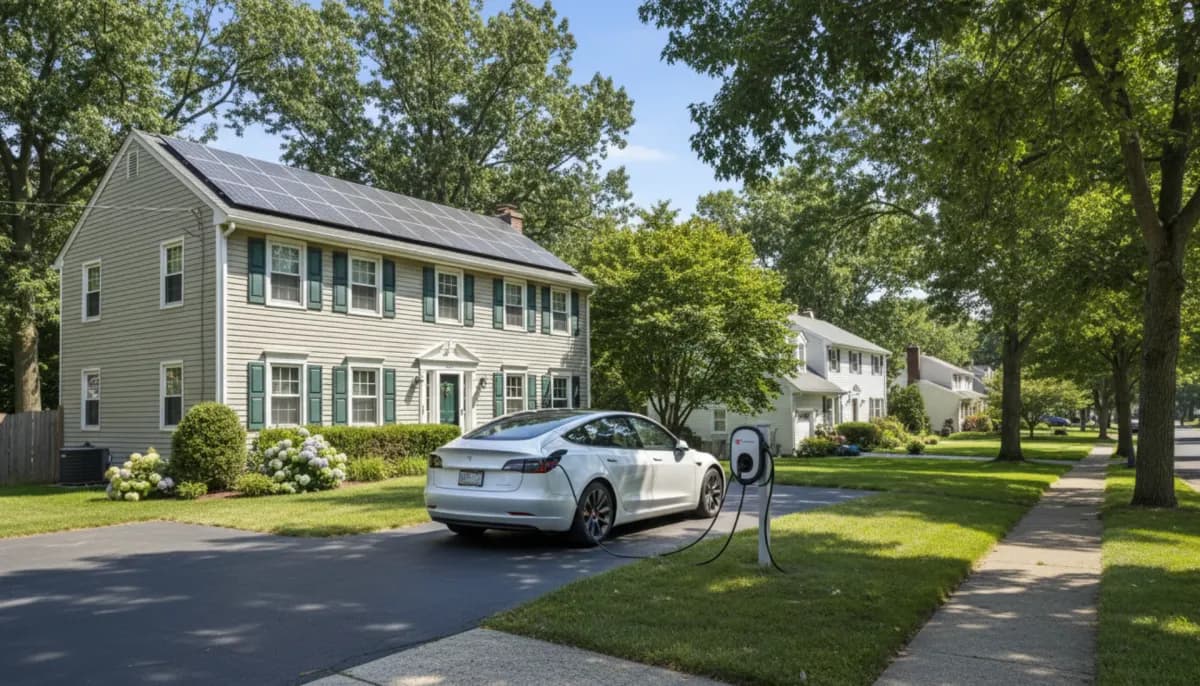
Size your solar system to charge your EV for free, stack NJ Charge Up and the NJ sales tax exemption, and earn SREC-II income at $85.00/MWh for 15 years.
$500-$1,000
Bundle Install Savings
$250
NJ Charge Up
$85.00/MWh
SREC-II Income
15 years
SREC-II Term
Installing a solar system and EV charger together saves money three ways.
One electrician visit, one permit, one inspection. Bundled installation saves $500-$1,000 vs. separate projects. The charger circuit gets wired during the solar panel install.
Your solar installer runs the 240V circuit for the EV charger while they are already on-site for the panel and inverter installation. One disruption instead of two.
Stack NJ Charge Up ($250 for income-qualified) + ADI/SREC-II ($85.00/MWh for 15 years) + NJ sales tax exemption, on top of $500-$1,000 saved by bundling the install.
Select your EV, enter your annual miles, and choose your utility to see exactly how much extra solar you need and what it will cost in New Jersey.
Adjust inputs below to see your NJ results
24.2 kWh/100mi · 310 mi range
$0.2694/kWh
Total Annual Savings
$1,032/yr
Solar offset + ADI/SREC-II income · 6.5 yr payback
Annual EV Energy
2,904kWh
Extra Solar Needed
2.3kW
Additional Panels
~6panels
Solar Upgrade Cost
$6,691
You save $898/yr vs gas
$782/yr
Solar EV Offset
$249/yr
ADI/SREC-II
6.5 yrs
Payback Period
Based on PSE&G ($0.2694/kWh) ·1,250 kWh/kW/yr NJ avg · $2.88/W installed · Gas: $3.50/gal at 25 MPG · Residential 30C EV credit expired 6/30/26 · No residential ITC (25D expired 12/31/25)
Four steps from daily driving to panel count.
Start with your annual miles (US avg: 12,000) and your EV's efficiency rating (kWh per 100 miles).
12,000 mi/yrMultiply: (miles / 100) x efficiency. A Tesla Model Y at 24.2 kWh/100mi x 12,000 miles = 2,904 kWh/year.
2,904 kWh/yrDivide by NJ solar production: 2,904 kWh / 1,250 kWh/kW/yr = 2.3 kW of additional solar capacity.
2.3 kW extraDivide by panel wattage: 2,300W / 420W/panel = 6 additional panels on your roof.
~6 panels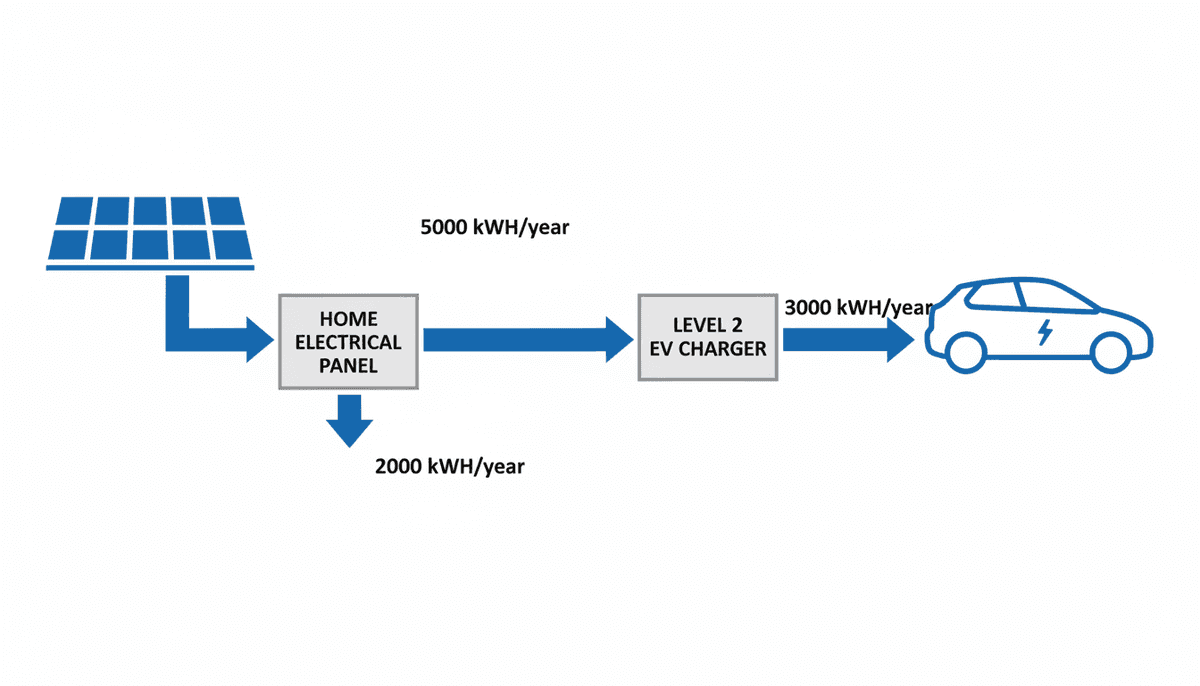
Annual EV energy: (12,000 / 100) x 24.2 = 2,904 kWh
Additional solar: 2,904 / 1,250 = 2.3 kW
Extra panels: 2,300 / 420 = ~6 panels
Solar upgrade cost: 2.3 kW x $2,880/kW = $6,624
Charger net cost: $1,200 (Section 30C credit expired June 30, 2026)
Annual savings: $755/yr electricity + $247/yr ADI = $1,002/yr
Every dollar you can claim in 2026. No residential solar ITC (25D expired).
| Incentive | Amount | Type | Status | Notes |
|---|---|---|---|---|
| Section 30C (EV Charger) | $0 (expired) | Expired | Dead | Expired June 30, 2026 - no longer available. Previously 30% of cost, max $1,000 residential. |
| NJ Charge Up (EV Charger) | Up to $250 | State rebate | Active | Income-qualified NJ residents. Level 2 charger installation. Through NJ BPU. |
| ADI / SREC-II | $85.00/MWh x 15 yr | State production incentive | Active | $85.00/MWh through Jul 26, 2026; $77.00/MWh from Jul 27, 2026. All solar production qualifies. |
| NJ Whole Home Program | Up to $7,500 | Heat pump rebate | Active | For heat pump installation. $2,000 base + $200 per TES%. BPI-certified installer required. |
| Garden State EV Incentive | Up to $2,000 | Vehicle purchase incentive | Active | For EV vehicle purchase (not charger). Reduces vehicle cost, freeing budget for solar + charger. |
| Net Metering (1:1) | Full retail rate | Bill credit | Active | 1:1 retail credit for systems up to 100% of consumption. Excess rolls over annually. |
| Property Tax Exemption | 100% exempt | Tax exemption | Active | Solar does not increase property tax assessment. Permanent exemption in NJ. |
| Sales Tax Exemption | 6.625% saved | Tax exemption | Active | No sales tax on solar equipment and installation in NJ. |
| Section 25D (Residential Solar ITC) | $0 | Expired | Dead | Expired December 31, 2025. No federal credit for homeowner-owned solar. |
| Section 25C (Energy Efficiency) | $0 | Expired | Dead | Expired December 31, 2025. No federal credit for heat pumps, insulation, etc. |
The federal Section 30C residential EV-charger tax credit expired June 30, 2026 and is no longer available. The good news for New Jersey homeowners: the state incentives that drive most of a solar + EV bundle’s value are still in place.
Timeline tip: Solar + EV charger installations in New Jersey typically take 6-12 weeks from contract to completion (permitting, utility interconnection, inspection). NJ has a dense installer market but permit timelines vary by municipality. Starting SREC-II registration and NJ Charge Up early keeps your incentive income accruing sooner.
Level 2 is the standard for home charging. Here is what to know.
Many older NJ homes have 100A or 150A panels. Adding solar + EV charger may require a 200A panel upgrade ($1,500-$3,000). Your installer should assess panel capacity during the site visit. NJ requires licensed electricians for all work.
NJ has 564 municipalities, each with its own permitting process. Permit timelines range from 1-4 weeks depending on your town. Your installer typically handles all permitting. No HOA can prohibit solar in NJ (state law).
NJ has 130 miles of coastline. Homes within 2 miles of the shore should use NEMA 4X stainless steel enclosures and marine-grade wiring for the EV charger. Salt air corrosion adds $100-$300 to installation costs.
Your utility determines your charging cost and which programs you can access.
North & Central NJ
Best for: Largest territory, fastest interconnection, most installer experience
Northwest NJ
Best for: Lower rate than PSE&G - strong solar economics with lower baseline cost
South NJ / Shore
Best for: Shore communities with highest EV adoption. Strong salt-air installer network.
With the ADI/SREC-II program, your solar earns $85.00/MWh ($0.0859/kWh) for all production for 15 years. This rate is. Unlike net metering alone, ADI pays for total production regardless of consumption. Size your system to cover both home usage and EV charging to maximize total ADI income while also benefiting from 1:1 net metering credits on your electric bill.
NJ has unique advantages for EV owners going solar.
The ADI program pays $85.00/MWh for all solar production for 15 years. This is in addition to net metering bill credits. Every kWh generated, including EV charging offset, earns ADI income.
New Jersey exempts solar equipment and installation from the 6.625% sales tax. On a $30,000 solar + EV charger system, that saves nearly $2,000 upfront compared to buying without the exemption.
NJ has 130 miles of coastline. Shore communities have high EV adoption rates and experienced installers who know marine-grade installations. Salt-air-rated charger enclosures protect your investment for decades.
New Jersey offers up to $2,000 toward EV vehicle purchases through the Charge Up New Jersey program. This is separate from the charger rebate and reduces your overall EV ownership cost when bundled with solar.
Solar panels are permanently exempt from property tax increases in NJ. A $30,000 system adds zero to your property tax bill, unlike a kitchen renovation or addition that would be taxed.
New Jersey has one of the most competitive solar installer markets in the US. Dense population + strong incentives = more installers competing for your business, which keeps prices low. Average NJ cost: $2.88/W.
Everything homeowners ask about bundling solar with an EV charger in NJ.
Most EVs need 2,400-4,900 extra kWh per year (12,000 miles). In New Jersey with 1,250 kWh/kW/yr production, that translates to 1.9-3.9 kW of additional solar, or roughly 5-10 extra 420W panels. Efficient sedans like the Tesla Model 3 need fewer panels; trucks like the F-150 Lightning need more.
Yes. Bundling saves on installation costs (one crew, one permit, one inspection) - roughly $500-$1,000 versus doing the projects separately. Income-qualified New Jersey residents can claim NJ Charge Up ($250) toward the charger. Plus your solar earns ADI/SREC-II income at $85.00/MWh for 15 years and is exempt from NJ sales tax. (The federal Section 30C home EV-charger credit expired June 30, 2026 and is no longer available.)
Section 30C was a federal tax credit for alternative fuel vehicle refueling property, including home EV chargers. It covered 30% of equipment and installation costs, up to $1,000 for residential, for chargers placed in service by June 30, 2026. The residential home-charger credit expired June 30, 2026 and is no longer available. New Jersey homeowners can still use NJ Charge Up ($250 for income-qualified residents) toward a Level 2 charger.
No. The residential Section 30C home EV-charger credit expired June 30, 2026 and is no longer available. The One Big Beautiful Bill Act (OBBBA), signed July 4, 2025, accelerated the expiration date, and there was no extension mechanism. New Jersey homeowners should instead look to NJ Charge Up ($250 for income-qualified residents) and ADI/SREC-II income at $85.00/MWh.
NJ Charge Up provides up to $250 toward Level 2 EV charger installation for income-qualified New Jersey residents. It is administered through the NJ Board of Public Utilities. Income eligibility thresholds apply. It remains available even though the federal Section 30C home-charger credit expired June 30, 2026.
The ADI (Administratively Determined Incentive, formerly SREC-II) program pays $85.00/MWh (registered by Jul 26, 2026; $77.00/MWh from Jul 27, 2026) for all solar production for 15 years. This income applies to every kWh your panels generate, including energy used to charge your EV. A 2.3 kW EV solar adder produces roughly 2,875 kWh/year, earning about $247/year in ADI income.
Level 2 (240V, 32-48 amp) is recommended for home charging. It adds 25-37 miles of range per hour, fully charging most EVs overnight. Level 1 (120V) only adds 3-5 miles per hour, which is impractical for daily commuters unless you drive under 30 miles/day.
A Level 2 charger unit costs $400-$800, and professional installation (240V circuit, wiring, permit) adds $400-$1,200, for a total of $800-$2,000. Income-qualified residents can get $250 from NJ Charge Up. Bundling the charger with a solar install typically saves another $500-$1,000 versus a separate project. (The federal Section 30C credit that previously covered up to $1,000 expired June 30, 2026 and is no longer available.)
Only if you have a battery backup system (like Tesla Powerwall) with a solar+battery hybrid inverter that can island from the grid. Standard grid-tied solar systems shut down during outages for safety. With a battery, you can charge your EV from stored solar energy.
The Garden State $2,000 EV purchase incentive (Charge Up New Jersey) is separate from the EV charger rebate and applies to the vehicle purchase, not the charger. Check with the NJ BPU for current vehicle incentive availability. The charger-specific incentive through NJ Charge Up is $250 for income-qualified residents.
Stack NJ Charge Up, the NJ sales tax exemption, and 15 years of SREC-II income. Our NJ-licensed installers handle solar panels, EV charger, and all permitting in one project.
Free, no-obligation quote. Licensed NJ electricians. Typical installation: 6-12 weeks.
Complete pricing by city and system size
How solar pencils out without 25D ITC
1:1 retail credit explained
$85.00/MWh for 15 years
Compare financing options
No rooftop needed
Business solar with ITC
National EV charger guide