Loading NuWatt Energy...

We use your location to provide localized solar offers and incentives.
We serve MA, NH, CT, RI, ME, VT, NJ, PA, and TX
Loading NuWatt Energy...
NuWatt designs, installs, and manages solar, battery, heat pump, and EV charger systems across 9 states. One company, one warranty, one point of contact.
Get a Free Quote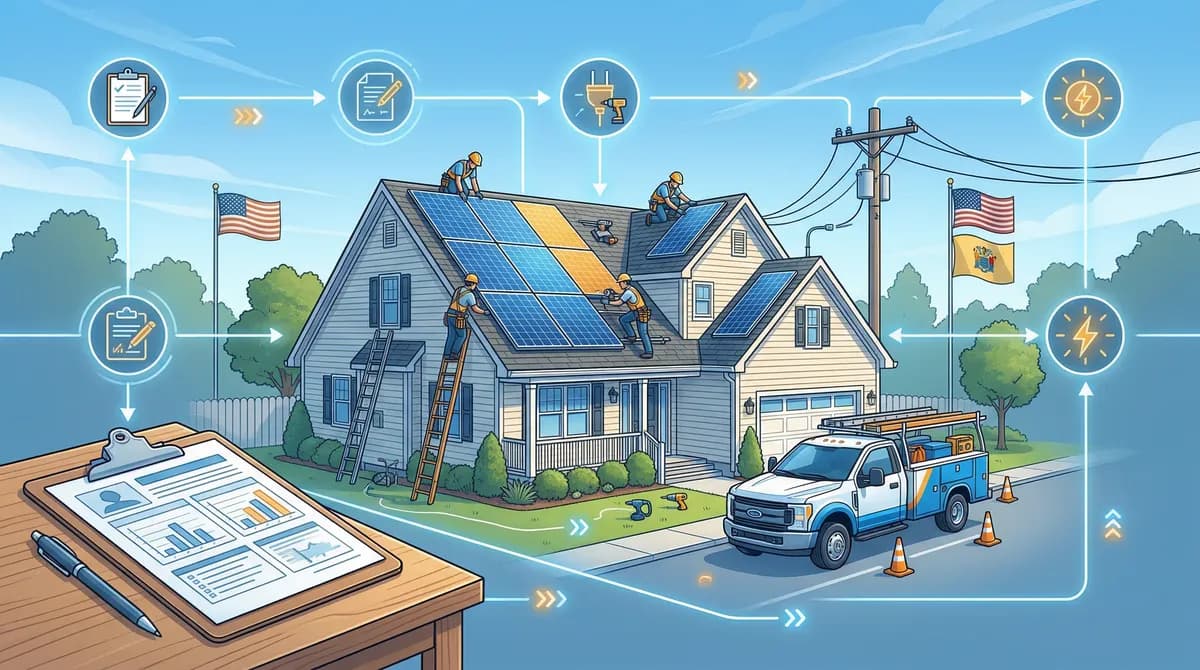
Every step from signing your solar contract to flipping the switch. Timeline, costs, utility-specific interconnection processes, common delays, and how to get your NJ system live as fast as possible.
8-12 wks
Typical Timeline
$200-$800
Permit Cost
1-3 days
Installation
4 Options
NJ Utilities
The most common question we hear from NJ homeowners after signing a solar contract: "How long until my panels are actually producing electricity?"
The short answer: 8 to 12 weeks from contract signing to Permission to Operate (PTO) for a straightforward residential installation in New Jersey. That timeline covers seven distinct steps, each involving different parties — your installer, your municipality, your utility, and state incentive programs.
The longer answer depends on your specific situation. An older roof, a small electrical panel, an HOA, or a property in a historic district can add weeks to the process. This guide walks through every step so you know exactly what to expect — and how to avoid the most common delays.
No Federal Tax Credit in 2026
The Section 25D residential solar tax credit expired December 31, 2025. NJ homeowners purchasing solar with cash or a loan receive $0 in federal tax credits. However, NJ still offers strong state incentives: 1:1 net metering, ADI/SREC-II payments ($85.00/MWh for 15 years), full sales tax exemption, and 100% property tax exemption.
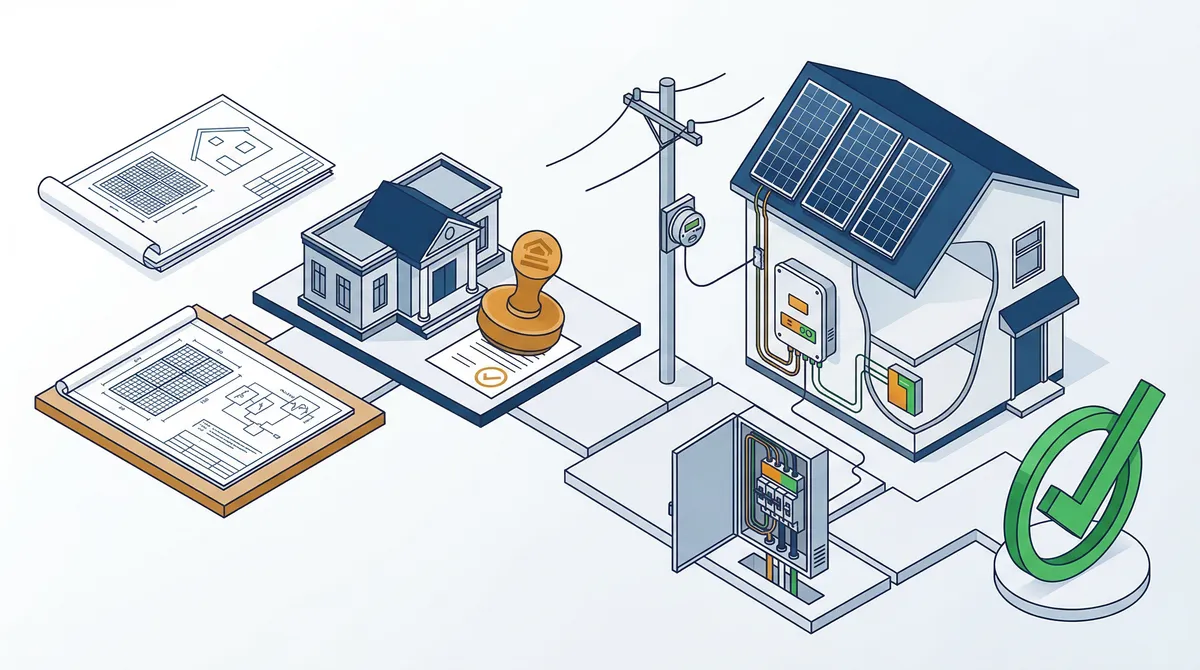
Here is every step in the NJ solar permitting and interconnection process, with realistic timelines and costs for 2026.
Your installer visits your home, inspects the roof, measures dimensions, evaluates shading, and checks your electrical panel. They design a system using satellite imagery and on-site measurements.
What Happens
Cost: $0 (included in solar contract)
Your installer submits structural and electrical plans to your local building department. NJ requires a licensed electrician to sign off on the electrical plans.
What Happens
Cost: $200-$800 (varies by municipality)
Your installer submits an interconnection application to your utility (PSE&G, JCP&L, ACE, or RECO). The utility reviews the application, checks grid capacity, and issues conditional approval.
What Happens
Cost: $0-$50 (most NJ utilities charge nothing for residential)
The crew installs racking, panels, inverter(s), and wiring. Most residential installations in NJ take 1-2 days. Larger systems or ground mounts may take 3 days.
What Happens
Cost: Included in solar contract price
Your local electrical inspector visits to verify the installation meets NJ electrical code (NEC 2020) and the approved permit plans. The inspector checks wiring, grounding, rapid shutdown compliance, and labeling.
What Happens
Cost: $0 (included in permit fee)
After passing inspection, your installer sends the inspection certificate to the utility. The utility schedules a meter swap to a bidirectional (net) meter and issues Permission to Operate (PTO). This is when your system goes live.
What Happens
Cost: $0 (utility covers meter swap in NJ)
After PTO, your installer registers your system with the NJ SuSI (Successor Solar Incentive) program to receive ADI (Administratively Determined Incentive) payments. This is a separate process from interconnection.
What Happens
Cost: $0 (installer typically handles this)
Total Timeline: 8-12 Weeks (Typical)
Steps 2 and 3 (municipal permit and utility interconnection) often run in parallel, which compresses the total timeline. A well-organized installer will submit both applications simultaneously. The installation itself (Step 4) takes only 1-3 days — most of the time is waiting for approvals and scheduling.
Best case: 6-8 weeks (small system, online permits, PSE&G territory).
Worst case: 16-20+ weeks (roof replacement + panel upgrade + historic district + JCP&L).
Your utility determines how long the interconnection review takes. Here is a side-by-side comparison for 2026.
| Utility | Territory | Application | Review Time | Meter Swap | Total to PTO |
|---|---|---|---|---|---|
| PSE&G | North & Central NJ | Online via PSE&G My Account portal | 2-4 weeks | 1-2 weeks after approval | 3-6 weeks |
| JCP&L (FirstEnergy) | Central & Western NJ | Online via FirstEnergy interconnection portal | 3-6 weeks | 2-3 weeks after approval | 5-9 weeks |
| Atlantic City Electric (ACE) | South NJ & Shore | Online via Exelon interconnection portal | 2-4 weeks | 1-2 weeks after approval | 3-6 weeks |
| Rockland Electric (RECO) | Bergen & Passaic counties | Contact RECO directly or via Orange & Rockland portal | 2-3 weeks | 1-2 weeks after approval | 3-5 weeks |
North & Central NJ · 2.3 million customers
Largest NJ utility. Most streamlined online process. Pre-application available for systems over 25 kW.
Central & Western NJ · 1.1 million customers
Can be slower for larger systems or areas needing transformer upgrades. Batch processing delays possible.
South NJ & Shore · 560,000 customers
Generally fast approval. Shore communities have strong solar irradiance.
Bergen & Passaic counties · 73,000 customers
Smallest NJ utility. Fewer applications means faster processing.
Most NJ solar projects that exceed 12 weeks hit one of these issues. The good news: nearly all can be identified during the site assessment.
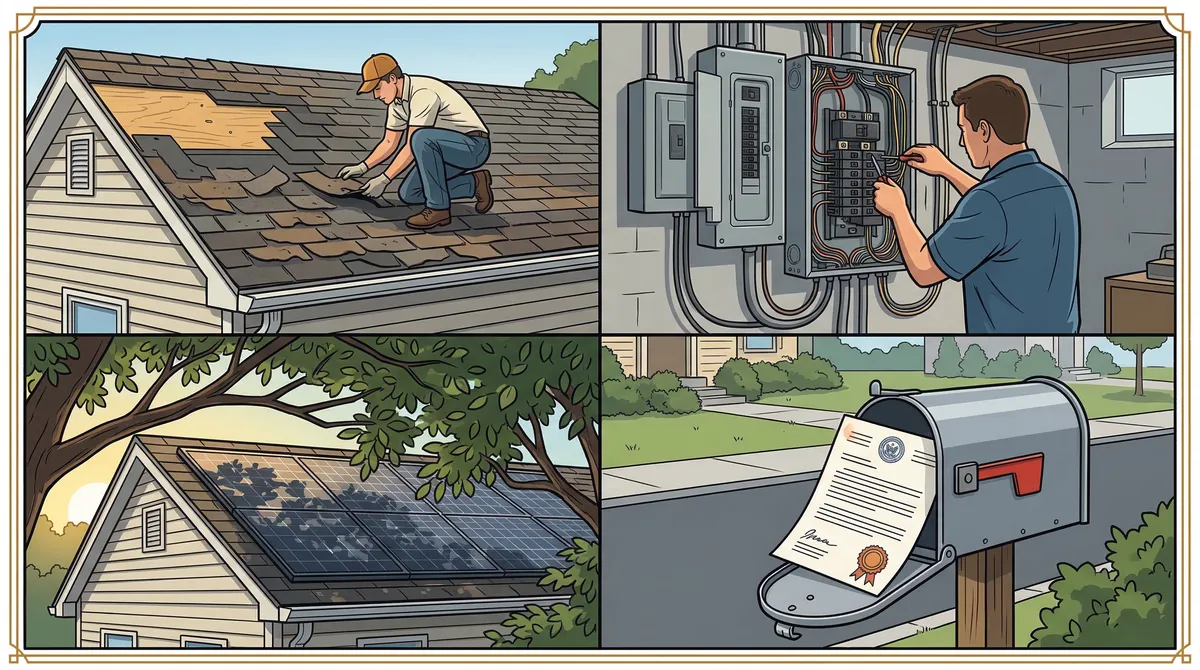
If your roof is older than 10-15 years, most installers will recommend replacement before installing solar. You cannot install solar on a roof that needs replacement — it would void warranties and create leak risks.
Solution: Get a roof inspection early. If replacement is needed, coordinate with your installer — many can bundle roofing work or refer a partner. NuWatt offers solar reroof packages.
Estimated cost: $8,000-$18,000 for a typical NJ roof replacement
Many older NJ homes have 100A or 150A electrical panels. Solar typically requires 200A service. Panel upgrades require a separate permit from your municipality.
Solution: Your installer will assess your panel during the site visit. If an upgrade is needed, it can often be done concurrently with the solar permit process.
Estimated cost: $1,800-$4,500 depending on complexity
While NJ has the Solar Access Act (N.J.S.A. 45:22A-48.2) that prohibits HOAs from completely banning solar, they can impose "reasonable" aesthetic requirements like panel color or placement.
Solution: Submit your HOA application as early as possible — ideally before the building permit. NJ law limits HOA review to 90 days. If they deny, you may have legal recourse under the Solar Access Act.
Estimated cost: $0-$200 HOA application fee
Properties in NJ historic districts (common in towns like Princeton, Morristown, Cape May, Lambertville) require Historic Preservation Commission (HPC) approval for exterior modifications.
Solution: Work with an installer experienced in historic districts. Panels on non-street-facing roof sections are typically approved faster. Some HPCs have pre-approved solar guidelines.
Estimated cost: $0-$100 HPC review fee
Trees shading your roof reduce solar production. Significant shade from neighboring trees may require removal or aggressive trimming. NJ requires permits for tree removal in most municipalities.
Solution: Get a shade analysis early. Many towns require a tree removal permit ($50-$200). If the tree is on a neighbor's property, you'll need their cooperation.
Estimated cost: $500-$2,500 per tree (removal)
If your neighborhood transformer is at or near capacity (multiple solar systems, new construction, EV chargers), the utility may require a supplemental review or transformer upgrade.
Solution: This is out of your control but uncommon for residential. Your installer can check with the utility before signing a contract. PSE&G has the fastest resolution process.
Estimated cost: $0 to homeowner (utility bears upgrade cost)
NJ requires a licensed electrician to sign off on all solar electrical plans submitted for building permits. The NJ Division of Consumer Affairs (DCA) oversees electrical contractor licensing.
Solar installers in NJ must hold a Home Improvement Contractor (HIC) registration from the NJ Division of Consumer Affairs. This is in addition to any electrical or general contractor licenses.
NJ's Solar Access Act (N.J.S.A. 45:22A-48.2) prevents HOAs and deed restrictions from completely prohibiting solar installations. It is one of the strongest solar rights laws in the country.
All solar installations in NJ must comply with the Uniform Construction Code (UCC). Municipal code officials enforce UCC requirements through the building permit and inspection process.
Beyond the solar system itself, here are the additional costs NJ homeowners may encounter. Your installer should identify these during the site assessment.
| Item | Low | High | When Needed |
|---|---|---|---|
| Building Permit | $200 | $800 | Always |
| Electrical Permit | $75 | $250 | Always (often bundled) |
| Interconnection App | $0 | $50 | Always (usually free) |
| Panel Upgrade (200A) | $1,800 | $4,500 | If panel < 200A |
| Tree Removal | $500 | $2,500 | If significant shading |
| Roof Replacement | $8,000 | $18,000 | If roof > 15 years |
Most Homeowners Pay Only the Permit Fee
For homes with a roof under 15 years old and a 200A electrical panel, the only extra cost is the building permit ($200-$800). Your installer handles the utility interconnection application at no extra charge. The meter swap is free — NJ utilities cover the cost of the bidirectional meter.
After your system receives PTO, your installer enrolls it in the NJ SuSI (Successor Solar Incentive) program for ADI payments. This step is separate from utility interconnection but equally important — it is the primary financial incentive for NJ solar in 2026.
$85.00
per MWh (reg. by Jul 26, 2026; $77 after)
15 years
Payment duration
Quarterly
Payment frequency
For a typical 10 kW system in NJ producing approximately 11,300 kWh/year, ADI income is roughly $970 per year, or about $14,000 over 15 years. This income is in addition to your net metering bill savings. Learn more in our NJ SuSI/ADI Program Guide.
Before signing a solar contract in NJ, make sure your installer can answer these questions. A good installer will address them during the site assessment.
Current pricing per watt, system costs by size, and what drives NJ solar prices.
How 1:1 retail credits work, monthly rollover, and annual true-up by utility.
Everything about SREC-II payments: rates, enrollment, and 15-year income projections.
Compare electric rates and solar value across all three major NJ utilities.
Financing comparison: ownership, SREC income, total cost, and best-fit scenarios.
How NJ solar pencils out in 2026 with $0 federal ITC: state incentives carry the load.
What to look for, red flags, HIC verification, and how to compare quotes.
Sales tax and property tax exemptions: how much they save you in NJ.
How 2025-2026 tariffs affect NJ solar panel pricing and availability.
Get a free assessment with accurate pricing, timeline estimate, and permit cost breakdown for your specific property. No pushy sales — just honest numbers.