Loading NuWatt Energy...

We use your location to provide localized solar offers and incentives.
We serve MA, NH, CT, RI, ME, VT, NJ, PA, and TX
Loading NuWatt Energy...
NuWatt designs, installs, and manages solar, battery, heat pump, and EV charger systems across 9 states. One company, one warranty, one point of contact.
Get a Free Quote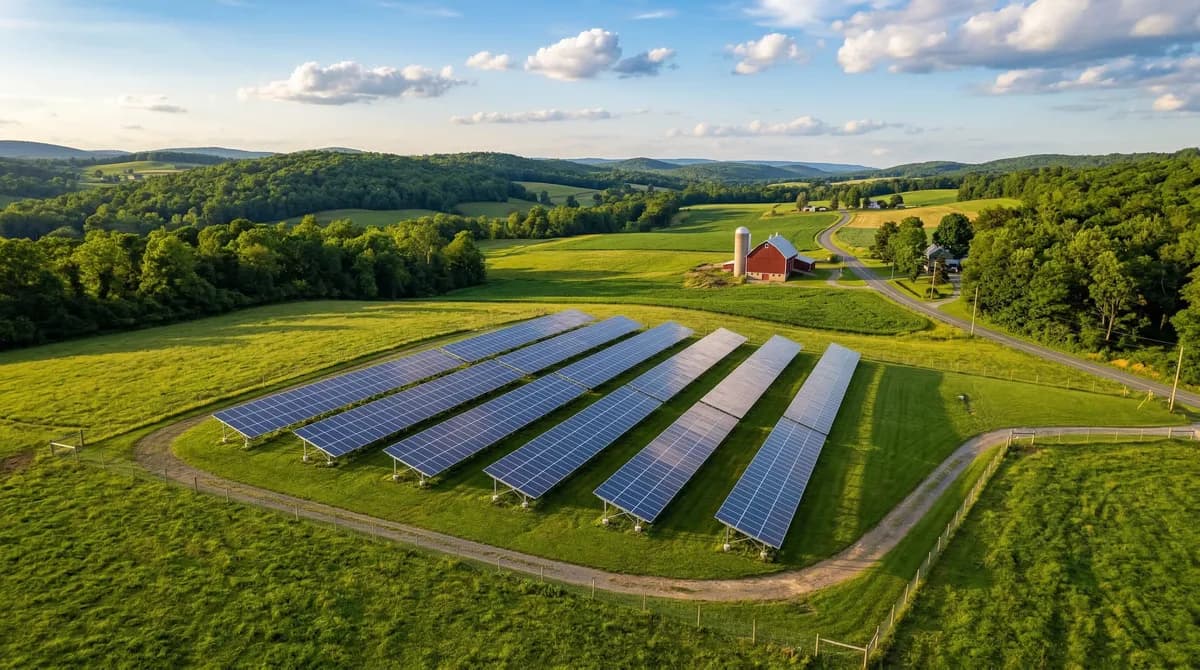
PA has millions of acres of rural land ideal for ground-mount solar. But township-level permitting, limestone karst, and Western PA clay/shale make foundation choice critical. Here is what every PA landowner needs to know in 2026.
Ground-mount solar is not just a fallback for bad roofs. In rural Pennsylvania, ground-mount is often the superior choice. Here is when to consider it:
You have open, unshaded land. Lancaster, Berks, and Chester Counties are packed with 2-10+ acre lots ideal for ground arrays.
Your roof needs replacement within 5 years, faces north/east, has heavy shade, or has complex dormers that limit panel placement.
Your 3,000+ sq ft home with high electric bills needs 15-25 kW, but your roof only fits 8-10 kW. Ground-mount removes that constraint.
PA has the most farms of any northeastern state. Many ag-zoned townships allow ground-mount with minimal permitting. Dual-use agrivoltaics are growing.
Your township's historic district overlay prohibits visible roof panels. A ground-mount array set back from the road may be the only option.
If your roof will need replacement within 10 years, ground-mount avoids the cost of removing, storing, and reinstalling roof panels ($2,000-$5,000).
This is the single biggest difference between PA and neighboring states. Pennsylvania has no state-level or county-level solar permitting. Each of PA's 2,560 municipalities (townships, boroughs, and cities) has its own zoning code and building permit process. What is allowed in one township may require a zoning hearing next door.
Township classifies ground-mount as accessory to residence. Standard building permit only.
Many ag zones exempt solar from site plan review. Fastest path to permit.
Township requires public hearing before Board of Supervisors. 30-day public notice required.
Zoning Hearing Board decision required. Most difficult path. Hire a land use attorney.
Before signing a ground-mount solar contract, call your township building department and ask: (1) Is ground-mount solar permitted in your zoning district? (2) Is it classified as an accessory structure or does it require conditional use? (3) What are the setback requirements? (4) Is there a height limit? A 5-minute phone call can save months of delay. Your installer should handle this, but verify independently.
Pennsylvania spans four geological provinces — each with different soil and bedrock conditions that directly affect foundation choice and cost. Central PA's limestone karst is the biggest concern.
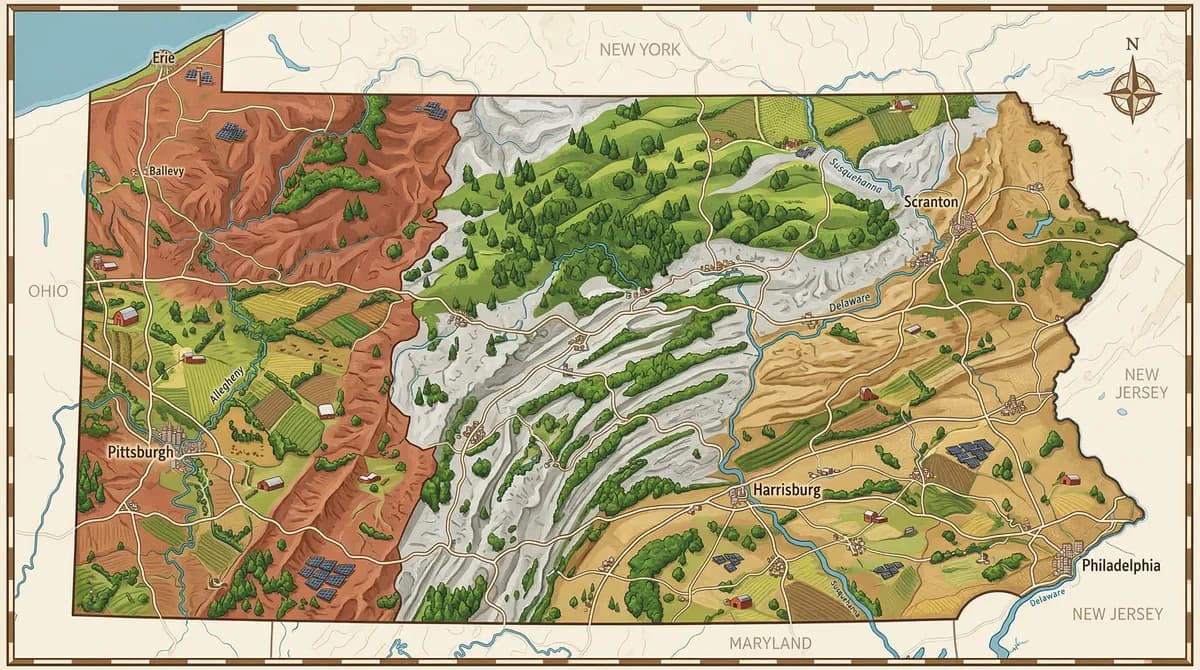
Counties: Chester, Montgomery, Delaware, Bucks
Soil: Schist, gneiss, and quartzite bedrock with deep loam topsoil
Drillability: Good — 10-20 ft of workable soil above bedrock
Ground screws work well. Standard geotechnical survey recommended.
Counties: Lancaster, Berks, Lebanon, Adams, York
Soil: Limestone and dolomite with rich agricultural loam
Drillability: Good in loam areas, challenging near limestone outcrops
Ground screws in deep soil areas. Concrete piers near limestone. Always check county geology maps.
Counties: Centre, Huntingdon, Mifflin, Juniata, Clinton
Soil: Limestone karst with sinkholes, sandstone ridges
Drillability: Challenging — highly variable depth to bedrock
Mandatory geotechnical survey. Concrete pier footings recommended. Avoid obvious karst features (sinkholes, disappearing streams). GPR (ground-penetrating radar) survey for large systems.
Counties: Allegheny, Westmoreland, Butler, Washington, Fayette
Soil: Shale and clay (Pittsburgh formation), some coal measures
Drillability: Moderate — dense clay at surface, shale bedrock at 5-15 ft
Ground screws if soil depth permits. Concrete piers in shallow shale. Check PA DEP mine subsidence maps for old coal workings.
Counties: Lycoming, Tioga, Potter, Bradford, Sullivan
Soil: Glacial till over sandstone and shale
Drillability: Good in glacial deposits, moderate in bedrock areas
Ground screws in most areas. Large open parcels make ground-mount very practical. Lower irradiance extends payback.
Central PA sits on one of the most extensive karst formations in the eastern US. Sinkholes can form without warning. If your property is in Centre, Huntingdon, Mifflin, or Blair County, you MUST get a geotechnical survey before any ground-mount foundation work. Cost: $1,500-$3,500 for GPR and bore testing. This is not optional — it is a structural safety requirement.
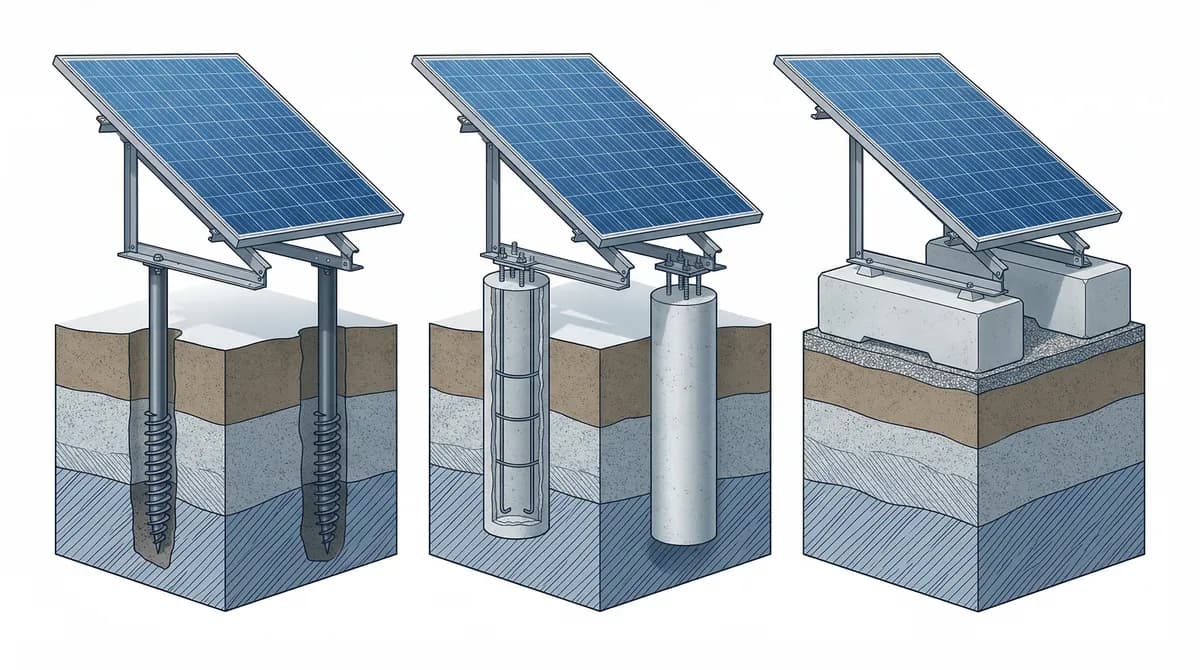
The right foundation depends on your soil type, budget, and whether you want the system to be removable. Here are the four main options used in Pennsylvania:
Best For
Most PA soils — loam, clay, sandy soils
Install Time
1-2 days for typical residential system
Steel screws twisted into ground by machine. No concrete needed, minimal soil disturbance, easily removable. The most common choice for PA residential ground-mount. Struggles in rocky soil or limestone bedrock.
PA-specific note: Works well in Lancaster, Berks, and Chester County loam soils. May hit refusal in shallow limestone karst (Centre County) or dense shale (Western PA). Always do a test bore first.
Best For
Rocky soil, shallow bedrock, karst terrain
Install Time
3-5 days (includes cure time)
Concrete poured into drilled holes with embedded steel posts. Most durable foundation. Required when ground screws cannot achieve depth. Permanent — harder to remove.
PA-specific note: Necessary in Centre County karst zones where sinkholes are a risk. Also common in Western PA shale regions. Higher cost but eliminates settling risk. Check with township for concrete footing inspection requirements.
Best For
Flood plains, protected land, temporary installations
Install Time
1 day
Heavy concrete blocks or steel frames sit on ground surface. No penetration, no permits in some townships. Can be moved. Wind uplift is a concern — requires engineering for PA storm loads.
PA-specific note: Useful in Susquehanna and Delaware River flood plains where soil penetration triggers FEMA review. Some PA townships allow ballasted systems without a foundation permit. Check local zoning.
Best For
Large commercial ground-mount, utility-scale
Install Time
1-2 days
Steel I-beams driven into ground by pile driver. Most common for commercial/utility-scale. Fast installation but noisy. Requires flat, obstruction-free terrain.
PA-specific note: Popular for PA commercial ground-mount in Lancaster and Adams County farm conversions. Requires relatively soft, deep soil. Not suitable for residential in most cases due to equipment access requirements.
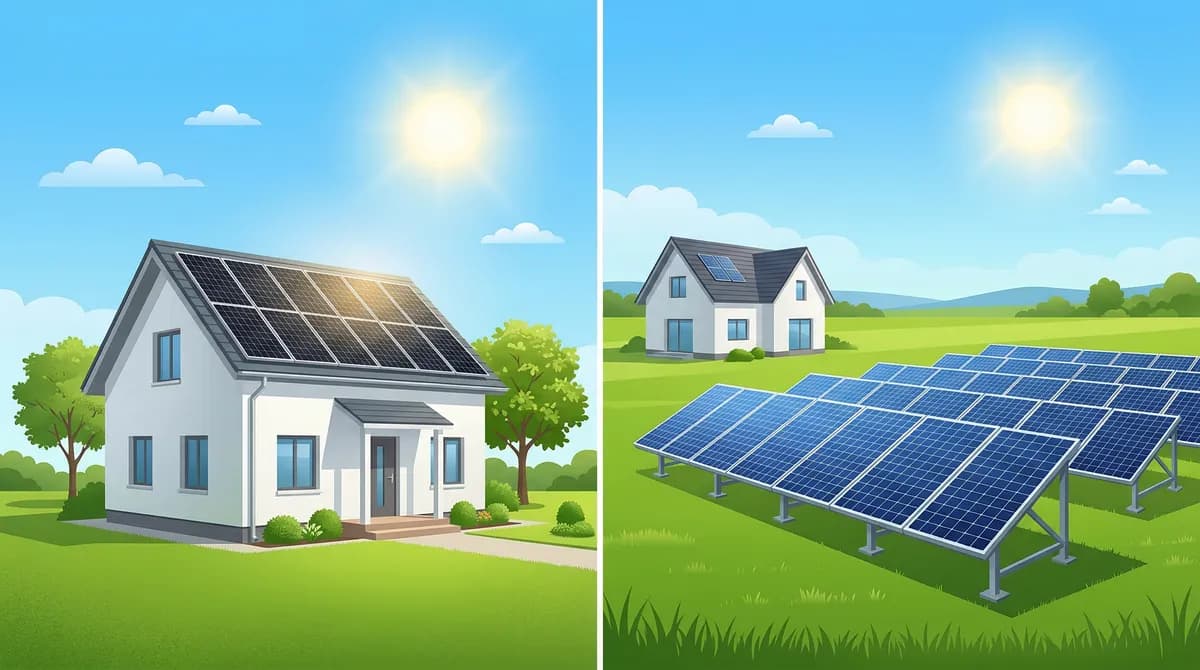
Ground-mount costs more upfront but can produce more energy. Here is how the economics compare for a typical PA system:
| Factor | Roof-Mount | Ground-Mount |
|---|---|---|
| Cost per watt | $2.95-$3.15/W | $3.20-$3.60/W |
| Typical system size | 10-13 kW (roof limited) | 12-25 kW (land limited) |
| 15 kW system cost (before tax) | $44,250-$47,250 | $48,000-$54,000 |
| 6% PA sales tax added | $2,655-$2,835 | $2,880-$3,240 |
| Federal 25D ITC | $0 (expired) | $0 (expired) |
| Optimal tilt/orientation | Constrained by roof angle | Fully optimizable |
| Production (15 kW, eastern PA) | ~17,500 kWh/yr | ~18,750 kWh/yr (+7%) |
| SRECs earned | ~17.5/yr | ~18.75/yr |
| Net metering | 1:1 retail (same) | 1:1 retail (same) |
| Property tax impact | Adds to assessed value | Adds to assessed value |
| Maintenance | Minimal ($100-200/yr) | Mowing + inspection ($200-400/yr) |
| Roof replacement interaction | $2,000-$5,000 to remove/reinstall | No impact |
| Typical payback (cash, PECO) | ~10 years | ~11 years |
The Section 25D residential clean energy credit expired December 31, 2025. PA homeowners who purchase or finance solar (cash or loan) receive $0 in federal tax credits. This applies to both roof-mount and ground-mount systems. Only third-party owners (PPA/lease companies) can claim the Section 48/48E commercial ITC.
Ground-mount systems can be oriented due south at the optimal tilt angle (30-35 degrees in PA), while most roofs are fixed at suboptimal angles. In eastern PA, this can yield 7-15% more production per kW. Over 25 years, the extra production more than offsets the upfront premium for homeowners with large lots.
Not all PA counties are equal for ground-mount solar. These six counties combine large lot sizes, favorable soil conditions, reasonable permitting, and decent solar irradiance:
Amish/Mennonite farming community with large open parcels. Many properties already have barn solar. Ground-mount is a natural fit for flat fields.
Mix of suburban and rural. Western townships like Maidencreek, Longswamp, and Albany have excellent open land. Reading suburbs too dense for ground-mount.
Wealthiest rural county in PA. Horse farms and estates with 2-10+ acre lots. Higher property values offset the ground-mount premium. PECO territory has the best net metering economics.
Penn State corridor. Ferguson, Patton, and Spring townships have large rural lots. Watch for karst voids and sinkholes in limestone areas. Lower electric rates ($0.18) extend payback.
Williamsport area. Very affordable land. Large open parcels ideal for ground-mount. Lower irradiance than eastern PA (~1,100 kWh/kW) but lower costs partially offset.
Gettysburg area. Agricultural economy with large orchards and farms transitioning to solar. Good irradiance (~1,200 kWh/kW). Historic battleground overlay may restrict visible installations near monuments.
Pennsylvania's SREC program treats ground-mount solar identically to roof-mount. Every megawatt-hour your system produces earns 1 SREC, which you can sell on the PJM-GATS market. Ground-mount systems often earn more SRECs because of their higher production efficiency.
$22-$35
per SREC (1 MWh)
~18.75
SRECs/yr (15 kW, eastern)
$410-$660
annual SREC income
The PRESS Act (PA Renewable Energy Standard Strengthening) is pending in the PA legislature. If passed, it would raise the solar carve-out from 0.5% to 5.5%, which could significantly boost SREC prices. Current low prices ($22-$35) reflect the weak 0.5% carve-out. Monitor this legislation — it could improve ground-mount economics substantially.
Ground-mount systems are registered through PJM-GATS exactly like roof-mount. Your installer handles initial registration. You can sell SRECs through SRECTrade, Flett Exchange, or directly to utilities. SRECs have a 3-year useful life from the vintage year. Ground-mount systems with monitoring verify production automatically.
PA's net metering rules apply equally to ground-mount and roof-mount systems. Key requirements: the system must be on the same property as the meter, and residential systems are capped at 50 kW.
PPL Electric Utilities has proposed shifting to hourly LMP-based credits (~July 2026). This would dramatically reduce net metering value for PPL customers in the Lehigh Valley, Harrisburg, and Scranton areas. If you are in PPL territory and considering ground-mount, lock in your interconnection agreement under current 1:1 rules before the tariff change.
With the residential 25D ITC dead, ground-mount solar PPAs and leases are more attractive than ever in Pennsylvania. Here is why: the third-party system owner claims the Section 48/48E commercial ITC (30% base) and passes the savings through as a lower electricity rate for you.
The Section 48/48E ITC did not vanish in mid-2026. July 4, 2026 was a begin-construction safe harbor: projects that began construction on or before that date locked in the full timing pathway (placed in service through roughly 2030). Projects that begin construction after July 4, 2026 still qualify for the 30% credit, but generally must be placed in service by December 31, 2027. For a ground-mount PPA/lease, beginning construction early simply gives the financing company the widest schedule. Start the process now anyway — permitting alone can take 2-12 weeks depending on your township.
Ground-mount PPAs work especially well for PA landowners with large lots because the PPA company handles all foundation work, township permitting, and ongoing maintenance (including mowing). You just sign up for a lower electricity rate and use the power. Read our full PA lease/PPA guide.
We evaluate your lot size, soil conditions, township zoning, and utility territory to design the optimal ground-mount system. Free site assessment for properties with 1+ acres.
Full cost breakdown by city and system size
1:1 retail credits + PPL tariff change warning
How to earn $22-$35/MWh from your solar system
Section 48 ITC benefits for homeowners
Post-ITC financing comparison for PA
Sales tax + property tax — no exemptions in PA