Loading NuWatt Energy...

We use your location to provide localized solar offers and incentives.
We serve MA, NH, CT, RI, ME, VT, NJ, PA, and TX
Loading NuWatt Energy...
NuWatt designs, installs, and manages solar, battery, heat pump, and EV charger systems across 9 states. One company, one warranty, one point of contact.
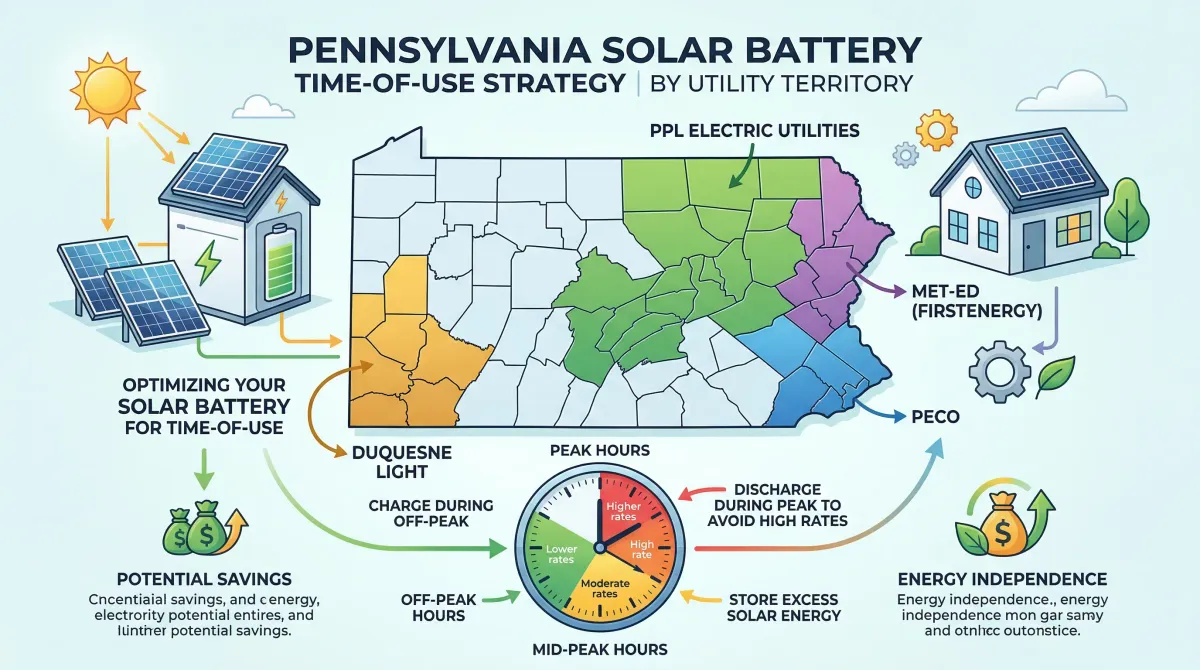
Get a Free QuotePennsylvania has 4 investor-owned utilities with different time-of-use rates and battery arbitrage potential. PECO leads with a $0.19/kWh peak-to-off-peak spread. With the federal ITC dead for homeowners, TOU arbitrage is the primary way to make batteries pay for themselves.
4
PA IOUs Compared
$0.19
Best TOU Spread (PECO)
$550-720
Annual PECO Arbitrage
$0 ITC
25D Expired
The federal residential solar tax credit (Section 25D) expired December 31, 2025. Pennsylvania homeowners now pay full price for solar and batteries with no federal tax break. This changes the battery value equation entirely.
While homeowners get $0 in federal tax credits, third-party financing companies can still claim the Section 48/48E commercial ITC (30%) on projects beginning construction before July 4, 2026. This makes PPA and lease agreements more attractive in PA because the financing company passes their ITC savings to you as a lower electricity rate. Battery-inclusive PPAs are emerging as the most cost-effective option for many PA homeowners.
Pennsylvania is a deregulated electricity state. You can choose your electricity supplier, which affects both your base rate and how TOU arbitrage works.
Your bill has two parts: supply (the electricity commodity) and delivery (distribution by your IOU). TOU rates apply to the supply portion. Your delivery charges remain flat regardless of time of use.
Some competitive suppliers offer their own TOU plans that may differ from the default utility TOU. Compare total costs carefully. Switching suppliers does not change your interconnection or net metering with your utility.
At the annual true-up, net excess solar is paid at the Price-to-Compare (PTC) rate — the supply-only rate. With a battery, you can reduce annual excess by self-consuming more, avoiding the lower PTC rate.
Not all PA utilities offer equally attractive TOU rates. PECO leads with the highest peak-to-off-peak spread, making it the best territory for battery arbitrage.
| Utility | Peak Rate | Off-Peak | Spread | Peak Hours | Annual Arbitrage | Battery ROI |
|---|---|---|---|---|---|---|
| PECO Energy 1.6M customers | $0.28 | $0.09 | $0.19 | 2 PM - 7 PM weekdays (summer) | $550-$720 | Strong |
| PPL Electric 1.4M customers | $0.26 | $0.14 | $0.12 | 1 PM - 7 PM weekdays (summer) | $280-$370 | Moderate |
| Duquesne Light 600K customers | $0.25 | $0.12 | $0.13 | 9 AM - 9 PM weekdays | $300-$400 | Moderate |
| Met-Ed (FirstEnergy) 560K customers | N/A | N/A | -- | No residential TOU | $0 (backup only) | Low |
Key finding: PECO has almost double the TOU spread of PPL and Duquesne, and more than triple Met-Ed (which has no TOU at all). If you are in PECO territory and considering solar, adding a battery for TOU arbitrage is strongly recommended.
Each PA utility has different TOU economics, peak windows, and interconnection requirements. Here is what matters for your territory.
Philadelphia metro, SE PA
Peak
$0.28/kWh
Off-Peak
$0.09/kWh
Spread
$0.19/kWh
Annual Arb.
$550-$720
Summer Peak Hours
2 PM - 7 PM weekdays (summer)
Winter Peak Hours
6 AM - 9 AM & 5 PM - 8 PM
Largest PA utility. Best TOU spread in the state. Ideal for battery arbitrage.
Full PECO Battery GuideLehigh Valley, Harrisburg, NE/Central PA
Peak
$0.26/kWh
Off-Peak
$0.14/kWh
Spread
$0.12/kWh
Annual Arb.
$280-$370
Summer Peak Hours
1 PM - 7 PM weekdays (summer)
Winter Peak Hours
6 AM - 10 AM weekdays
Net metering tariff change proposed for July 2026. Lock in 1:1 rates before change.
Full PECO Battery GuidePittsburgh, Allegheny & Beaver counties
Peak
$0.25/kWh
Off-Peak
$0.12/kWh
Spread
$0.13/kWh
Annual Arb.
$300-$400
Summer Peak Hours
9 AM - 9 PM weekdays
Winter Peak Hours
9 AM - 9 PM weekdays
Wide 12-hour peak window aligns well with solar production. Lower production in western PA offsets some benefit.
Full PECO Battery GuideReading, York, Lancaster, south-central PA
No residential TOU rate available
Summer Peak Hours
No residential TOU
Winter Peak Hours
No residential TOU
No residential TOU rate. Battery provides backup power only. Net metering is stable.
Full PECO Battery GuidePennsylvania Act 129 mandates energy efficiency and peak demand reduction for all IOUs. As behind-the-meter batteries proliferate, Act 129 creates a framework for future demand response payments.
2021-2026
Phase IV Period
Current phase of Act 129 energy efficiency mandates
Required
Demand Response
All PA IOUs must offer demand response programs
4.5%
Peak Reduction
Required peak demand reduction target across PA
Emerging
Battery Impact
Behind-the-meter batteries can qualify for DR programs
Unlike Massachusetts (which has ConnectedSolutions paying $225-275/kW) or Rhode Island (which pays $225/kW summer), PA does not yet have a mature residential battery demand response program. However, Act 129 Phase IV creates the regulatory groundwork. Early battery adopters will be positioned to participate when formal programs launch.
Current value: TOU arbitrage + backup power + self-consumption optimization.
Future value: Utility-managed demand response payments (expected 2027-2028 as Act 129 evolves).
The right battery size depends on your utility, peak window duration, and daily energy usage. Here are our recommendations by utility territory.
Without a residential TOU rate, battery arbitrage is not available in Met-Ed territory. A battery provides backup power only. Consider a smaller 5 kWh unit for essential circuits if outage protection is your primary goal, or skip the battery entirely and focus on maximizing solar system size for net metering value.
PA solar + battery owners can stack three independent revenue streams. Here is how they combine for a typical 12 kW system with a 13.5 kWh battery in each utility territory.
| Revenue Stream | PECO | PPL | Duquesne | Met-Ed |
|---|---|---|---|---|
| TOU Arbitrage | $650 | $320 | $350 | $0 |
| Net Metering Savings | $3,150 | $2,900 | $2,520 | $2,620 |
| SREC Income | $420 | $386 | $353 | $386 |
| Total Annual | $4,220 | $3,606 | $3,223 | $3,006 |
Based on 12 kW solar + 13.5 kWh battery, 80% DoD, 92% round-trip efficiency, 250 TOU weekdays/yr, PA SREC at $28/MWh. Net metering at 1:1 retail credit. Section 25D expired; no federal credit included.
PECO Energy offers the strongest TOU arbitrage in Pennsylvania. Their Rate R-TOU has a $0.19/kWh spread between peak ($0.28/kWh) and off-peak ($0.09/kWh) rates during summer. A 13.5 kWh battery can earn $550-720/year in pure TOU arbitrage in PECO territory.
The residential solar tax credit (Section 25D) expired December 31, 2025. There is no federal tax credit for homeowners purchasing solar or batteries with cash or a loan. However, if you use a PPA or lease, the third-party financing company can still claim the Section 48/48E commercial ITC (30%) on projects beginning construction before July 4, 2026, and pass the savings to you as a lower rate.
TOU arbitrage means charging your battery during low-cost off-peak hours (or from excess solar production) and discharging during high-cost peak hours. In PECO territory, you charge at $0.09/kWh off-peak and discharge at $0.28/kWh during summer peak, pocketing the $0.19/kWh difference minus about 8% round-trip efficiency losses.
Met-Ed (FirstEnergy) does not offer a residential TOU rate, so there is no TOU arbitrage revenue. A battery in Met-Ed territory provides backup power during outages only. Unless you have frequent power outages or strongly value energy independence, a battery is generally not cost-effective in Met-Ed territory.
Act 129 requires PA utilities to reduce peak demand. Some utilities have emerging demand response programs where behind-the-meter batteries can participate. As the program evolves through Phase IV (2021-2026) and beyond, battery owners may gain additional revenue streams through utility-managed dispatch events similar to ConnectedSolutions in Massachusetts.
For PECO territory, a 10-13.5 kWh battery is ideal. The 5-hour peak window (2 PM - 7 PM summer) means a 13.5 kWh battery at 80% depth of discharge provides 10.8 kWh of usable energy, perfectly covering the peak period. A 20 kWh battery offers diminishing returns unless your home has very high peak consumption.
Yes. TOU arbitrage and SREC income are completely independent revenue streams. Your solar system generates SRECs (worth $22-35/MWh in PA) regardless of your rate schedule or battery usage. A 12 kW solar system in PECO territory can earn approximately $420/year in SRECs on top of TOU arbitrage savings.
With the Section 25D residential ITC expired, PA homeowners pay full cost for solar and batteries with no federal tax break. TOU arbitrage helps offset this by generating ongoing revenue from your battery. In PECO territory, a battery earning $600+/year in TOU arbitrage alone can pay for itself in about 20-23 years through arbitrage, plus it provides backup power and can extend overall system payback benefits.
Deep dive into PECO Rate R-TOU, peak windows, battery sizing, and interconnection.
Read moreAll 7 PA utilities compared for solar value, net metering, and interconnection.
Read moreNo property tax exemption, 6% sales tax, no state credit. Full cost analysis.
Read moreWe analyze your utility territory, TOU rate options, and roof exposure to design the optimal solar + battery system for your home.