Loading NuWatt Energy...

We use your location to provide localized solar offers and incentives.
We serve MA, NH, CT, RI, ME, VT, NJ, PA, and TX
Loading NuWatt Energy...
NuWatt designs, installs, and manages solar, battery, heat pump, and EV charger systems across 9 states. One company, one warranty, one point of contact.
Get a Free QuotePennsylvania has fewer income-eligible solar programs than New England states -- we are honest about that. But real pathways exist: free WAP weatherization, community solar coming via Act 93, SRECs for 15 years, and $0-down TPO through Section 48. Here is exactly what is available and what is not.
2026 Reality: The 30% federal solar tax credit (Section 25D) expired December 31, 2025. Income-eligible households receive $0 federal credit for cash/loan purchases. PA has fewer state incentives than NE -- $0-down TPO and community solar are your best paths. Full details
Pennsylvania uses Federal Poverty Level (FPL) guidelines for income-eligible programs. LIHEAP uses 150% FPL, while WAP uses 200% FPL. Community solar LMI thresholds under Act 93 are still being determined by the PUC.
LIHEAP uses 150% FPL for standard grants. WAP and LIHEAP crisis grants use 200% FPL. If your income falls below either threshold, you qualify for those programs.
| Household | 150% FPL | 200% FPL |
|---|---|---|
| 1 person | $22,050 | $29,400 |
| 2 persons | $29,580 | $39,440 |
| 3 persons | $37,110 | $49,480 |
| 4 persons | $44,640 | $59,520 |
| 5 persons | $52,170 | $69,560 |
| 6 persons | $59,700 | $79,600 |
Based on 2025 Federal Poverty Level guidelines. Updated annually by HHS. 150% FPL = LIHEAP; 200% FPL = WAP + crisis grants.
Also qualify automatically if enrolled in:
Pennsylvania has six major electric distribution companies. Each administers its own WAP referral process and will support Act 93 community solar once launched.
Philadelphia/SE PA
East/Central PA
Pittsburgh/SW PA
Eastern PA
Northern PA
Western PA
Honest assessment: PA electric rates (~$0.16-$0.19/kWh) are among the lowest of NuWatt states. Lower rates mean smaller bill savings from solar. This makes $0-down financing especially important for income-eligible households -- you save from day one without any payback risk.
Pennsylvania has fewer dedicated solar incentives than NE states, but four programs provide meaningful support for income-eligible households. Community solar (Act 93) will significantly expand options once fully implemented.
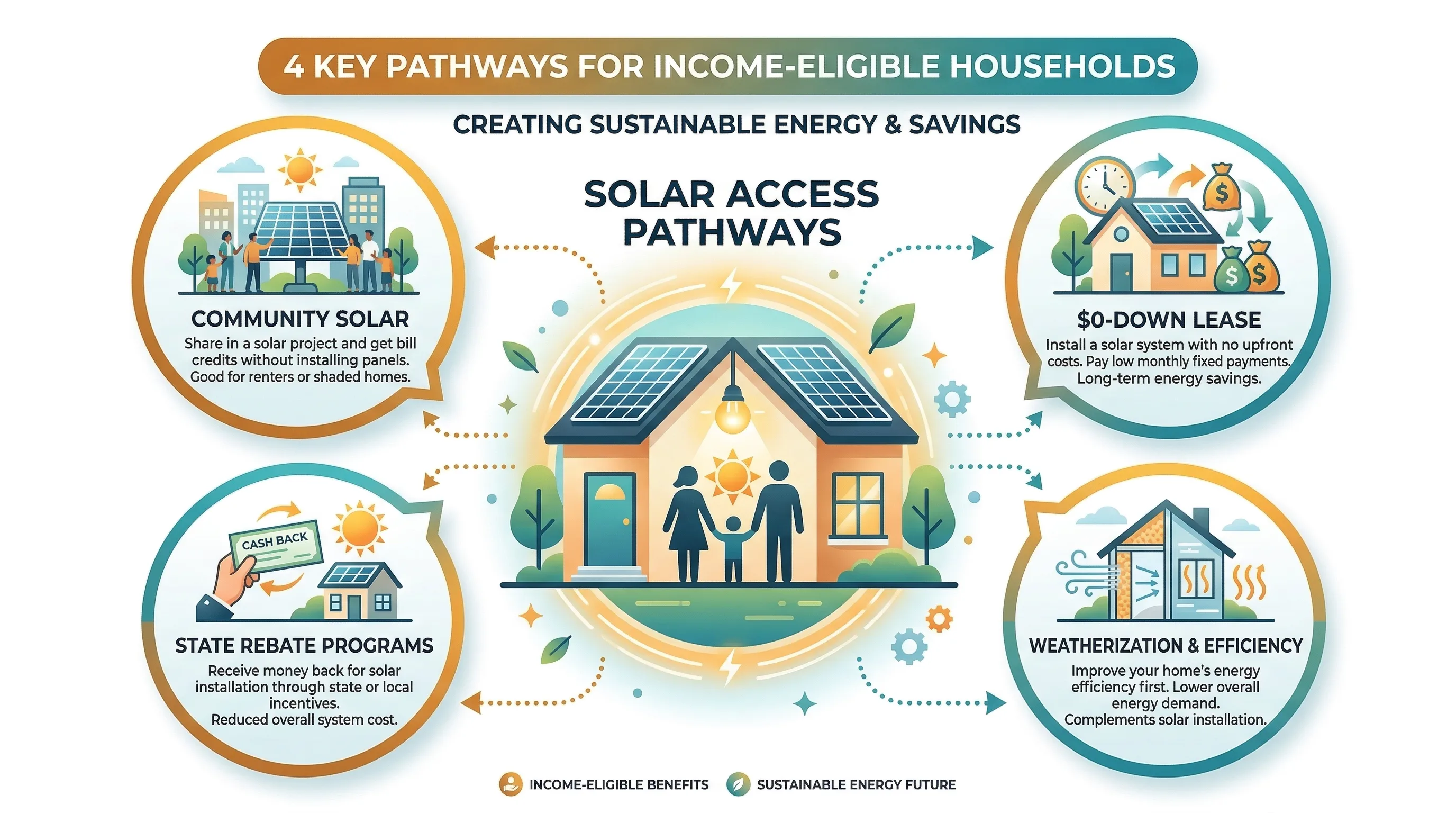
Pennsylvania passed Act 93 in 2024 enabling community solar statewide. The program is still in early implementation, with the PUC developing rules and the first projects expected to begin subscriber enrollment in late 2026 or early 2027. LMI carve-outs are expected but final percentages have not been set by the PUC.
Eligibility
All PA utility customers will be eligible. LMI carve-outs are anticipated in the PUC rulemaking, likely aligned with LIHEAP thresholds.
How to Access
Not yet available for subscriber enrollment. Monitor the PA PUC website for Act 93 implementation updates and approved project lists.
Example Value
Once operational, community solar subscribers typically save 5-15% on their electric bill. For a household using 900 kWh/month at $0.18/kWh: $97-$291/year estimated.
Pennsylvania WAP provides free comprehensive weatherization services including insulation, air sealing, heating system repairs, and health and safety improvements. Administered by county community action agencies across all 67 PA counties. This is the strongest income-eligible energy program currently available in PA.
Eligibility
Household income at or below 200% FPL. Priority given to elderly (60+), disabled, and families with young children. LIHEAP recipients are automatically eligible.
How to Access
Contact your county community action agency or PA Department of Community and Economic Development (DCED). Find your local agency at dced.pa.gov.
Example Value
Average WAP improvements save $283/year on energy bills (DOE estimate). Typical insulation and air sealing work valued at $4,000-$10,000, fully covered.
Pennsylvania SRECs provide per-MWh payments for solar generation over a 15-year compliance period. SREC prices are market-driven and currently range from $30-$45/MWh. While lower than NJ ADI payments ($85.00/MWh), SRECs still provide meaningful annual income for system owners. For TPO systems, the system owner receives SRECs.
Eligibility
All PA solar installations registered with PJM-GATS. No income restriction.
How to Access
Your solar installer registers the system with PJM Generation Attribute Tracking System (GATS). SRECs are generated automatically and sold on the open market or through aggregators.
Example Value
For an 8 kW system producing 9,600 kWh/year: $288-$432/year in SREC income (at $30-$45/MWh). Over 15 years: $4,320-$6,480 total.
Pennsylvania LIHEAP provides direct financial assistance for heating and cooling costs. Administered by county assistance offices. LIHEAP enrollment demonstrates income eligibility for WAP and creates a pathway to community solar LMI slots once Act 93 projects launch.
Eligibility
Household income at or below 150% FPL. Higher thresholds for crisis grants (200% FPL).
How to Access
Apply through your county assistance office (CAO) in person, by mail, or online through COMPASS (compass.state.pa.us). Application period: November through April.
Example Value
Average PA LIHEAP benefit: $500-$1,000/year for heating costs. Crisis grants up to $1,500 for emergencies. Enrollment also qualifies you for WAP.
Illustrative savings for an income-eligible Pennsylvania household with average residential electricity use. Your actual savings depend on your home, your roof, and your utility.
Average residential electric bill for a typical Pennsylvania household paying full retail rates to the utility.
Solar covers roughly 85% of household consumption; remainder is utility minimum charges and grid-pull on cloudy stretches.
25-year figure assumes a 3% annual electric-rate increase, consistent with EIA historical residential rate trends in Pennsylvania. Income-eligible program coverage can reduce or eliminate upfront cost; savings begin immediately at system turn-on.
PA solar costs $2.80-$3.40 per watt in 2026. An average 8 kW system runs $22,400-$27,200 before incentives. With no federal ITC and no state rebate, the full cost falls to the homeowner for cash/loan purchases. $0-down TPO avoids this entirely.
After sales tax exemption only. No federal ITC, no state rebate. WAP savings are separate.
9,600 kWh x $0.18/kWh average PA rate
9.6 MWh x $30-$45/MWh for 15 years
Average DOE estimate for weatherization improvements
Direct heating cost assistance (separate from solar)
Net metering + SRECs only. Payback: ~10-11 years for cash purchase. WAP and LIHEAP are separate energy savings. Lower than NE states due to lower electric rates.
| System Size | Cost Range | After Sales Tax Savings | Annual Production |
|---|---|---|---|
| 5 kW | $14,000-$17,000 | $13,160-$15,980 | 6,000 kWh/yr |
| 8 kW | $22,400-$27,200 | $21,056-$25,568 | 9,600 kWh/yr |
| 10 kW | $28,000-$34,000 | $26,320-$31,960 | 12,000 kWh/yr |
| 12 kW | $33,600-$40,800 | $31,584-$38,352 | 14,400 kWh/yr |
| 15 kW | $42,000-$51,000 | $39,480-$47,940 | 18,000 kWh/yr |
Costs based on $2.80-$3.40/W range. Annual production assumes 1,200 kWh/kW PA average. Sales tax savings = 6% exemption.
With no federal ITC and no state rebate, PA homeowners face the full system cost for cash and loan purchases. The $0-down PPA/lease pathway is especially critical in PA, where lower electric rates mean longer payback periods for purchased systems.
In PA, the Section 48/48E commercial ITC is even more important than in NE states. Without a state rebate or strong state incentive program, the only federal pathway for income-eligible households is through a PPA or lease where the third-party system owner claims the 30% ITC for projects beginning construction before July 4, 2026.
The TPO owner can stack Section 48 ITC + SRECs + depreciation, resulting in lower PPA rates. This is the most practical path for PA LMI homeowners. PA Solar PPA/Lease Guide
Pennsylvania SRECs are generated for each MWh of solar production and sold on the open market. Unlike NJ ADI (fixed rate), PA SREC prices fluctuate with market conditions. Current range: $30-$45/MWh over a 15-year compliance period.
| System Size | Annual SRECs | Annual Income | 15-Year Total |
|---|---|---|---|
| 5 kW | 6.0 MWh | $180-$270 | $2,700-$4,050 |
| 8 kW | 9.6 MWh | $288-$432 | $4,320-$6,480 |
| 10 kW | 12.0 MWh | $360-$540 | $5,400-$8,100 |
SREC prices are market-driven and can fluctuate. Prices shown are current 2026 estimates. Full PA SREC Guide
Pennsylvania provides limited tax benefits for solar compared to NE states. Sales tax is exempt, but property tax exemption is NOT statewide -- it varies by municipality.
Solar energy equipment is exempt from Pennsylvania 6% state sales tax. This applies to panels, inverters, racking, and related equipment. Applied automatically at time of purchase.
Applied at purchase. One-time savings. No income requirement.
Unlike CT, NJ, and MA, Pennsylvania does NOT have a statewide property tax exemption for solar. Some municipalities have adopted local clean energy property tax exemptions, but this is not guaranteed. Check with your local tax assessor before assuming exemption.
PA avg effective property tax ~1.58%. If NOT exempt, an $22,400 system could add ~$354/year in property taxes. Check your municipality.
No state income tax credit: Pennsylvania does not offer a state income tax credit for solar installations. With no federal ITC, no state rebate, and no guaranteed property tax exemption, the sales tax exemption and SRECs are your only automatic state-level benefits. This is why $0-down TPO is especially important in PA.
Pennsylvania passed Act 93 in 2024 enabling community solar statewide. The program is still in the PUC rulemaking phase, with the first projects expected to begin subscriber enrollment in late 2026 or early 2027.
Act 93 signed into law (2024)
Enables community solar statewide. Directs PUC to develop implementation rules.
PUC rulemaking (2025-2026)
PUC developing subscriber protections, billing credit mechanisms, LMI carve-outs, and project size limits.
Project applications (mid-2026)
Solar developers begin applying for CSEP project approval from PUC.
Subscriber enrollment (late 2026/early 2027)
First community solar projects open for subscriber enrollment. LMI carve-outs expected.
Community solar will be the most important new solar option for PA renters and income-eligible households. Monitor the PA PUC website for Act 93 implementation updates.
Follow these five steps to access income-eligible solar programs in Pennsylvania. Start with LIHEAP and WAP (available now), then explore rooftop solar and community solar as it becomes available.
Check if your household income is at or below 150% FPL (LIHEAP) or 200% FPL (WAP, crisis grants). You also qualify through enrollment in SNAP, TANF, SSI, Medicaid, or Section 8. Contact PA 211 or your county assistance office for guidance.
Apply for LIHEAP through your county assistance office or COMPASS (compass.state.pa.us) for heating assistance. Then contact your county community action agency for WAP -- free insulation, air sealing, and heating system repairs. LIHEAP enrollment fast-tracks WAP eligibility.
PA community solar is in early implementation. Once CSEP projects launch (expected late 2026/early 2027), LMI households will have priority enrollment in community solar with bill credit savings. Check the PA PUC website for updates. This will be the best option for renters.
If you own your home, request quotes from at least three solar installers. Ask for $0-down PPA or lease options leveraging Section 48/48E ITC. Mention SREC enrollment. PA lower electric rates mean solar payback is longer -- $0-down TPO avoids the upfront cost entirely.
Your installer submits interconnection and SREC registration with PJM-GATS and your utility. Interconnection approval takes 4-10 weeks depending on your utility (PECO, PPL, Duquesne, FirstEnergy). Net metering credits begin once the system is producing electricity.
PA 211
pa211.org
Central intake for all assistance programs
COMPASS (LIHEAP)
compass.state.pa.us
LIHEAP, SNAP, Medicaid applications
PA DCED (WAP)
dced.pa.gov
Weatherization program and local agency finder
Common questions about income-eligible solar programs in Pennsylvania for 2026.
Not yet for community solar, but soon. PA passed Act 93 in 2024 enabling community solar statewide, and the PUC is developing implementation rules. Once CSEP projects launch (expected late 2026 or early 2027), renters will be able to subscribe at $0 upfront cost with bill credit savings. In the meantime, renters can benefit from LIHEAP energy assistance and WAP weatherization (if eligible) to reduce energy bills while waiting for community solar to become available.
No. The federal residential solar tax credit (Section 25D) expired December 31, 2025 for all homeowners regardless of income. There is $0 federal credit for cash or loan solar purchases. The only way to indirectly benefit from a federal credit is through a PPA or lease, where the third-party system owner claims the 30% commercial ITC under Section 48/48E for projects beginning construction before July 4, 2026. This benefit is passed through as lower PPA/lease payments.
Yes, honestly. PA does not have equivalents to Connecticut RRES adders, Massachusetts SMART program, or NJ 51% community solar carve-outs. PA SRECs ($30-$45/MWh) are lower than NJ ADI ($85.00/MWh). PA electric rates (~$0.18/kWh) are also lower than most NE states ($0.26-$0.32/kWh), meaning smaller bill savings. However, PA has full sales tax exemption, 1:1 net metering, SRECs for 15 years, and Act 93 community solar coming. For income-eligible households, $0-down TPO and community solar are the most practical paths.
Pennsylvania SRECs are tradeable credits generated for each MWh of solar production. They are sold on the open market through PJM-GATS at current prices of $30-$45/MWh. For an 8 kW system producing 9,600 kWh/year, that is $288-$432/year in SREC income for 15 years. While lower than NJ ADI, SRECs still add meaningful value on top of net metering savings. If you use a PPA or lease, the third-party owner receives the SRECs and passes savings through as lower rates.
Act 93, signed into law in 2024, enables community solar statewide in Pennsylvania. The PUC is currently developing implementation rules, including subscriber protections, LMI carve-out percentages, billing credit mechanisms, and project size limits. The first CSEP projects are expected to begin subscriber enrollment in late 2026 or early 2027. Once available, community solar will allow renters, condo owners, and shaded-roof homeowners to subscribe at $0 upfront and receive bill credits.
Yes. WAP provides free weatherization first (insulation, air sealing, heating system repairs), which reduces your energy use by $283/year on average. Then adding solar on top of a weatherized home maximizes your savings because the solar system covers a larger percentage of your reduced energy needs. The recommended sequence: (1) apply for WAP, (2) complete weatherization, (3) install solar. This combination delivers the best economics.
The best $0-down options in PA are PPAs and solar leases. A third-party company installs, owns, and maintains the system on your roof. You pay a fixed monthly rate lower than your current utility bill, saving $400-$800/year from day one. The system owner claims the Section 48/48E ITC (30% for projects beginning construction before July 4, 2026) and SREC income, passing savings through as lower PPA rates. This is the most practical path for income-eligible homeowners who want solar with no upfront cost.
PA sales tax exemption on solar equipment applies to all homeowners regardless of income. Solar equipment and installation are exempt from the 6% state sales tax, saving approximately $1,344 on an 8 kW system. However, PA does NOT have a statewide property tax exemption for solar -- this varies by municipality. Some PA municipalities have adopted local clean energy property tax exemptions, but it is not automatic statewide like CT, NJ, or MA.
PA offers 1:1 retail net metering for systems up to 200% of annual usage. Credits roll month to month within your annual billing period. At true-up, excess credits are compensated at the avoided cost rate (much lower, typically $0.03-$0.05/kWh). This is comparable to NJ (1:1) and better than some states, but PA lower electric rates (~$0.18/kWh vs. $0.26-$0.32/kWh in NE) mean each kWh credit is worth less in dollar terms.
No. The PA Sunshine Solar Program provided state rebates for solar installations but has ended. There is currently no active state rebate program for residential solar in Pennsylvania. Your state-level benefits are limited to the sales tax exemption and SRECs. This makes the Section 48 TPO pathway (PPA/lease) and community solar (once Act 93 launches) the most important options for income-eligible households.
PA Solar Cost 2026
Full breakdown of solar panel costs and payback in PA.
PA Solar Lease/PPA Guide
$0-down solar options for PA homeowners.
PA Community Solar (Act 93)
Community solar implementation timeline and details.
PA SREC Guide 2026
SRECs at $30-$45/MWh -- how they work in PA.
Cash vs Loan vs Lease
Side-by-side financing comparison for every budget.
Solar Without the Tax Credit
Why PA solar still works even without the 25D ITC.
Pennsylvania may have fewer solar incentives than New England, but real pathways exist. Free weatherization, SRECs, $0-down PPA/lease, and community solar on the horizon -- start with a free assessment today.
Free, no-obligation assessment. We will help you identify which PA programs you qualify for.