
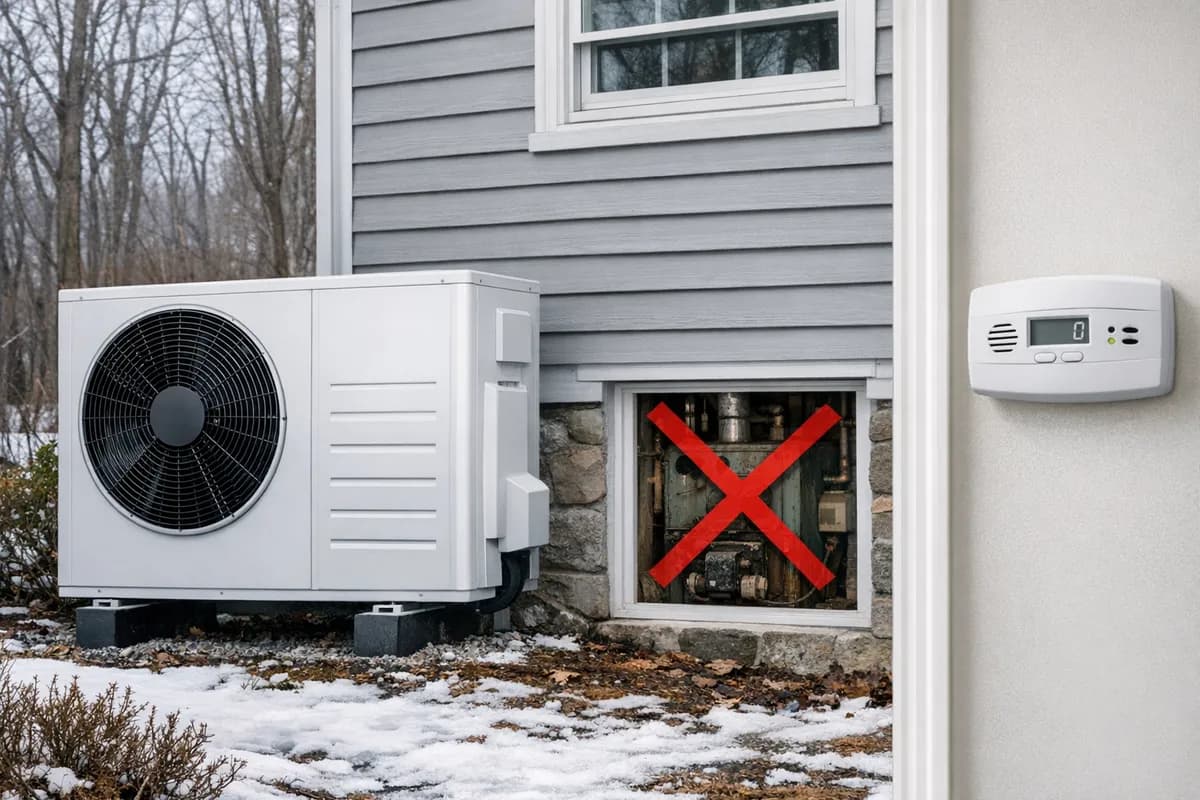
Carbon monoxide is the leading cause of accidental poisoning deaths in the United States. It's odorless, colorless, and in high concentrations, lethal. In Rhode Island — where 35% of homes still burn heating oil and another 40% use natural gas — the risk is particularly acute during the heating season (October through April).
Heat pumps eliminate this risk entirely. Not reduce it. Not mitigate it. Eliminate it. A heat pump has no flame, no combustion chamber, no flue, and no fossil fuel. It moves heat using electricity and refrigerant. Carbon monoxide cannot be produced because there is no combustion reaction occurring — not at any temperature, not at any load, not under any conditions.
This page explains the CO risks in RI homes with combustion heating, how heat pumps eliminate those risks, Rhode Island's CO detector requirements, and what Clean Heat RI's 60% rebate means for making this safety upgrade affordable.
CO Risk by Heating Fuel Type in Rhode Island
Heating Oil (Fuel Oil)
CO Risk: High~130,000 (35% of RI households)
Incomplete combustion in oil burner, cracked heat exchanger, blocked flue, or backdrafting
Complete — heat pump has no combustion, no flue, no CO production
Natural Gas
CO Risk: Moderate–High~150,000 (40% of RI households)
Cracked heat exchanger, pilot light issues, poor ventilation, gas appliance malfunction
Complete — no combustion byproducts of any kind
Propane
CO Risk: Moderate–High~25,000 (7% of RI households)
Same combustion risks as natural gas plus tank/line leaks
Complete — eliminates combustion and propane storage risk
Electric Resistance
CO Risk: None~40,000 (11% of RI households)
No combustion — no CO risk (but very high operating cost)
N/A — already CO-free. Heat pump reduces electric bill by 50–60%
Heat Pump
CO Risk: None~25,000 and growing (7% of RI households)
No combustion, no flame, no flue, no fossil fuel. Zero CO production under any conditions.
Already the safest option
How Combustion Heating Creates Carbon Monoxide
Understanding how CO enters your home helps you appreciate why heat pumps are fundamentally different. These are the most common failure modes in RI combustion heating systems:
Cracked Heat Exchanger
Oil, GasThe most dangerous furnace failure. A crack in the heat exchanger allows combustion gases (including CO) to mix with heated air distributed through your home. Often invisible and odorless. Can develop in furnaces 15+ years old — a significant concern in RI where many oil furnaces are 20–30 years old.
Prevalence: Affects ~3% of furnaces over 15 years old
Blocked Flue or Chimney
Oil, GasBird nests, leaves, ice, or chimney deterioration can block the flue, preventing combustion gases from venting outside. CO accumulates inside the home. RI's older housing stock (median home age: ~60 years) often has aging chimney systems that are prone to blockage.
Prevalence: Common in homes with deferred chimney maintenance
Backdrafting
Oil, GasNegative air pressure in the home (from range hoods, bathroom fans, or tight weatherization) can pull combustion gases backward through the flue into the living space. Ironically, well-sealed homes can increase backdrafting risk unless combustion appliances are properly vented.
Prevalence: Risk increases in recently weatherized homes
Incomplete Combustion
OilDirty or misadjusted oil burners produce higher levels of CO. Oil systems require annual cleaning and adjustment — many RI homeowners defer this maintenance. A burner that ran fine last year can produce dangerous CO levels this year without proper service.
Prevalence: Risk increases with deferred maintenance
Gas Leak + Ignition
Gas, PropaneWhile not directly a CO issue, natural gas and propane leaks create explosion risk. RI Energy responds to thousands of gas leak calls annually. Heat pumps eliminate this risk entirely — no gas lines in the home.
Prevalence: RI Energy responds to ~5,000+ gas calls/year
Why Heat Pumps Are Inherently CO-Safe
The Fundamental Difference
A heat pump does not burn anything. It works like a refrigerator in reverse — compressing and expanding refrigerant to move heat from outdoor air into your home (heating mode) or from indoor air to outside (cooling mode). The compressor runs on electricity. The refrigerant circulates in a sealed loop. No combustion reaction occurs. No carbon monoxide can be produced because no carbon-based fuel is being burned. This is not a safety feature that can fail — it is a physical impossibility.
Zero Carbon Monoxide Production
Heat pumps move heat using electricity and refrigerant — no combustion occurs at any point. There is literally no mechanism for CO to be produced. This is not a reduced risk; it is zero risk.
No Flue or Chimney Required
Eliminating the flue removes a major failure point. No risk of blockage, backdrafting, or improper venting. After heat pump installation, some RI homeowners cap and seal their old chimney — eliminating a source of heat loss and water infiltration.
No Fuel Storage on Property
Oil tanks (indoor or outdoor) are a spill risk and environmental liability. Underground oil tanks in particular can leak, contaminating soil and groundwater. Propane tanks have explosion potential. Heat pumps eliminate all on-site fuel storage.
No Annual Combustion Safety Service
Oil furnaces require annual cleaning, burner adjustment, and combustion analysis. Gas furnaces need heat exchanger inspection. Heat pumps need minimal maintenance — filter cleaning and occasional refrigerant check. No combustion means no combustion safety testing.
Refrigerant Is Non-Toxic (Modern Systems)
Modern heat pumps use R-410A or R-32 refrigerant. While a large leak in an enclosed space could theoretically displace oxygen, this is extremely unlikely in a residential setting. The refrigerant is non-flammable (R-410A) or mildly flammable (R-32) and non-toxic at normal concentrations.
Electrical Safety Standards
Heat pumps are installed to NEC (National Electrical Code) standards with circuit breakers, GFCI protection where required, and disconnect switches. Electrical risks are managed through standard residential electrical safety practices — the same as your dryer, range, or EV charger.
Recognizing Carbon Monoxide Exposure
CO is called the "silent killer" because it's odorless and colorless. If you still have combustion heating, know these symptoms:
| Severity | Symptoms | Timeframe | Action |
|---|---|---|---|
| Mild (50–100 ppm) | Headache, dizziness, nausea, fatigue | After 1–2 hours exposure | Open windows, leave home, call utility |
| Moderate (100–300 ppm) | Severe headache, confusion, vomiting, impaired judgment | After 30–60 minutes | Evacuate immediately, call 911 |
| Severe (300+ ppm) | Loss of consciousness, seizures, brain damage, death | Within minutes to 1 hour | Evacuate immediately, call 911 |
If your CO detector alarms: Evacuate everyone from the home immediately. Call 911. Do not re-enter until the fire department clears the building. If anyone shows CO symptoms, seek medical attention — CO poisoning requires treatment even after leaving the contaminated area.
Rhode Island CO Detector Requirements
Rhode Island General Laws § 23-28.1-4
CO detectors required in all residential buildings with fossil fuel-burning appliances or attached garages
- Every habitable floor (including basement)
- Within 15 feet of each sleeping area
- On the ceiling or 5 feet above floor level (per manufacturer instructions)
Hard-wired with battery backup (new construction), battery-only (existing homes)
Every 5–7 years per manufacturer specifications
RI State Fire Marshal. Non-compliance can result in fines.
After Switching to a Heat Pump
If you remove ALL fossil fuel appliances AND don't have an attached garage, CO detectors are technically no longer required by law. However, fire safety experts recommend keeping them — they protect against vehicle exhaust and neighboring building CO infiltration.
Why This Matters More in Rhode Island
RI has the 8th highest percentage of oil-heated homes in the U.S.
Approximately 35% of RI households use heating oil — far above the national average of 4%. This means RI has a disproportionately high number of homes with active CO risk from oil combustion.
Median RI home age is approximately 60 years
Many RI homes were built before modern building codes. Older homes often have aging chimneys, outdated flue systems, and oil furnaces that are well past their 20-year expected lifespan. These aging systems are more prone to CO-producing failures.
40–60 CO incidents reported in RI annually
Rhode Island fire departments respond to 40–60 carbon monoxide incidents per year, ranging from detector activations to hospitalizations. The majority involve combustion heating systems (oil and gas). Every incident from a heating system would be prevented by a heat pump.
RI has some of the highest heating oil costs in the nation
At $4.20–$4.80/gallon (2025–2026), heating oil costs $2,500–$4,500/year for a typical RI home. Heat pumps reduce this to $1,200–$2,000/year in electricity — a savings AND a safety upgrade.
Safety AND Savings: The Clean Heat RI Opportunity
Clean Heat RI makes the switch from combustion heating to a heat pump both a safety upgrade and a financial win. The numbers for a typical oil-to-heat-pump conversion:
| Item | Amount |
|---|---|
| 3-Ton Ducted Heat Pump (Installed) | $18,000 |
| Clean Heat RI Discount (60%) | -$10,800 |
| RI Energy Utility Rebate (from oil) | -$1,250/ton x 3 = -$3,750 |
| Your Net Cost | $3,450 |
| Annual Heating Oil Savings | +$1,500–$2,500/year |
| CO Risk After Conversion | Eliminated |
| Annual Furnace Maintenance Savings | +$200–$400/year |
| Payback on Net Cost | 1.5–2.5 years |
The bottom line: For as little as $3,450 net (after Clean Heat RI + RI Energy rebates), you can permanently eliminate carbon monoxide risk from your home AND save $1,700–$2,900/year on heating and maintenance costs. The payback is 1.5–2.5 years. After that, it's pure savings — and zero CO risk — for the 15–25 year life of the heat pump.
A Note on Dual Fuel / Hybrid Systems
Some RI homeowners choose a "dual fuel" setup: a heat pump handles most heating, with the existing oil or gas furnace as backup during extreme cold. This is a reasonable transition strategy, but understand: the oil/gas furnace retains all its original CO risks during the periods it operates.
If you keep a combustion backup:
- Maintain annual combustion safety service on the furnace
- Keep all CO detectors active and tested monthly
- Have the heat exchanger inspected annually (cracking risk increases with age and intermittent use)
- Plan to fully decommission the furnace when it reaches end of life — don't replace it
Modern cold-climate heat pumps (ENERGY STAR 6.1) operate efficiently down to -15°F. In Rhode Island, where temperatures rarely drop below 0°F, a properly sized cold-climate heat pump can handle the entire heating load without backup. Full decommission is the safest option.