Loading NuWatt Energy...

We use your location to provide localized solar offers and incentives.
We serve MA, NH, CT, RI, ME, VT, NJ, PA, and TX
Loading NuWatt Energy...
NuWatt designs, installs, and manages solar, battery, heat pump, and EV charger systems across 9 states. One company, one warranty, one point of contact.
Get a Free QuoteRhode Island has two main solar incentives — the REF rebate ($0.65/W upfront) and the REG program (31.55¢/kWh for 15 years). They stack together, but understanding how each works changes your payback by thousands.
$5,000
REF Rebate
max upfront
31.55¢/kWh
REG Rate
15 years locked
80%
Net Metering
retail credit
$0
Fed ITC
expired 2025
No — REF and REG are mutually exclusive.Commerce RI says it plainly: "Our program CAN NOT BE PAIRED with the Renewable Energy Growth Program," and the state regulation 870-RICR-20-00-1 confirms projects enrolled in REG are not eligible for REF. The REF (Renewable Energy Fund) gives you an upfront rebate of $0.65/W (max $5,000). The REG (Renewable Energy Growth) program pays 31.55¢/kWh for every kilowatt-hour your system produces for 15 years (Small-Scale Solar I). For typical residential systems the REG path far outperforms REF's one-time cap — use the calculator below to compare your specific situation.
Rhode Island offers two distinct state solar incentives. They work differently, are run by different agencies, and can be combined. Here's what each does.
Administered by Commerce RI
The REF is a one-time upfront rebatethat reduces your installation cost. It pays $0.65 per watt, capped at $5,000 for residential systems. For a typical 8 kW system, that's the full $5,000 cap (8,000W × $0.65 = $5,200, capped).
If you add a battery, there's an additional $2,000 battery adder. So a solar + battery system can receive up to $7,000 in REF funds.
Administered by Rhode Island Energy
The REG is a performance-based incentive that pays you a fixed rate per kilowatt-hour for every unit of electricity your solar system produces. The 2026 residential rate is 31.55¢/kWh, locked for 15 years at enrollment.
During the REG term, the REG tariff replaces net metering as your compensation mechanism. After the 15-year term, you revert to standard net metering.
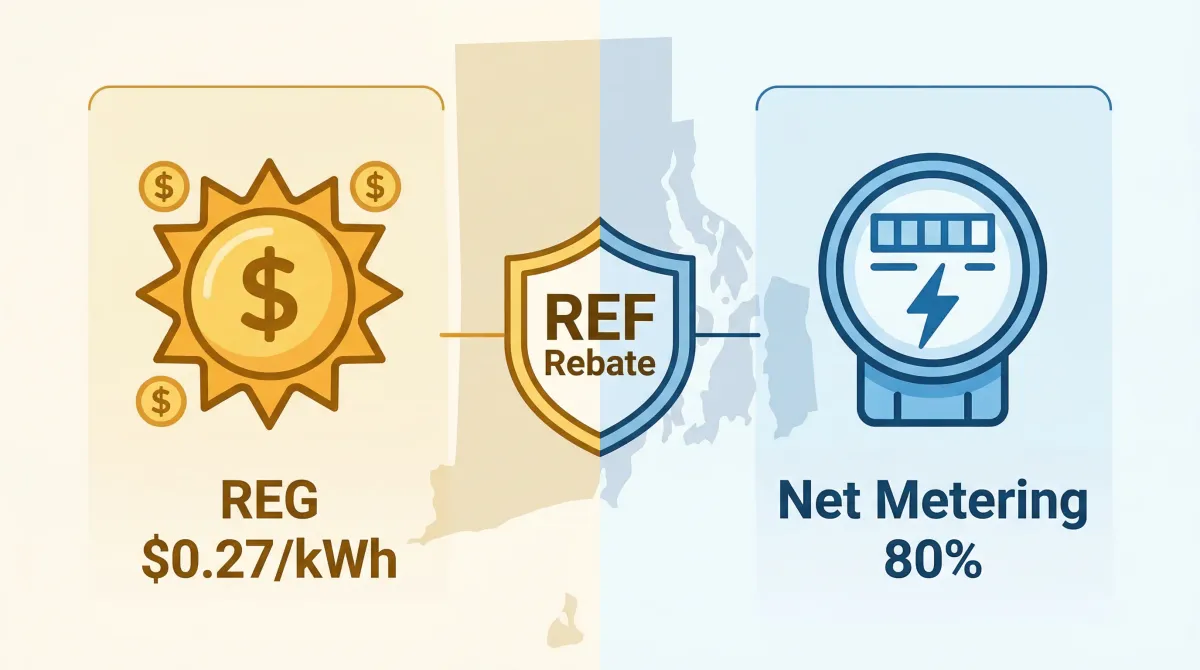
REF reduces your upfront cost; REG provides guaranteed income for 15 years. Both programs can be used together.
These programs solve different problems. REF lowers your cost; REG guarantees your income. Here's how they compare on every dimension that matters.
| Feature | REF (Rebate) | REG (Production) |
|---|---|---|
| Full Name | Renewable Energy Fund | Renewable Energy Growth |
| Administered By | Commerce RI | Rhode Island Energy |
| Payment Type | One-time upfront rebate | Per-kWh production payments |
| Amount | $0.65/W (max $5,000) | 31.55¢/kWh (PY2026) |
| Duration | Instant (at interconnection) | 15 years (residential) |
| Battery Bonus | $2,000 adder | No battery bonus |
| Enrollment | Open year-round (first-come) | Annual April window |
| Capacity Limit | Budget-limited ($5.8M/yr) | MW cap per program year |
| Stacks With | REG, net metering, tax exemptions | REF, net metering (after term), tax exemptions |
| Impact on Net Metering | None — NM continues normally | Replaces NM during 15-year term |
| Best For | Reducing upfront cost | Maximizing long-term income |
Both paths include the REF upfront rebate. The real question is your compensation mechanism: REG's fixed 31.55¢/kWh for 15 years, or standard net metering at tariff-specific renewable credit for 25 years? Adjust your system size and utility below to see the 25-year comparison.
Compare your 25-year returns under each RI incentive path
Net metering wins by $5,550 over 25 years
Under this scenario, Rhode Island Energy's variable import components begin at $0.32303/kWh and rise 3% annually; the export credit remains at the current $0.27553/kWh snapshot rather than being escalated.
Important: REF and REG are mutually exclusive per Commerce RI rules — you choose one track. The REF rebate ($5,000) only applies to the REF + NM path.
Year 1 Income
$3,062/yr
Payback
8.0 years
25-Year Total
$82,899
Year 1 Income
$2,835/yr
Payback
6.9 years
25-Year Total
$88,449
Assumes 3% annual utility rate escalation. REG rate is fixed at enrollment.
REG annual income is constant (31.55¢/kWh, PY2026 Small-Scale Solar I). Net metering rises with utility rates.
The Bottom Line
REF and REG are mutually exclusive.Commerce RI's own rules prohibit pairing them — you enroll in one track or the other, not both. This calculator shows the 25-year total value of each path so you can pick the one that fits your situation.
REG (31.55¢/kWh for 15 years, Small-Scale Solar I) gives you predictable, bankable income. It's especially valuable if you finance with a loan because lenders can underwrite the guaranteed cash flow. You forfeit the REF rebate but gain 15 years of PBI that usually far exceeds the $5K REF cap.
REF + Net Metering gives you upfront cash ($5,000) plus modeled bill credits. Only avoided variable import components escalate in this scenario; the current export credit is held flat and is not a future-tariff promise.
Estimates based on RI averages (1,213 kWh/kW annual production). Actual values depend on system design, shading, and orientation. REG rate locked at enrollment for 15 years (Small-Scale Solar I, 0-15 kW DC). The October 2026 snapshot uses $0.32303/kWh variable import components and a separate $0.27553/kWh renewable NEM credit; the $11.25 monthly charge is not avoidable. The 3% escalation applies only to variable import components. Future tariffs are not guaranteed. Federal ITC (Section 25D) expired Dec 31, 2025. REF and REG are mutually exclusive per Commerce RI rules — homeowners pick one track.
The most common confusion: "If I get REG, do I lose REF?" No. Here's the stack order and timeline for a typical 8 kW system.
Day 0: Installation
System installed and interconnected. Cost: ~$24,480 for 8 kW.
Week 2: REF Rebate Applied
Commerce RI processes REF rebate: $5,000 returned. Your net cost drops to ~$19,480. If battery installed, add $2,000.
Month 1: First REG Payment
Rhode Island Energy begins paying 31.55¢/kWh for all production. ~$220/month in summer, ~$100/month in winter.
Years 1-15: REG Income
Fixed $2,643/year in REG payments. Total over 15 years: ~$39,645. Rate never changes regardless of utility rate.
Year 16: Revert to Net Metering
REG term ends. System automatically switches to standard net metering at tariff-specific renewable credit rate. By Year 16, utility rates will likely be ~$0.43/kWh (at 3% inflation), making net metering very valuable.
Years 16-25: Net Metering
After the RE Growth term, verify the tariff then in effect before modeling later-year net-metering value. The RE Growth path does not include an REF rebate.
The "best" path depends on your utility, financing, and whether you can get into REG before capacity fills. Here are the most common situations.
You can afford the full cost, so the REF rebate is nice but not critical. REG's guaranteed $2,643/yr for 15 years ($39,645 total) far exceeds what net metering alone provides in the same period.
REG's predictable income helps offset loan payments from Day 1. Lenders also view REG enrollment favorably because the cash flow is guaranteed and contractual.
If you can't get into REG (capacity filled, missed April deadline), net metering + REF is still a strong path. With RI Energy at $0.30/kWh and rising, your returns grow annually.
At $0.35/kWh (highest in RI), net metering value exceeds the fixed REG rate of 31.55¢/kWh from Year 1 — and it only grows. REG would actually lower your annual income.
The $2,000 REF battery adder only comes through the REF program. ConnectedSolutions ($225/kW summer DR) works with both paths. Apply for REF regardless of your compensation choice.
The federal residential solar ITC (Section 25D) expired December 31, 2025.
Without the federal ITC, Rhode Island's state programs are the primary financial drivers for going solar. A properly stacked REG or REF (pick one) combination can still deliver 8-10 year payback despite the loss of the 30% credit.
The application processes are separate. Your installer typically handles both, but here's what to know.
REF Rebate Deep Dive
Complete guide to applying for the $5,000 REF rebate
REG Program Guide
31.55¢/kWh guaranteed rate — enrollment, eligibility, stacking
All RI Solar Incentives
Every active (and dead) incentive in one place
RI Net Metering Guide
current tariff-specific renewable credit, caps, and how it works in 2026
RI Solar Cost Guide
What solar really costs in Rhode Island in 2026
Cash vs Loan vs Lease
Which financing makes sense with no federal ITC
RI Tax Exemptions
Sales tax + property tax exemptions for solar
ConnectedSolutions
$225/kW summer demand response for battery owners
Solar Without ITC
Why solar still works without the 30% federal credit
Get a free solar quote from a certified RI installer. We'll help you navigate both programs and maximize your 25-year return.