Loading NuWatt Energy...

We use your location to provide localized solar offers and incentives.
We serve MA, NH, CT, RI, ME, VT, NJ, PA, and TX
Loading NuWatt Energy...
NuWatt designs, installs, and manages solar, battery, heat pump, and EV charger systems across 9 states. One company, one warranty, one point of contact.
Get a Free QuoteThe residential solar credit (25D) is dead. But Section 48/48E — the commercial investment tax credit — is alive and available to homeowners through third-party ownership. Here is exactly how it works.

Section 48E is a commercial investment tax creditworth 30-70% of a solar system's cost. Homeowners cannot claim it directly — but when you go solar through a lease, PPA, or prepaid ESA like NuWatt Propel, the financing company owns the system, claims the 48E credit, and passes the savings to you through lower rates and $0 down. This is the only way to access federal solar tax credits in 2026 after the residential 25D credit expired on December 31, 2025.
Section 48E (and its predecessor Section 48) is the investment tax credit for businesses that own energy-generating equipment. When a third-party company finances your solar installation, they are the system owner. They claim the ITC on their federal taxes. You benefit through lower pricing.
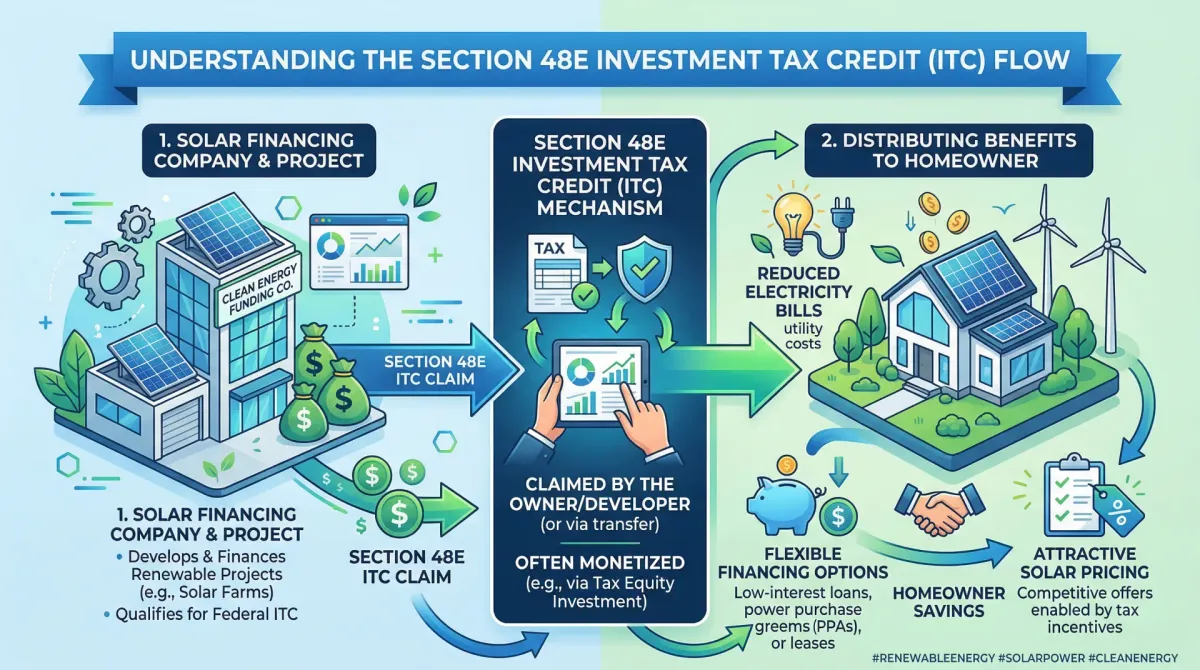
Concert Finance, Sunrun, or another TPO company purchases and installs solar on your roof. They hold legal title to the equipment.
The system owner claims the 30% base ITC (plus any adders) on their corporate tax return. They also claim MACRS depreciation.
The tax savings flow to you as lower lease/PPA rates, $0 down offers, and favorable contract terms. With Propel, you own after 7 years.
Key distinction
The ITC goes to the system owner (the financing company), not the installer. Your solar installer is a contractor — they do not own the system and cannot claim the credit. This is a common misconception.
You will never see a 48E credit on your personal tax return. Instead, the financial benefit shows up as tangible advantages in your solar contract:
TPO companies can afford to install systems with no upfront cost because the ITC offsets 30-70% of their investment immediately.
Lease and PPA rates dropped 15-25% after the IRA expanded adders. The ITC directly reduces the rate the company needs to charge you.
Because the TPO company owns the system, they guarantee its performance. If panels underperform, they fix it at no cost to you.
With NuWatt Propel, Concert Finance claims the 48E ITC, and you own the system outright after 7 years. No 20-year contracts.
The base 30% credit is just the starting point. Qualifying projects can stack adders to reach up to 70% of system cost:
| Credit Component | Value | Requirement |
|---|---|---|
| Base ITC | 30% | Project meets prevailing wage & apprenticeship OR is under 1 MW |
| Domestic Content (FEOC) | +10% | Equipment manufactured in the U.S. (40% steel/iron, 20% manufactured components) |
| Energy Community | +10% | Project located in a brownfield, coal community, or fossil-fuel-dependent area |
| Low-Income (Tier 1) | +10% | Located in a low-income census tract or on Indian land |
| Low-Income (Tier 2) | +20% | Qualified low-income residential building or economic benefit project |
| Maximum Total | Up to 70% | All adders stacked (rare for residential) |
Most residential TPO projects qualify for the 30% base + 10% domestic content = 40% effective ITC. Energy community and low-income adders depend on project location.
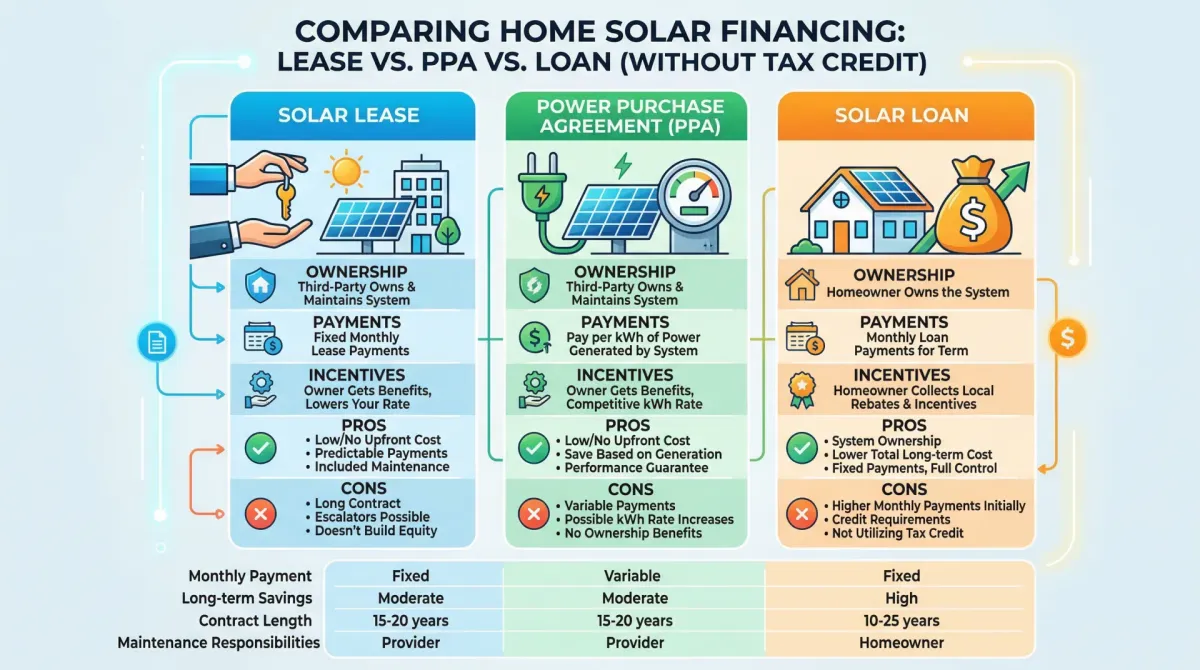
With the residential 25D credit expired, the economics of buying solar with cash have fundamentally changed. Here is how the options compare for a typical 8 kW system:
| Factor | Cash Purchase | Lease / PPA / Propel |
|---|---|---|
| Federal Tax Credit | $0 (25D expired) | 30-70% claimed by system owner |
| Upfront Cost (8 kW) | ~$24,000-$28,000 | $0 down |
| MACRS Depreciation | Not available to homeowners | Claimed by TPO (reduces your rate) |
| Payback Period | 12-18 years (no credits) | Day 1 savings (rate < utility) |
| Maintenance Risk | You pay for repairs | TPO covers maintenance |
| Ownership | Immediate | After contract (7yr Propel, 20-25yr lease) |
The 2026 math is clear
Before 2026, cash purchases made sense because you could claim the 30% credit yourself. Now, with 25D at $0, third-party ownership is the only path to federal incentives. A TPO deal effectively gives you 30-40% off the system cost through lower rates — savings a cash buyer cannot access.
Most solar leases lock you into 20-25 year agreements. NuWatt Propel is a prepaid Energy Service Agreement (ESA) that works differently:
$0 down
Upfront Cost
7 years
Ownership Transfer
Concert Finance
ITC Claimed By
Concert Finance purchases and owns the system, claiming the Section 48E ITC and MACRS depreciation on their corporate taxes. After 7 years, legal title transfers to you — and you own the panels, inverter, and racking outright with 18+ years of production life remaining.
Currently available in 2 states
NuWatt Propel is live in Maine and Texas. Propel requires FEOC-compliant panels (Silfab 440W, U.S.-manufactured) to qualify for the domestic content adder.
Under the OBBBA (signed July 4, 2025), Section 48E projects that began construction on or before July 4, 2026locked in the full timing pathway (placed in service through roughly 2030). Projects beginning after that date can still qualify but generally must be placed in service by December 31, 2027. July 4, 2026 was also the FEOC date for domestic-content adder eligibility. “Beginning construction” means either:
Significant physical work begins at the project site or at a factory where components are manufactured specifically for the project.
For low-output solar (1.5 MW AC or smaller, which covers residential systems), the taxpayer pays or incurs at least 5% of the total project cost. For a $25,000 system, that is $1,250 in equipment orders.
What this means for you:
No. Section 48E is a commercial/investment tax credit. Only the system owner can claim it. For homeowners, that means using a third-party ownership model — a solar lease, PPA, or prepaid ESA — where a financing company owns the system, claims the ITC, and passes savings to you through lower rates.
Section 25D expired on December 31, 2025 under the One Big Beautiful Bill Act (OBBBA), signed July 4, 2025. Homeowners who purchase solar with cash or a loan in 2026 receive $0 in federal tax credits.
The base credit is 30% of the system cost. With adders, it can reach up to 70%: +10% for domestic content (FEOC), +10% for energy community siting, and +10-20% for low-income community projects. Most residential TPO deals qualify for 40-50%.
There are two pathways. Projects that began construction on or before July 4, 2026 locked in the full Section 48E timing pathway (placed in service through roughly 2030). Projects that begin construction after that date can still qualify but generally must be placed in service by December 31, 2027. July 4, 2026 is also the Foreign Entity of Concern (FEOC) date for domestic-content adder eligibility. For low-output solar (1.5 MW AC or smaller), beginning construction can be established by incurring at least 5% of total project cost (the 5% safe harbor).
NuWatt Propel is a prepaid Energy Service Agreement (ESA). You pay $0 down, Concert Finance owns the system and claims the 48E ITC, and after 7 years you own the system outright. Unlike a lease, there are no monthly payments and no 20-25 year contracts. Propel is currently available in Maine and Texas.
Indirectly, yes. The TPO company claims 5-year MACRS accelerated depreciation (with 100% first-year bonus depreciation, made permanent under OBBBA), which reduces their cost basis. They pass those savings to homeowners through lower lease/PPA/ESA rates. This is why third-party rates dropped significantly after the IRA passed.
Projects that began construction on or before July 4, 2026 locked in the full timing pathway. Check if your home qualifies for NuWatt Propel or a solar lease/PPA in your state.