Loading NuWatt Energy...

We use your location to provide localized solar offers and incentives.
We serve MA, NH, CT, RI, ME, VT, NJ, PA, and TX
Loading NuWatt Energy...
NuWatt designs, installs, and manages solar, battery, heat pump, and EV charger systems across 9 states. One company, one warranty, one point of contact.
Get a Free Quote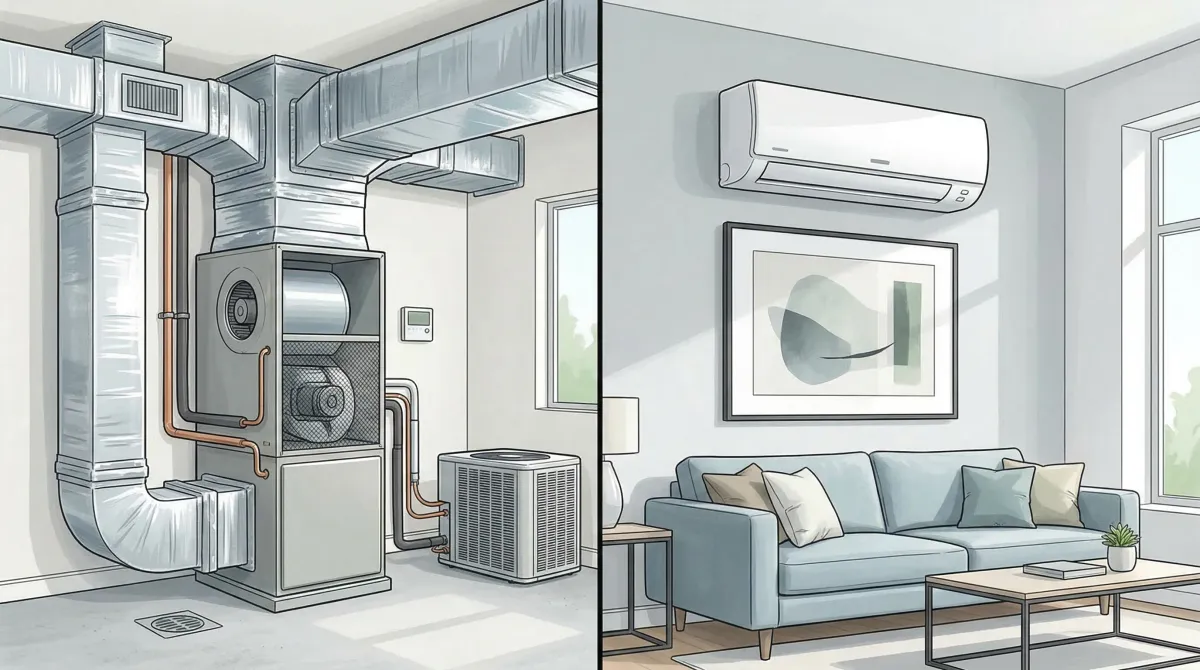
Most Vermont homes were built with oil boilers, woodstoves, baseboard heat, or radiators and have no ductwork. Others have forced-air furnaces with existing ducts. The right heat pump type depends on what your home already has, how cold your region gets, and what you need.
$1,800 - $5,000
Ductless Single-Zone
$4,500 - $13,000
Ductless Multi-Zone
$5,500 - $11,000
Ducted Central HP
Available
Efficiency VT Rebates
Answer a few questions to get a personalized recommendation based on your home and heating situation.
How ducted, single-zone ductless, and multi-zone ductless heat pumps stack up on the factors that matter most in Vermont.
| Feature | Ducted | Ductless (Single) | Ductless (Multi) |
|---|---|---|---|
| Installed Cost | $5,500 - $11,000 | $1,800 - $5,000/zone | $4,500 - $13,000 |
| Uses Existing Ducts | Yes (required) | No | No |
| Whole-Home Coverage | Yes | No (single zone) | Yes (2-5 zones) |
| Efficiency (HSPF2) | 8.5 - 12.0 | 10.0 - 13.5 | 9.5 - 12.5 |
| Cold-Climate Rating | Select models to -15°F | Most models to -15°F | Most models to -13°F |
| Zone Control | Limited (dampers optional) | Individual room | Per-zone independent |
| Installation Disruption | Moderate (if ducts exist) | Minimal (4-6 hours) | Moderate (1-2 days) |
| Best For in VT | Homes with existing forced-air | Oil/propane supplement, additions | Old farmhouses without ducts |
Factors unique to the Green Mountain State that affect which heat pump type makes sense for your home.
Vermont is entirely Climate Zone 6, and the Northeast Kingdom (NEK) regularly sees -25°F. Cold-climate rated models are absolutely essential, not optional. Mitsubishi Hyper-Heat and Fujitsu XLTH maintain heating output down to -13°F to -15°F. A backup heat source is still recommended for the coldest NEK nights.
Over 50% of Vermont homes heat with oil or propane, among the highest rates in the country. Ductless mini-splits are Vermont's primary displacement strategy: homeowners add 1-3 heads to offset fossil fuel usage in main living areas, cutting oil/propane consumption by 30-60% without replacing the existing system.
Efficiency Vermont offers rebates on qualified cold-climate heat pumps for both ducted and ductless systems. Additionally, the Clean Heat Standard generates thermal energy credits that installers can monetize, often reducing your out-of-pocket cost further. GMP's Bring Your Own Device program adds incentives for battery-connected systems.
Vermont's Clean Heat Standard requires fossil fuel dealers to reduce emissions through clean heating measures. This creates thermal energy credits (TECs) that incentivize switching from oil/propane to heat pumps. Installers and fuel dealers may offer additional discounts or financing to earn these credits, making 2026 a strategic time to switch.
Vermont's housing stock is among the oldest in the nation. Many homes are 100+ years old, built with radiators, woodstoves, or baseboard heat and no ductwork whatsoever. Installing new ducts in a farmhouse costs $3,000-$8,000+ and often isn't feasible due to plaster walls and limited chase space. Ductless multi-zone systems serve these homes without structural disruption.
These models are proven performers in extreme cold and are commonly installed throughout Vermont, including the NEK.
-13°F
12.5
100% at 5°F, ~76% at -13°F
19 dB indoor
$4,500 - $7,000/zone
Most popular in VT for oil/propane displacement
-15°F
12.0
100% at 5°F, ~80% at -15°F
18 dB indoor
$4,200 - $6,500/zone
Best extreme-cold rating for NEK and mountain areas
-13°F
10.5
100% at 5°F, ~75% at -13°F
Concealed unit
$6,000 - $10,000
Whole-home ducted cold-climate solution
-4°F
10.0
100% at 17°F, variable below
Integrated with ductwork
$5,500 - $9,000
Good value for Champlain Valley with existing ducts
Yes. Modern cold-climate ductless mini-splits like the Mitsubishi Hyper-Heat and Fujitsu XLTH operate effectively down to -13°F to -15°F, maintaining 75-80% heating capacity at those temperatures. In the Champlain Valley and southern Vermont, they handle 95%+ of winter hours. In the Northeast Kingdom where temps hit -25°F, a backup heat source for the coldest nights is recommended while the heat pump handles the other 90%+ of the heating season.
Efficiency Vermont offers rebates on qualified cold-climate heat pumps for both ducted and ductless systems. Rebate amounts vary based on system type and whether it replaces fossil fuel heating. Additionally, the Clean Heat Standard creates thermal energy credits that may further reduce costs. Contact Efficiency Vermont or a participating installer for current rebate amounts, as they update periodically.
The Clean Heat Standard requires fossil fuel dealers to reduce emissions, creating a market for thermal energy credits (TECs). When you switch from oil or propane to a heat pump, your installer or fuel dealer earns credits they can monetize. This often translates to additional discounts or financing incentives beyond Efficiency Vermont rebates, making 2026 a particularly good time to install a heat pump.
Absolutely, and this is the most common approach in Vermont. Many homeowners install 1-3 ductless mini-split heads in primary living spaces while keeping their oil boiler for backup and domestic hot water. This hybrid approach typically cuts oil consumption by 30-60%, saving $1,000-$2,500 per year depending on oil prices. The oil system provides backup on the coldest NEK nights and continues producing hot water.
With oil at $3.50-$4.00/gallon and Vermont electricity at approximately $0.20-$0.22/kWh, a heat pump operating at a COP of 2.5-3.0 costs roughly 50-60% less per BTU than oil. For a typical Vermont home using 800 gallons of oil per year ($2,800-$3,200), displacing 50-60% with ductless mini-splits saves $1,400-$1,900 annually. Full displacement with a multi-zone system can save $1,800-$2,500 per year.
This is exactly where ductless multi-zone systems shine. A ductless system requires only a 3-inch hole through the wall for refrigerant lines, minimal disruption to historic plaster walls and timber frames. A typical Vermont farmhouse needs 3-4 indoor heads covering the main living area, kitchen, and bedrooms. The outdoor unit sits on a stand (raised above snow line) outside. Installation takes 1-2 days with no structural modifications required.
Explore more Vermont heat pump and solar guides.
VT Heat Pump Costs 2026
Full pricing breakdown by system type and size
VT Heat Pump Rebates 2026
Efficiency Vermont incentives and Clean Heat Standard credits
Cold Climate Heat Pumps in VT
Performance data for sub-zero Vermont temperatures
Choosing a VT Installer
What to look for in a heat pump contractor
Heat Pump vs Oil in VT
Cost comparison with oil boiler systems
Solar + Heat Pump in VT
Pair solar panels with your heat pump system
Get a free assessment from a qualified Vermont heat pump installer. We will help you determine whether ducted or ductless is the best fit for your home, your heating system, and your budget.