Loading NuWatt Energy...

We use your location to provide localized solar offers and incentives.
We serve MA, NH, CT, RI, ME, VT, NJ, PA, and TX
Loading NuWatt Energy...
NuWatt designs, installs, and manages solar, battery, heat pump, and EV charger systems across 9 states. One company, one warranty, one point of contact.
Get a Free Quote
The federal residential solar tax credit (Section 25D) died on December 31, 2025. Vermont never had a state solar rebate to begin with. That makes the Green Mountain State one of the tougher places to pencil out solar — but 5 programs still make it work, and Vermont's 90% renewable mandate means the state is deeply committed to solar for the long run. Here is the honest, complete picture.
The federal residential solar tax credit (Section 25D) expired December 31, 2025. Vermont has never had a state solar rebate. Homeowners who buy solar with cash or a loan receive $0 in federal or state rebates. However, Vermont still has 5 mechanisms that support solar investment:
Bottom line: A 10 kW system at $3.05/W costs $30,500 with no federal or state offset. Over 25 years, NM savings + tax exemptions generate approximately $52,900 in total value (GMP territory). Payback: ~13 years. Longer than Massachusetts (7-9 years) or New Hampshire (9.5 years), but Vermont's environmental commitment and declining net metering rates create urgency to lock in current rates now.
Before we cover what still works, let's be honest about what's gone. Many solar websites still list the federal tax credit as available for VT homeowners. They are wrong.
Homeowners who purchase solar with cash or a loan receive $0 in federal tax credits. This was 30% in 2025, worth ~$9,150 on a 10 kW system. Now it is zero.
Vermont has never had a direct state solar rebate program. Unlike NH (repealed), MA (SMART), or RI (REF), Vermont has no state-level cash incentive for residential solar.
The $2,000 heat pump tax credit and $1,200 insulation credit are both dead. Efficiency Vermont rebates for heat pumps are separate and state-funded.
H.289 phased out virtual net metering effective January 1, 2025. No new community solar projects can be created in Vermont. Existing legacy projects continue until contracts expire.
Vermont is the toughest state in New England for solar payback. With moderate electricity rates ($0.22/kWh vs $0.27-$0.32 in MA, CT, RI), no state rebate (never had one), declining net metering rates (7 consecutive annual cuts), and now no federal ITC, the economics are significantly weaker than neighboring states. The case for solar in Vermont rests on net metering with positive adjustor, dual tax exemptions, GMP battery programs, and environmental commitment. If pure financial return is your only metric, solar pencils out — but with a ~13-year payback vs ~7-9 years in Massachusetts.
The federal credit was the big loss. Vermont never had a state rebate. But the 5 remaining programs all survived — and net metering's declining adjustor creates urgency to install now.
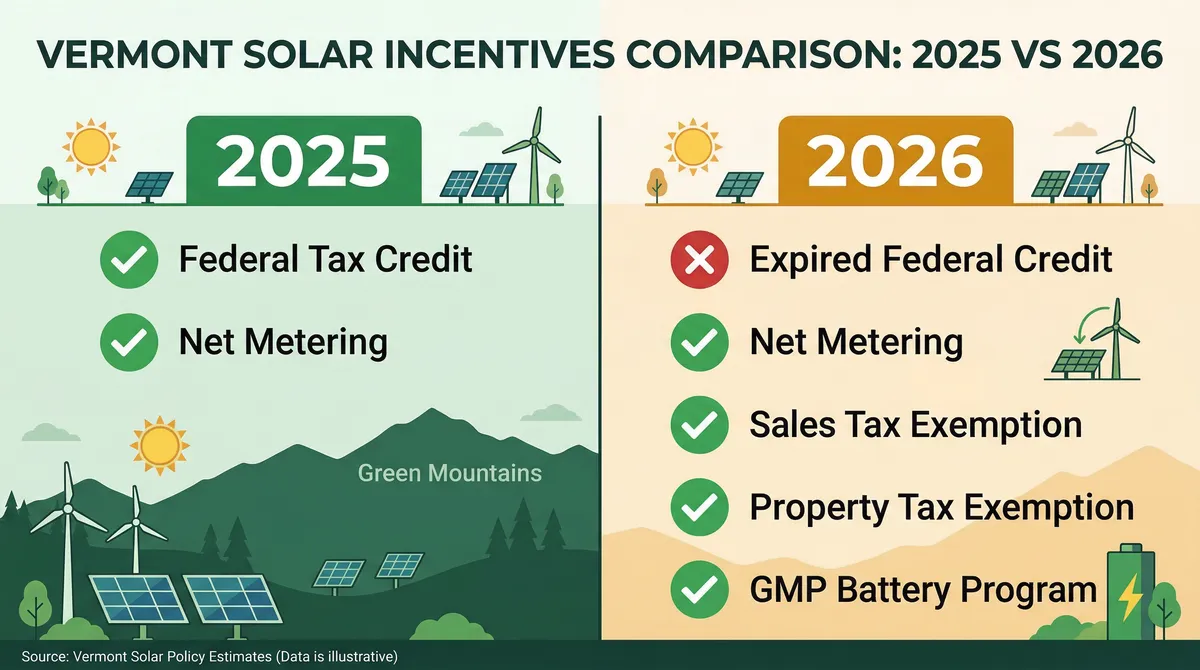
| Incentive Program | 2025 | 2026 | Status |
|---|---|---|---|
| Federal Tax Credit (25D) | 30% of system cost (~$9,150) | $0 — Expired Dec 31, 2025 | Dead |
| VT State Solar Rebate | Never existed | Still no state rebate | Dead |
| Net Metering (Cat. I) | ~$0.22/kWh effective credit | ~$0.22/kWh — but declining annually | Active |
| Sales Tax Exemption (6%) | 6% exempt on equipment + labor | 6% exempt on equipment + labor | Active |
| Property Tax Exemption | 100% exempt (systems <50 kW) | 100% exempt (systems <50 kW) | Active |
| Section 48E (Lease/PPA) | 30%+ for third-party owner | 30%+ through July 4, 2026 | Deadline |
| GMP Battery Program | $55/mo lease or BYOD incentive | BYOD deadline Sep 30, 2026 | Deadline |
| Section 25C (Heat Pump) | $2,000 heat pump credit | $0 — Expired Dec 31, 2025 | Dead |
| Community Solar | Already phased out (H.289) | Dead — no new projects | Dead |
The federal 25D credit was worth approximately $9,150 on a typical 10 kW system. That is a significant loss. Unlike NH and MA, Vermont never had a state rebate to lose. The net impact is a $9,150 increase in out-of-pocket cost compared to 2025. But net metering, sales tax exemption ($1,830), and property tax exemption ($10,000 over 25 years) still provide real value. And with NM adjustors declining annually, every year you wait costs you money in locked-in credits.
Vermont's net metering program is the primary financial driver for residential solar. Category I (systems up to 15 kW) is the relevant tier for most homeowners. Unlike most states, Vermont uses a "category + adjustor" system managed by the VT Public Utility Commission.
Effective NM rate = Base blended rate ($0.1839/kWh) + Category I adjustor (+$0.04/kWh) = ~$0.22/kWh
The positive adjustor is what makes Category I attractive for homeowners. It adds approximately $0.04/kWh above the blended rate for 10 years from your interconnection date. After 10 years, credits revert to the base blended rate.
The VT PUC has reduced the Category I adjustor 7 years in a row. Each annual cut lowers the effective NM credit for new installations. If you install in 2026, you lock in the current adjustor for 10 years. Wait until 2027, and the adjustor will almost certainly be lower. This is the strongest urgency factor for Vermont solar.
Read our complete VT net metering guide for full category-by-category breakdown
Based on 11,750 kWh annual production (10 kW system), 70% self-consumed at retail rate, 30% exported at NM credit rate. Category I adjustor included.
Urgency: The Category I adjustor has been cut 7 years running. Install in 2026 to lock in current rates for 10 years.
Vermont's 6% sales tax does not apply to solar equipment, installation labor, or battery storage. This saves approximately $1,830 on a typical 10 kW system. The exemption is automatic — no application needed.
Under 32 V.S.A. section 3802, solar energy systems under 50 kW are exempt from property tax assessment in Vermont. Unlike New Hampshire (where each town must vote to adopt), this is a statewide exemption — every VT homeowner with a system under 50 kW qualifies automatically.
Based on average VT property tax rate. Your actual savings depend on your town's tax rate. Burlington, Montpelier, and other cities may vary.
Vermont's property tax exemption is statewide — every homeowner qualifies. In New Hampshire, each town must vote to adopt RSA 72:62 at town meeting, and ~34% of NH towns have not done so. This is a meaningful advantage for VT homeowners.
Green Mountain Power runs the most innovative residential battery program in the country. GMP aggregates ~50 MW of distributed batteries into a virtual power plant. Homeowners get backup power and financial benefits. There is nothing else like it in New England.
Includes installation, maintenance, monitoring, firmware updates. GMP handles everything. Battery provides backup during outages and participates in GMP's virtual power plant during peak demand.
Buy your own battery, get a GMP incentive. Compatible brands: Tesla, Enphase, FranklinWH, SolarEdge, Generac, Sonnen, and more. You own the battery and participate in GMP's virtual power plant for grid peak events.
If you do not want to (or cannot) pay cash or take a loan, a lease or PPA arrangement lets you access the last remaining federal solar tax benefit. The third-party financing company that owns the system claims the 30% Section 48E ITC, and passes some of those savings to you through lower monthly payments.
While not direct solar incentives, these programs can stack with your solar installation to maximize whole-home energy savings.
Efficiency Vermont offers rebates on qualifying heat pumps. A solar + heat pump bundle maximizes your electrification savings — your solar panels power your heating and cooling.
View Efficiency VT program guideGMP offers time-of-use rates (off-peak $0.1452/kWh, on-peak $0.3407/kWh, weekdays 4-9 PM). Solar + battery owners can charge during off-peak and export during on-peak for additional arbitrage value.
View GMP TOU battery guidePairing solar with a heat pump is the highest-value electrification play in Vermont. Your solar panels offset both electricity AND heating costs. Efficiency VT rebates reduce the heat pump portion.
View solar + heat pump guideSelect your utility, system size, and see exactly how much value each remaining incentive delivers. Numbers are based on 2026 VT rates and programs.
The honest math — see what Vermont actually offers (and what it does not)
Federal Solar ITC (Section 25D): EXPIRED
$0 for homeowner cash or loan purchases. Expired December 31, 2025.
Net Metering Cut 7 Consecutive Years
VT PUC has reduced net metering credit rates every year since 2017. Every year you wait, the economics get worse. Lock in current rates before the next annual reduction.
First-Year Value
$4,520
savings + tax benefits
25-Year Lifetime
$70,528
on a $29,500 system
Payback Period
10.7 years
then pure savings
Estimates based on VT averages ($2.95/W, 1150 kWh/kW/yr). Net metering uses ~90% retail approximation for Category I adjustor. Actual NM rates set annually by VT PUC and have declined 7 consecutive years. GMP Battery Program terms vary. Federal residential ITC (Section 25D) expired Dec 31, 2025. Vermont has no state rebate, no SREC, and no production-based incentive.
Here is the complete incentive stack for a typical Vermont system — and what it actually delivers in dollar value.
| Program | Type | Value (10 kW) | Period |
|---|---|---|---|
| Net Metering (GMP, Cat. I) | Bill Credit | $41,090 | 25 years |
| Sales Tax Exemption (6%) | Upfront Savings | $1,830 | At purchase |
| Property Tax Exemption | Annual Savings | $10,000 | 25 years |
| GMP Battery BYOD | One-time Incentive | Up to $10,500 | At enrollment |
| Section 48E (Lease/PPA only) | Lower Monthly Payment | ~$9,150 (to TPO) | At construction |
| Total Lifetime Value (Cash/Loan, GMP) | ~$52,920 | NM + Tax savings | |
System cost: $30,500 | Net savings over 25 years: ~$52,900 (GMP) | ROI: ~173%
Sales tax savings is realized as a lower purchase price (you don't pay the tax), so gross cost already reflects it.
Includes 2.5% annual rate escalation. VEC territory payback is ~10.6 years due to higher rates. BED territory payback is ~13 years due to lower rates ($0.1837/kWh).
In Massachusetts, this same system would have ~7-9 year payback thanks to SMART 3.0, ConnectedSolutions, state tax credit, and higher rates ($0.28-0.32/kWh). In New Hampshire, ~9.5 year payback from $0.27/kWh rates. Vermont's ~11-13 year payback is the longest in New England. The math still works — you still earn $52,900+ in net savings — but set realistic expectations about the timeline.
Vermont has one of the most aggressive renewable energy standards in the country. H.289 requires 100% renewable electricity for large utilities by 2030 and all utilities by 2035. This creates structural demand for in-state solar.
What this means for you: Vermont's renewable energy standard creates long-term policy support for solar. Even as net metering adjustors decline, the state's commitment to distributed generation (Tier II: 20% by 2032) means utilities need in-state solar. Your system contributes to Vermont's clean energy mandate — and that policy commitment provides a stability backstop that less ambitious states do not offer.
Vermont is unique in New England — all solar installations require a Certificate of Public Good (CPG) from the Vermont Public Utility Commission. This is not an incentive, but it is a mandatory step that affects timeline and cost.
| Factor | VT | MA | NH | CT | ME |
|---|---|---|---|---|---|
| Avg Electric Rate | $0.22 | $0.30 | $0.27 | $0.29 | $0.27 |
| Net Metering | Cat. I +$0.04 | 1:1 retail | ~85% retail | 1:1 retail | 1:1 retail |
| State Rebate/SREC | None | SMART $0.03 | Repealed | None | None |
| Sales Tax Exempt | 6% | 6.25% | No sales tax | 6.35% | 5.5% |
| Property Tax | Statewide | Statewide | Local option | Statewide | Statewide |
| Battery Program | GMP VPP | ConnSol | None | None | None |
| Avg Payback | ~13 yrs | ~7-9 yrs | ~9.5 yrs | ~8-10 yrs | ~12-15 yrs |
Vermont's advantage: statewide property tax exemption, nationally unique GMP battery program, and the strongest state renewable mandate. Disadvantage: lowest electric rates in NE (except some rural co-ops) and no production-based incentive.
Honest, detailed answers to the most common questions about solar incentives in Vermont after the federal ITC expired.
Vermont has 5 active solar incentive mechanisms in 2026: Net metering with positive adjustor for systems up to 15 kW (Category I), 6% sales tax exemption on solar equipment and installation, property tax exemption under 32 V.S.A. section 3802 for systems under 50 kW, the GMP Battery Program (Powerwall lease at $55/month or BYOD incentives up to $10,500), and Section 48E commercial ITC for lease/PPA systems (30%+ through July 4, 2026). The federal residential 25D credit is $0.
No. The federal residential solar tax credit (Section 25D) expired December 31, 2025. Homeowners who buy solar with cash or a loan receive $0 in federal tax credits. However, lease/PPA companies that own the system can still claim Section 48E (30%+) on projects beginning construction before July 4, 2026, passing savings to you via lower monthly payments.
No. Vermont has never had a direct state solar rebate program. Unlike New Hampshire (which had one until SB 303 repealed it in 2024) or Massachusetts (which has SMART 3.0), Vermont does not offer any state-level cash rebate for residential solar installations. The value in Vermont comes from net metering credits, tax exemptions, and GMP battery programs.
Vermont net metering uses a category system. Category I (residential, up to 15 kW) has a positive adjustor of approximately $0.04/kWh added to the base blended rate of $0.1839/kWh, yielding an effective NM credit of about $0.22/kWh. However, VT PUC has cut net metering rates 7 consecutive years. The adjustor is locked for 10 years from your interconnection date, making 2026 installation urgent before further cuts.
Under 32 V.S.A. section 3802, solar energy systems under 50 kW are exempt from property tax assessment in Vermont. This is a statewide exemption, not a local option like in New Hampshire. For a typical 10 kW system adding approximately $20,000 in assessed value at the average VT property tax rate of about 2%, the exemption saves approximately $400 per year.
The average payback period for solar in Vermont is approximately 13 years without any federal tax credit. This is the longest payback in New England, driven by moderate electricity rates ($0.22/kWh average via GMP, compared to $0.27-0.32 in MA, CT, and ME) and declining net metering rates. After payback, you get 12+ years of near-free electricity from a typical 25-year panel warranty.
Indirectly, yes. When you sign a lease or PPA, the third-party financing company owns the system and claims the Section 48E commercial ITC (30%+ for projects beginning construction before July 4, 2026). They pass savings to you through lower monthly payments. You do not file anything on your tax return. This is the only way to access any federal solar tax benefit in 2026.
Yes, but with realistic expectations. Vermont has the longest payback in New England (~13 years) because of moderate electricity rates and no state rebate program. The value proposition is built on net metering credits (positive adjustor for Category I), sales tax exemption (6%), property tax exemption (statewide), and GMP battery program. A 10 kW system at $3.05/W costs $30,500 and generates approximately $45,000-55,000 in net savings over 25 years. Vermont homeowners should also consider the environmental value — the state has a 90% renewable by 2050 mandate.
Massachusetts has significantly more solar incentives than Vermont. MA has SMART 3.0 ($0.03/kWh for 20 years), ConnectedSolutions battery payments ($225-$275/kW), a state income tax credit ($1,000), 1:1 net metering for small systems, plus sales and property tax exemptions. VT has net metering with a positive adjustor (but declining annually), sales and property tax exemptions, and GMP battery programs. MA offers roughly $30,000-40,000 more in lifetime incentive value and has higher rates ($0.28-0.32/kWh vs $0.22/kWh).
Green Mountain Power offers two battery options: a Powerwall/Enphase lease at $55/month for 2 units ($5,500 upfront alternative), or a Bring Your Own Device (BYOD) incentive paying $850-$950/kW plus a $100/kW solar retrofit bonus (max $10,500). BYOD deadline is September 30, 2026. Your battery provides backup during outages and participates in GMP virtual power plant. This is nationally unique — no other New England utility offers anything similar at this scale.
Effectively no. H.289 (signed 2024, effective January 1, 2025) phased out virtual net metering, which was the mechanism that made community solar viable in Vermont. No new community solar projects can be created. Existing projects continue under legacy terms until their contracts expire. If you cannot install rooftop solar, your best option in VT is a lease/PPA arrangement.
The average cost of solar in Vermont in 2026 is $3.05 per watt installed. For a typical 10 kW residential system, that is approximately $30,500 before any incentives. Costs range from $2.75/W to $3.15/W depending on your location, installer, panel brand, and roof complexity. There is no federal tax credit or state rebate to offset this cost for cash/loan purchases. Sales tax exemption saves approximately $1,830.
The Vermont Public Utility Commission (PUC) has cut net metering adjustor rates 7 consecutive years. The PUC has gradually reduced the positive adjustor for Category I (residential) systems as solar costs have fallen. Each annual reduction makes new solar installations slightly less economically attractive. Systems installed before each cut lock in the current rate for 10 years. This creates urgency to install sooner rather than later.
Deep-dive into the specific programs and topics that matter most for your situation.
City-by-city pricing from $2.75-$3.15/W
Read guideCategory system, adjustors, and declining rates
Read guidePowerwall lease, BYOD, and VPP details
Read guideComplete guide to VT solar after 25D expired
Read guideSales tax + property tax details and savings
Read guideCompare financing options in the post-ITC world
Read guideUtility comparison for solar economics
Read guideHow lease/PPA ITC works for homeowners
Read guideMaximize electrification savings
Read guideThe VT PUC has cut net metering adjustors 7 years in a row. Every year you wait, Section 48E lease/PPA deadline: July 4, 2026. GMP BYOD deadline: September 30, 2026. Get your free VT solar estimate now.