Loading NuWatt Energy...

We use your location to provide localized solar offers and incentives.
We serve MA, NH, CT, RI, ME, VT, NJ, PA, and TX
Loading NuWatt Energy...
NuWatt designs, installs, and manages solar, battery, heat pump, and EV charger systems across 9 states. One company, one warranty, one point of contact.
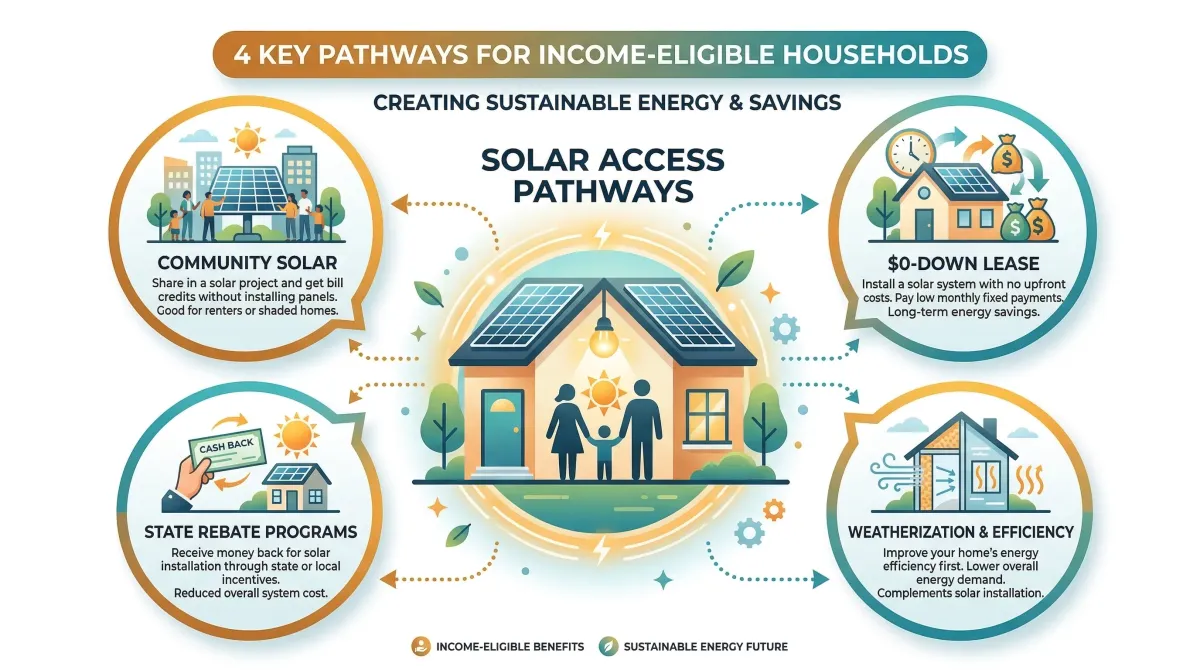
Get a Free QuoteVermont offers practical solar pathways for income-eligible households -- even without the federal tax credit. From community solar LMI carve-outs to free WAP weatherization and $0-down PPA/lease structures, here is exactly who qualifies and how to access every program.
2026 Reality: The 30% federal solar tax credit (Section 25D) expired December 31, 2025. Income-eligible households receive $0 federal credit for cash/loan purchases. VT state programs and $0-down financing are your path to affordable solar. Full details
Vermont uses Federal Poverty Level (FPL) guidelines to determine income-eligible status. Different programs have slightly different thresholds, but most align around 185-200% FPL.
WAP requires income at or below 200% FPL. LIHEAP uses 185% FPL. Community solar LMI carve-outs vary by project but generally align with these thresholds.
| Household | 185% FPL (LIHEAP) | 200% FPL (WAP) |
|---|---|---|
| 1 person | $27,195 | $29,400 |
| 2 persons | $36,482 | $39,440 |
| 3 persons | $45,769 | $49,480 |
| 4 persons | $55,056 | $59,520 |
| 5 persons | $64,343 | $69,560 |
| 6 persons | $73,630 | $79,600 |
Based on 2025 Federal Poverty Level guidelines. Updated annually by HHS.
Also qualify automatically if enrolled in:
Five regional community action agencies administer WAP, LIHEAP, and other assistance programs across Vermont. They are your primary point of contact for all income-eligible energy programs.
Contact your regional agency:
Not sure which agency covers your area? Call 211 Vermont for routing to the correct office.
Key advantage: Vermont community action agencies handle intake for multiple programs simultaneously. A single appointment can connect you with WAP, LIHEAP, 3SquaresVT, and community solar referrals -- reducing paperwork and speeding up access.
Vermont does not have a single large income-eligible solar incentive like some states. Instead, a combination of net metering, community solar, weatherization, and energy assistance programs work together to make solar accessible.
Green Mountain Power net metering provides 1:1 retail-rate credits for rooftop solar production. Available to all GMP customers. For LMI households, the key is accessing $0-down third-party ownership (TPO) or lease structures so you can participate without upfront capital.
Eligibility
All GMP residential customers. No income requirement for net metering itself.
How to Access
Contact a participating solar installer who offers $0-down PPA or lease options. GMP handles interconnection upon application.
Example Value
For a 7 kW system producing 8,190 kWh/year at $0.19/kWh: ~$1,556/year in bill credits.
Vermont community solar projects increasingly include LMI carve-outs, reserving a portion of project capacity for income-eligible households. These subscribers typically receive guaranteed bill discounts of 10-15% with no upfront cost, no roof installation, and no long-term equipment commitment.
Eligibility
Income-eligible households per project-specific criteria. Generally aligned with LIHEAP thresholds (185% FPL or below).
How to Access
Contact community solar developers operating in VT or check with your utility. Some projects actively recruit LMI subscribers through community action agencies.
Example Value
For a household using 600 kWh/month at $0.19/kWh: $137-$205/year in guaranteed bill savings through discounted subscription.
Vermont WAP provides free comprehensive weatherization services including insulation, air sealing, heating system repairs, and health and safety improvements. Administered by five regional community action agencies. Prepares your home for maximum solar benefit by reducing energy waste first.
Eligibility
Household income at or below 200% of Federal Poverty Level (FPL). Priority given to elderly, disabled, and families with young children.
How to Access
Contact your regional community action agency directly. They handle intake, energy audits, and coordinate all work at no cost to you.
Example Value
Average WAP improvements save $283/year on energy bills (DOE estimate). Typical insulation and air sealing work valued at $5,000-$12,000, fully covered.
Vermont LIHEAP provides direct financial assistance for heating costs. While not solar-specific, LIHEAP enrollment demonstrates income eligibility for other programs and reduces your overall energy burden. LIHEAP recipients are often fast-tracked for WAP services.
Eligibility
Household income at or below 185% FPL. Apply through your regional community action agency.
How to Access
Apply through SEVCA, CVOEO, BROC, NEKCA, or CVCAC depending on your county. Application period typically October through May.
Example Value
Average VT LIHEAP benefit: $800-$1,200/year for heating costs. Enrollment also qualifies you for WAP and may qualify you for community solar LMI slots.
Illustrative savings for an income-eligible Vermont household with average residential electricity use. Your actual savings depend on your home, your roof, and your utility.
Average residential electric bill for a typical Vermont household paying full retail rates to the utility.
Solar covers roughly 85% of household consumption; remainder is utility minimum charges and grid-pull on cloudy stretches.
25-year figure assumes a 3% annual electric-rate increase, consistent with EIA historical residential rate trends in Vermont. Income-eligible program coverage can reduce or eliminate upfront cost; savings begin immediately at system turn-on.
Vermont solar costs $2.80-$3.40 per watt in 2026. An average 7 kW system (typical for VT homes with lower electric rates) runs $19,600-$23,800 before incentives. Here is what income-eligible households actually pay through different pathways.
After sales tax exemption. WAP savings are separate (reduces energy bills, not solar cost).
8,190 kWh x $0.19/kWh average GMP retail rate
$22,400 x 2.0% VT avg effective rate (permanent)
5 kW battery x $850/kW demand response payments
Average DOE estimate for weatherization improvements
Lower end: solar + property tax + WAP savings. Upper end: includes GMP battery BYOD payments ($850/kW).
| System Size | Cost Range | After Sales Tax Savings | Annual Production |
|---|---|---|---|
| 5 kW | $14,000-$17,000 | $13,160-$15,980 | 5,850 kWh/yr |
| 7 kW | $19,600-$23,800 | $18,424-$22,372 | 8,190 kWh/yr |
| 9 kW | $25,200-$30,600 | $23,688-$28,764 | 10,530 kWh/yr |
| 11 kW | $30,800-$37,400 | $28,952-$35,156 | 12,870 kWh/yr |
| 13 kW | $36,400-$44,200 | $34,216-$41,548 | 15,210 kWh/yr |
Costs based on $2.80-$3.40/W range. Annual production assumes 1,170 kWh/kW VT average. Sales tax savings = 6% exemption.
Honest about VT solar economics: Vermont electric rates ($0.17-$0.21/kWh) are among the lowest in New England. This means solar payback periods are longer (12-16 years for cash purchases) compared to states like CT or MA. For income-eligible households, community solar or $0-down PPA/lease structures avoid the payback question entirely -- you save from day one with no upfront cost.
With Section 25D expired, Vermont homeowners pay the full system cost for cash and loan purchases. But $0-down PPA/lease structures and community solar make solar accessible without any upfront investment -- especially important for income-eligible households.
While Section 25D (homeowner ITC) is dead, Section 48/48E (commercial ITC) remains active for projects beginning construction before July 4, 2026. When you sign a PPA or lease, the third-party system owner claims the 30% ITC and passes the savings through as lower monthly payments. This is often the best path for income-eligible households.
With VT net metering at 1:1 retail and no state income tax credit, the TPO pathway is particularly important for LMI households. VT Solar PPA/Lease Guide
Green Mountain Power offers BYOD (Bring Your Own Device) payments of $850/kW for off-peak battery capacity used during grid peaks. If your solar installation includes battery storage, this provides significant additional annual revenue on top of net metering savings.
| Battery Size | Annual BYOD Payment | 10-Year Value |
|---|---|---|
| 5 kW (Powerwall 3) | $4,250 | $42,500 |
| 7.6 kW (Enphase IQ10) | $6,460 | $64,600 |
| 10 kW (2x Powerwall) | $8,500 | $85,000 |
GMP BYOD payments at $850/kW. Availability subject to GMP program capacity. GMP Battery Program Guide
Vermont provides two tax exemptions for solar that benefit all homeowners regardless of income. These are automatic savings with minimal paperwork.
Vermont exempts solar energy equipment from the 6% state sales tax. This applies to panels, inverters, racking, and installation labor. Applied at time of purchase.
Applied at purchase. One-time savings.
Solar installations are excluded from property tax assessment in Vermont. Adding solar does NOT increase your assessed home value for tax purposes. This is a permanent exemption.
Based on $22,400 system value. 25-year value: $11,175. Vermont property tax rates vary by municipality.
No state income tax credit: Vermont does not offer a state income tax credit for solar installations. The sales tax and property tax exemptions above are your state-level tax benefits. Full VT Solar Tax Guide
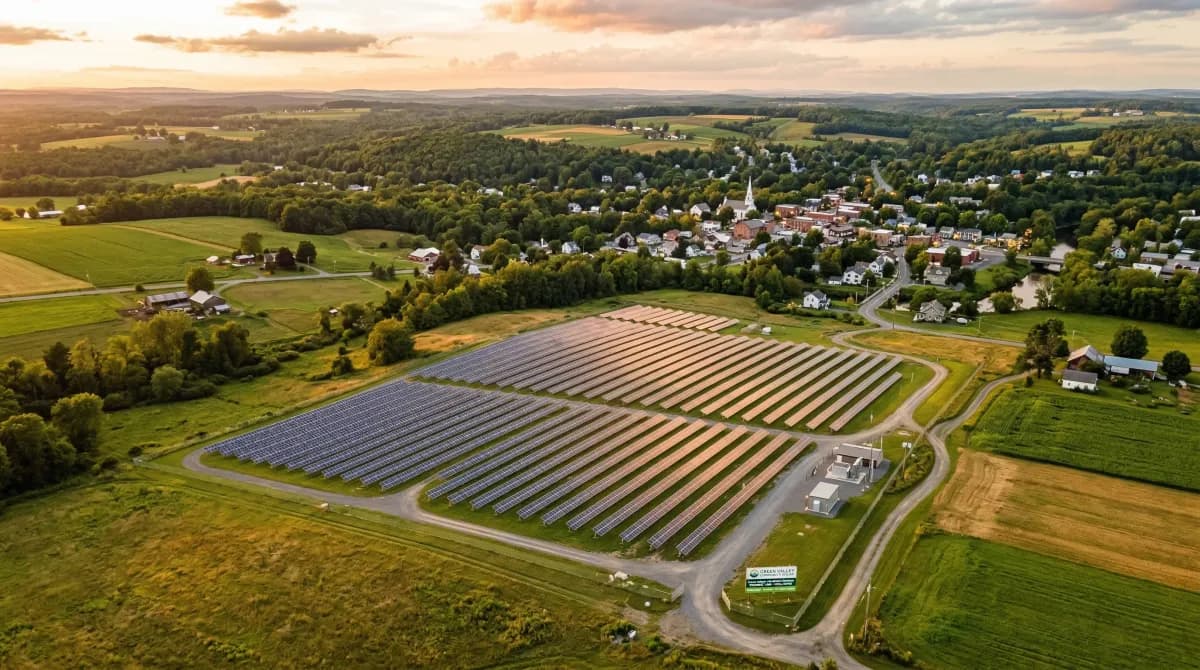
Given Vermont's lower electric rates and the loss of the federal tax credit, community solar is often the most practical path for income-eligible households. No roof needed, no upfront cost, and guaranteed bill savings.
Subscribe to a community solar project
Sign up for a share of a local solar farm in your utility territory. Some projects have dedicated LMI slots with enhanced discounts.
Solar farm generates electricity
The off-site solar installation feeds clean electricity into the grid on your behalf.
Receive net metering credits
Credits appear on your GMP, VEC, or BED utility bill based on your subscription share.
Pay a discounted rate
You pay a subscription fee lower than the credits you receive. LMI subscribers may receive additional discounts of 10-15%.
Vermont's lower electric rates mean rooftop solar payback is longer than in CT or MA. Community solar avoids this issue entirely -- you save from day one with zero risk and zero capital.
Follow these five steps to access income-eligible solar programs in Vermont. Start with eligibility verification and work through to installation or community solar enrollment.
Check if your household income is at or below 200% FPL (for WAP) or 185% FPL (for LIHEAP). You can also qualify through enrollment in 3SquaresVT (SNAP), Medicaid, SSI, or TANF/Reach Up. Contact 211 Vermont for guidance on which programs fit your situation.
Contact your regional community action agency (SEVCA, CVOEO, BROC, NEKCA, or CVCAC) to apply for free weatherization. They will schedule an energy audit, identify air leaks and insulation gaps, and complete all work at no cost. This reduces your energy use before adding solar.
If rooftop solar is not feasible (renting, shaded roof, condo), look into community solar projects with LMI carve-outs. Contact your utility or community action agency for current project availability. Community solar requires $0 upfront and no equipment installation.
If you own your home with a suitable roof, request quotes from at least three solar installers. Specify that you need $0-down financing options: PPA, lease, or solar loan. Ask about GMP net metering enrollment and the GMP battery program ($850/kW BYOD).
Your installer submits the GMP interconnection application and net metering enrollment. GMP reviews and approves within 4-8 weeks. Once connected, your meter runs backward when producing excess electricity, and credits appear on your monthly bill.
211 Vermont
211.org
Central intake for all assistance programs
Efficiency Vermont
efficiencyvermont.com
Energy efficiency rebates and programs
Green Mountain Power
greenmountainpower.com
Net metering and battery program
Common questions about income-eligible solar programs in Vermont for 2026.
Yes. Renters can subscribe to community solar projects with no rooftop installation and no upfront cost. Some community solar projects in Vermont have LMI carve-outs that reserve capacity for income-eligible households at guaranteed discounts of 10-15% on your electric bill. You just need an active GMP, VEC, or BED utility account. Contact your utility or a community action agency for available projects.
No. The federal residential solar tax credit (Section 25D) expired December 31, 2025 for all homeowners regardless of income. There is $0 federal credit for cash or loan solar purchases. The only way to indirectly benefit from a federal credit is through a PPA or lease, where the third-party system owner claims the 30% commercial ITC under Section 48/48E for projects beginning construction before July 4, 2026. This benefit is passed through as lower PPA/lease payments.
The Vermont Low-Income Trust Fund provides energy assistance to qualifying households through utility bill support and emergency assistance. While not a solar-specific program, it can help reduce your energy burden and connects you with other assistance programs including WAP weatherization and LIHEAP. Contact your community action agency or 211 Vermont for details.
GMP net metering works the same for all customers regardless of income. Your solar system produces electricity, and GMP credits you at the retail rate (approximately $0.19/kWh) for excess production. Credits roll month-to-month and are trued up annually. For income-eligible households, the key is accessing $0-down PPA or lease options so you do not need upfront capital. The third-party system owner handles installation, maintenance, and you simply pay a lower monthly rate.
GMP BYOD (Bring Your Own Device) battery program pays $850/kW for off-peak battery capacity used during grid peaks. For a 13.5 kWh Tesla Powerwall 3, that is approximately $4,250/year in demand response payments. The program is available to all GMP customers with qualifying battery systems. Income-eligible households can participate if their PPA/lease includes battery storage, though the payments typically go to the system owner who may pass through partial savings.
Yes. Vermont solar property tax exemption applies to all homeowners regardless of income. Solar installations are excluded from property tax assessment, so adding solar does not increase your tax bill. Vermont also exempts solar equipment from the 6% sales tax. Neither exemption has an income requirement or expiration date. These apply automatically.
WAP (Weatherization Assistance Program) is fully free for households at or below 200% FPL -- it covers 100% of insulation, air sealing, and heating system improvements. Efficiency Vermont programs are available to all Vermonters and provide rebates and incentives on efficient equipment, but typically require co-pays. If you qualify for WAP, start there for comprehensive free weatherization, then look at Efficiency Vermont rebates for additional equipment like heat pumps.
It depends on your situation. Community solar is better if you rent, have a shaded roof, or cannot access $0-down financing for rooftop solar. It requires $0 upfront and provides guaranteed 10-15% bill savings. Rooftop solar through a $0-down PPA or lease typically provides larger savings ($400-$800/year) and you benefit from net metering. If you own your home with a good roof and can get a PPA or lease, rooftop solar generally delivers more value.
The timeline is typically 3-6 months from first contact to producing solar power. If you start with WAP weatherization, add 2-4 months for the audit and improvement work. Solar installation itself takes 1-3 days. GMP interconnection approval takes 4-8 weeks. Community solar subscriptions can begin within 1-2 billing cycles with no installation wait. During winter months, timelines may be longer due to weather and shorter daylight.
Yes, honestly. Vermont electric rates ($0.17-$0.21/kWh) are among the lowest in New England (compared to $0.27-$0.32/kWh in CT, MA, NH). This means smaller bill savings from solar. However, Vermont has excellent net metering (1:1 retail credit), strong property and sales tax exemptions, and the GMP battery program adds $850/kW in annual demand response income. For income-eligible households, community solar with LMI carve-outs or $0-down PPA/lease still provides meaningful savings without any upfront cost.
VT Solar Cost 2026
Full breakdown of solar panel costs and payback in Vermont.
Section 48 Homeowner Guide
How third-party ownership makes solar accessible after 25D.
VT Solar Lease/PPA Guide
$0-down solar options for Vermont homeowners.
Cash vs Loan vs Lease
Side-by-side financing comparison for every budget.
GMP Battery Program
BYOD $850/kW demand response payments from GMP.
VT Community Solar
Community solar options for renters and shaded roofs.
Whether community solar, a $0-down PPA/lease, or cash purchase with tax exemptions -- Vermont has practical paths to solar for every income level. Start with a free assessment today.
Free, no-obligation assessment. We will help you identify which VT programs you qualify for.