
Solar for Renters: Community Solar & Your Options in 2026
You do not need a roof or a landlord's permission to benefit from solar energy. Community solar is the most practical path for renters -- and it is available in most NuWatt service states right now.
Quick Answer
Community solar lets renters subscribe to a share of a local solar farm and receive 5-15% savings on their electric bill as credits. No installation, no equipment, no landlord permission needed. Available in MA, CT, NJ, NY, RI, ME, and 15+ other states. Sign-up is free for most residential programs and you can cancel if you move.
What Is Community Solar?
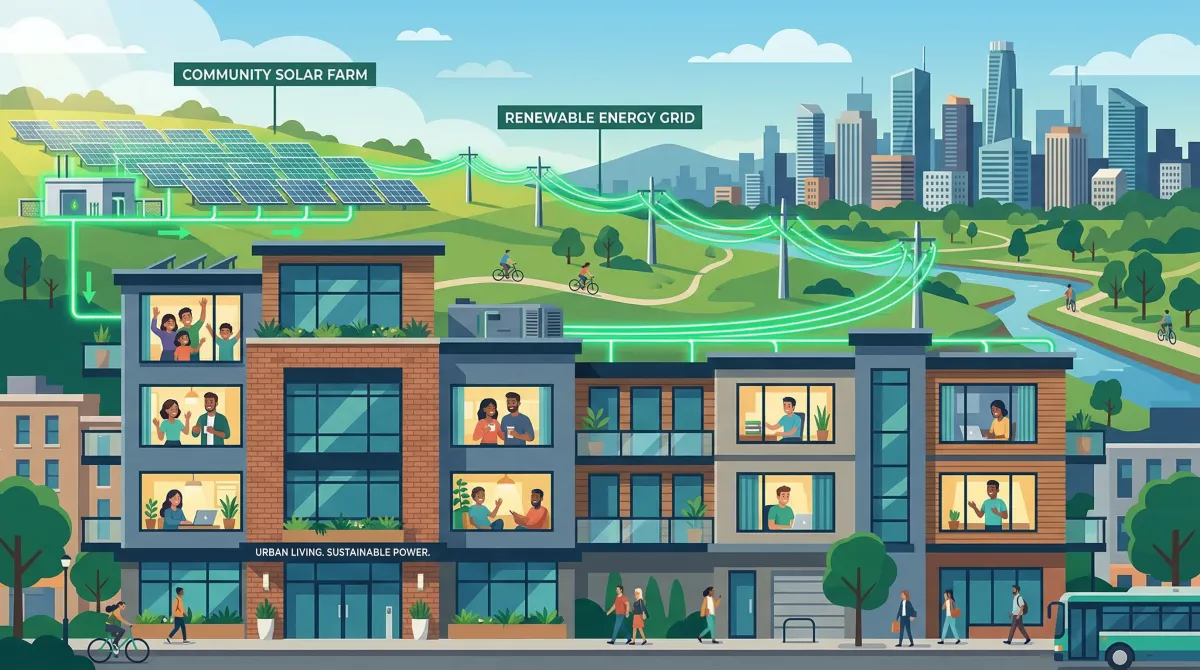
Community solar (also called shared solar or solar gardens) is a model where a large solar farm is built in your area and local residents subscribe to a portion of its output. The solar farm feeds electricity into the grid, and subscribers receive credits on their utility bill proportional to their share.
Solar Farm Generates Electricity
A 1-5 MW solar farm is built in your utility territory (usually on commercial land or brownfields). It connects to the same grid you use.
You Subscribe to a Share
You sign up for a portion of the farm's output -- typically sized to offset a percentage of your monthly electricity use. No upfront cost for most residential programs.
Credits Appear on Your Bill
Each month, your utility applies credits based on your share's production. You pay the community solar provider a discounted rate for those credits, pocketing the 5-15% difference as savings.
Key point for renters:
Community solar is tied to your utility account, not your address or your landlord. If you have an electric bill in your name, you can subscribe.
State Availability & Savings (NuWatt Service Area)
Community solar availability and savings vary significantly by state. Here is the landscape across NuWatt's primary service states:
| State | Program | Typical Savings | Status | Notes |
|---|---|---|---|---|
| Massachusetts | SMART + NM | 10-15% | Active | Largest NE market, many providers |
| Connecticut | Shared Clean Energy | 5-10% | Active | Growing rapidly since 2023 |
| New Jersey | CSEP | 10-20% | Active | Permanent program since 2024 |
| Rhode Island | NM + REG | 5-10% | Active | Smaller market, limited projects |
| New York | VDER | 5-15% | Active | Largest US market, huge selection |
| Maine | NEB / Community | 5-10% | Active | LD 1777 framework for community solar |
| New Hampshire | Group NM | 5-8% | Limited | Few projects, cap constraints |
How to Sign Up for Community Solar
The sign-up process is straightforward and entirely online for most providers:
- Check eligibility: You need a utility account in a service territory with community solar. Most programs accept renters, homeowners, businesses, and nonprofits.
- Choose a provider: Search your state's community solar marketplace or use platforms like EnergySage, Arcadia, or Nexamp. Compare discount rates (the higher the guaranteed discount, the better).
- Review the contract: Look at contract length (typically 12-25 months for residential), cancellation terms, credit rate guarantee, and any fees.
- Provide your utility info: Share your utility account number so credits can be applied to your bill. No credit check required for most programs.
- Start saving: Credits typically begin appearing on your bill within 1-2 billing cycles after the solar farm is interconnected.
Contract Terms: What to Watch For
| Term | What to Look For | Red Flag |
|---|---|---|
| Contract length | 12-25 months (residential typical) | 20+ years for a renter |
| Upfront cost | $0 (most residential programs) | Any upfront payment required |
| Guaranteed discount | 5-15% off utility credits | Savings over 25% (unrealistic) |
| Cancellation | 30-90 day notice, no fee | Large early termination fee |
| Transferability | Can move within utility territory | Non-transferable |
| Credit check | Not required (most programs) | Hard credit pull required |
| Escalator clause | Fixed rate or capped increase (1-3%) | Uncapped annual rate increases |
Moving? What Happens to Your Subscription
Same Utility Territory
Your subscription transfers to your new address. Just update your utility account number with the provider. Most handle this in 1-2 business days.
Different Utility, Same State
You typically need to cancel and re-enroll in a project in your new utility territory. Most providers waive cancellation fees for moves.
Different State
Cancel your current subscription (30-90 day notice) and search for community solar in your new state. Not all states have programs.
Beyond Community Solar: Other Options for Renters
Green Energy Plans
In deregulated electricity markets (CT, MA, NH, NJ, NY, RI, ME), you can choose a competitive supplier offering 100% renewable energy. This does not save money (often costs 1-3 cents more per kWh) but ensures your electricity spend supports renewable generation through RECs.
Portable Solar Panels
Small plug-in solar panels (200-800W) for balconies or windows are emerging in the US market. They plug into a standard outlet and feed your home's electrical system. Practical savings are modest ($50-$150/year) but they are a tangible way to generate your own power. Check your lease and local codes before installing.
Negotiate with Your Landlord
Some landlords are open to installing solar if it increases property value and attracts tenants. A solar lease or PPA means zero cost to the landlord. In Massachusetts, the SMART program makes this particularly attractive for landlords who own the electricity account.
Energy Efficiency First
Before or alongside community solar, simple efficiency measures offer immediate savings: LED bulbs, smart power strips, efficient appliances, weatherstripping, and smart thermostats (if your landlord allows). These can reduce your bill by 10-25% -- and that is money in your pocket regardless of solar.
Community Solar vs. Rooftop Solar: Quick Comparison
| Feature | Community Solar | Rooftop Solar |
|---|---|---|
| Who can use it | Renters, homeowners, anyone with a utility account | Homeowners with suitable roof |
| Upfront cost | $0 (most programs) | $20,000-$35,000 (or $0 with lease/PPA) |
| Savings | 5-15% bill reduction | 80-100% bill elimination |
| Installation needed | None | Yes (2-4 weeks) |
| Landlord permission | Not needed | N/A (must own property) |
| Property value increase | None | 3-4% average increase |
| Outage protection | None | With battery backup |
| Portability | Within utility territory | Stays with property |
Frequently Asked Questions
Can renters get solar energy without installing panels?
Yes. Community solar lets renters subscribe to a share of a local solar farm and receive credits on their electricity bill, typically saving 5-15%. No installation, no roof access, and no landlord permission is needed. You just need a utility account in a participating service territory. Community solar is available in Massachusetts, Connecticut, New Jersey, New York, Rhode Island, Maine, and about 20 other states.
How much can renters save with community solar?
Most community solar programs offer 5-15% savings on your electricity bill. The exact savings depend on your state, the specific project, and your subscription size. In Massachusetts, typical savings are 10-15% through net metering credits. In New Jersey, the Community Solar Energy Pilot (CSEP) targets 10-20% savings for residential subscribers.
What happens to my community solar subscription if I move?
If you move within the same utility territory, your subscription typically transfers to your new address with just a phone call or form. If you move outside the utility territory or to a different state, you can usually cancel with 30-90 days notice. Early termination fees are rare in residential community solar contracts but always check the terms before signing.
Is community solar a scam?
Legitimate community solar is not a scam -- it is regulated by state public utility commissions and backed by real solar farms. However, be cautious of aggressive door-to-door sales. Red flags include: requiring upfront payments (most residential subscriptions are free to join), guaranteed savings over 25%, pressure to sign immediately, and unclear cancellation terms. Always verify the provider through your state energy office.
Can I do community solar AND have rooftop solar at a future home?
Yes, but you typically would not want both simultaneously since community solar credits offset the same bill your rooftop solar would offset. Most renters use community solar as a bridge until they own a home and can install rooftop panels. When you buy a home, cancel the community solar subscription and go with your own system for larger savings (zero bill vs. 10-15% discount).
State-Specific Community Solar Guides
Planning to Buy a Home?
When you are ready to own, solar pays for itself. Get a free estimate for your future home's solar system so you know what to budget.
Get Your Free Solar Estimate