
Microinverters vs String Inverters 2026: Which Setup Wins?
Your inverter converts DC power from solar panels into AC power for your home. It is the second most important component after the panels themselves — and it directly affects how much energy you produce, how you monitor your system, and what batteries you can add. Here is the honest comparison.
Quick Answer
Microinverters (like Enphase IQ8HC) are better for complex roofs, shaded areas, future expansion, and homeowners who want panel-level monitoring. They cost $0.25-$0.40/W more but maximize production on difficult roofs.
String inverters with optimizers (like SolarEdge Home Hub) are better for simple south-facing roofs, budget-conscious buyers, and homeowners planning immediate battery integration. They cost $0.15-$0.25/W and deliver excellent performance on straightforward installations.
Post-ITC reality: The federal residential solar tax credit (Section 25D) expired on December 31, 2025. With no 30% tax credit to absorb costs, every dollar per watt matters more than ever. Choosing the right inverter architecture directly affects your payback period.
How Solar Inverters Work
Solar panels produce direct current (DC) electricity. Your home, appliances, and the utility grid run on alternating current (AC). An inverter is the device that converts DC to AC — without it, your panels would produce power your home cannot use.
Beyond basic DC-to-AC conversion, modern inverters also handle maximum power point tracking (MPPT), which continuously adjusts the electrical load to extract the most energy possible from each panel. They also manage grid synchronization, rapid shutdown compliance, and system monitoring.
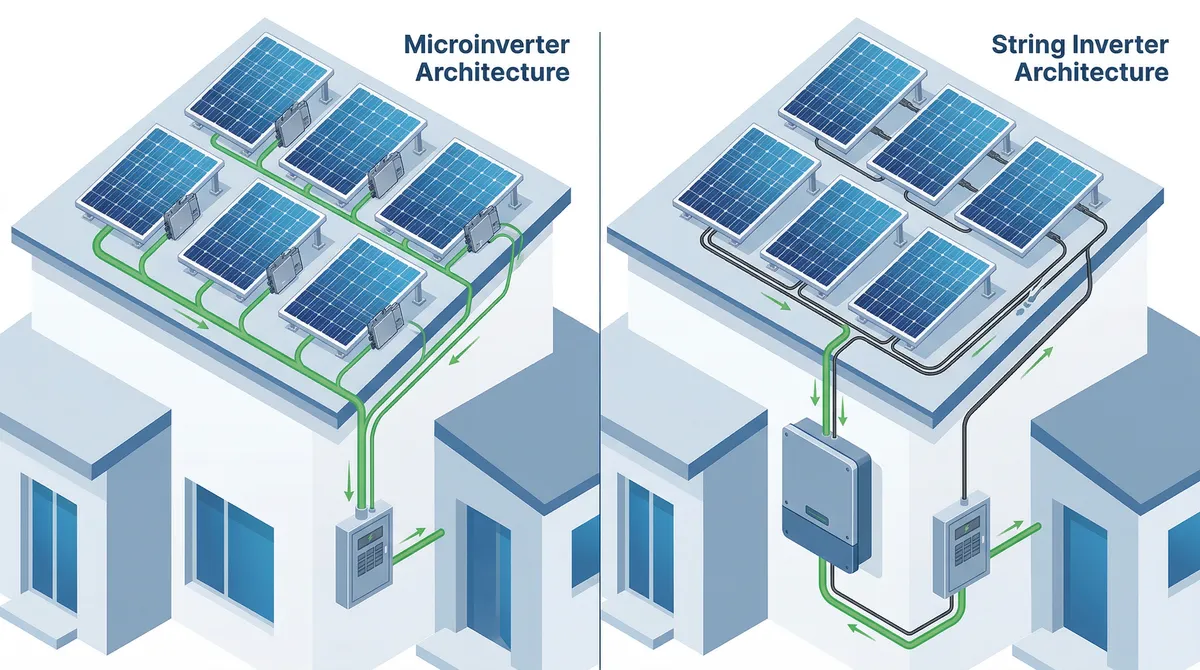
Microinverter Architecture
One small inverter per panel. DC-to-AC conversion happens at the panel. Each panel operates independently with its own MPPT. AC power from all panels combines at the electrical panel.
String Inverter Architecture
Panels wired in series (a “string”). DC power flows to a single central inverter. With optimizers, each panel has a small DC-to-DC device for individual MPPT, but conversion to AC still happens at the central unit.
Microinverters Explained
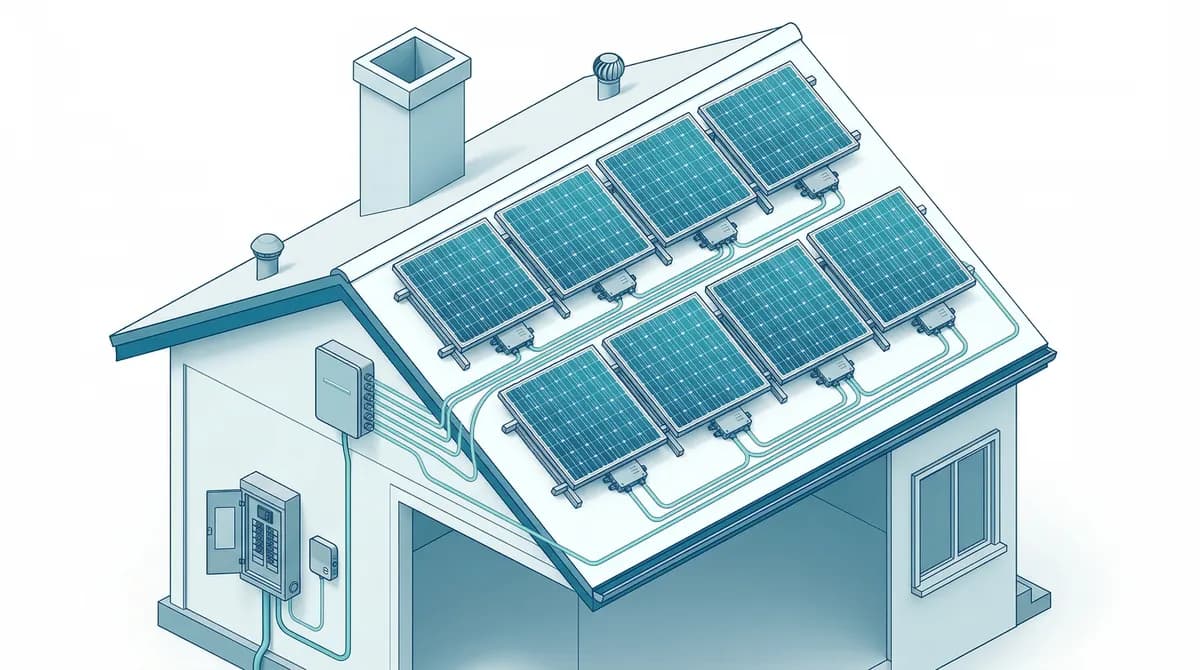
A microinverter is a small box (roughly the size of a paperback book) mounted directly underneath each solar panel. Each microinverter independently converts that single panel's DC output to AC power. The dominant player is Enphase Energy, which holds approximately 50% of the US residential inverter market.
Enphase IQ8HC — The Industry Standard
Key Microinverter Advantages
- Panel-level optimization: Each panel operates at its own maximum power point. A shaded or dirty panel does not drag down neighbors.
- Panel-level monitoring: See production from every individual panel in the Enphase app. Instantly identify underperformers.
- No single point of failure: If one microinverter fails, only that panel stops producing. The rest of the system runs normally.
- Easy expansion: Add panels one at a time, anywhere on the roof. No string sizing calculations or inverter capacity limitations.
- Inherent rapid shutdown: Microinverters comply with NEC 2020/2023 rapid shutdown codes out of the box — no additional hardware needed. The roof-level voltage drops to safe levels within seconds when AC power is cut.
Microinverter Limitations
- Higher cost: $0.25-$0.40/W adds $2,000-$3,200 to an 8 kW system compared to a basic string inverter (without optimizers).
- More components on the roof: More units means more potential failure points exposed to weather, though individual failure rates are very low (less than 0.5% annually).
- Slightly lower peak efficiency: 97.5% vs 99.2% for SolarEdge — but real-world energy harvest often favors micros on complex roofs because of superior MPPT per panel.
String Inverters Explained
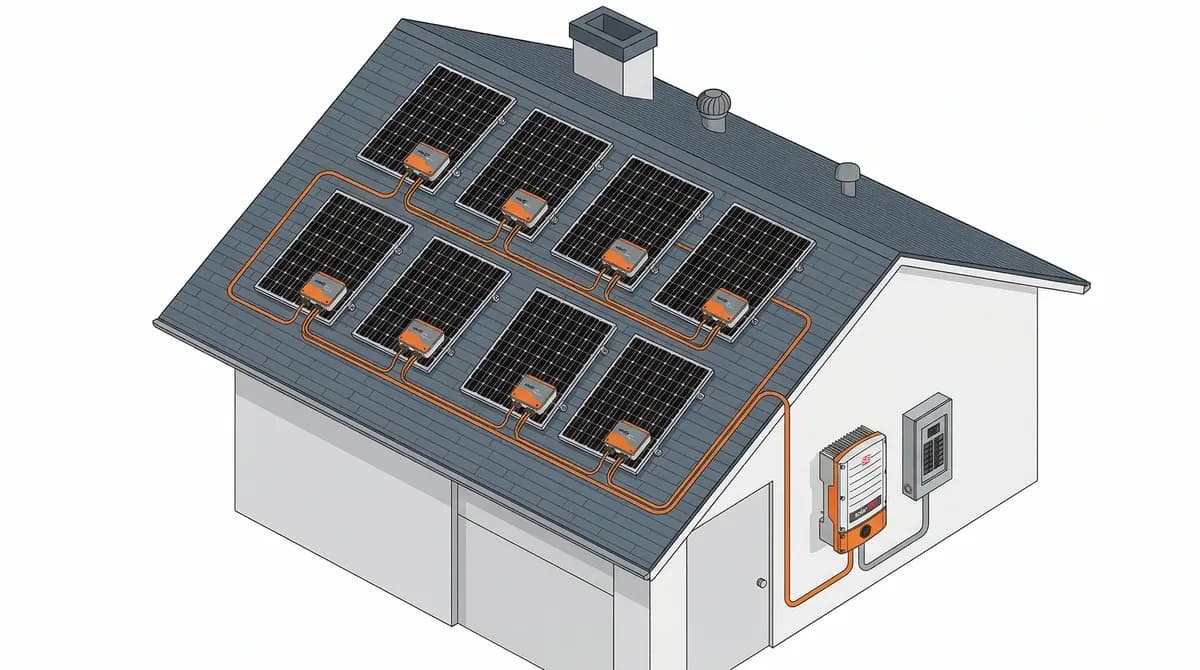
A string inverter is a single, wall-mounted unit (about the size of a small suitcase) installed in your garage, basement, or on an exterior wall. Multiple panels are wired together in series — a “string” — and their combined DC power flows to this central inverter for conversion to AC.
The modern standard for residential string inverters is the SolarEdge Home Hub, which pairs with individual power optimizers on each panel. This hybrid approach gives you some of the benefits of microinverters (panel-level optimization) while keeping the main conversion centralized.
SolarEdge Home Hub — The Leading String Inverter
Key String Inverter Advantages
- Lower upfront cost: $0.15-$0.25/W for the inverter + optimizers. Saves $800-$1,200 on a typical 8 kW system vs microinverters.
- Higher peak conversion efficiency: 99.2% DC-to-AC efficiency at the inverter level, though real-world gains are marginal.
- Integrated battery port: The SolarEdge Home Hub has a built-in DC-coupled battery connection. Adding a SolarEdge Home Battery requires no additional inverter hardware.
- Panel-level optimization (with optimizers): Power optimizers give each panel its own MPPT, similar to microinverters. You get panel- level monitoring in the SolarEdge app.
- Fewer roof-mounted electronics: Optimizers are simpler devices than microinverters — they handle DC-to-DC conversion only, with less heat generation and fewer components.
String Inverter Limitations
- Single point of failure: If the central inverter fails, your entire system goes down. Replacement can take days to weeks.
- Shorter inverter warranty: 12 years standard (extendable to 25 for $300-$500). The inverter will likely need replacement once in a 25-year system lifetime.
- String sizing constraints: Panels must be configured in strings within specific voltage windows. Adding panels later may require reconfiguring strings or replacing the inverter entirely.
- Rapid shutdown hardware: While SolarEdge optimizers serve as rapid shutdown devices, the system is more complex than the inherent shutdown behavior of microinverters.
Head-to-Head Comparison Table
| Feature | Microinverters (Enphase IQ8HC) | String + Optimizers (SolarEdge Home Hub) |
|---|---|---|
| Cost (inverter only) | $0.25-$0.40/W | $0.15-$0.25/W |
| Cost on 8 kW system | $2,000-$3,200 | $1,200-$2,000 |
| Peak efficiency | 97.5% | 99.2% |
| Shade handling | Excellent | Good (with optimizers) |
| Panel-level monitoring | Yes (native) | Yes (with optimizers) |
| Warranty (inverter) | 25 years | 12 years (ext. to 25) |
| Warranty (optimizers) | N/A | 25 years |
| Expansion | Add panels anytime | String reconfiguration needed |
| Battery integration | AC-coupled (Enphase IQ Battery) | DC-coupled (built-in port) |
| Rapid shutdown (NEC 2020/2023) | Inherent | Via optimizers |
| Single point of failure | No (one panel affected) | Yes (entire system down) |
| Fire safety | AC on roof (120/240V) | DC on roof (reduced by optimizers) |
Pricing reflects 2026 market rates for residential solar installations. Costs vary by region, system size, and installer. SolarEdge pricing includes power optimizers.
When Microinverters Win
Microinverters are the better choice in these situations:
Complex Roof with Multiple Planes
If your panels face east, south, and west across different roof sections, microinverters let each panel optimize independently regardless of orientation. String inverters struggle when panels on different planes are wired together — the lowest performer limits the entire string unless you add additional strings and inverter inputs.
Partial Shade from Trees or Structures
Shade on even one panel in a string can reduce output by 20-50% for the entire string. Power optimizers help (reducing the impact to the single shaded panel), but microinverters handle shade marginally better because the full DC-to-AC conversion happens at each panel independently. For heavily shaded sites, microinverters produce 5-15% more energy annually than optimized strings.
Future Expansion Plans
Planning to add an EV, heat pump, or more panels in the future? Microinverters let you add panels one at a time, on any roof surface, without reconfiguring your entire system. With string inverters, adding panels often means recalculating string voltage windows or upgrading the inverter — potentially a $2,000-$4,000 expense.
Homeowners Who Want Detailed Monitoring
The Enphase app shows production from every individual panel in real time. You can spot a dirty panel, a bird nest, or a failing unit immediately. While SolarEdge also offers panel-level monitoring through optimizers, the Enphase monitoring platform is widely considered more user-friendly and granular.
When String Inverters Win
String inverters with optimizers are the better choice in these situations:
Simple, Unshaded South-Facing Roof
If your roof is a clean south-facing surface with no shade trees, chimneys, or obstructions, all panels will produce nearly identical output. The per-panel optimization advantage of microinverters shrinks to almost zero. On these ideal roofs, a string inverter system produces 98-99% of what microinverters would — at $800-$1,200 less.
Budget-Conscious Installations
With no federal tax credit to offset costs in 2026, every dollar of savings matters. The $0.10-$0.15/W cost difference means $800-$1,200 less on an 8 kW system. If your roof conditions are good, that savings goes straight to a shorter payback period. At current electricity rates, $1,000 in upfront savings translates to roughly 6-8 months off your payback timeline.
Day-One Battery Integration
The SolarEdge Home Hub has a built-in DC-coupled battery port. If you are installing battery storage from day one, the SolarEdge ecosystem is cleaner: solar panels → optimizers → Home Hub inverter → Home Battery, all on one DC bus. DC-coupled batteries are 3-5% more efficient than AC-coupled (Enphase) because they avoid an extra DC-AC-DC conversion cycle.
Large Systems (12+ kW)
On large systems, the cost gap widens. A 12 kW system with microinverters costs $3,000-$4,800 for inverter hardware alone. The same system with SolarEdge costs $1,800-$3,000. The $1,200-$1,800 savings is meaningful when amortized over 25 years — especially on a large, unshaded roof where microinverters offer minimal production advantage.
Battery Compatibility
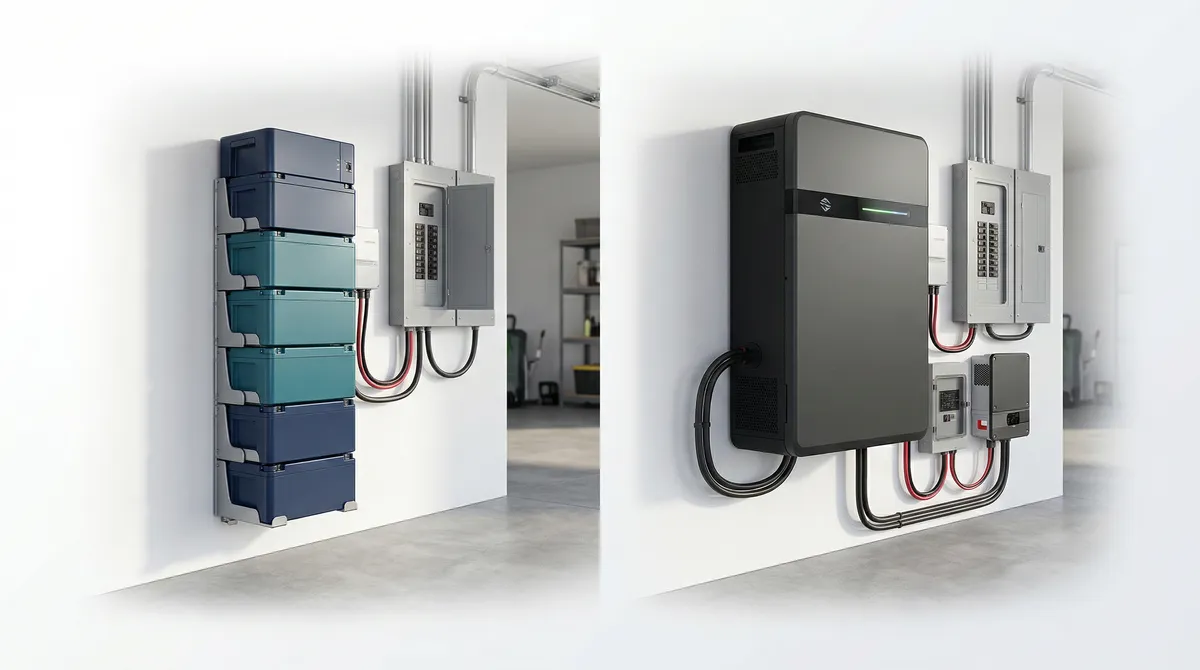
Battery storage is increasingly popular for backup power and time-of-use optimization. Your inverter choice locks you into a specific battery ecosystem:
Enphase IQ Battery
- Models: IQ Battery 5P (5 kWh), IQ Battery 10c (10.08 kWh)
- Coupling: AC-coupled (adds alongside existing inverter)
- Modularity: Stack up to 4 units (up to 40 kWh)
- Placement: Indoor or outdoor, wall or floor
- Backup: Whole-home or essential loads, automatic transfer
- Round-trip efficiency: ~89% (extra DC-AC-DC conversion)
- Best for: Homeowners who want to start small and expand
SolarEdge Home Battery
- Capacity: 9.7 kWh per unit
- Coupling: DC-coupled (direct to Home Hub inverter)
- Modularity: Stack up to 3 units (29.1 kWh)
- Placement: Indoor or outdoor, wall-mounted
- Backup: Whole-home with Backup Interface
- Round-trip efficiency: ~91.5% (single DC conversion)
- Best for: Day-one battery installs with clean integration
Third-party batteries:Both systems also work with select third-party batteries. Enphase systems can pair with any AC-coupled battery. SolarEdge recently added compatibility with select LG and BYD models. However, the tightest integration and best warranty support comes from staying within each manufacturer's ecosystem.
What NuWatt Recommends
NuWatt Energy installs both Enphase microinverters and SolarEdge string inverter systems. We do not push one over the other — we recommend the architecture that produces the most energy for the lowest cost on your specific roof.
We recommend microinverters when:
- Your roof has 2+ orientations
- Trees or dormers cause partial shade
- You plan to add panels or an EV later
- You want the most detailed monitoring
- You value the 25-year full-system warranty
We recommend string + optimizers when:
- Your roof is simple south or south-west facing
- There is minimal shade throughout the day
- You are installing battery storage from day one
- Budget optimization is a top priority
- Your system is 10+ kW on a clean roof
Not sure which is right? Our Solar IQ Quiz analyzes your roof with satellite imagery and recommends the optimal inverter architecture as part of your custom system design.
Related Equipment Reviews
Frequently Asked Questions
Are microinverters worth the extra cost over string inverters?
It depends on your roof. If you have shade, multiple roof planes, or plan to expand later, microinverters typically deliver 5-15% more energy over 25 years, which more than offsets the $0.10-$0.15/W price premium. On a simple, unshaded south-facing roof, the extra cost may not be justified. NuWatt analyzes your specific roof with satellite imagery to recommend the best fit.
Which lasts longer — microinverters or string inverters?
Microinverters generally last longer. Enphase IQ8 microinverters carry a 25-year warranty and have no moving parts, fans, or capacitors under thermal stress. SolarEdge string inverters carry a 12-year warranty (extendable to 25 years for $300-$500). The power optimizers have a 25-year warranty. String inverters may need replacement once during a 25-year panel lifetime.
Can I mix microinverters and string inverters on one system?
No. You must choose one architecture for your entire system. Microinverters and string inverters use fundamentally different wiring (parallel AC vs series DC) and are not compatible on the same solar array. However, you can have different panel orientations and tilts within either system.
Do microinverters work during a power outage?
Not by themselves. Both microinverters and string inverters shut down during outages (rapid shutdown requirement). To keep power during outages, you need a battery system. Enphase pairs with IQ Battery 5P/10c for backup. SolarEdge pairs with the SolarEdge Home Battery. Both require a transfer switch or backup gateway.
Is SolarEdge or Enphase better for battery storage?
Both work well with their respective battery ecosystems. Enphase IQ Battery is modular (add 5 kWh at a time) and installs indoors or outdoors. SolarEdge Home Battery is a single 9.7 kWh unit that integrates through the Home Hub inverter, which simplifies wiring. If you want to start with a small battery and grow, Enphase is more flexible. If you want a clean single-unit install, SolarEdge is simpler.
What happens if one microinverter fails vs one string inverter failing?
If one microinverter fails, only that single panel stops producing — the rest of your system operates normally. You lose roughly 3-5% of total output until the unit is replaced under warranty. If a string inverter fails, your entire system goes down until the inverter is repaired or replaced, which can take days to weeks depending on parts availability.
Not Sure Which Inverter Is Right for Your Roof?
NuWatt Energy analyzes your roof with satellite imagery to recommend the optimal inverter architecture — microinverters or string — based on your specific shading, orientation, and energy goals. No obligation, no pressure.