
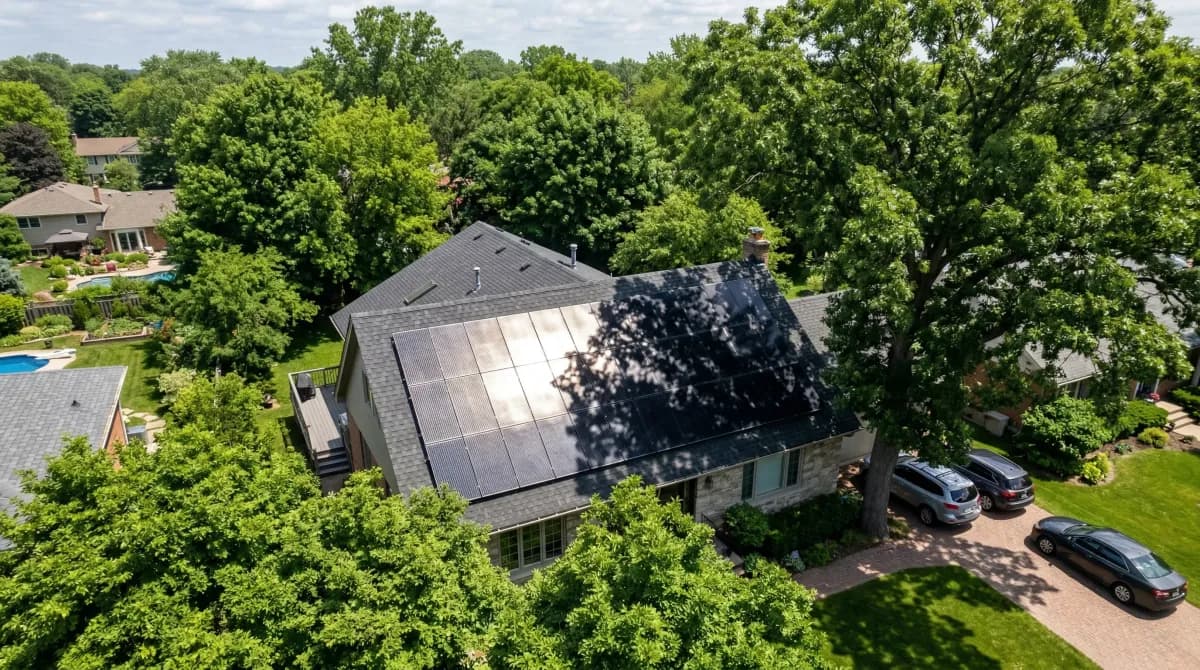
Shade is the single biggest production killer for residential solar. A tree shadow crossing just one panel can reduce that panel's output by 50 to 80% — and with traditional string inverters, it drags down every other panel on the same string too.
The good news: modern technology — microinverters, half-cut cells, and advanced design software — has dramatically reduced shade losses. A roof that would have been a “no-go” five years ago may now be a viable solar candidate. The key is understanding what type of shade you have and designing around it.
Types of Shade: Not All Shade Is Equal
Solar designers categorize shade into two main types. The distinction matters because each requires a different approach:
Hard Shade
Complete blockage of direct sunlight. A chimney, vent pipe, dormer, or adjacent building casting a defined shadow. Even the best inverter technology cannot recover production from hard shade — the light simply is not reaching the cell.
Strategy: Avoid placing panels in hard-shade zones entirely.
Soft Shade
Partial light filtering — dappled shade from tree branches, thin clouds, or haze. Panels still receive diffuse light and produce some electricity. Soft shade reduces output by 15 to 40% on affected panels depending on density.
Strategy: Microinverters + panel placement optimization can recover much of this loss.
Temporary Shade
Shade that occurs only at certain times — early morning from an east-side tree, or late afternoon from a western neighbor's building. This is often acceptable because it does not impact the critical 10 AM to 2 PM peak hours when 60% or more of daily production occurs.
Permanent Shade
Shade from structures or terrain that affects panels during peak hours year-round. This is the most damaging type and the hardest to work around. A south-side building or mountain ridge to the south creates permanent shade that no amount of technology can fix.
How Much Does Shade Actually Reduce Output?
The production impact depends on three factors: the type of shade, the inverter technology, and how many panels are affected. Here is what to expect:
| Shade Scenario | String Inverter Loss | Optimizers Loss | Microinverter Loss |
|---|---|---|---|
| 1 panel, soft shade (morning only) | 8-15% | 2-5% | 1-3% |
| 2-3 panels, soft shade (peak hours) | 20-35% | 8-15% | 5-10% |
| 1 panel, hard shade (chimney, midday) | 25-40% | 5-10% | 3-8% |
| Multiple panels, heavy tree shade | 30-60% | 15-25% | 10-20% |
| No shade (ideal) | 0% | 0% | 0% |
Percentage loss refers to the total system production loss, not just the shaded panels. String inverter losses are higher because shaded panels limit the entire string.
Microinverters vs String Inverters with Optimizers
The inverter choice is the most important decision for shaded roofs. Here is how each technology handles shade differently:
Microinverters (Enphase IQ8+, IQ8HC)
Each panel has its own inverter and operates completely independently. If one panel is shaded, the rest of the system produces at full capacity. Best choice for partially shaded roofs, complex roof geometries, or panels on multiple roof planes.
Cost: Typically $0.25-0.40/W more than string inverters. For a 10 kW system, that is an extra $2,500 to $4,000 — usually recovered in 2 to 4 years through higher production on shaded sites.
Power Optimizers (SolarEdge)
DC-DC optimizers on each panel condition the power before it reaches a central string inverter. This reduces (but does not eliminate) the impact of shade on other panels. Performance in shade falls between string-only and microinverters.
Cost: Typically $0.15-0.25/W more than basic string inverters. A middle-ground option if your shade is moderate and predictable.
String Inverters (No Optimization)
Panels wired in series — the weakest panel limits the entire string. One shaded panel can reduce 8 to 12 panels' output to that shaded panel's level. Only appropriate for completely unshaded roofs with consistent orientation. Rarely recommended for residential in 2026.
Shade Analysis Tools
Before committing to a solar installation, a shade analysis quantifies exactly how much sunlight your roof receives throughout the year. Here are the main tools used:
| Tool | Method | Accuracy | Cost |
|---|---|---|---|
| Aurora Solar | Satellite/LiDAR 3D modeling | High | Included by most installers |
| Solmetric SunEye | Handheld fisheye camera on-site | Very high | $200-$400 standalone |
| Drone + LiDAR | Aerial 3D point cloud mapping | Highest | $300-$600 standalone |
| Google Sunroof | Satellite estimate (free consumer tool) | Low-Medium | Free |
We recommend getting at least an Aurora-based analysis from your installer. If you have significant trees or neighboring structures, request an on-site SunEye measurement. The difference between a satellite estimate and an on-site reading can be 10 to 15 percentage points of solar access.
Design Strategies for Shaded Roofs
A skilled solar designer can work around moderate shade. Here are the most effective strategies:
Skip the Worst Panels
Rather than filling every available space, leave out panel positions with less than 70% solar access. Fewer panels producing well outperform more panels dragging each other down.
Use Multiple Roof Planes
If your south-facing roof is shaded but the west face is clear, split the array. Microinverters make multi-plane designs easy since each panel is independent.
Microinverters Are Non-Negotiable
On any roof with shade during peak hours, microinverters are the clear choice. The extra cost pays for itself in 2 to 4 years through recovered production.
Use Higher-Wattage Panels
If shade limits how many panels you can place, use higher-watt panels (420W+) in the good spots to maximize output from limited unshaded area.
Consider Half-Cut Cell Panels
Panels with half-cut cells have better partial shade performance because the top and bottom halves can operate semi-independently. Most modern panels (2024+) use this design.
Tree Trimming: When It Makes Sense
Removing or trimming trees is a sensitive topic. Here is a practical framework:
Worth Trimming
- Lower branches extending over the roof line — often a simple $200-500 trim
- Dead or dying trees that are a liability anyway
- Small ornamental trees that provide minimal shade benefit
- Fast-growing species that will only get worse over time (silver maple, poplar)
Probably Not Worth Removing
- Mature hardwoods (oak, maple) that provide significant property value ($1,000-10,000+)
- Trees that shade your home in summer, reducing AC costs by 10-25%
- Protected or heritage trees that require permits to remove
- Neighbor's trees (legal complications, relationship damage)
Remember: deciduous trees lose their leaves in winter when solar production is already low. A tree that creates 30% shade in summer may only cause 10% shade in the leafless months of November through March. Factor in the seasonal difference before making removal decisions.
When Is a Roof Too Shaded for Solar?
Not every home is a good solar candidate. Here are the thresholds where we typically recommend alternatives:
- Below 60% solar access: The system will underperform and payback stretches beyond 18 to 20+ years. Not recommended.
- 60-70% solar access: Marginal. Only viable in states with very high rates ($0.25+/kWh) and microinverters.
- 70-80% solar access: Good candidate with proper design. Microinverters recommended.
- 80%+ solar access: Excellent candidate. Any inverter technology works well.
If your roof is too shaded, consider a ground-mounted system in a sunnier part of your property, or look into community solar programs in your state.
Frequently Asked Questions
How much shade is too much for solar panels?
If more than 25% of your roof is shaded during peak sun hours (10 AM to 2 PM), your production will drop significantly. With string inverters, even 10% shade can reduce output for the entire string. With microinverters, only the shaded panels are affected. A professional shade analysis can quantify the exact impact for your specific site.
Do microinverters solve the shade problem?
Microinverters significantly reduce shade losses but do not eliminate them. With string inverters, one shaded panel can reduce the entire string by 30-60%. With microinverters, only the shaded panel's output drops — the rest produce at full capacity. This typically recovers 50-75% of the energy that would have been lost with a string system.
Should I cut down trees for solar panels?
It depends on the tree and the shade impact. Trimming lower branches or thinning canopy is often enough. Removing a healthy, mature tree for solar is rarely worth it economically or environmentally. Trees provide cooling shade in summer, wind protection, and property value. Consider the full picture before removing trees — a shade analysis will show exactly how much each tree affects your output.
Can solar panels work in partial shade?
Yes. Partial shade reduces output from affected panels but does not shut them down completely. Modern panels with half-cut cells and microinverters handle partial shade much better than older technology. A system with 15-20% shading can still be economically viable, especially in states with high electricity rates. The key is proper system design that accounts for the shade patterns.
What is a solar shade analysis and how much does it cost?
A shade analysis measures how much sunlight your roof receives throughout the year. Installers use tools like Aurora Solar (satellite-based), Solmetric SunEye (handheld), or drone-based LiDAR to create a shade map. Most reputable installers include shade analysis in their free site assessment. If you want an independent analysis, expect to pay $200-$400 for a standalone report with monthly shade percentages.