
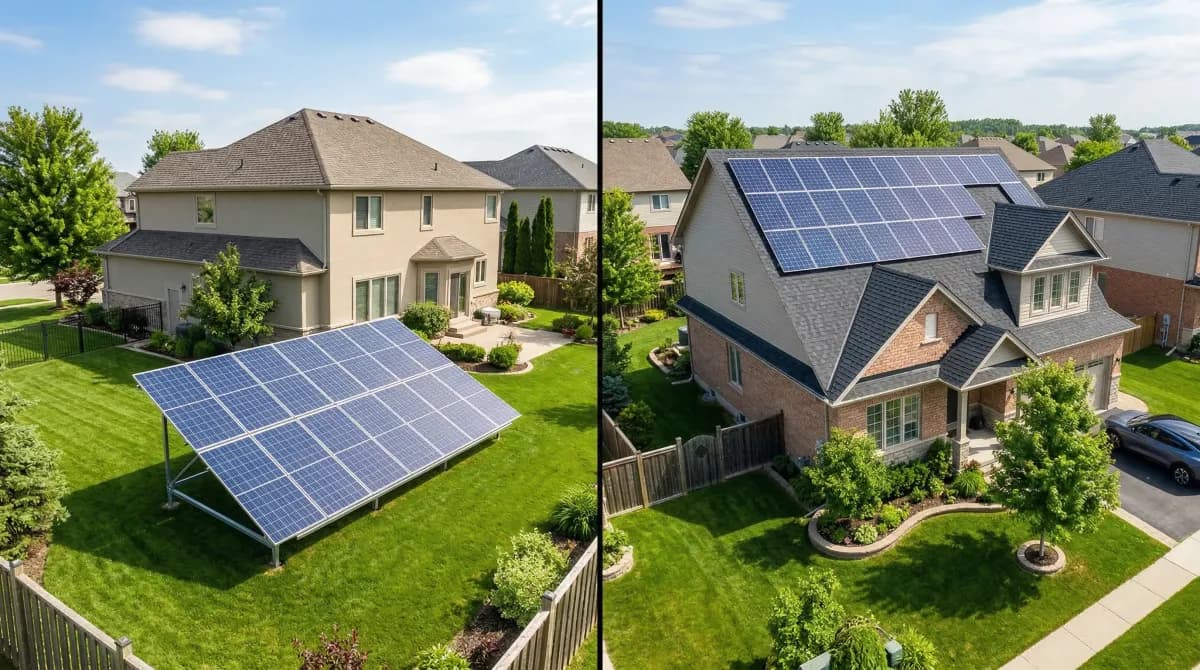
Most residential solar installations go on rooftops for a simple reason: the space is already there. But if you have land, a problematic roof, heavy shading, or plans to re-roof in the next few years, a ground-mounted system might be the smarter investment.
Ground-mounted solar panels cost roughly $0.30 to $0.50 per watt more than rooftop installations. On a 10 kW system, that is an extra $3,000 to $5,000. But they can produce 10 to 25% more electricity because you control the orientation and tilt angle. Whether that premium pays off depends on your specific situation.
Cost Comparison: Ground Mount vs Rooftop
The biggest difference is the mounting infrastructure. Rooftop systems bolt directly to your existing roof structure. Ground mounts need their own foundation — either concrete piers, driven posts, or ground screws — plus underground conduit to connect back to your electrical panel.
| Cost Factor | Rooftop | Ground Mount |
|---|---|---|
| Base system cost (10 kW) | $28,000 - $32,000 | $31,000 - $37,000 |
| Cost per watt (installed) | $2.80 - $3.20/W | $3.10 - $3.70/W |
| Racking/mounting | $500 - $1,000 | $2,000 - $4,000 |
| Trenching (100 ft avg) | N/A | $1,000 - $2,500 |
| Permit fees | $200 - $500 | $300 - $1,000 |
| Typical payback period | 8 - 12 years | 9 - 14 years |
| Annual production (est.) | 12,000 - 14,000 kWh | 13,500 - 17,000 kWh |
Costs reflect 2026 national averages. Actual pricing depends on your state, installer, and site conditions. The federal residential solar tax credit (25D) expired at the end of 2025 and is no longer available.
Pros and Cons at a Glance
Rooftop Solar
Pros
- + Lower upfront cost
- + Uses existing unused space
- + Faster installation (1-2 days)
- + No yard space required
- + Fewer permitting hurdles
Cons
- - Constrained by roof angle and direction
- - Roof condition matters (age, material)
- - Harder to access for maintenance
- - Must remove panels for re-roofing
Ground Mount Solar
Pros
- + Optimal tilt and azimuth for max output
- + Easy maintenance and cleaning
- + No roof penetrations or structural load
- + Scalable to larger system sizes
- + Better airflow = cooler panels = more output
Cons
- - Higher cost ($0.30-$0.50/W premium)
- - Requires open yard or land
- - Trenching for conduit adds complexity
- - HOA restrictions more common
When Ground-Mounted Solar Makes Sense
Ground-mounted systems are not for everyone, but in certain situations they are clearly the better option. Consider ground-mount if any of the following apply:
Your Roof Needs Replacement Soon
If your roof is more than 15 years old, installing rooftop solar means you will likely need to remove and reinstall panels within the next decade. That removal/reinstall costs $2,000 to $5,000 and voids some warranties. A ground mount avoids this entirely.
Heavy Roof Shading
Tall trees to the south or east of your home can reduce rooftop output by 20 to 40%. A ground mount lets you position panels in an unshaded area of your property, possibly hundreds of feet from the trees causing the problem.
Poor Roof Orientation
North-facing roofs, steep pitches, or complex multi-hip roofs with dormers leave limited usable space. A ground system can face due south at the ideal 25 to 35 degree tilt regardless of your home's orientation.
You Have Available Land
Rural properties, farms, and larger suburban lots with unused backyard or side-yard space are ideal candidates. You need roughly 500 to 600 square feet of clear ground for an 8 kW system, plus setback clearances.
HOA Blocks Rooftop Panels
Some HOAs restrict visible rooftop panels on street-facing roof planes. Ironically, a ground-mount in a backyard may be acceptable where a front-facing rooftop system is not. Check your specific CC&Rs — state solar access laws often protect rooftop but not ground-mount installations.
Permitting and Zoning Differences
Rooftop solar is generally classified as a building-mounted accessory structure. In most jurisdictions, you need an electrical permit and a building permit, and the process takes 1 to 4 weeks.
Ground-mounted solar is treated more like a standalone structure. Depending on your municipality, you may also need:
- A zoning variance or special-use permit (especially in residential zones)
- Setback compliance — most towns require 10 to 25 foot setbacks from property lines
- Height restrictions — ground arrays typically must stay under 8 to 15 feet at peak
- An engineering stamp for the foundation design (concrete vs ground screws)
- A trenching permit if the conduit crosses driveways or utility easements
Trenching: The Hidden Cost
The conduit run from the ground array to your electrical panel is one of the biggest variables in ground-mount pricing. The trench needs to be 18 to 24 inches deep (deeper if crossing a driveway) and typically costs:
| Trench Length | Typical Cost | Notes |
|---|---|---|
| Under 50 ft | $500 - $1,000 | Short run, minimal disruption |
| 50 - 100 ft | $1,000 - $2,000 | Most common residential distance |
| 100 - 200 ft | $2,000 - $4,000 | Larger wire gauge needed for voltage drop |
| Over 200 ft | $4,000+ | May need step-up transformer or thicker conductors |
Rocky soil, ledge, or crossing under pavement can double these costs. Always get a site assessment before assuming a simple trench run. Some installers use directional boring for driveways, which avoids cutting and repaving but adds $500 to $1,500.
Property Requirements
A rough planning guide for the land you need:
Add 25-50% more space for row spacing, setbacks, and access paths. With setbacks, plan on ~0.25 acre per 10 kW as a conservative estimate.
Aesthetic and Resale Considerations
Rooftop panels are generally better accepted by buyers and neighbors because they are expected. Ground-mounted arrays are more visible and can be polarizing — some people find them industrial-looking, while others appreciate keeping the roof clean.
For resale value, both types of owned solar systems typically add a 3 to 4% premium to the home sale price. Ground-mounted systems can be a selling point for rural properties where energy independence is valued, but may slightly deter buyers on smaller suburban lots where they reduce usable yard space.
Design tip: Landscaping around the base of a ground array — low shrubs, decorative gravel, or pollinator gardens — can improve aesthetics significantly. Some homeowners use the shaded area under panels for shade-tolerant plantings.
Fixed vs Tracking Ground Mounts
Ground-mounted systems come in two categories: fixed-tilt and tracking. Most residential systems use fixed-tilt because tracking adds cost and mechanical complexity.
| Feature | Fixed Tilt | Single-Axis Tracker |
|---|---|---|
| Cost premium over rooftop | +$0.30-0.50/W | +$0.70-1.20/W |
| Production gain over rooftop | +10-15% | +25-35% |
| Moving parts | None | Motors, controllers |
| Maintenance | Minimal | Annual motor/bearing check |
| Best for | Most homeowners | Farms, large acreage |
Frequently Asked Questions
How much more do ground-mounted solar panels cost than rooftop?
Ground-mounted solar systems typically cost $0.30 to $0.50 per watt more than rooftop installations. For a 10 kW system, that translates to an additional $3,000 to $5,000. The premium covers the racking structure, concrete footings or ground screws, and trenching for underground conduit runs to your electrical panel.
Do I need a specific amount of land for ground-mounted solar?
A good rule of thumb is roughly 0.25 acres per 10 kW of solar capacity, including setback requirements. A typical 8 kW residential system needs about 500-600 square feet of ground area. Pole-mounted trackers need slightly more space between rows to avoid self-shading.
Do ground-mounted solar panels produce more electricity than rooftop?
Ground-mounted systems can produce 10-25% more electricity than a comparable rooftop system because you can orient them at the optimal azimuth and tilt angle. Rooftop systems are constrained by your roof's direction and pitch, which rarely matches the ideal south-facing 30-degree tilt.
Can I install ground-mounted solar if I have an HOA?
HOA rules vary widely. Many HOAs restrict or prohibit ground-mounted solar in front yards or common-view areas. Some states have solar access laws that limit HOA restrictions on rooftop solar, but these laws typically do not extend to ground-mounted systems. Always check your CC&Rs and consult with your HOA before planning a ground-mount installation.
Are ground-mounted solar panels easier to maintain?
Yes. Ground-mounted panels are easier to inspect, clean, and repair since they do not require roof access. Snow removal is simpler, and you never need to worry about voiding a roof warranty. However, ground-level panels are more susceptible to shading from vegetation, animal interference, and accidental damage from lawn equipment.