
Quick Answer
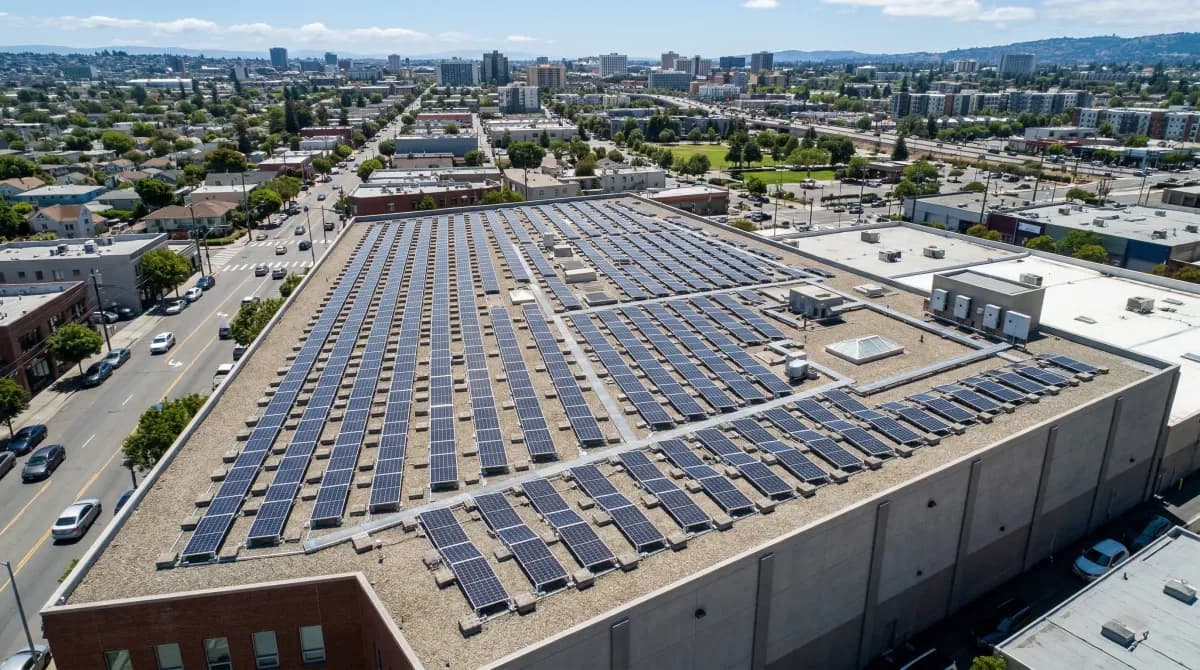
Flat roofs can work very well for solar. Ballasted, attached, and hybrid systems solve different structural, wind, membrane, and warranty constraints. The correct choice comes from the stamped project design and written roof-manufacturer requirements—not from a universal weight, wind, or cost rule.
Commercial or multifamily property?
Check roof age, warranty, and mounting readiness first.
Use the commercial owner guide and preliminary roof tool before treating any mounting concept as final.
Why Flat Roofs Are Actually Great for Solar
Many homeowners and building owners assume flat roofs are a disadvantage for solar. The opposite is often true. Here is why:
Advantages
- Optimal tilt angle: Tilted racking achieves the ideal angle regardless of roof orientation
- No shade from roof itself: Panels can be placed to avoid self-shading
- Easy maintenance: Walk-on access for cleaning, inspection, and repairs
- No aesthetic impact: Panels are invisible from street level
- Larger system potential: Full roof area is usable (no hips, valleys, dormers)
- Bifacial panel bonus: Light reflection from white/light-colored membranes boosts bifacial output 5-10%
Considerations
- Wind exposure: Flat roofs have higher wind loads (no shelter from roof pitch)
- Weight capacity: The stamped layout must fit the actual roof structure and zone-by-zone loads
- Row spacing: Tilted panels need spacing to avoid self-shading, reducing density
- Drainage: Racking must not block roof drains or ponding areas
- Membrane compatibility: Some racking systems are not compatible with all roof types
- Project scope: Racking, reinforcement, membrane protection, engineering, and access affect pricing
Ballasted vs Attached: Complete Comparison
The two primary mounting approaches for flat roofs have very different trade-offs. Your choice depends on roof type, structural capacity, wind zone, and warranty requirements.
| Factor | Ballasted Racking | Attached (Penetrating) |
|---|---|---|
| How it is secured | Distributed weight holds the array on a low-slope roof; some designs use limited anchors. | Engineered attachments transfer forces into the roof structure. |
| Roof openings | Few or none, depending on the final wind and load design. | Requires project-specific flashed or manufacturer-approved attachment details. |
| Added roof load | Usually the highest distributed dead load; the amount varies across roof zones. | Usually lower dead load, with concentrated forces transferred to the structure. |
| Warranty coordination | Still requires membrane protection, access paths, and written manufacturer review. | Requires approved flashing and installation details plus manufacturer coordination. |
| Often considered when | The low-slope roof has adequate capacity and the wind design permits ballast. | Dead-load capacity is limited, wind forces are high, or the roof assembly favors attachment. |
| Owner question to resolve | Can the structure carry the stamped zone-by-zone ballast plan without harming the membrane? | Who owns the flashing detail, inspection, leak coverage, and future roof work? |
This is preliminary planning guidance, not a structural or warranty approval. Final mounting, ballast, attachment, wind, snow, and load values must come from the project-specific stamped design and the roofing manufacturer’s written requirements.
Tilt Angle Optimization for Flat Roofs
On a pitched roof, panels follow the roof angle. On a flat roof, you choose the tilt. The optimal angle depends on latitude, but there is a trade-off: steeper tilts produce more energy per panel but require wider row spacing (reducing total panel count).
| Region | Latitude | Optimal Tilt | Practical Tilt | Row Spacing |
|---|---|---|---|---|
| Southern US (TX, FL) | 25-30° | 25-30° | 5-10° | 2-3 ft |
| Mid-Atlantic (NJ, PA) | 38-42° | 30-35° | 10-15° | 3-4 ft |
| New England (MA, CT, NH) | 42-44° | 35-40° | 10-15° | 3.5-5 ft |
| Northern ME/NH | 44-47° | 38-42° | 12-18° | 4-6 ft |
Design trade-off:Most flat roof installers use 10-15° tilt (not the latitude-optimal 35-40°) because the lower tilt can allow tighter row spacing and more total panels. Compare complete production models and usable-roof layouts rather than optimizing tilt or panel count in isolation.
Roof Membrane Compatibility Guide
Not all flat roof types work equally well with solar. Here is how each common membrane interacts with solar racking:
TPO (Thermoplastic Polyolefin)
Best for solar. White reflective surface boosts bifacial panel output. Ballasted and attached systems both work well. Most solar racking manufacturers have TPO-specific mounting accessories. Typical roof life: 20-30 years.
EPDM (Rubber)
Good for ballasted systems.Black surface absorbs heat (no bifacial benefit). Ballasted racking is strongly preferred — EPDM penetrations require specialized flashing and experienced installers. Common on older commercial buildings. Typical roof life: 25-30 years.
Built-Up Roof (BUR / Tar and Gravel)
Compatible with some limitations. Ballasted racking works but the gravel surface must be cleared under and around panel arrays. Weight capacity may be a concern since BUR is already heavy (6-8 lbs/sqft). Structural engineering review is recommended. Typical roof life: 15-25 years.
PVC Membrane
Excellent for solar. Similar to TPO with a white reflective surface. PVC is slightly more expensive but has excellent chemical resistance. Both ballasted and attached systems work. Some PVC membranes can be heat-welded to specialized solar flashings for zero-leak attachments. Typical roof life: 20-30 years.
Modified Bitumen
Compatible, check age. Common on residential flat roofs. Works with both ballasted and attached racking. If the membrane is more than 15 years old, consider re-roofing before adding solar. Typical roof life: 15-20 years.
Commercial vs Residential Flat Roof Solar
Commercial Flat Roof
- System size: 25-500+ kW
- Roof area: 5,000-100,000+ sqft
- Racking: Usually ballasted (lower cost at scale)
- Structural: Engineered for heavy HVAC equipment
- Cost: $1.40-$2.20/W installed
- Federal timing: The Section 48E begin-construction window closed July 4, 2026: projects that began construction on or before that date may use the longer continuity pathway. Commercial solar projects starting now generally must be placed in service by December 31, 2027. The statutory credit is 6%; it can increase to 30% when the applicable prevailing-wage and registered-apprenticeship requirements are met.
Residential Flat Roof
- System size: 5-15 kW
- Roof area: 500-2,000 sqft
- Racking: Ballasted or attached depending on location
- Structural: Must verify load capacity (older homes)
- Cost: $2.80-$3.30/W installed
- Note: Residential ITC (Section 25D) expired Dec 31, 2025
Weight Load Considerations
Structural capacity is the most critical factor for flat roof solar. Here is a breakdown of typical loads:
Existing structure
Deck, joists, beams, columns, connections, prior alterations, and rooftop equipment
Mounting design
Panel and racking dead load, zone-by-zone ballast, attachments, and load paths
Site criteria
Project-specific wind, uplift, snow, drifting, seismic, and code requirements
Roof operations
Drainage, ponding, fire access, HVAC service, walkways, and future roofing work
Important:A structural engineer must evaluate any flat roof before solar installation. This is not optional — it is required to establish the project-specific load path and code compliance. Confirm the engineering scope and fee in writing rather than assuming it is included.
Related Reading
Frequently Asked Questions
Can you put solar panels on a flat roof?
Yes. Flat roofs are excellent for solar panels. Specialized racking systems tilt panels to the optimal angle (10-15 degrees in the Northeast, 5-10 degrees in the South) and can be either ballasted (weighted, no roof penetrations) or mechanically attached. Many commercial buildings use flat roof solar, and the same technology works for residential flat roofs.
What is ballasted solar racking?
Ballasted racking uses distributed weight to secure a solar array on a low-slope roof. Some projects are fully ballasted; others use limited attachments or a hybrid design. The final ballast and attachment plan depends on the roof structure, wind and snow criteria, roof assembly, and written warranty requirements.
Is flat roof solar more expensive than pitched roof solar?
It can be, but a universal per-watt premium is misleading. Flat-roof pricing depends on the selected racking, ballast or attachments, structural reinforcement, membrane protection, access paths, engineering, and roof work. Compare project-specific proposals that carry the same scope rather than applying a generic adder.
How much weight can a flat roof support for solar panels?
That cannot be determined from roof type or a regional average. A structural engineer must evaluate the actual deck, joists, connections, existing equipment, drainage, local design loads, and the zone-by-zone mounting plan. Fully ballasted systems usually add more distributed dead load than attached systems, but every final value is project-specific.
Will flat roof solar void my roof warranty?
Not automatically. Both ballasted and attached systems can affect warranty coverage if the owner skips required review, protection, installation, or inspection steps. Obtain the current written requirements from the roof manufacturer or warranty administrator before finalizing the solar mounting design.
Choose the right roof-design path
Commercial owners can screen roof readiness and see a preliminary roof layout. Homeowners can continue to the residential design experience.