
Can Solar Panels Withstand Hail? Durability Facts
Modern solar panels pass rigorous hail testing — 1-inch ice balls at 52 mph. Real-world hail damage is rare, and when it happens, insurance covers it. Here are the facts every solar homeowner should know.
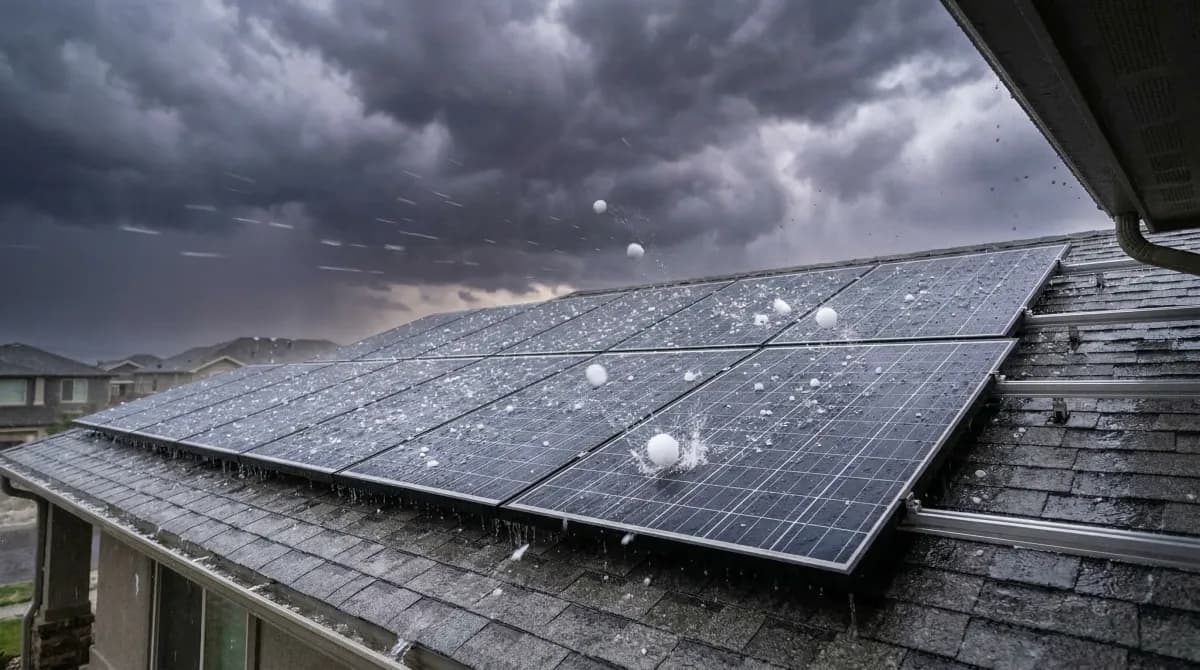
IEC 61215 Hail Testing Standard
Every solar panel sold in the United States must pass the IEC 61215 certification, which includes a hail impact test. Here is exactly what the test involves:
Standard Test Parameters
The test fires frozen ice spheres at 11 different points on the panel surface, including cell centers, edges, and corners. The panel must show no visible cracks, delamination, or power output degradation greater than 5% after testing.
Context: 25mm (1-inch) hail accounts for over 95% of all hailstorms in the United States. The IEC standard covers the vast majority of real-world hail events. Only extreme supercell thunderstorms produce hail larger than 1 inch.
Panel Construction & Glass Thickness
The front surface of a solar panel is tempered glass — the same type used in car side windows and glass doors. It is engineered to be impact-resistant and to shatter into small, rounded pieces (rather than sharp shards) if broken.
Glass Thickness Matters
Meets IEC 61215 minimum. Adequate for most climates. More vulnerable to large hail (1.5 inch+).
Industry standard. 60% thicker than budget. Withstands 1.5-inch hail. Used by REC, Silfab, Canadian Solar, Hyundai.
Maximum protection. Some SunPower and specialty panels. Withstands 2-inch hail at most speeds.
Beyond Glass: Other Protective Layers
- EVA encapsulant: A clear polymer layer between the glass and solar cells absorbs impact energy and holds broken glass in place (like a car windshield).
- Aluminum frame: The rigid frame prevents the glass from flexing on impact, distributing force across the panel surface.
- Backsheet: The rear polymer layer provides additional structural support and weather sealing.
Real Hail Events: What Actually Happens
Texas, June 2023 — Severe Supercell Storms
Multiple DFW-area hailstorms produced 2-3 inch hail (baseball to softball size) at speeds exceeding 70 mph. Solar installations across the region reported mixed results:
- Systems with 3.2mm glass: approximately 5-8% of panels showed visible cracking
- Systems with 2.0mm glass: approximately 15-25% of panels sustained damage
- All damaged panels were covered by homeowners insurance
- Roof sections under solar panels had significantly less shingle damage than exposed sections
Colorado, August 2024 — Denver Metro Hailstorm
1.5-inch hail over Denver. The Colorado Solar and Storage Association reported that fewer than 1% of residential solar installations required panel replacements. Most systems continued producing at full capacity. The few damaged panels were on older systems with thinner glass.
NREL Study: 50,000 Systems Over 6 Years
The National Renewable Energy Laboratory (NREL) studied over 50,000 solar installations across hail-prone regions. Key finding: only 0.1% of panels (1 in 1,000) showed hail-related damage requiring replacement. The annual hail damage rate for solar panels is far lower than for car windshields or roof shingles.
Hail Resistance by Brand
| Brand / Model | Glass | IEC 61215 | Extended Hail Test | Rating |
|---|---|---|---|---|
| REC Alpha Pure-R 470 | 3.2mm | ✓ | 35mm @ 27 m/s | Excellent |
| SunPower Maxeon 7 | 3.2mm | ✓ | 35mm @ 27 m/s | Excellent |
| Silfab SIL-440 | 3.2mm | ✓ | 25mm standard | Very Good |
| Hyundai HiE-S440 | 3.2mm | ✓ | 25mm standard | Very Good |
| Canadian Solar CS7L-440 | 3.2mm | ✓ | 35mm @ 27 m/s | Excellent |
| Jinko Tiger Neo 435 | 3.2mm | ✓ | 25mm standard | Very Good |
| Q CELLS Q.PEAK DUO | 3.2mm | ✓ | 25mm standard | Very Good |
| GAF Energy Timberline Solar | Polymer | ✓ | UL 2703 Class 4 | Excellent |
Extended hail test: Optional test beyond IEC 61215 minimum. 35mm = 1.4-inch ice ball. UL 2703 Class 4 = tested with 2-inch ice balls. All major manufacturers pass the standard 25mm test.
Insurance Claims Process
If hail damages your solar panels, your homeowners insurance covers the repair or replacement. Here is the step-by-step process:
- 1
Document the damage
Photograph panels from the ground or with a drone. Do NOT climb onto the roof — broken glass plus live electrical current is dangerous. Screenshot your monitoring app showing production drops.
- 2
Contact your solar installer
Request a professional inspection. Your installer can identify cracked panels, test electrical connections, and provide a repair estimate that your insurance company needs.
- 3
File the insurance claim
Solar panels are covered as a permanent fixture of your home. Provide photos, installer inspection report, and the repair estimate. Typical deductible: $1,000-$2,500.
- 4
Panel replacement
Your installer replaces damaged panels. If the exact model is discontinued, an equivalent or better panel is substituted. Replacement cost per panel: $200-$600 including labor.
Before you install solar: Call your insurance company and confirm that your policy covers solar panels. Some policies automatically cover them as a permanent home improvement. Others require a rider or an increase in your dwelling coverage amount. Get this in writing before installation day.
Warranty Coverage for Weather Damage
Understanding what your warranty does and does not cover is important:
Covered by Manufacturer Warranty
- ✓ Manufacturing defects (delamination, junction box failure)
- ✓ Power output degradation beyond guaranteed levels
- ✓ Frame and material defects
- ✓ Typically 25-30 years product, 25-30 years power
NOT Covered by Manufacturer Warranty
- ✗ Hail damage (weather is an "act of God")
- ✗ Wind damage / flying debris
- ✗ Lightning strikes
- ✗ Flood or water intrusion
Weather damage is covered by homeowners insurance, not the panel warranty.
Protective Measures
While solar panels are engineered to handle hail, homeowners in high-risk zones can take additional steps:
1. Choose panels with 3.2mm+ glass
If you live in Texas, Colorado, Nebraska, or other hail-prone states, specify 3.2mm glass panels. The incremental cost is $0-$0.05/W (negligible) and provides significantly better impact resistance than 2.0mm budget panels.
2. Verify your insurance coverage
Confirm solar panels are covered before installation. Increase dwelling coverage if needed ($300-$500/year cost for a typical system). Some insurers offer discounts for solar homes.
3. Consider panel angle and orientation
Panels mounted at steeper angles (30-40 degrees) deflect hail better than flat-mounted panels. Hail typically falls at an angle, and a steeper panel presents less perpendicular surface area to the impact.
4. Maintain your monitoring system
After any hailstorm, check your monitoring app for production anomalies. Micro-cracks from hail may not be visible to the naked eye but will show up as gradual production decline on affected panels. Catching damage early ensures timely insurance claims.
Key Takeaway
Solar panels are designed to withstand the hail conditions that 95%+ of US homes will ever experience. The 0.1% annual damage rate is lower than windshields or roof shingles. When damage does occur, homeowners insurance covers the full replacement cost. Hail should not be a reason to hesitate on going solar.
Related Resources
Frequently Asked Questions
Can hail break solar panels?
Standard hail (up to 1 inch / 25mm diameter) will not break solar panels. Panels are tested to IEC 61215 standard, which requires surviving 25mm ice balls fired at 23 m/s (52 mph). However, extremely large hail (2+ inches, baseball-sized) during severe storms can crack the tempered glass, especially at speeds above 70 mph. This is rare — affecting less than 0.1% of installed panels annually.
Does homeowners insurance cover hail damage to solar panels?
Yes. Most homeowners insurance policies cover solar panels as a permanent attachment to your home (like a roof or skylight). Hail damage is covered under the same perils as roof damage. You file a claim, pay your deductible, and the insurance company covers repair or replacement. Some policies require a separate rider for solar — check with your agent before installation.
Which solar panels are most resistant to hail?
Panels with thicker tempered glass (3.2mm vs 2.0mm) are more hail-resistant. REC Alpha Pure-R and SunPower Maxeon panels use the thickest glass in the industry. Some manufacturers like GAF Energy offer panels with a unique nailed-in design that eliminates the glass surface entirely. For hail-prone areas, look for panels that have passed the optional 35mm or 45mm hail test.
What should I do if my solar panels are damaged by hail?
First, do NOT walk on your roof or touch damaged panels (broken glass + electrical current is dangerous). Check your monitoring app for panels showing reduced or zero production. Document damage with photos from the ground or a drone. Contact your installer for a professional inspection. File an insurance claim with your documentation. Most panel warranties cover manufacturing defects but NOT weather damage — that is what insurance is for.
Do solar panels make hail damage to the roof worse?
Actually, the opposite. Solar panels protect the roof surface underneath them. During the 2023 Texas hailstorms, roofing contractors reported that roof sections covered by solar panels had significantly less shingle damage than exposed sections. The panels absorb the impact that would otherwise hit your shingles directly.
Built to Last — Just Like Our Installs
NuWatt Energy installs panels with 3.2mm tempered glass and 25-year warranties. We help you verify insurance coverage before installation day.
Get a Free Solar Quote