
Vehicle-to-Home (V2H): Can Your EV Power Your House During Outages?
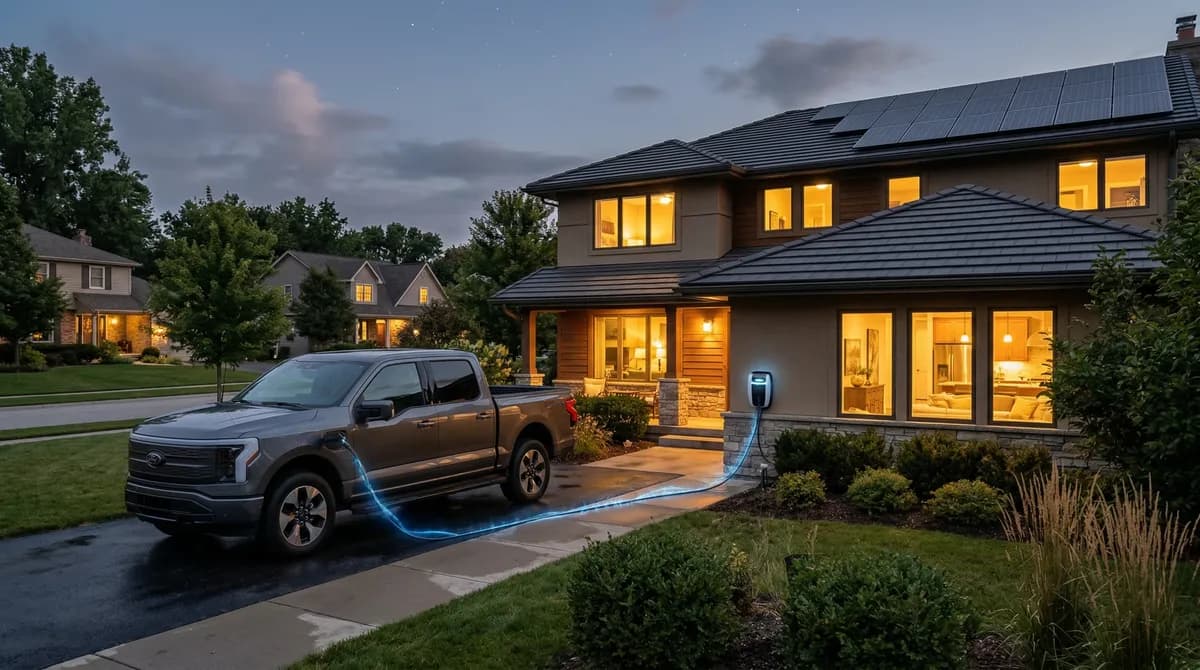
Your electric vehicle has a battery 5-10x larger than a Tesla Powerwall. V2H technology lets you tap into that stored energy to keep your lights on when the grid goes down. Here is everything you need to know about this fast-emerging technology in 2026.
Quick Answer
Yes, certain EVs can power your house during outages using Vehicle-to-Home (V2H) bidirectional charging. The Ford F-150 Lightning leads the pack with 9.6 kW output and up to 131 kWh of usable battery -- enough to power an average home for 3-4 days. You will need a compatible bidirectional charger (like Ford Charge Station Pro or Wallbox Quasar 2) and a transfer switch. Total setup cost: $2,500-$6,000, far less than a dedicated home battery at $12,000-$18,000.
What Is Vehicle-to-Home (V2H)?
Standard EV charging is a one-way street: electricity flows from the grid (or your solar panels) into your car's battery. Vehicle-to-Home (V2H)flips that flow, allowing your EV to send stored electricity back to your home's electrical panel.
This requires three things working together:
Bidirectional EV
An EV with hardware and software that supports reverse power flow
Bidirectional EVSE
A charger that can convert DC from the car back to AC for your home
Transfer Switch
Safely disconnects from the grid and routes EV power to your home panel
Think of it like this: your EV already has a massive battery -- the Ford F-150 Lightning's 131 kWh battery is nearly 10 times the capacity of a Tesla Powerwall 3 (13.5 kWh). V2H technology simply gives you a way to use that stored energy for your home, not just your driving.
V2H vs. V2G vs. V2L -- what is the difference?
V2H (Vehicle-to-Home) powers your house. V2G (Vehicle-to-Grid) sends power back to the electrical grid for utility programs. V2L (Vehicle-to-Load) provides a standard outlet on the car for small appliances -- most Hyundai/Kia EVs already do this without special equipment. This article focuses on V2H, the most practical option for home backup.
Which EVs Support V2H in 2026?
V2H capability is still relatively rare. Here are the EVs that currently support -- or are confirmed to support -- bidirectional home charging as of March 2026:
| Vehicle | Battery | V2H Output | Days of Backup* | Required EVSE | Status |
|---|---|---|---|---|---|
| Ford F-150 Lightning | 98-131 kWh | 9.6 kW | 3-4 days | Ford Charge Station Pro | Available Now |
| Hyundai Ioniq 5 | 77 kWh | 3.6 kW (V2L) | 2-3 days | Wallbox Quasar 2 | Available Now |
| Hyundai Ioniq 6 | 77 kWh | 3.6 kW (V2L) | 2-3 days | Wallbox Quasar 2 | Available Now |
| Kia EV6 | 77 kWh | 3.6 kW (V2L) | 2-3 days | Wallbox Quasar 2 | Available Now |
| Kia EV9 | 99.8 kWh | 3.6 kW (V2L) | 3-4 days | Wallbox Quasar 2 | Available Now |
| Nissan Leaf | 40-62 kWh | 6 kW | 1-2 days | Fermata FE-15 (CHAdeMO) | Limited |
| GM Ultium (Silverado EV, Equinox) | 85-200 kWh | 10.2 kW (announced) | 3-7 days | TBD | Coming 2026 |
*Estimated backup days based on 30 kWh/day average home consumption and 80% usable battery capacity. Actual duration varies with usage.
Notable absence: Tesla
Tesla vehicles do not currently support V2H despite having large batteries (60-100 kWh). Tesla has indicated V2H capability is coming but has not announced a timeline. Tesla's strategy appears focused on selling Powerwall batteries rather than enabling V2H from their vehicles.
V2H vs. Dedicated Home Battery: Side-by-Side Comparison
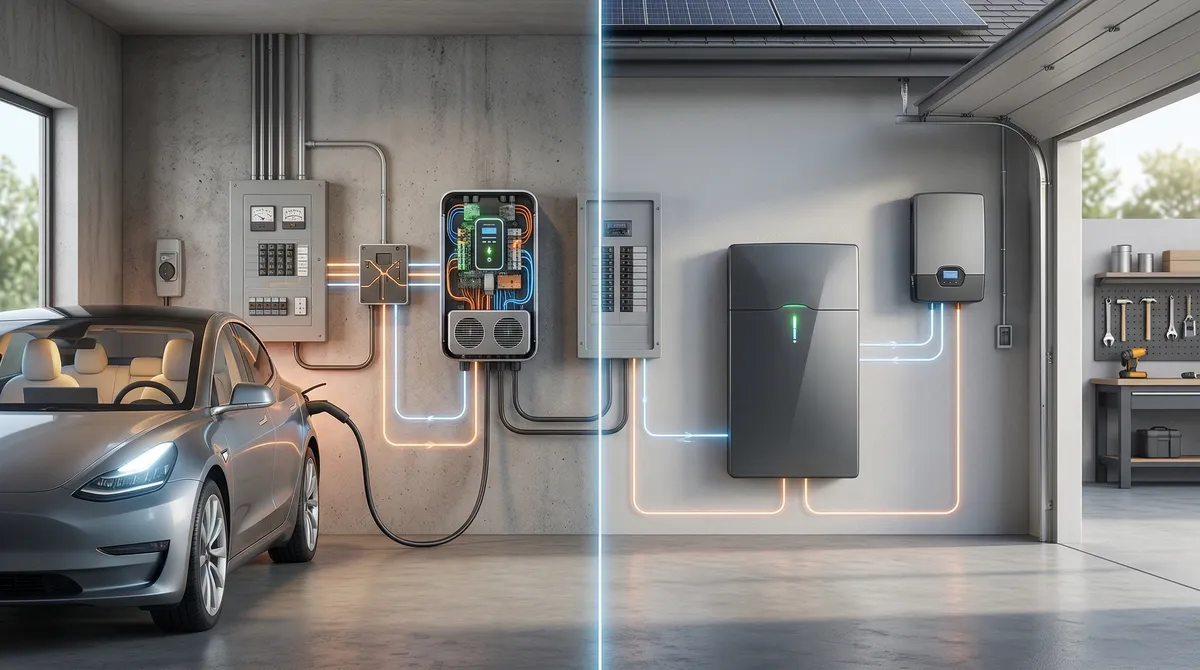
Both V2H and home batteries provide backup power. But they serve different needs and have distinct trade-offs. Here is how they compare:
| Feature | V2H (EV as Battery) | Home Battery (e.g., Powerwall 3) |
|---|---|---|
| Usable capacity | 60-131 kWh (depends on EV) | 13.5-20 kWh per unit |
| Output power | 3.6-9.6 kW | 5-11.5 kW continuous |
| Always available? | Only when car is home and plugged in | Yes -- 24/7 backup |
| Installed cost | $2,500-$6,000 | $12,000-$18,000 |
| Solar integration | Good (solar charges EV, EV powers home) | Excellent (seamless, automatic) |
| Affects driving range? | Yes -- using V2H depletes your driving battery | No -- dedicated system |
| Automatic switchover | Yes (with transfer switch) | Yes (built-in) |
| Lifespan | Tied to EV ownership (8-15 years) | 10-15 year warranty |
| Best for | Budget-conscious EV owners, occasional backup | Reliable daily energy management, critical backup |
The bottom line: if you already own (or plan to buy) a V2H-capable EV, adding V2H capability is dramatically cheaper than buying a dedicated home battery. But a dedicated battery is the better choice if you need guaranteed, always-on backup regardless of where your car is.
V2H + Solar: The Ultimate Resilience Stack
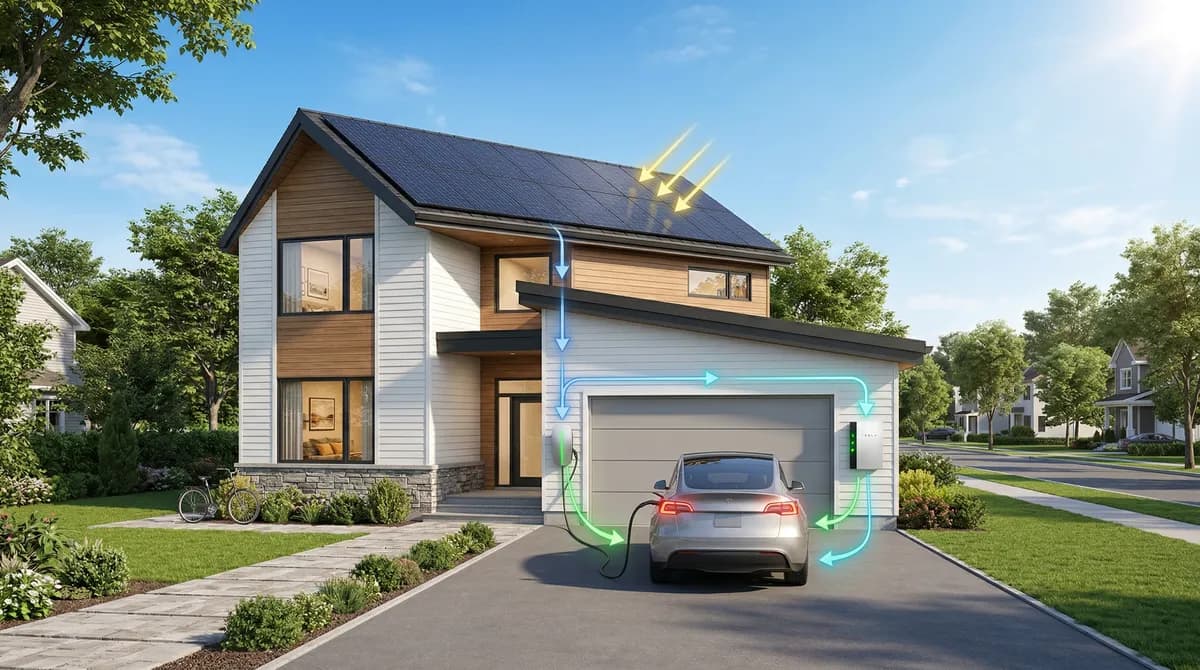
Pairing solar panels with a V2H-capable EV creates a remarkably resilient energy system. Here is how the cycle works:
Daytime: Solar charges your EV
Your rooftop solar panels generate electricity during the day. If your EV is home (remote workers, second vehicle), it charges directly from solar -- free fuel.
Evening: EV powers your home
After the sun sets, your EV discharges stored solar energy back into your home via V2H. You are running on free solar energy around the clock.
Outage: True energy independence
During a grid outage, solar keeps charging your EV during the day, and your EV keeps powering your home at night. This cycle can sustain essential loads indefinitely (weather permitting).
Real-world example
A homeowner in Massachusetts with a 10 kW solar system and a Ford F-150 Lightning could generate ~35 kWh/day in summer. With average home consumption of 25 kWh/day, the solar system charges the truck with 10 kWh of surplus. Even during a multi-day outage, the solar + V2H cycle keeps essential loads running. In winter (15-20 kWh/day solar production), the truck's 131 kWh battery provides a multi-day buffer between sunny days.
What Equipment Do You Need for V2H?
Setting up V2H requires specific hardware beyond a standard EV charger. Here is the complete equipment list:
1. Bidirectional EVSE (Charger)
A standard Level 2 charger only pushes power into the car. A bidirectional EVSE can also pull power out and convert it back to AC for your home.
| EVSE | Output | Compatible EVs | Price (unit only) |
|---|---|---|---|
| Ford Charge Station Pro | 9.6 kW | F-150 Lightning only | $1,310 (included with ER battery) |
| Wallbox Quasar 2 | 11.5 kW | Hyundai, Kia, Nissan (CCS) | $3,900-$4,500 |
| dcbel r16 | 9.6 kW | Multiple (CCS) | $5,500-$6,000 |
| Fermata FE-15 | 15 kW | Nissan Leaf (CHAdeMO) | $4,000-$5,000 |
2. Automatic Transfer Switch (ATS)
The transfer switch is critical for safety. It disconnects your home from the grid when V2H activates, preventing backfeed that could endanger utility workers. Most V2H installations use a manual or automatic transfer switch ($300-$800 installed). The Ford Charge Station Pro includes integrated transfer switch functionality.
3. Electrical Panel Compatibility
Your home needs a 200A electrical panel (standard in most homes built after 2000). Older homes with 100A or 150A panels may need an upgrade ($1,500-$3,000). Smart panels like Span or Lumin can manage V2H loads alongside solar and other circuits.
4. Utility Approval (Some Areas)
Some utilities require interconnection approval for V2H, similar to solar installations. Check with your local utility. In most cases, V2H with a proper transfer switch is treated like a generator and does not require special approval.
Limitations and Gotchas: What V2H Cannot Do
V2H is a promising technology, but it is not a perfect solution. Be aware of these real-world limitations before investing:
Your car must be home
If the power goes out while you are at work or on a road trip, V2H is useless. A dedicated home battery is always on-site. This is the biggest disadvantage of V2H.
It depletes your driving range
Using your EV as a home battery means less charge for driving. During a multi-day outage, you may have to choose between keeping the lights on and having enough range to drive. Most V2H systems let you set a minimum charge floor (e.g., keep at least 20% for driving).
Additional battery cycling
Every charge/discharge cycle puts wear on your EV battery. Regular V2H use (daily cycling for arbitrage) adds degradation. Occasional backup use during outages has minimal impact. Ford warranties the Lightning battery for 8 years/100,000 miles regardless of V2H use.
Limited EV compatibility
Most EVs on the road do not support V2H. Tesla (the best-selling EV brand) does not support it. You are limited to specific models from Ford, Hyundai, Kia, and Nissan.
Lower output than some home batteries
The Hyundai/Kia V2L output of 3.6 kW cannot run a central AC unit or electric dryer. The F-150 Lightning's 9.6 kW is comparable to home batteries, but smaller V2H setups may only support essential loads (lights, fridge, internet, medical devices).
Cost Analysis: V2H Setup vs. Home Battery
If you already own (or plan to buy) a V2H-capable EV, the incremental cost of adding V2H capability is a fraction of a dedicated home battery system:
V2H Setup Cost
- Bidirectional EVSE$1,300-$4,500
- Transfer switch$300-$800
- Electrical work / install$500-$1,500
- Total$2,100-$6,800
F-150 Lightning with included Charge Station Pro can be as low as $800-$2,000 (install only).
Home Battery Cost
- Battery unit (13.5 kWh)$8,500-$12,000
- Gateway / inverter$1,000-$2,000
- Installation$2,500-$4,000
- Total$12,000-$18,000
For 13.5 kWh capacity. Two-battery systems for whole-home backup run $20,000-$30,000+.
Section 30C residential credit expired
The residential Section 30C EV charger tax credit (30% up to $1,000) expired June 30, 2026 and is no longer available for home chargers, including bidirectional units. Instead, use state and utility EV charger rebates and off-peak/TOU charging rates to cut the cost of your EVSE purchase and installation. Check current state and utility options here.
Frequently Asked Questions
Can any EV power my house during an outage?
No. Only EVs with bidirectional charging capability can send power back to your home. As of 2026, the Ford F-150 Lightning, Hyundai Ioniq 5/6, Kia EV6/EV9, and Nissan Leaf (via CHAdeMO) support V2H. Most Teslas, Chevrolet EVs, and many others do not yet support bidirectional charging to the home.
How long can a Ford F-150 Lightning power a house?
Ford claims the F-150 Lightning with the extended-range 131 kWh battery can power an average home for up to 3 days at 9.6 kW output. Real-world duration depends on your home's power consumption -- a home using 30 kWh/day would get roughly 3-4 days, while a more efficient home using 20 kWh/day could stretch to 5-6 days.
Does using V2H void my EV warranty?
For EVs that officially support V2H (like the F-150 Lightning with Ford Charge Station Pro), using the feature as designed does not void the warranty. However, using third-party bidirectional chargers on EVs that don't officially support V2H could void your battery warranty. Always check with your manufacturer.
Is V2H cheaper than buying a home battery like the Tesla Powerwall?
V2H can be significantly cheaper if you already own a compatible EV. A Ford Charge Station Pro plus transfer switch costs $2,500-$4,000 installed, compared to $12,000-$18,000 for a Powerwall 3 or similar home battery system. However, dedicated batteries are always available regardless of whether your car is home.
Can I use V2H with solar panels?
Yes, and this is the most powerful combination. Solar panels charge your EV during the day for free, and at night or during outages, your EV can discharge stored solar energy back to your home. This creates a solar + storage system using your EV battery instead of (or in addition to) a dedicated home battery.
Does the Section 30C EV charger tax credit apply to V2H equipment?
No. The Section 30C credit — residential (30% up to $1,000) and commercial (up to $100,000 per item) alike — expired June 30, 2026 and is no longer available for EV charging equipment placed in service after that date, including bidirectional chargers like the Wallbox Quasar 2. Homeowners should instead use state and utility EV charger rebates and off-peak/TOU charging rates.
Related Resources
EV Charger Incentives (30C expired)
The residential 30C credit expired June 30, 2026 — see current state and utility EV charger rebates.
Best Home Batteries 2026
Compare Powerwall, Franklin, Enphase, and more dedicated backup options.
Whole-Home Electrification
Solar + battery + EV + heat pump: the complete electrified home guide.
EV Charging Solar Sizing
How many extra solar panels do you need to charge your EV?
Ready to Build Your Solar + EV Resilience Stack?
Our solar designers can size a system that charges your EV, powers your home, and keeps the lights on during outages. Get a free custom proposal.