Loading NuWatt Energy...

We use your location to provide localized solar offers and incentives.
We serve MA, NH, CT, RI, ME, VT, NJ, PA, and TX
Loading NuWatt Energy...
Use the free estimator for a preliminary layout, or share your preferred response method with the commercial team. Final feasibility still requires site, utility, and engineering review.
Compare Eversource CT vs. United Illuminating rate structures, demand charges, net metering credit values, SCEF rates, and TOU optimization. See exactly what your CT commercial solar system is worth per kWh.
Avg Commercial Rate
$0.221/kWh
Supply + delivery
Blended All-In
$0.27-$0.30
With demand charges
Net Metering
Retail Rate
Up to 2 MW
Sales Tax Exempt
6.35%
Form CERT-140
Connecticut commercial electricity rates average $0.221/kWh, with blended all-in rates of $0.33-$0.30/kWh including demand charges. Eversource CT serves ~75% of the state with demand charges ranging from $11.47-$16.83/kW depending on rate class. United Illuminating serves southwest CT at slightly higher rates ($13.21-$19.45/kW demand). Net metering credits are at the full retail rate for systems up to 2 MW. Combined with the 6.35% sales tax exemption, 100% property tax exemption, C-PACE financing, and the federal ITC (30-70%), CT commercial solar achieves 3-5 year payback periods for most businesses.
New Connecticut commercial projects enroll in the Non-Residential Renewable Energy Solutions (NRES) program and must elect one of two 20-year tariffs: Netting (self-consumed generation offsets your retail load and exports earn a retail-rate credit) or Buy-All(you sell 100% of generation at your awarded price and buy 100% of your load at retail). There is no published fixed price for either side — Buy-All is as-bid per tranche — so enter your own retail rate and award price below to see which election wins for your project.
Enter your own retail rate and Buy-All award to see which 20-year election wins.
NRES tranche: Medium (over 200 – under 1,000 kW)
Editable default — adjust for your site's orientation, tilt, and shading.
Share of generation used on-site (Netting only — Buy-All sells 100%).
From your Eversource or United Illuminating bill (example shown — replace with your figure).
Your bid or assumed award (example shown — replace with your figure). Medium and Large tranches are competitively bid; Small and School tracks are PURA-set.
Netting
$82,250
per year
20-year (level): $1,645,000
Buy-All
$82,250
per year
20-year (level): $1,645,000
At these inputs the two elections are effectively a tie.
Buy-All overtakes Netting once your award price rises above your retail netting rate — breakeven award here is $0.2800 per kWh.
Because Connecticut credits exported generation at the full retail rate, your self-consumption mix shifts where the Netting value comes from but not the Netting total. The real decision is Netting (valued at retail) vs. Buy-All (valued at your award), so a Buy-All award above retail wins — but Buy-All means you still buy 100% of your load at retail.
Estimates only — both NRES elections run a 20-year term. Netting value rises over the term as retail rates escalate, while a Buy-All award is a fixed 20-year price; this level view does not model escalation. This tool never sets an authoritative program rate: enter the retail rate from your bill and the award price from your bid or Statement of Qualification. The next NRES program year (PY5) RFP window runs August 3 – September 14, 2026.
Connecticut is served by two major investor-owned utilities: Eversource CT (approximately 75% of the state) and United Illuminating (southwest CT including Bridgeport, New Haven, and much of Fairfield County). A small number of municipalities are served by municipal utilities like Norwich Public Utilities. Understanding your utility rate structure is the foundation of any commercial solar savings analysis.
Connecticut commercial electricity rates are among the highest in the continental United States, averaging $0.221/kWh for the combined supply and delivery rate. However, the true cost for most commercial customers is higher when demand charges are factored in. Demand charges — based on your peak 15-minute power draw each month — add $0.03-$0.08/kWh equivalent to the blended rate, bringing the all-in cost to $0.27-$0.30/kWh for typical commercial facilities.
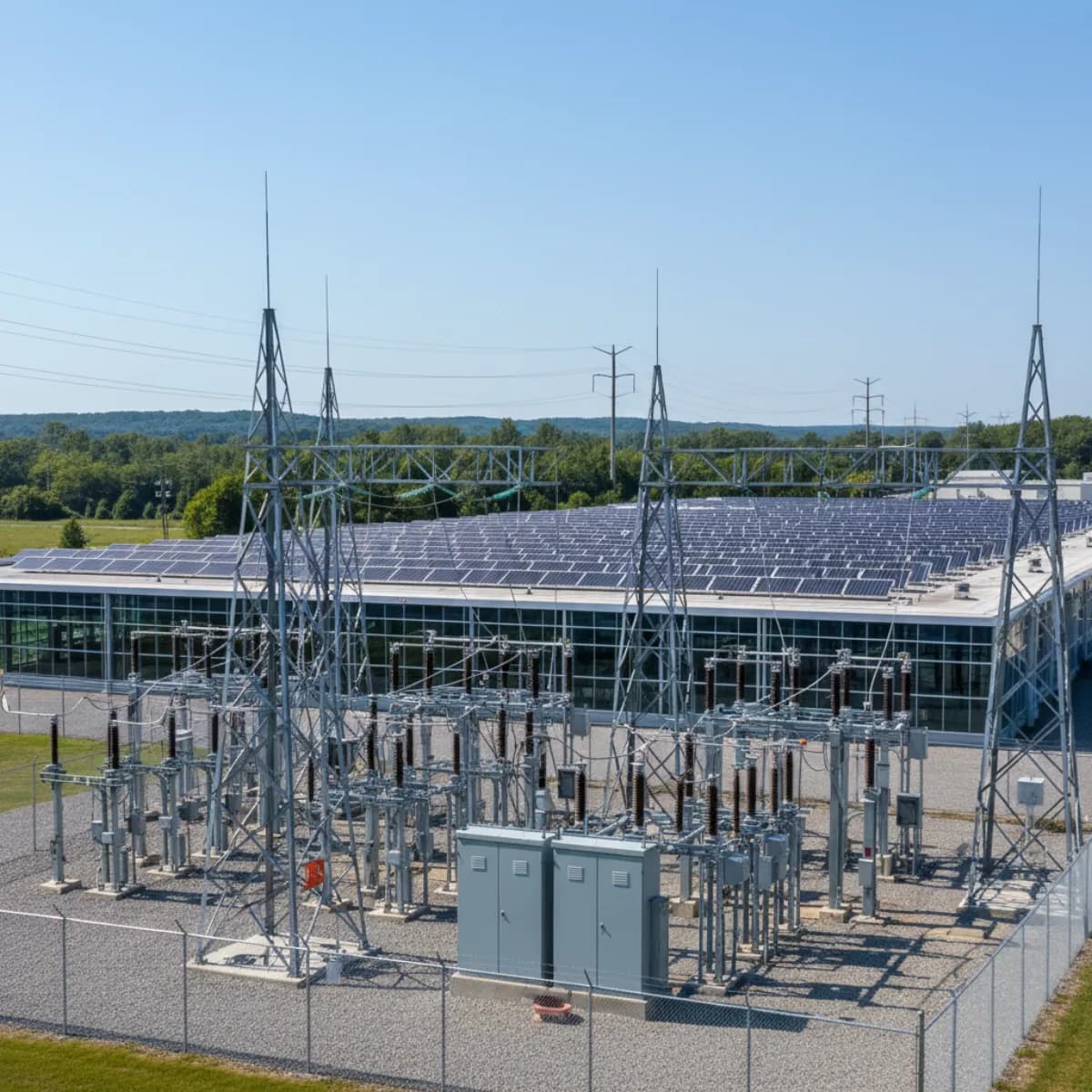
Eastern CT, Hartford, central corridor (~75% of CT)
| Rate Class | Demand | Total Rate | Demand $/kW | Notes |
|---|---|---|---|---|
| Rate 30 (Small Commercial) | <100 kW | $0.2210 | N/A | Non-demand, volumetric only |
| Rate 35 (General Service) | 10-200 kW | $0.2131 | $11.47 | Demand metered, most common commercial |
| Rate 37 (Large Power) | 200-1,000 kW | $0.1921 | $16.83 | TOU pricing available |
| Rate 56 (Time-of-Use) | Any qualifying | $0.2131 | $12.94 | On-peak 12-8pm weekdays, off-peak all other |
Southwest CT (Bridgeport, New Haven, Fairfield County)
| Rate Class | Demand | Total Rate | Demand $/kW | Notes |
|---|---|---|---|---|
| GSN (Small Non-Demand) | <25 kW | $0.2300 | N/A | Volumetric, no demand meter |
| GS (General Service) | 25-500 kW | $0.2218 | $13.21 | Standard demand-metered commercial |
| GST (General Time-of-Use) | 25-500 kW | $0.2218 | $14.58 | Peak 12-8pm weekdays Jun-Sep, 4-8pm Oct-May |
| LP (Large Power) | 500+ kW | $0.1910 | $19.45 | Primary voltage, highest demand charges |
Connecticut electricity bills consist of two components: supply (the cost of generating electricity) and delivery (transmission and distribution). Supply rates are set by competitive suppliers or the utility standard service rate. Delivery rates are set by PURA. Solar net metering credits apply to both supply and delivery charges — meaning you receive the full retail rate credit, not just the supply portion. This is a significant advantage compared to states that only credit the supply component.
Connecticut net metering is one of the most generous in the Northeast. Commercial solar systems up to 2 MW receive full retail rate credits for all excess generation exported to the grid. Credits roll over month to month and settle annually on April 30, with any remaining credits compensated at the avoided cost rate. Virtual net metering allows businesses with multiple accounts to distribute credits across all accounts under the same entity.
The full retail rate credit means that every kWh your solar system exports is worth the same $0.22-$0.23/kWh that you would otherwise pay. This makes Connecticut one of the most favorable states for commercial solar net metering. For a 250 kW system producing approximately 293,750 kWh/year (at 1,175 kWh/kW), net metering credits alone can be worth $64,913-$67,563 annually before accounting for demand charge reductions.
| Tier | Max Size | Credit Type | Rollover | Notes |
|---|---|---|---|---|
| Residential & Small Commercial | 100 kW | Full retail rate | Annual (Apr 30) | Credits at full bundled rate including T&D |
| Medium Commercial | 100 kW - 1 MW | Full retail rate | Annual (Apr 30) | Same retail rate credit as smaller systems |
| Large Commercial / SCEF | 1-2 MW | Full retail rate | Annual (Apr 30) | Applies to qualifying net-metered or SCEF projects |
| Virtual Net Metering | Up to 2 MW | Full retail rate | Annual | Credits applied across multiple accounts under same entity |
Connecticut virtual net metering is particularly valuable for businesses with multiple facilities. Install a single large solar system (up to 2 MW) at your most suitable location and distribute credits across all utility accounts under the same entity. This is ideal for property managers, retail chains, and manufacturers with separate office and production facilities. Credits transfer at the full retail rate — no discount for virtual allocation.
For most demand-metered commercial customers in Connecticut, demand charges represent 30-50% of the total electricity bill. Unlike energy charges ($/kWh), demand charges ($/kW) are based on your highest 15-minute average power draw during the billing period. A single spike — starting up large HVAC equipment, running industrial machinery, or high-power EV charging — can set your demand charge for the entire month.
Solar alone provides limited demand charge reduction because your peak demand may not coincide with peak solar production. Cloud cover during a peak demand event means solar provides little demand reduction for that month. However, solar combined with battery storage enables peak shaving — using stored solar energy to flatten demand spikes. The CT Energy Storage Solutions (ESS) program pays commercial batteries $325/kW for years 1-5 and $175/kW for years 6-10 (small and medium C&I) specifically to encourage battery installations for demand management.
A 200 kW peak demand customer on Eversource Rate 37 pays $3,366/month ($40,392/year) in demand charges alone. Battery storage that shaves 50 kW from peak demand saves $841.50/month ($10,098/year) in demand charges — before considering energy arbitrage, ESS program payments, or grid services revenue. For a detailed analysis of battery ROI including demand charge reduction, see our CT demand charge and battery calculator.
Both Eversource CT (Rate 56) and United Illuminating (GST) offer time-of-use rate options that can significantly enhance commercial solar value. TOU rates charge higher prices during on-peak hours (typically 12-8pm weekdays) and lower prices during off-peak hours. Since commercial solar production peaks during the 10am-4pm window, there is substantial overlap with on-peak pricing periods, increasing the per-kWh value of solar generation.
| Period | Eversource CT | United Illuminating | Solar Alignment |
|---|---|---|---|
| On-Peak | 12-8pm weekdays | 12-8pm weekdays (Jun-Sep), 4-8pm weekdays (Oct-May) | High — peak solar production overlaps peak pricing |
| Off-Peak | All other hours | All other hours | Moderate — weekend/evening solar offset off-peak consumption |
| Critical Peak | Event-based (10-15 days/yr) | Event-based | High — battery storage maximizes critical peak value |
For commercial solar with battery storage, TOU optimization becomes even more powerful. Batteries can be charged during off-peak hours (or from solar production) and discharged during on-peak periods when electricity is most expensive. This arbitrage strategy — buying low, selling high — can add $0.04-$0.08/kWh in additional value on top of standard net metering credits. The CT ESS program incentives further improve battery economics.
United Illuminating has a notable seasonal variation in TOU periods: on-peak is 12-8pm weekdays during summer (June-September) but shifts to 4-8pm weekdays during winter (October-May). This winter shift means solar production during winter afternoons may fall partially outside the peak window, while summer production aligns well. Battery storage can bridge the gap by storing midday solar for late-afternoon peak discharge during winter months.
Connecticut's Shared Clean Energy Facility (SCEF) program is the state's community solar framework, administered by PURA. SCEF allows commercial-scale solar projects (up to 5 MW) to distribute bill credits to multiple subscribers — enabling businesses, residents, and organizations that cannot install on-site solar to benefit from solar savings. For commercial developers, SCEF projects offer a revenue model beyond traditional behind-the-meter installations.
| Attribute | Details |
|---|---|
| Program Name | Shared Clean Energy Facility (SCEF) |
| Administrator | PURA (Public Utilities Regulatory Authority) |
| Max Project Size | 5 MW |
| Subscriber Minimum | 10+ subscribers |
| Low-Income Requirement | 20% of capacity to low-income subscribers |
| Credit Type | Bill credit at retail rate value |
| Contract Term | Up to 20 years |
| Eligible Utilities | Eversource CT and United Illuminating |
A key requirement of SCEF projects is that at least 20% of capacity must serve low-income subscribers. This requirement can be paired with the low-income ITC adder (+10-20%) to improve project economics. For developers, the SCEF model provides predictable revenue through long-term subscriber agreements (up to 20 years) while leveraging the ITC, MACRS depreciation, and potentially C-PACE financing for construction costs.
SCEF credits are distributed as bill credits at retail rate value to subscribers within the same utility territory. Both Eversource CT and United Illuminating territories are eligible. The subscriber management aspect adds administrative complexity compared to behind-the-meter installations, but the ability to develop larger projects (up to 5 MW) on optimal sites without roof constraints can significantly improve per-watt economics.
Connecticut offers one of the most comprehensive incentive stacks in the nation for commercial solar. Every incentive listed below can be stacked — they are not mutually exclusive. The combined effect can offset 50-75% of total system cost within the first 1-2 years through tax benefits, exemptions, and utility credits.
Base 30% + domestic content, energy community, low-income adders
30-70%
Stackable
CT conforms to federal bonus (20% in 2026). At 28.5% combined rate.
~27% of cost
Stackable
Solar equipment exempt via Form CERT-140. Applies to equipment and installation labor.
6.35%
Stackable
Permanent exemption. Solar never increases property tax assessment.
100%
Stackable
Up to 2 MW. Full retail rate credit. Annual rollover.
Retail rate
Stackable
CT Green Bank administers. 140+ municipalities. 20-25yr terms at 5-7%.
100% LTV
Stackable
Effective Apr 1 2026: $10/kWh enrollment for priority C&I only, plus a ten-year performance incentive — $325/kW-yr small/medium C&I and $275/kW-yr large C&I for years 1-5, $175/kW-yr for years 6-10, paid on measured contribution during Active Dispatch events.
$10/kWh enrollment + $175-$325/kW-yr
Stackable
A 250 kW system at $1.75/W ($437,500 installed) in an Eversource CT Rate 35 territory:
ITC (30%): $131,250
5-Year MACRS savings: ~$88,669
Sales tax exemption: $27,781
Annual energy savings: $64,913/yr
Property tax exemption: Permanent
Simple payback: ~3.2 years
The Public Utilities Regulatory Authority (PURA) oversees Connecticut's electric utility rates and distributed generation policies. PURA's decisions directly affect the economics of commercial solar through rate structures, net metering rules, and incentive program design. Several active PURA proceedings in 2026 may affect commercial solar project economics.
Key 2026 PURA developments for commercial solar include: the ESS program transition to a performance-based compensation model starting April 2026 (moving from upfront incentives to performance payments), ongoing Eversource CT and UI rate case proceedings that may adjust demand charge structures, and the continued evolution of the SCEF program framework. PURA Docket No. 17-12-03 remains the primary proceeding for distributed generation policy updates.
For businesses evaluating commercial solar in Connecticut, the regulatory direction is generally favorable. Connecticut has codified aggressive clean energy targets, and PURA has consistently supported net metering at retail rates. However, rate structures are evolving toward more granular pricing (TOU, demand-based) that rewards distributed generation paired with storage over solar-only installations. This trend reinforces the value of solar+battery systems for commercial applications.
For a comprehensive analysis of how these rates translate to project returns, use our CT commercial solar IRR calculator, which incorporates utility-specific rates, net metering values, and incentive stacking for both Eversource CT and United Illuminating territories.
Complete guide to commercial solar in Connecticut: ITC, MACRS, C-PACE, net metering, and more.
25-year IRR/NPV calculator with ITC, MACRS, net metering, and C-PACE financing scenarios.
CT Green Bank C-PACE: 100% financing, 140+ municipalities, 20-25yr terms.
Retail rate credits, virtual NM, and SCEF for commercial and residential solar.
Get your commercial rate and incentive analysis
We model your bill against current program rates for your utility and usage.
Connecticut commercial electricity rates average $0.221/kWh for supply and delivery combined. However, when including demand charges, the blended all-in rate for most commercial customers ranges from $0.33-$0.30/kWh. Eversource CT serves approximately 75% of the state with rates varying by rate class (Rate 30, 35, 37, 56). United Illuminating serves southwest CT including Bridgeport and New Haven with slightly higher rates in most classes.
We analyze your actual Eversource or UI bills to calculate precise solar savings including demand charge reduction, net metering credits, and the full incentive stack.