Loading NuWatt Energy...

We use your location to provide localized solar offers and incentives.
We serve MA, NH, CT, RI, ME, VT, NJ, PA, and TX
Loading NuWatt Energy...
NuWatt designs, installs, and manages solar, battery, heat pump, and EV charger systems across 9 states. One company, one warranty, one point of contact.
Get a Free QuoteCape Cod homes are the most common — and most challenging — housing style in Connecticut. Knee walls, limited attic access, dormers, and 1.5-story layouts require a specific approach. Mini-split zones + insulation-first strategy = comfortable upstairs bedrooms year-round.
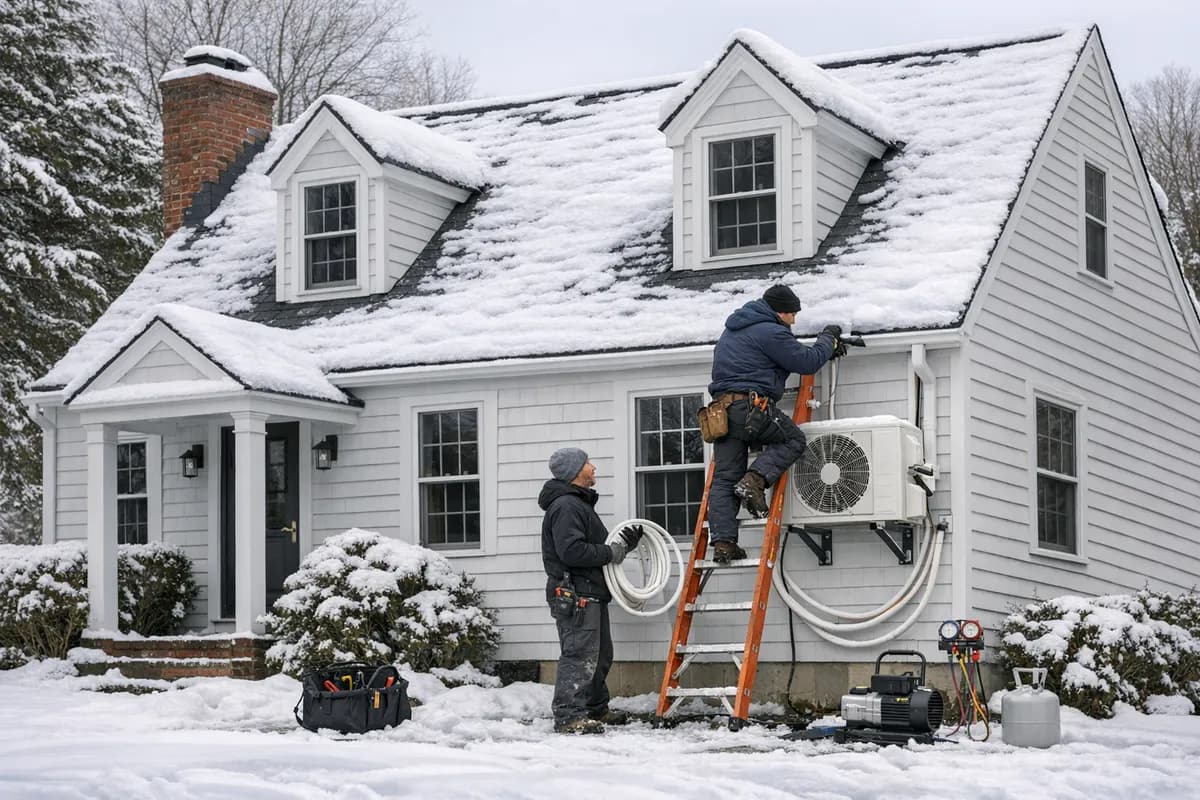
Connecticut has more Cape Cod style homes per capita than almost any other state. Built primarily in the 1940s-1970s, these 1.5-story homes with their characteristic steep roofs and dormers are the single hardest residential style to heat and cool. Standard HVAC approaches that work in colonial or ranch homes fail in Cape Cods because of the unique architecture. The good news: ductless mini-splits were essentially designed to solve this exact problem.
Each challenge has a specific solution. Understanding your home’s architecture is the first step to a comfortable, efficient heat pump installation.
The sloped ceiling meets the floor at knee walls — short vertical walls typically 3-5 feet high. The space behind knee walls is uninsulated or poorly insulated in most CT Capes, allowing massive heat loss.
Up to 30-40% of heat loss in winter comes through un-insulated knee wall cavities.
Insulate behind and above knee walls with spray foam or rigid foam board before installing heat pumps. This single improvement can cut heating costs 20-30%.
Cape Cod 1.5-story design means the "attic" IS the second floor living space. There's minimal room above the ceiling for ductwork, and the sloped roof leaves almost no conventional attic to insulate.
Ducted systems are often impossible or require expensive dropped ceilings.
Ductless mini-splits are ideal — wall-mounted heads need no attic space. Ceiling cassettes can fit in the small flat ceiling area between dormers.
Cape Cod homes have a full first floor with standard 8-foot ceilings and a half-story second floor with sloped ceilings (often 4-7 feet at the walls). The upstairs is dramatically hotter in summer and colder in winter.
10-20°F temperature difference between floors is common in CT Capes.
Dedicated mini-split heads for each upstairs bedroom provide independent zone control, eliminating the floor-to-floor temperature gap.
Most CT Cape Cods have dormers to create usable space upstairs. Dormers create complex roof geometry with multiple valleys and intersections — difficult to insulate properly and prone to ice dams.
Dormer walls and roofs are often the worst-insulated surfaces in the home.
Spray foam insulation inside dormer rooflines + dedicated mini-split in each dormer bedroom. This combination addresses both the insulation and temperature control problems.
Many CT Cape Cods were built with hot water baseboard, radiators, or gravity-fed warm air systems. There are no conventional ducts to tap into for a ducted heat pump.
Installing new ductwork in a Cape Cod is extremely disruptive and expensive ($8,000-$15,000).
Ductless mini-splits bypass the ductwork problem entirely. A multi-zone system with 3-4 indoor heads connected to one outdoor unit serves the whole home.
Installing a heat pump in an un-insulated Cape Cod is like buying a sports car and driving it with the windows down. Fix the building envelope first.
| Area | Typical Current State | Recommended | Cost | Impact |
|---|---|---|---|---|
| Knee Wall Cavities | Typically un-insulated or R-11 fiberglass batts (1950s-1970s construction) | R-21 to R-38 spray foam or rigid foam + air sealing | $1,500-$3,500 | Reduces heat loss 25-35%. The single most impactful upgrade for a Cape Cod. |
| Dormer Rooflines | Often only R-11 to R-19 between rafters | Closed-cell spray foam to R-30+ in rafter bays | $2,000-$4,500 | Eliminates the "oven upstairs in summer" problem. Reduces ice dams. |
| Flat Ceiling Over Second Floor | Limited space — often R-19 or less | Dense-pack cellulose or spray foam to maximum achievable R-value | $800-$2,000 | Seals the top of the thermal envelope. Critical for energy efficiency. |
| Exterior Walls (First Floor) | Fiberglass batts, R-11 to R-13 | Dense-pack cellulose blown in (R-13 to R-15) or exterior rigid foam if re-siding | $2,000-$5,000 | Moderate improvement. Lower priority than knee walls and dormers. |
| Air Sealing (Whole House) | CT Cape Cods average 8-15 ACH50 (very leaky) | Target 3-5 ACH50 with weatherstripping, caulk, spray foam | $500-$2,500 (often included in HES audit) | Air sealing + insulation together can reduce heating load 30-50%. |
A comprehensive insulation upgrade (knee walls + dormers + air sealing) typically costs $5,000-$12,000 for a CT Cape Cod. This investment reduces your heating load by 30-50%, which means you can install a smaller, less expensive heat pump systemthat costs less to operate. The insulation also qualifies for Smart-E Loan financing at the standard Smart-E rate — see ctgreenbank.com for current rates. Combined with the heat pump rebate, the total project often has a 5-7 year payback.
Where to put each indoor head for maximum comfort in a CT Cape Cod.
First floor has standard ceiling height. One larger head can condition the open living area effectively. Position for good air circulation.
Many CT Capes have a first-floor bedroom. Separate zone allows nighttime temperature control independent of the living area.
Critical zone — dormer bedrooms are the hottest rooms in summer and coldest in winter. Individual control is essential.
Same as front bedroom. If rooms are small, a single 9,000 BTU head handles heating AND cooling.
Many installers skip this zone and let the bedroom units handle overflow. Add if the hallway is large or connects a bathroom.
1st floor open + 2 upstairs bedrooms
Cape Cods with open first floor and 2 upstairs bedrooms. Most CT Cape owners choose this.
1st floor open + 1st floor bedroom + 2 upstairs bedrooms
Cape Cods with first-floor bedroom/office. Better whole-home coverage.
1st floor open + 1st floor bed + 2 upstairs beds + hallway/bonus
Full replacement of existing heating. Qualifies for higher Energize CT rebate tier.
Smart-E Loan financing (CT Green Bank) is available for heat pump and insulation projects. Heat-pump-only loans up to $25,000 qualify for the current 1.99% APR, 5-year offer; bundled projects are written at a blended rate. Available to Eversource and United Illuminating electric customers.
These Connecticut towns have large inventories of Cape Cod style homes, many of which are ideal candidates for heat pump conversion.
Large stock of 1940s-1960s Cape Cods. Coastal humidity adds moisture challenges.
Classic post-WWII Cape neighborhood around Sleeping Giant. Many oil-heated Capes converting to heat pumps.
Elmwood neighborhood full of Cape Cods. Eversource territory, strong insulation contractor availability.
Many Cape Cods built during WWII housing boom. Typical 1,200-1,400 sq ft. Perfect for 3-zone mini-split.
Mix of original Cape Cods and expanded versions. Expanded Capes may need 4-5 zones.
Coastal Cape Cods with salt air exposure. Ensure outdoor unit has marine-rated coil coating.
Northern CT location with colder winters. Recommend Mitsubishi Hyper-Heat or Fujitsu XLTH for best cold-weather performance.
Inland micro-climate slightly colder than coast. Good inventory of affordable Cape Cods going through electrification.
A Home Energy Solutions audit identifies all insulation gaps, air leaks, and thermal weak points in your Cape Cod. The auditor often fixes small air leaks on the spot at no extra charge.
Address the biggest heat loss areas before sizing the heat pump. This reduces the required system size and operating costs. The insulation contractor may be different from the HVAC installer.
After insulation, have an HPIN-registered contractor perform a Manual J calculation for your specific home. This sizes the heat pump correctly for your INSULATED Cape Cod, not the leaky original.
Work with the installer to place mini-split heads optimally. Upstairs bedrooms need individual zones. First floor may need one or two zones depending on layout. Knee wall and gable end wall mounting options for upstairs.
Installation typically takes 1-2 days for a 3-4 zone system. The installer runs refrigerant lines, mounts indoor and outdoor units, and commissions the system. Line hide covers protect exterior lines.
Apply for Energize CT rebate ($250-$1,000/ton). Set thermostat to 68°F heating with minimal setbacks. Install a smart thermostat with aux heat lockout if the system includes backup strips.
Cape Cod homes have a unique 1.5-story design where the second floor living space is directly under the roof with sloped ceilings, knee walls, and dormers. This design creates multiple insulation challenges: knee wall cavities allow massive heat loss, dormer rooflines are hard to insulate properly, there's no conventional attic for insulation, and the second floor has limited space for ductwork. In Connecticut winters, this means 10-20°F temperature differences between floors. In summer, upstairs bedrooms can be 80-90°F even with window AC units.
A multi-zone ductless mini-split system is the best solution for CT Cape Cods. A typical setup uses 3-4 indoor heads (one for the first floor open area, one per upstairs bedroom) connected to one outdoor unit. This bypasses the ductwork problem entirely, provides zone control for each room, and addresses the floor-to-floor temperature difference. Brands like Mitsubishi Hyper-Heat and Fujitsu Halcyon XLTH are ideal for CT winters, operating efficiently down to -13°F to -15°F.
Yes — insulation first is critical for Cape Cod homes. Un-insulated knee walls and dormer rooflines can account for 30-40% of heat loss. Without proper insulation, you'll need a larger (more expensive) heat pump system and it will run more hours, increasing operating costs. Start with an Energize CT Home Energy Solutions (HES) audit ($50-$100) which identifies and often fixes air leaks on the spot. Then insulate knee walls, dormers, and flat ceiling areas before sizing and installing the heat pump.
A 3-zone mini-split system (most common for CT Cape Cods) costs $12,500-$18,000 before rebates. A 4-zone system runs $16,000-$23,000. A 5-zone whole-home system is $20,000-$28,000. Energize CT rebates range from $250/ton (Standard tier) to $1,000/ton (Energy Optimization tier, max $10,000) for whole-home conversions. The Smart-E Loan offers 1.99% APR heat pump financing through the CT Green Bank on a 5-year term for loans up to $25,000.
It's difficult and usually not recommended. The 1.5-story design leaves almost no space for ductwork on the second floor — the "attic" IS the living space. Installing ducts typically requires dropping ceilings (losing headroom in rooms that already have low ceilings) or running ducts through knee wall cavities (reducing insulation space). In rare cases, a small ducted unit can serve the first floor if existing ductwork exists, while mini-splits handle upstairs. But for most CT Capes, a fully ductless approach is simpler and more effective.
Energize CT offers two tiers. The Standard rebate is $250 per ton (max $2,500) for any qualifying heat pump installation. The Energy Optimization rebate is $1,000 per ton (max $10,000) for whole-home heating replacements — which most Cape Cod full-system installations qualify for. You must use an HPIN-registered contractor and pre-register the project. The Smart-E Loan can cover both the heat pump and the insulation work, but note the rate difference: the 1.99% APR offer applies to heat-pump-only loans up to $25,000 on a 5-year term, and a loan that bundles other measures is written at a blended rate.
Wall-mounted heads work best on the knee wall (the short vertical wall where the ceiling slopes down) or on the gable end wall. The knee wall location is popular because it's at occupant level and directs airflow across the room effectively. Ceiling cassettes are another option if there's a flat ceiling section between dormers — they're less visible and distribute air more evenly. Avoid mounting on the sloped ceiling itself.
Most Connecticut Cape Cods need 3-4 zones: one for the first floor open living area (12,000-18,000 BTU), one for each upstairs bedroom (9,000 BTU each), and optionally one for a first-floor bedroom. A 3-zone system handles 90%+ of comfort needs. Adding a fourth zone for a first-floor bedroom or home office provides better control. Five zones (adding hallway/landing) is for maximum coverage but often unnecessary.