Loading NuWatt Energy...

We use your location to provide localized solar offers and incentives.
We serve MA, NH, CT, RI, ME, VT, NJ, PA, and TX
Loading NuWatt Energy...
NuWatt designs, installs, and manages solar, battery, heat pump, and EV charger systems across 9 states. One company, one warranty, one point of contact.
Get a Free QuoteComplete guide to solar carport costs, configurations, EV charging integration with CHEAPR rebates, C-PACE financing, CT structural requirements, and ROI analysis for commercial parking facilities.
Carport Premium
$3-5/W
On top of solar cost
ITC on Full Cost
30-70%
Includes structural
CHEAPR Rebate
$4-25K
Per EV charger
C-PACE Eligible
100%
140+ CT towns
Solar carport ROI in Connecticut ranges from 10-20% IRR for cash purchases. A 200 kW solar carport costs approximately $1.1M installed ($5.55/W total including structure). The 30% ITC applies to the full cost ($333,000 credit), MACRS provides ~$189K in 5-year tax savings (CT conforms to federal bonus), and annual energy savings average $52,000 at $0.221/kWh. C-PACE finances 100% with no upfront cost. CHEAPR rebates add $4,000-$25,000 per EV charger. Payback: 6-9 years cash, Day 1 positive with C-PACE.
Enter your parking size (or system kW), your installed cost, and the electricity rate from your own utility bill. The model returns a live net cost after the ITC and MACRS, simple payback, 25-year cumulative value, and cost per parking space. The worked-example cost breakdown below stays as a reference case.
Enter your parking size and your own electricity rate for a live result.
Spaces and kW are linked at ~2.2 kW per covered space (a 200 kW canopy covers roughly 91 spaces at that density). Edit either field.
Published carport range $4.20-$7.55/W — carports run higher than rooftop for the steel structure. Adjust to your quote.
Enter the blended rate from your own utility bill — the placeholder is only an example, not a default.
Payback
—
Net cost
$578,865
25-yr value
—
Total installed cost
$1,110,000
91 spaces · 200 kW
Federal ITC (30%)
$333,000
on full carport cost
MACRS tax value
$198,135
Cost per space (net)
$6,361
$12,198 before incentives
Cumulative net cash position (25 yr)
Enter your electricity rate to see payback, 25-year value, and the cash-flow curve.
The carport premium over rooftop is not pure cost: it converts otherwise idle parking into covered, EV-charging-ready space you already own — value this model does not monetize. Connecticut compensates exports through the NRES tariff (Non-Residential Renewable Energy Solutions — Buy-All or Netting) rather than a per-kWh canopy adder, and C-PACE can finance the full structure.
These results are estimates driven entirely by the values you enter above — not a quote. Cash flows assume 0.5% annual panel degradation, upfront ITC and MACRS present value netted into the cost, and 25-year straight electricity escalation. The MACRS shield assumes a taxable owner; state conformity to federal bonus depreciation varies (Massachusetts, for example, decouples), and tax-exempt entities use Direct Pay for the ITC and cannot claim MACRS. Confirm structural cost, bonus eligibility, ITC adders, interconnection, and your actual tax position with a professional.
Turn this model into an engineer-reviewed carport proposal
We size the canopy to your lot, confirm the structural cost, and build your 25-year cash flow on your real utility tariff.
Solar carports are elevated solar panel arrays mounted on structural canopies over parking areas. Unlike rooftop solar, carports require significant structural investment — steel columns, beams, and foundations — which adds $3.00-$5.00/W to the cost of the solar panels themselves. The structural configuration chosen depends on lot layout, vehicle types, wind and snow requirements specific to your CT municipality, and budget.
The critical economic advantage of solar carports is that the ITC applies to the full installed cost including structural components. On a $1.1 million carport project, the 30% ITC is $333,000 — significantly more than the $105,000 ITC on an equivalent $350,000 rooftop system. This ITC advantage partially offsets the structural premium and is the primary reason carport projects can achieve reasonable financial returns.
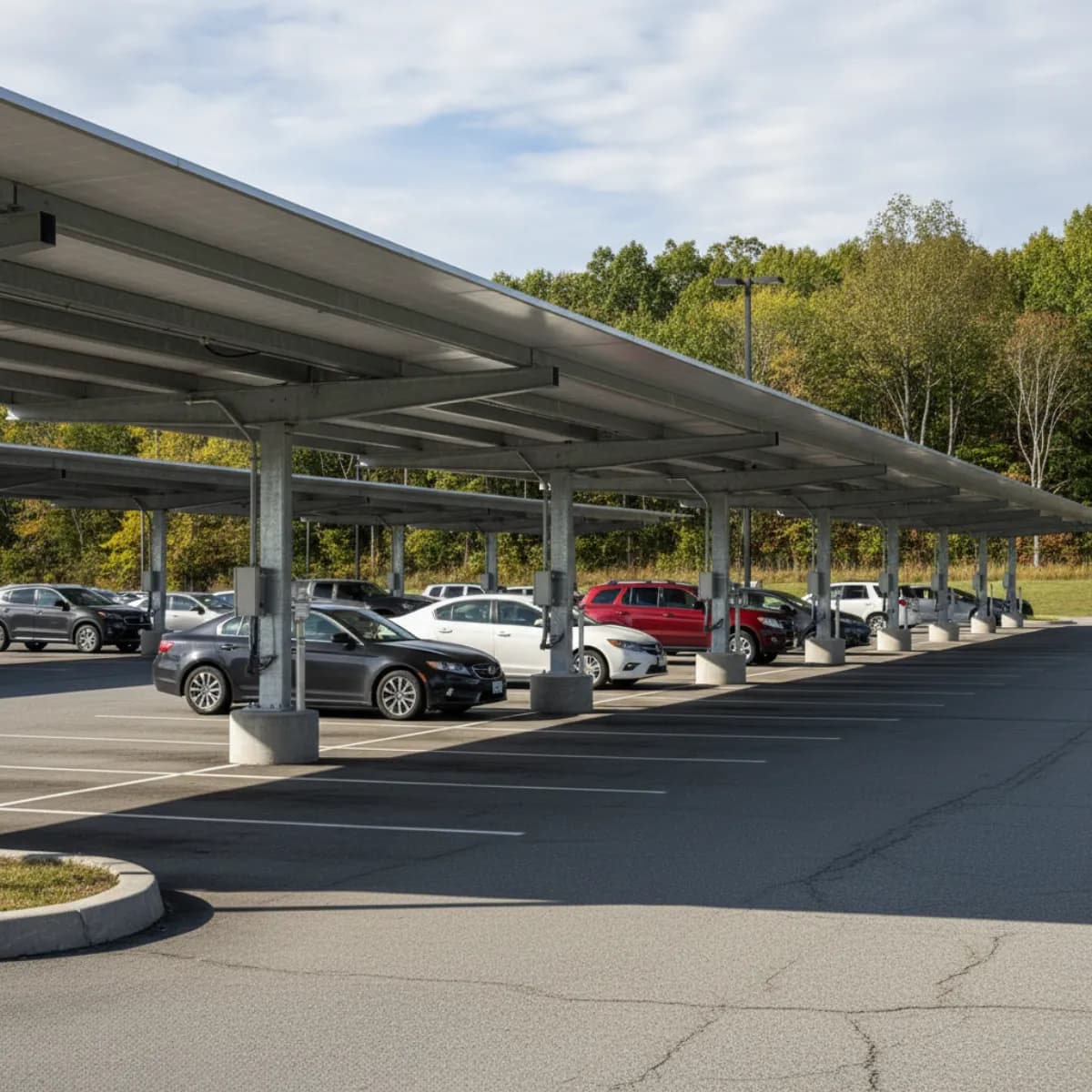
One center column per section. Most cost-effective for standard parking. Spans one row of parking.
Advantages
Considerations
Best for: Small lots, employee parking, single-row configurations
Two columns per section with cantilevered overhang. Covers two parking rows from columns placed between them.
Advantages
Considerations
Best for: Large retail lots, hospital parking, corporate campuses
Heavy steel frame spanning wide parking areas. Maximum coverage per structure. Commercial-grade engineering.
Advantages
Considerations
Best for: Large commercial, EV charging stations, coastal CT areas
Below is a detailed cost breakdown for a 200 kW dual-column cantilever solar carport in Connecticut. This configuration covers approximately 80-100 parking spaces and is the most common commercial carport design.
While the per-watt cost of carports is 2-3x rooftop installations, several factors narrow the ROI gap:
Solar carports paired with EV charging stations create a compelling combined value proposition. Connecticut's CHEAPR program (Connecticut Hydrogen and Electric Automobile Purchase Rebate), administered by the CT Green Bank, provides significant rebates for commercial EV charging installations. These incentives stack with the solar ITC, MACRS depreciation, C-PACE financing, and net metering credits.
A solar carport with 10 Level 2 EV charging stations captures $40,000 in CHEAPR rebates on top of the solar incentives. The federal Section 30C alternative fuel vehicle refueling property credit provides an additional 30% credit on the EV charging equipment cost. Combined with C-PACE financing for the complete installation (solar carport + EV chargers), a CT business can deploy a comprehensive solar+EV infrastructure with zero upfront cost and multiple revenue streams: energy savings, net metering credits, and EV charging fees.
EV adoption in Connecticut is accelerating, with the state targeting 500,000 registered EVs by 2030. Businesses that install EV charging infrastructure now position themselves for growing demand. Workplace charging is particularly valuable — it drives employee satisfaction, extends charging time during work hours (maximizing solar self-consumption), and generates revenue through charging fees. The solar carport structure provides a natural housing for charger equipment while protecting it from weather.
Connecticut's climate presents specific structural challenges for solar carports. The state experiences significant snowfall (25-60+ inches annually), with higher accumulations in the northwest hills and lower amounts along Long Island Sound. Wind loads vary from 115 mph in inland areas to 130 mph in coastal zones. All carport designs must meet current ASCE 7-22 standards as adopted by the Connecticut State Building Code.
| Requirement | Value | Notes |
|---|---|---|
| Ground Snow Load | 35-55 psf (varies by municipality) | Higher in NW CT hills, lower along coast. ASCE 7-22 minimum. |
| Wind Speed Design | 115-130 mph (3-sec gust) | Coastal CT requires higher wind ratings. Hurricane zone considerations for shoreline properties. |
| Minimum Clearance | 14 ft (cars), 16 ft (trucks/vans) | ADA accessible routes must be maintained. Fire lane access per local codes. |
| Foundation Type | Drilled pier or spread footing | Soil conditions vary significantly across CT. Geotechnical report typically required. |
| Building Permit | Required in all CT municipalities | Structural engineer stamp required. Some municipalities require separate electrical and building permits. |
| Setback Requirements | Varies by municipality | Carport structures must comply with local zoning setbacks. May need variance for tight lots. |
Connecticut permitting for solar carports is handled at the municipal level, and requirements vary significantly between the state's 169 municipalities. Larger cities like Hartford, New Haven, Bridgeport, and Stamford have established solar permitting processes, while smaller towns may require more pre-application coordination. The CT Green Bank can assist with navigating local permitting as part of the C-PACE application process.
Properties along Long Island Sound and in flood zones face additional structural requirements. Higher wind design speeds (up to 130 mph), potential flood zone construction requirements, and coastal area management program (CAMP) reviews may apply. These factors increase structural costs by 10-20% compared to inland installations but are well-understood by experienced carport designers. The higher wind ratings may require full-span steel frame configurations rather than lighter T-frame designs.
Solar carports are particularly well-suited for businesses with large parking areas, high daytime electricity consumption, and customer or employee-facing visibility. Connecticut's commercial electricity rates ($0.221/kWh average, $0.27-$0.30 blended) make carport projects financially viable across many industries.
Shaded customer parking increases foot traffic. High daytime consumption = excellent self-consumption ratio. Visible sustainability branding for CT customers.
Critical load backup when paired with battery storage. Employee/patient parking shade. 24/7 facility operations maximize self-consumption. CT ESS incentives improve battery economics.
Tax-exempt entities benefit from PPA pricing that passes ITC savings through lower rates. Student safety (covered walkways). Educational value. C-PACE may apply for private schools.
ESG compliance and sustainability reporting. Employee amenity (shade/weather protection). EV charging integration for fleet and employees. CHEAPR rebates available for EV stations.
For C-PACE financing details and how carport projects qualify, see our C-PACE guide for CT commercial solar. For a full IRR analysis including carport-specific costs and incentives, use the CT commercial solar IRR calculator.
Complete guide to commercial solar in Connecticut: ITC, MACRS, C-PACE, net metering, and utility rates.
CT Green Bank C-PACE: 100% financing for carports, rooftop solar, and battery storage.
25-year IRR/NPV calculator including carport-specific costs and incentive stacking.
Peak shaving, ESS program incentives, and solar+battery ROI for CT commercial properties.
Solar carport costs in Connecticut range from $3.00-$5.00/W for the structural canopy on top of the standard solar installation cost of $1.20-$2.55/W. Total all-in cost for a solar carport is typically $4.20-$7.55/W depending on configuration (single-column T-frame, dual-column cantilever, or full-span steel frame), size, and structural requirements. A 200 kW solar carport system typically costs $840,000-$1,510,000 installed. Higher structural costs in coastal CT areas due to wind load requirements.
We design, engineer, and install solar carports with EV charging across Connecticut — including C-PACE financing, CHEAPR rebates, and full structural engineering.