Loading NuWatt Energy...

We use your location to provide localized solar offers and incentives.
We serve MA, NH, CT, RI, ME, VT, NJ, PA, and TX
Loading NuWatt Energy...
NuWatt designs, installs, and manages solar, battery, heat pump, and EV charger systems across 9 states. One company, one warranty, one point of contact.
Get a Free QuoteFederal tax credits are dead. Energize CT rebates are the only incentives left. Bundle solar panels with a cold-climate heat pump to eliminate both your electric bill and your fuel bill.
Connecticut has the 4th highest electric rates in the country and over 40% of homes still heat with oil or propane. That means CT homeowners are uniquely positioned to save by eliminating both energy costs at once.
A cold-climate heat pump replaces your oil/propane/gas furnace. Typical oil-heated CT home saves $1,500/year in fuel costs (net of increased electricity).
Your heat pump adds ~4,400 kWh/year to your electric bill. Solar panels generate that power for free. An 8 kW system produces 9,400 kWh/year — more than enough.
Eversource rates have risen 40%+ in 3 years. Solar locks in your electricity cost at $0. Oil/propane prices are volatile. A heat pump runs on stable, solar-generated power.
$5,460/year. Rising every year with rate increases.
$468/year. Mostly locked — solar panels produce for 25+ years.
Annual savings: ~$4,992/year (oil-heated home scenario)
Federal tax credits are gone. These are the incentives that remain for Connecticut homeowners in 2026.
Federal Credits: Dead
Section 25D (solar ITC) and Section 25C (heat pump credit) expired December 31, 2025. $0 available for homeowner cash or loan purchases. The only remaining federal option is Section 48E for third-party PPA/lease solar — still active; July 4, 2026 was its begin-construction safe harbor (later starts: in service by Dec 31, 2027), not an expiry.
| Program | Amount | Your Value | Applies To | Status |
|---|---|---|---|---|
Energize CT HP Rebate (Standard) For supplemental HP installations. Must use HPIN contractor. | $250/ton (max $2,500) | $1,000 | Heat Pump | Active |
Energize CT HP Rebate (Energy Optimization) For whole-home primary heating replacement. Requires HES assessment. | $1,000/ton (max $10,000) | $4,000 | Heat Pump | Active |
CT Sales Tax Exemption Permanent exemption on solar equipment and installation. | 6.35% exempt (Form CERT-140) | $1,626 | Solar | Active |
CT Property Tax Exemption Solar does NOT increase your property tax bill. Permanent. | 100% assessment exclusion | $522/yr | Solar | Active |
RRES Net Metering Netting tariff minus $0.0402/kWh Solar Energy Adjustment for 2026 enrollees. | Retail-rate credits | ~$2,348/yr | Solar | Active |
Section 48E (PPA/Lease) Third-party claims ITC. July 4, 2026 was the begin-construction safe harbor (later starts: in service by Dec 31, 2027) — the credit does not expire. | 30% ITC to system owner | Lower rate for you | Solar | Active |
Smart-E Loan (HP only) The 1.99% rate is for heat pumps only. Solar rates are 6.99-7.99%. Bundling both on one loan produces a blended rate. | 1.99% APR, 5 yr, up to $25K | Saves ~$3,400 interest vs 7% | Heat Pump | Active |
Section 25D (homeowner solar ITC) Expired December 31, 2025. No residential solar tax credit available. | $0 | $0 | Solar | Expired |
Section 25C (HP tax credit) Expired December 31, 2025. No residential HP tax credit available. | $0 | $0 | Heat Pump | Expired |
Supplemental HP installation
$250/ton
Max $2,500 (10 tons)
4-ton system: $1,000 rebate
Whole-home primary heat
$1,000/ton
Max $10,000 (10 tons)
4-ton system: $4,000 rebate
Real numbers for a typical Connecticut bundle. Eversource territory, switching from oil heat to a whole-home heat pump.
Produces ~9,400 kWh/year. Offsets $2,726/yr at retail rates minus $378/yr Solar Energy Adjustment = $2,348/yr net value.
Consumes ~4,400 kWh/yr (COP 3.0). Saves $1,500/yr vs oil heat (net of electricity increase).
Gross Cost
$41,600
Solar + HP combined
Net After Incentives
$35,974
$4K rebate + $1.6K tax savings
Year 1 Savings
$4,370
Fuel + solar + property tax
Simple Payback
~8.2 yrs
Before rate increases
25-year projected savings: Over $110,000 (assumes 3% annual rate increase, 0.5% panel degradation). Property alone appreciates by $20,000-$30,000 with installed solar + HP.
Heating Oil
Was $2,700/yr
~$4,370/yr
total bundle savings
Propane
Was $2,900/yr
~$4,570/yr
total bundle savings
Natural Gas
Was $2,200/yr
~$3,870/yr
total bundle savings
Electric Resistance
Was $3,600/yr
~$5,270/yr
total bundle savings
All models below are Energize CT Qualified Product List approved and cold-climate rated for Connecticut winters.
Ductless Mini-Split
Min Temp
-13 F
SEER2 / HSPF2
22.0 / 12.5
Ducted Central
Min Temp
-10 F
SEER2 / HSPF2
24.0 / 13.0
Ductless Mini-Split
Min Temp
-15 F
SEER2 / HSPF2
20.0 / 12.0
Ducted Central
Min Temp
-4 F
SEER2 / HSPF2
18.0 / 10.0
Connecticut temperatures regularly drop to 0-10 F in winter. All recommended models maintain 70%+ heating capacity at 5 F and operate down to -4 F or colder. For homes in the Litchfield Hills or northwest CT, the Fujitsu XLTH (-15 F) is the strongest cold-weather performer.
Three realistic paths. Note: the Smart-E 1.99% APR rate applies to heat pumps only. Solar loans through Smart-E carry 6.99-7.99% APR.
Smart-E 1.99% heat pump offer: what it requires
The 1.99% APR rate runs on a five-year term up to $25,000, and only for Eversource or United Illuminating (Avangrid) electric customers. Your Energize CT heat pump rebate must be approved before the loan. Special-offer terms are revised periodically — confirm the current offer at ctgreenbank.com.
Installing both systems requires coordination. Here is the optimal sequence for maximum incentives and accurate solar sizing.
HES assessment through Energize CT ($50-$150 subsidized). Evaluates insulation, air sealing, and heating load. Required for Energy Optimization tier.
Week 1-2HPIN-registered contractor installs cold-climate HP. Apply for Energize CT rebate ($1K-$4K). Monitor electricity usage for 2-3 months.
Week 3-6Size solar based on actual HP electricity consumption + base load. Submit permits, RRES interconnection application to Eversource or UI.
Week 8-14Install panels, pass inspection, receive Permission to Operate (PTO) from utility. Begin generating and earning RRES net metering credits.
Week 14-20Single Contractor Advantage
NuWatt coordinates both the heat pump and solar installation, ensuring correct HP sizing, solar capacity matching, electrical panel compatibility, and all Energize CT paperwork. One point of contact from HES through PTO.
With the 2026 Solar Energy Adjustment ($0.0402/kWh on all production), a battery reduces your exposure by storing solar for evening use instead of exporting.
$30/kWh
One time, at commissioning. Tesla Powerwall 3 (13.5 kWh) = $405, or $1,755 on a Grid Edge circuit ($130/kWh). Grid Edge is circuit-level, never town-level. Max $16,000 or 50% of cost.
$300/kW-yr
Standard rate, one rate across all ten years. $450/kW-yr in DECD distressed municipalities, $550/kW-yr for income-qualified households. Paid on measured average kW-AC contribution during Active Dispatch events, not nameplate capacity.
55%+
Battery increases self-consumption from ~35% to 55%+. Reduces Solar Energy Adjustment cost from $378 to ~$240/yr.
ESS changed on April 1, 2026. The old upfront incentive model ($250/kWh standard, $450/kWh underserved, $600/kWh low-income) closed to new applications that day and was replaced by the enrollment + performance structure shown above. Source: ESS Program Manual revised Feb 11, 2026, Tables 9 and 16; PURA Docket 25-08-05 final decision Dec 17, 2025.
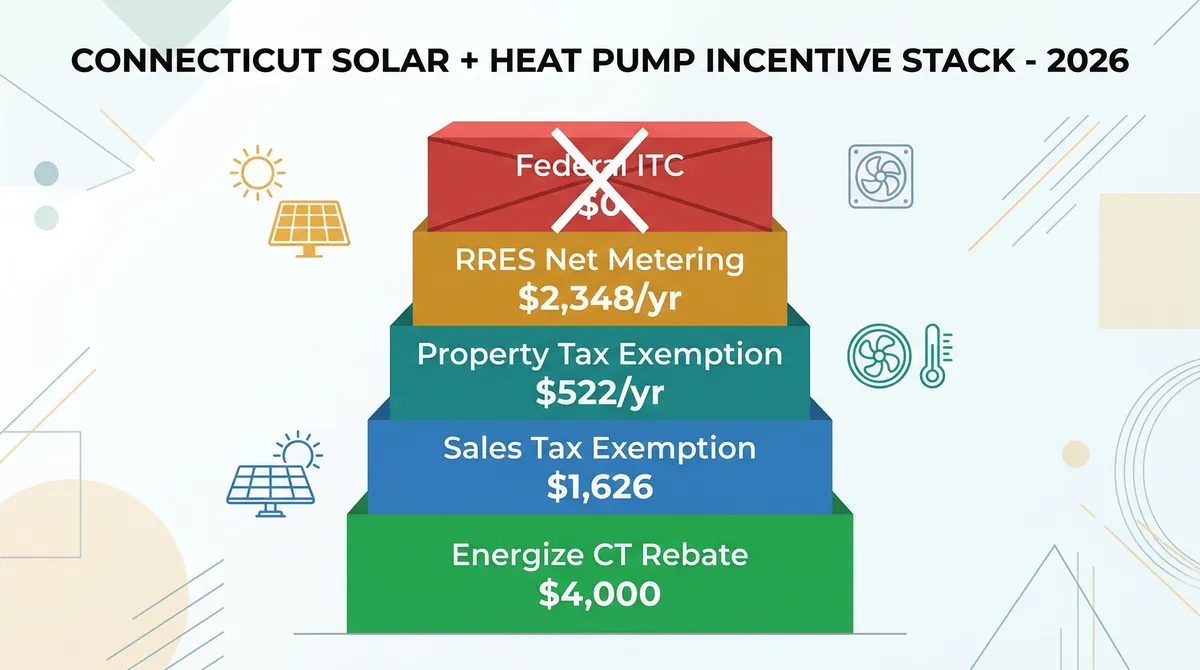
CT incentive stack for solar + heat pump bundles in 2026. Federal credits gone; state programs remain.
No homeowner-claimed credit. Section 25D (residential solar ITC) and Section 25C (heat pump efficiency credit) both expired December 31, 2025. The only federal option is Section 48/48E, which allows the THIRD-PARTY SYSTEM OWNER (not you) to claim a 30% ITC on solar installed via PPA or lease. That credit is still active — July 4, 2026 was the begin-construction safe harbor (projects that began on or before locked in the full timing pathway; later starts still qualify but generally must be placed in service by December 31, 2027), not an expiration. Energize CT rebates are now the primary incentive for CT homeowners.
A typical CT homeowner switching from oil heat saves $1,500/year in fuel costs plus $2,348/year in solar electricity value plus $522/year in property tax savings, totaling roughly $4,370 in year one. Over 25 years with rising utility rates, cumulative savings exceed $110,000 for a cash purchase.
The Energy Optimization tier pays $1,000 per ton (up to $10,000) for heat pumps that serve as the primary whole-home heating system. A 4-ton system qualifies for $4,000. Requirements: whole-home heating design, ENERGY STAR Cold Climate certified equipment, HPIN-registered contractor, and a Home Energy Solutions (HES) assessment.
No. The 1.99% APR Smart-E rate is a heat-pump-only offer through the CT Green Bank: a five-year term, up to $25,000, and only for Eversource or United Illuminating (Avangrid) electric customers who already have an approved Energize CT heat pump rebate. Solar loans through Smart-E carry rates of 6.99% (5-10 year terms) to 7.99% (15-year term). You can bundle both on one Smart-E loan up to $50,000, but a bundled loan is written at a blended rate rather than a flat 1.99% on the heat pump share.
For the Energy Optimization rebate tier ($1,000/ton), yes. The HES assessment is a comprehensive energy audit that evaluates your home insulation, air sealing, and heating needs. It costs $50-$150 for Eversource or UI customers (subsidized). For the Standard rebate tier ($250/ton), a HES assessment may not be required but is recommended.
A typical cold-climate heat pump in CT uses 4,400 kWh/year for heating and cooling. A 4 kW solar array generates about 4,700 kWh/year in CT. However, to offset your entire electric bill (base load + heat pump), you typically need 8-10 kW. We recommend installing the heat pump first, monitoring usage for 2-3 months, then sizing solar to match your measured annual demand.
New RRES enrollees in 2026 pay a Solar Energy Adjustment of $0.0402 per kWh on ALL solar production (not just exports). For an 8 kW system producing 9,400 kWh/year, this equals about $378/year. Legacy RRES customers (enrolled before 2026) pay only $0.005/kWh (~$47/year). This adjustment reduces net solar savings by about 14% compared to legacy rates.
Install the heat pump first. This lets you measure your actual electricity consumption (including heating and cooling) over 2-3 months, then size solar precisely to offset your total annual usage. Over-sizing solar wastes money; under-sizing leaves you buying grid power. A heat pump typically adds 4,000-6,000 kWh/year to your electric bill.
Yes. Effective April 1, 2026 CT Energy Storage Solutions pays a one-time enrollment incentive of $30/kWh at commissioning — $130/kWh for homes on a Grid Edge circuit — so a Tesla Powerwall 3 (13.5 kWh) earns $405, or $1,755 on Grid Edge, capped at $16,000 or 50% of cost. Grid Edge is a circuit-level designation, never a town-level one. On top of that, a performance incentive is paid annually for ten years: $300 per kW-year standard, $450 in DECD distressed municipalities, $550 for income-qualified households — all on measured average kW-AC contribution during Active Dispatch events, not nameplate capacity. The old upfront model ($250/$450/$600 per kWh) closed to new applications on April 1, 2026. Source: ESS Program Manual revised Feb 11, 2026, Tables 9 and 16; PURA Docket 25-08-05.
Your heat pump installer must be registered with the Energize CT Heat Pump Installer Network (HPIN). Your solar installer must be licensed and experienced with RRES interconnection. NuWatt Energy handles both solar and heat pump installations with HPIN-registered contractors, simplifying the process with a single point of contact for the entire bundle.
July 4, 2026 was the begin-construction safe harbor, not an expiration of the credit. If the third-party owner began construction on or before July 4, 2026, the project locked in the full §48E timing pathway (years to place in service). If construction begins later, the 30% ITC is still available, but the project generally must be placed in service by December 31, 2027. Because the credit underpins PPA and lease economics, an earlier construction start kept the widest, most certain window — but the ITC does not vanish on a single date.
Connecticut permanently excludes solar PV from property tax assessment. Adding a $25,600 solar system does NOT increase your assessed home value for tax purposes. At CT average effective property tax rate of 2.04%, this saves approximately $522 per year. No renewal required.
Smart-E offers 1.99% APR for heat pumps on a five-year term. For Section 48E PPA solar, July 4, 2026 was the begin-construction safe harbor; projects that began by then kept the widest timing window, and new starts still qualify if placed in service by December 31, 2027.
NuWatt handles both installations with HPIN-certified contractors. One quote, one timeline, one point of contact.
Full rebate details by tier
Panel costs by city
Rates, terms, qualification
Netting tariff vs Buy-All
ESS program details
Why it still makes sense
Utility rate comparison
Best models for CT winters
