Loading NuWatt Energy...

We use your location to provide localized solar offers and incentives.
We serve MA, NH, CT, RI, ME, VT, NJ, PA, and TX
Loading NuWatt Energy...
NuWatt designs, installs, and manages solar, battery, heat pump, and EV charger systems across 9 states. One company, one warranty, one point of contact.
Get a Free QuoteMultiple overlapping tariff layers are pushing panel costs up $0.10-0.25 per watt in Connecticut. But CT has a secret weapon: the RRES Buy-All tariff paying $0.3289/kWh locked for 20 years. Here is how tariffs, FEOC rules, and state incentives interact — and why CT remains one of the best solar markets in the country.

The US solar industry faces the most complex tariff environment in its history. Four separate trade actions — each with its own legal basis, rate structure, and exemption rules — are stacking on top of each other. The combined effective tariff rate on imported solar modules from Southeast Asia, which supplies most of the US residential market, now ranges from 35% to 55%.
This is not a single tariff. It is four overlapping layers that explain why module prices have risen from $0.30-0.35/W in 2024 to $0.40-0.50/W today, with further increases projected through the second half of 2026. For Connecticut homeowners, this translates to $0.10-0.25/W in additional system cost — a meaningful increase, but one that Connecticut's RRES Buy-All program can more than offset.
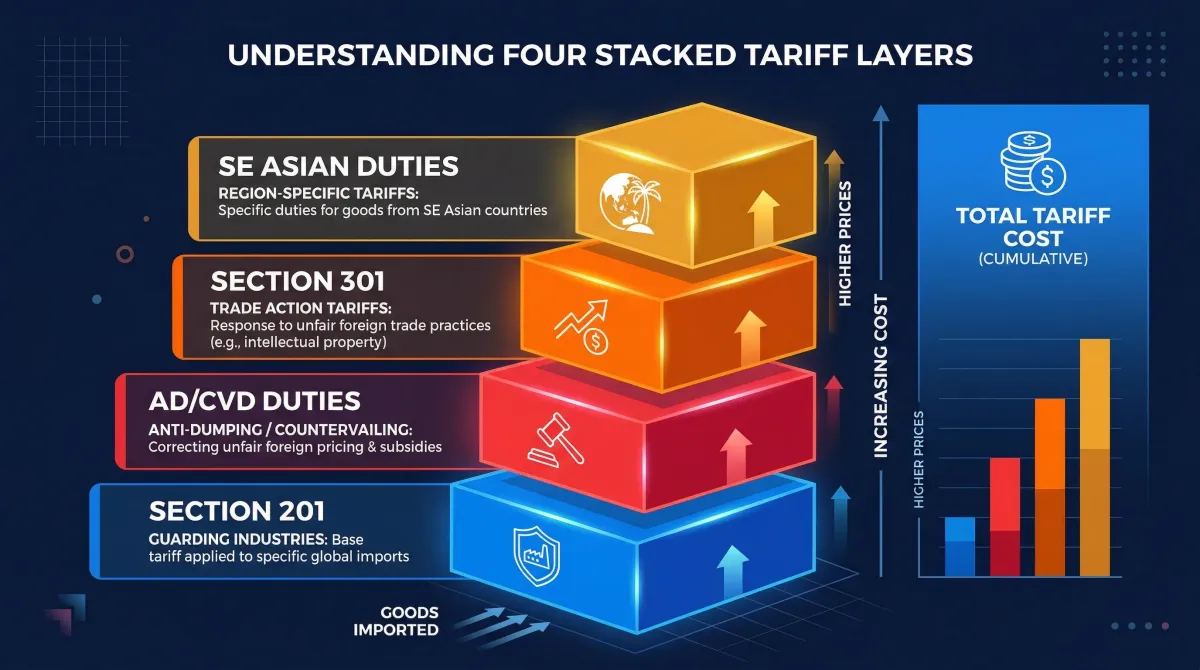
Graphic reflects early 2026. The Section 201 safeguard tariff on imported solar cells and modules expired on February 6, 2026 after reaching the 8-year maximum allowed under U.S. trade law. From December 4, 2026, the Section 232 tariff described below applies to imported solar cells and modules.
A Section 232 proclamation signed August 6, 2026 adds a 15% duty on imported polysilicon-based solar products, including solar cells and modules, plus minimum import prices of $0.22 per watt for cells and $0.38 per watt for modules, for goods entered on or after December 4, 2026. It follows the Section 201 safeguard tariff, which expired February 6, 2026 after reaching its 8-year legal limit.
Anti-dumping and countervailing duties target Chinese-manufactured cells, including those routed through Southeast Asian countries (Cambodia, Malaysia, Thailand, Vietnam). The Commerce Department confirmed circumvention findings in 2024. The two-year moratorium expired June 2024 and these duties now fully apply.
Broad tariffs on Chinese goods including solar panels, inverters, racking, and balance-of-system equipment. Combined with AD/CVD, Chinese module imports face 50%+ effective rates, making them uneconomical for the US market.
Additional tariffs targeting solar imports from Cambodia, Vietnam, Malaysia, and Thailand — countries that supply the majority of US residential panels. These are layered on top of existing AD/CVD duties, phasing in through mid-2026.
Chinese-manufactured panels face 50%+ effective rates, making direct import uneconomical. Panels from Cambodia, Vietnam, Malaysia, and Thailand — which historically supplied 80%+ of the US residential market — now carry 35-50% combined tariffs. Only panels manufactured in non-tariff-affected countries (South Korea, North America, Singapore) avoid most of these layers.
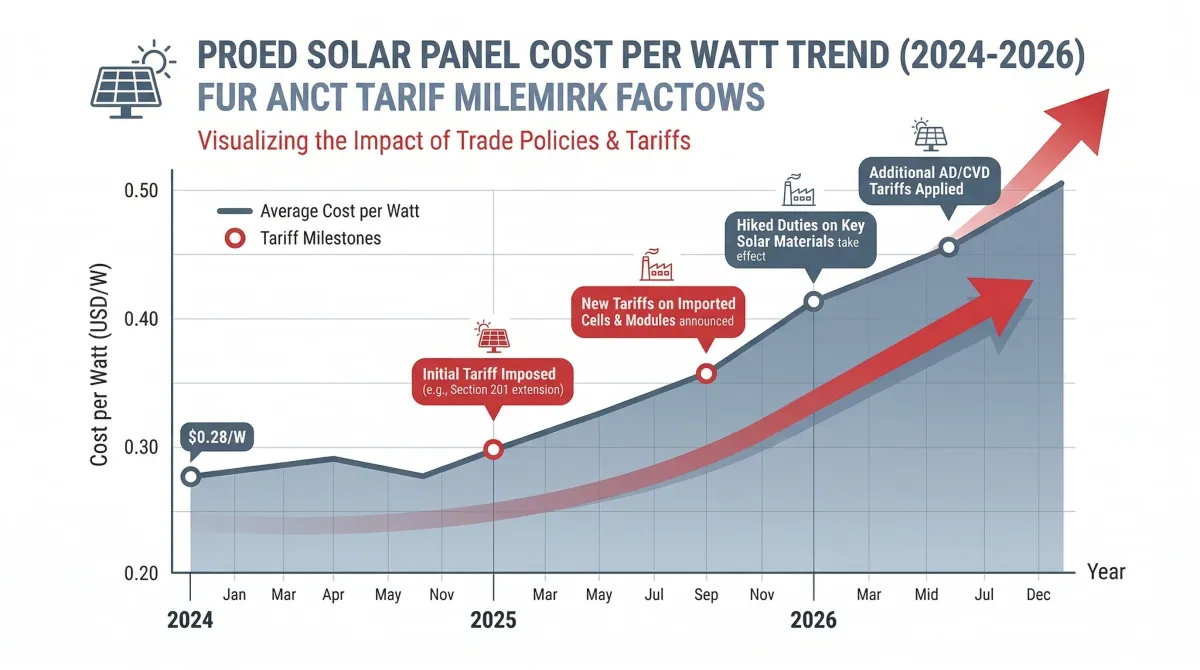
Connecticut solar costs currently average $2.85 per watt, ranging from $2.60 to $3.10 depending on system size, panel tier, and utility territory. Tariffs have added $0.10-0.25/W to these prices compared to 2024 levels. For a typical 11 kW system, that is $1,100 to $2,750 more than you would have paid 18 months ago from tariff escalation alone.
The tariff increase compounds a bigger loss: the federal residential tax credit (Section 25D) expired December 31, 2025. In 2024, a homeowner offset 30% of system cost with the ITC. Now that benefit is gone. However, Connecticut has a crucial advantage: the RRES Buy-All tariff at $0.3289/kWh for 20 years is the most generous production-based incentive in New England, and it is entirely unaffected by tariffs or panel costs.
| Cost Component | Pre-Tariff (2024) | Current (Q1 2026) | Change |
|---|---|---|---|
| Module Cost (per watt) | $0.30-0.35 | $0.40-0.50 | +$0.10-0.15 |
| Inverter + BOS | $0.55-0.65 | $0.60-0.70 | +$0.05 |
| Labor + Overhead | $0.85-1.00 | $0.90-1.05 | +$0.05 |
| Installer Margin + Soft Costs | $0.80-0.90 | $0.85-0.95 | +$0.05 |
| Total System Cost ($/W) | $2.50-2.90 | $2.60-3.10 | +$0.10-0.25 |
| System Size | Pre-Tariff (2024) | Current (Q1 2026) | Tariff Impact |
|---|---|---|---|
| 8 kW System | $20,800 | $20,800-22,800 | +$0-2,000 |
| 10 kW System | $26,000 | $26,000-28,500 | +$0-2,500 |
| 11 kW System (CT avg) | $28,600 | $28,600-31,350 | +$0-2,750 |
| 14 kW System | $36,400 | $36,400-39,900 | +$0-3,500 |
Beyond the tariffs you see in trade headlines, there is a separate policy that quietly reshapes which solar panels work for which financing paths. FEOC (Foreign Entity of Concern) rules determine whether a third-party system owner — the company behind your lease or PPA — can claim the 30% Section 48E commercial investment tax credit.
If a panel is manufactured by or contains critical components from an entity controlled by China, Russia, Iran, or North Korea, it is FEOC-non-compliant. The financing company cannot claim the 48E ITC on that system. Without the 30% credit, the company must recover their full investment from your monthly payments — meaning significantly higher lease/PPA rates.
For cash and loan buyers, FEOC is not directly relevant. You can choose any panel tier, including the most affordable options from non-FEOC-compliant manufacturers. But for lease, PPA, or NuWatt Propel customers, FEOC compliance is a hard requirement. Connecticut homeowners using a lease/PPA should pair FEOC-compliant panels with the RRES Buy-All tariff for maximum value.
Eligible for Section 48E ITC in lease/PPA deals. Lower tariff exposure.
Fine for cash/loan purchases. Cannot qualify for 48E ITC in lease/PPA.
The Section 48E begin-construction window closed July 4, 2026. Projects that began construction on or before that date locked in the full timing pathway (placed in service through roughly 2030). Third-party system owners (lease/PPA companies) can still claim the 30% credit on new projects, but those generally must be placed in service by December 31, 2027 — so lease/PPA pricing now depends on hitting that in-service window, and it still pays to move early.
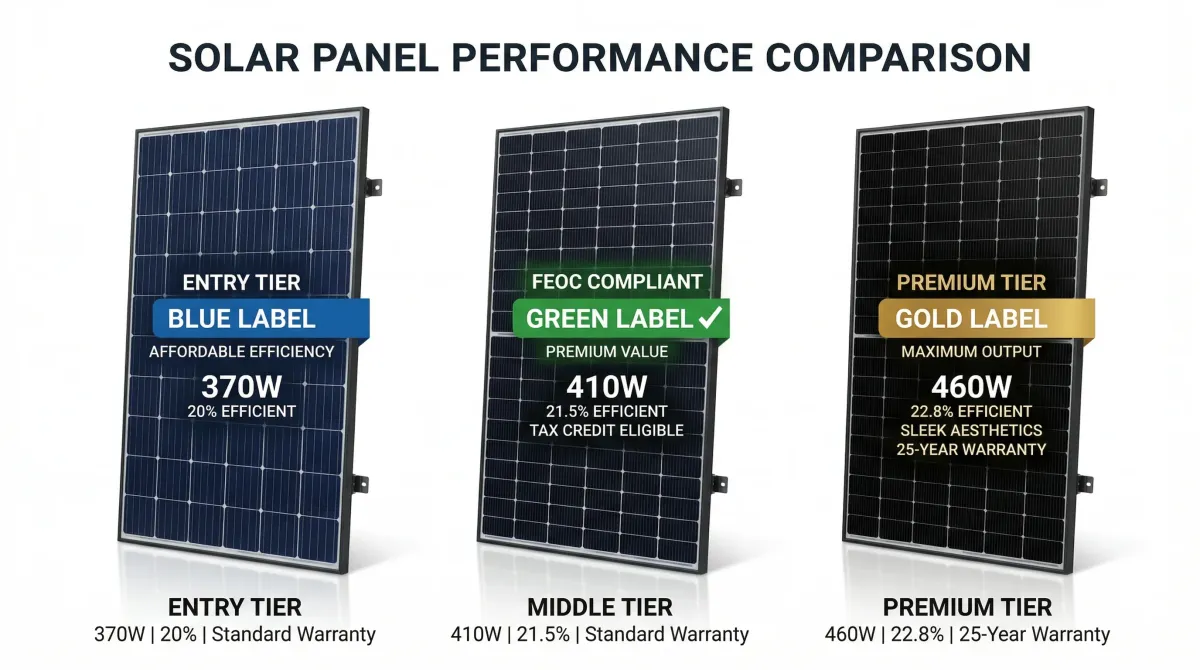
Not all panels are affected equally by tariffs. Country of origin, manufacturing supply chain, and FEOC compliance all determine your real cost and financing options. Here is how NuWatt's three panel tiers compare.
Cash or loan buyers seeking lowest upfront cost
Lease/PPA, Propel financing, or anyone wanting FEOC assurance
Premium installations, max efficiency, roof-space constrained
For cash/loan buyers, Hyundai 440W saves ~$770 on an 11 kW system compared to Silfab. With RRES Buy-All at $0.3289/kWh, even the premium REC 460W tier pays for itself within 8-9 years. For lease/PPA buyers, Silfab is the most cost-effective FEOC option — the 48E ITC more than offsets the base price difference. REC 460W (+$0.19/W) is worth considering only when roof space is limited and you need maximum watts per square foot.
Tariffs and FEOC rules affect each financing path differently. Your choice of financing determines which panels you can use, how much of the tariff burden you absorb directly, and whether the Section 48E ITC is accessible. Connecticut also offers the Smart-E Loan as a state-backed financing option.
You cannot control tariff policy, but you can control your timing, panel selection, and incentive strategy. These five actions reduce the tariff hit on your solar investment in Connecticut.
The §48E begin-construction window closed July 4, 2026; a lease, PPA, or Propel-financed system still qualifies for the 30% Section 48E ITC if the system is placed in service by December 31, 2027. Line up your project so it clears that in-service window and keeps your monthly payments low.
Cash and loan buyers can save with Hyundai 440W panels (-$0.07/W). Lease/PPA customers must use FEOC-compliant panels (Silfab or REC) but benefit from the 48E ITC pass-through. Match your panel tier to your financing method.
Connecticut RRES (Residential Renewable Energy Solutions) Buy-All tariff pays $0.3289/kWh for all production, locked for 20 years. For an 11 kW system producing ~13,200 kWh/year, that is $4,341 annually or $86,823 over the term. This single program can recover the entire system cost — including tariff increases — within 7-8 years.
The CT Green Bank Smart-E Loan offers 6.99-7.99% APR financing for solar with up to $50,000 in loan amounts. While not as low as pre-2026 rates, this is competitive compared to standard home improvement loans. The loan covers the tariff-inflated system cost with manageable monthly payments.
NuWatt pre-purchased Hyundai 440W and Silfab 440W panels before the latest tariff increases. While warehouse stock lasts, your system price reflects pre-tariff module costs. Once depleted, replacements carry the full tariff burden.
Connecticut has one of the strongest state incentive stacks in New England, anchored by the RRES Buy-All tariff. While the federal residential ITC is gone, CT's programs collectively make solar highly viable even with tariff-inflated panel costs.
Residential Renewable Energy Solutions program pays a fixed rate for all solar production. Locked for 20 years. Production-based — unaffected by panel cost or tariffs.
Full retail credit for excess solar production. Eversource at $0.29/kWh, UI at $0.28/kWh. Alternative to RRES Buy-All — choose one or the other.
CT Green Bank financing for solar and energy improvements. Up to $50,000 with terms up to 20 years. No prepayment penalties.
Solar equipment and installation exempt from CT sales tax. On a $31,350 system, that saves approximately $1,991.
Solar panels do not increase your assessed property value in Connecticut. Saves $500-800/year in avoided tax increases for the life of the system.
Third-party system owner claims 30% ITC on FEOC-compliant panels. Lowers your lease/PPA rate. The begin-construction window closed July 4, 2026; new starts still qualify if placed in service by December 31, 2027.
With RRES Buy-All, the tariff increase of $1,100-2,750 is absorbed within approximately 6-8 months of additional RRES income. Over 20 years, an 11 kW system in CT generates $86,823 in RRES payments alone — nearly 3x the system cost. The tariff impact is a rounding error in the long-term economics. Connecticut is one of the few states where solar economics actually improved in recent years thanks to the RRES rate increase.
Understanding the timeline helps you decide when to act. The window for pre-tariff inventory, RRES block availability, and the Section 48E deadline are the most time-sensitive factors.
Two-year pause on Southeast Asian anti-dumping duties ended. Full duties now apply to panels from Cambodia, Vietnam, Malaysia, Thailand.
Federal residential solar tax credit dropped to $0. CT homeowners no longer receive any federal tax benefit for cash/loan solar purchases.
The Section 201 safeguard tariff expired February 6, 2026 at its 8-year legal limit. Additional executive action tariffs on Southeast Asian panels beginning to take effect.
Pre-tariff inventory still available from some installers. RRES Buy-All blocks open. Best window for locking pricing before further tariff increases.
The §48E begin-construction safe harbor. Projects that began construction on or before this date locked in the full timing pathway (placed in service through roughly 2030); later starts still qualify for the 30% commercial ITC on lease/PPA deals if placed in service by December 31, 2027.
New executive action tariffs fully phased in. Pre-tariff inventory expected to be depleted. Projected CT pricing: $3.00-3.35/W.
A Section 232 proclamation signed August 6, 2026 adds a 15% duty on imported polysilicon-based solar products, including solar cells and modules, plus minimum import prices of $0.22 per watt for cells and $0.38 per watt for modules, for goods entered on or after December 4, 2026.
Tariffs are adding approximately $0.10-0.25 per watt to solar panel costs in Connecticut. For a typical 11 kW system, that translates to $1,100-2,750 in additional cost. The impact comes from multiple overlapping tariff layers: AD/CVD anti-dumping duties (15-250% on specific manufacturers), Section 301 China tariffs (25%), and new Southeast Asian duties (14-25%). The Section 201 safeguard tariff on imported solar cells and modules expired on February 6, 2026 after reaching the 8-year maximum allowed under U.S. trade law. From December 4, 2026, a broader Section 232 duty of 15% plus minimum import prices applies to imported solar cells and modules.
FEOC stands for Foreign Entity of Concern. Under current rules, solar panels manufactured by or containing critical components from entities controlled by China, Russia, Iran, or North Korea are considered FEOC-non-compliant. This matters because third-party system owners (lease/PPA companies) can only claim the 30% Section 48E commercial ITC if the panels are FEOC-compliant. For CT homeowners choosing a lease or PPA, using FEOC-compliant panels like Silfab (made in North America) or REC means lower monthly payments because the financing company can claim the tax credit. FEOC compliance is what lets the third-party owner claim the 48E ITC in the first place.
The RRES (Residential Renewable Energy Solutions) Buy-All tariff is Connecticut strongest solar incentive. It pays $0.3289/kWh for every kilowatt-hour your system produces, locked in for 20 years. For an 11 kW system producing approximately 13,200 kWh per year, that is about $4,341 annually or $86,823 over the full term. This income is unaffected by tariffs because it is based on production, not equipment cost. RRES payments alone can recover the entire system cost — including tariff increases — within 7-8 years. The remaining 12-13 years are pure profit. This makes RRES the most powerful tariff offset available in any New England state.
The data favors acting sooner. There is no indication tariffs will decrease under the current administration, and multiple tariff layers are still phasing in through mid-2026. Waiting means: (1) higher module prices as pre-tariff inventory depletes, (2) potential RRES block closures or rate adjustments, (3) a tighter path to the December 31, 2027 placed-in-service deadline that now governs the 48E ITC on new lease/PPA deals, and (4) continued electricity bills at $0.28-0.29/kWh. The federal residential ITC (Section 25D) expired December 31, 2025 with no scheduled return, so there is no upcoming incentive to wait for.
FEOC-compliant panels manufactured in North America, like Silfab panels made in Ontario, Canada and Bellingham, WA, face significantly lower tariff exposure. They are not subject to AD/CVD duties, Section 301 China tariffs, or the new Southeast Asian duties. From December 4, 2026, the Section 232 tariff applies to solar cells and modules imported into the US, so panels built from imported cells carry that cost too, but the overall tariff burden is still much lower than for Southeast Asian alternatives. This is why FEOC-compliant panels, while slightly higher in base price, offer better long-term value and are required for lease/PPA financing that accesses the 48E ITC.
Cash buyers have the most flexibility since FEOC compliance is not required for a direct purchase. The Hyundai 440W is the most affordable option at -$0.07/W below the base price, offering solid performance with a 25-year warranty. For homeowners who want higher efficiency or future-proofing, the Silfab 440W (base price, 30-year warranty, FEOC-compliant) or REC 460W (+$0.19/W, highest efficiency at 22.3%) are worth considering. The Hyundai saves roughly $770 on an 11 kW system compared to Silfab. With RRES Buy-All paying $0.3289/kWh, even the most expensive panel tier pays for itself within 8-9 years.
The Smart-E Loan is a financing product from the CT Green Bank offering 6.99-7.99% APR for solar installations with loan amounts up to $50,000 and terms up to 20 years. While the APR is higher than the pre-2026 era when ITC-adjusted loans could be structured at lower effective rates, Smart-E remains competitive compared to standard home improvement loans. The loan covers the full tariff-inflated system cost. When paired with RRES Buy-All income of $4,341/year, the monthly RRES payment often exceeds the monthly loan payment, creating a cash-flow-positive scenario from year one.
Yes. With a lease or PPA, the financing company owns the system and absorbs the equipment cost, including tariff impact. Your payment is fixed upfront and does not change based on module pricing. Additionally, the financing company can claim the 30% Section 48E commercial ITC, which lowers the cost they need to recover from your payments. However, the panels must be FEOC-compliant (Silfab or REC), which are slightly more expensive at the base level. The §48E begin-construction window closed July 4, 2026; new lease/PPA projects still qualify for the 30% credit but generally must be placed in service by December 31, 2027, so pricing now depends on hitting that in-service window.
The §48E begin-construction window closed July 4, 2026. Projects that began construction on or before that date locked in the full timing pathway (placed in service through roughly 2030). New lease and PPA projects starting now still qualify for the 30% Section 48E commercial ITC, but generally must be placed in service by December 31, 2027 — so third-party financing stays available, with pricing tied to meeting that in-service deadline. For cash and loan buyers, this milestone is less relevant since the residential ITC (Section 25D) already expired December 31, 2025. However, tariffs are expected to continue increasing, so waiting still means higher module costs.
Connecticut has high electric rates: Eversource at $0.29/kWh and United Illuminating at $0.28/kWh. These rates mean solar panels offset expensive electricity, which improves the payback calculation even with tariff-inflated panel costs. An 11 kW system producing 13,200 kWh/year offsets $3,696-3,828 in annual electricity costs via net metering, or earns $4,341 through RRES Buy-All. At RRES rates, even a $2,750 tariff increase adds less than 8 months to the payback period. The combination of high CT rates and the RRES program makes Connecticut one of the best solar markets in the country despite tariffs and the expired ITC.
All costs, incentives, and utility data for Connecticut.
Read guideCurrent pricing by utility territory and system size.
Read guideHow third-party financing works with tariffs and FEOC.
Read guideHow commercial ITC benefits flow to lease/PPA customers.
Read guideWhy RRES makes solar viable even without the ITC.
Read guideWhich financing path works best with tariffs and no ITC.
Read guidePre-tariff inventory is limited. New lease/PPA projects must be placed in service by December 31, 2027 to claim the 48E ITC. With RRES Buy-All paying $0.3289/kWh for 20 years, every month of delay costs you $350+ in foregone RRES income. Start your custom design now and lock your price.
Free custom design. No commitment. Price locked at signing.