Loading NuWatt Energy...

We use your location to provide localized solar offers and incentives.
We serve MA, NH, CT, RI, ME, VT, NJ, PA, and TX
Loading NuWatt Energy...
NuWatt designs, installs, and manages solar, battery, heat pump, and EV charger systems across 9 states. One company, one warranty, one point of contact.
Get a Free Quote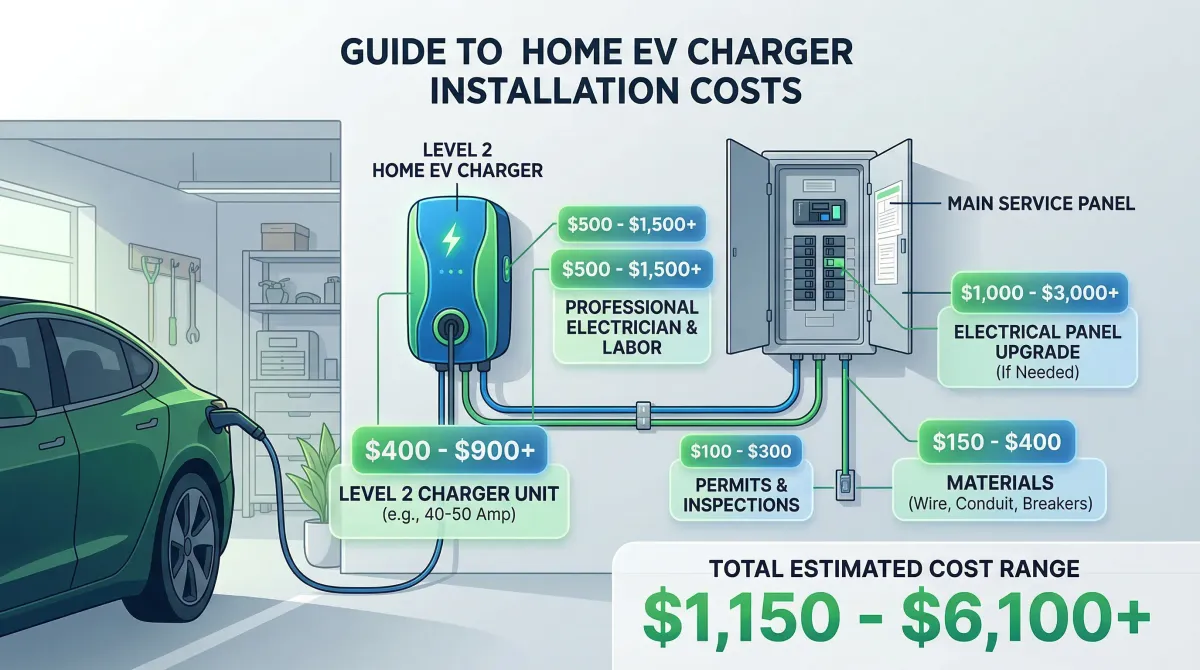
How much does it really cost to install a Level 2 home EV charger? We break down every cost — charger, labor, panel upgrades, permits — plus the state and utility rebates that remain now that the federal Section 30C credit has expired.
$800-$3,200
Avg L2 Install Cost
$200-$1,500
State/Utility Rebate
$80-$120/mo
Monthly Fuel Savings
$1,500-$3,000
Panel Upgrade Cost
A Level 2 home EV charger costs $800 to $3,200 fully installed in 2026, including the charger unit ($320-$700) and professional installation ($400-$1,300). If your electrical panel needs a 200A upgrade, add $1,500-$3,000. The federal Section 30C tax credit (30% of costs, up to $1,000 for residential) expired June 30, 2026 and is no longer available, but many states and utilities still offer rebates of $200-$1,500. A basic NEMA 14-50 outlet install runs $300-$600 if you already have a 200A panel. Level 1 (120V) charging requires no installation but only adds 3-5 miles of range per hour.
Level 1, Level 2, and hardwired installations compared side-by-side
| Feature | Level 1 (120V) | Level 2 — NEMA Outlet | Level 2 — Hardwired |
|---|---|---|---|
| Voltage | 120V | 240V | 240V |
| Amperage | 12A | 32-40A | 40-60A |
| Charge Speed | 3-5 mi/hr | 25-30 mi/hr | 30-44 mi/hr |
| Charger Cost | Included w/ EV | $300-$550 | $400-$700 |
| Install Cost | $0 | $300-$600 | $400-$800 |
| Distance Adder | N/A | $0-$500 | $0-$500 |
| Permit | None | $50-$200 | $50-$200 |
| Total Installed | $0 | $650-$1,850 | $850-$2,200 |
| + Panel Upgrade | N/A | +$1,500-$3,000 | +$1,500-$3,000 |
| Best For | Emergency / overnight | Flexibility / renters | Permanent home install |
Prices reflect national averages as of March 2026. Your cost depends on panel distance, local codes, and contractor rates.
Five factors determine whether you pay $500 or $5,000+
A 100A panel almost always needs a $1,500-$3,000 upgrade. Most modern homes have 200A panels that can handle a 50A EV circuit. Check the main breaker label on your panel to verify.
Every foot of conduit and wire between your electrical panel and charger location adds cost. Under 25 ft is standard; 50+ ft can add $300-$500 for materials and labor.
If your charger is in an attached garage with the panel inside, conduit is minimal. Detached garages may need underground trenching ($500-$1,500), surface conduit, or overhead runs.
Most cities require an electrical permit ($50-$200). Some jurisdictions also require a building permit or utility notification. Your electrician typically handles the paperwork.
Some utilities require a separate meter for EV charging, a load management device, or enrollment in a time-of-use (TOU) rate plan. These add $0-$300 in costs but can save on rates.
A simple NEMA 14-50 outlet costs less to install than a hardwired 60A circuit. Higher amperage chargers (48-60A) charge faster but require heavier gauge wire and a larger breaker.
A Level 2 EV charger draws 40-50 amps — that is a significant electrical load. If your home has a 100A or 150A panel, you likely need an upgrade before installing a charger. Here is how to tell:
100A to 200A
$1,800-$3,000
Full panel swap + possible service entrance upgrade
150A to 200A
$1,500-$2,500
Panel swap, existing wiring often reusable
200A (no upgrade)
$0
Just need a 50A breaker ($50-$100)
Future-proof your panel
A 200A panel upgrade is a one-time investment that supports not just your EV charger, but also heat pumps, battery storage, induction cooktops, and other electrification upgrades. Think of it as infrastructure for a fully electric home.
$300-$600 install
$400-$800 install labor
NEC 80% Rule: A NEMA 14-50 outlet on a 50A breaker can only continuously supply 40A (50A x 80%). Most plug-in chargers automatically limit to 32-40A. A hardwired 60A circuit can deliver a full 48A continuously.
No longer available for home EV chargers
The federal Section 30C Alternative Fuel Vehicle Refueling Property Credit — which covered 30% of charger and installation costs, up to $1,000 for a home installation — expired on June 30, 2026. Home EV chargers placed in service after that date no longer qualify for any federal tax credit. (Like the residential solar credit, Section 25D, which expired December 31, 2025, it was not extended.) The good news: state programs and utility rebates are still available and are what most homeowners rely on today.
8 chargers ranked by value, features, and charging speed
| Charger | Price | Amps | Power | Cord | Smart/WiFi | Miles/Hr | Best For |
|---|---|---|---|---|---|---|---|
| ChargePoint Home Flex | $599 | 16-50A | 12 kW | 23 ft | 37 | Best overall | |
| Tesla Wall Connector | $475 | 48A | 11.5 kW | 24 ft | 44 | Best for Tesla | |
| Emporia Smart EVSE | $450 | 48A | 11.5 kW | 24 ft | 37 | Best value smart | |
| Grizzl-E Classic | $400 | 40A | 9.6 kW | 24 ft | 30 | Best budget | |
| Autel MaxiCharger | $550 | 50A | 12 kW | 25 ft | 37 | Best high-power | |
| Wallbox Pulsar Plus | $500 | 48A | 11.5 kW | 25 ft | 37 | Best design | |
| Lectron V-BOX | $320 | 48A | 11.5 kW | 20 ft | 37 | Lowest price | |
| JuiceBox 48 | $600 | 48A | 11.5 kW | 25 ft | 37 | Best app |
Prices are MSRP as of March 2026. Smart chargers support WiFi scheduling, energy monitoring, and utility TOU rate integration.
| State | Program | Amount | Notes |
|---|---|---|---|
| MA | MOR-EV + utility programs | Up to $300 | Some utilities offer L2 install rebates. MOR-EV focuses on EV purchase. |
| CT | Energize CT | Up to $500 | Income-eligible rebate for L2 charger purchase + installation. |
| RI | None active | $0 | No dedicated state EV charger installation rebate as of March 2026. |
| NH | None active | $0 | No state rebate. Community power programs may offer EV rates. |
| NJ | NJ Charge Up | Up to $250 | Residential L2 charger rebate. Income-eligible bonus available. |
| ME | Efficiency Maine | Up to $250 | Income-eligible households. Must use qualified contractor. |
| TX | Utility-specific | Varies | Austin Energy, CPS Energy offer EV TOU rates. No statewide charger rebate. |
| PA | None active | $0 | No statewide residential charger rebate as of March 2026. |
| VT | GMP rebate | Up to $400 | Green Mountain Power offers L2 charger rebate for customers. |
Stack your savings: Even without the federal Section 30C credit (which expired June 30, 2026), state and utility programs can be combined. For example, a CT homeowner installing a $2,500 L2 charger could pair an Energize CT rebate (up to $500) with a utility TOU rate to meaningfully cut both install and charging costs.
How solar panels eliminate your EV charging costs
$1,200-$1,800
Annual Gas Savings
EV vs. 25 MPG gas car at $3.50/gal
$600-$1,500/yr
Solar Charging Offset
Electricity cost eliminated by solar
$1,800-$3,300/yr
Total Annual Savings
Gas + electric savings combined
Install Solar
Add 2-3 kW to cover EV charging (~$5,000-$9,000)
Install L2 Charger
Hardwired or NEMA 14-50 ($800-$3,200)
Charge at Home
Solar produces power during peak sun; net metering credits the rest
Drive for Free
Excess solar production offsets 100% of EV charging costs
Note: The residential solar tax credit (Section 25D) expired December 31, 2025. There is no federal tax credit for homeowner solar purchases in 2026. Solar still makes financial sense through electricity savings and net metering, but payback periods are longer without the credit. Third-party-owned systems (leases/PPAs) may still benefit from the commercial Section 48/48E ITC.
Answer 4 questions to get a personalized cost estimate with available state & utility rebates
Get a personalized cost estimate in seconds
Your estimated net cost
Some utilities offer L2 install rebate
$550 - $1,400
Estimates are based on national averages. Actual costs vary by contractor, local codes, and site conditions. The federal Section 30C credit expired June 30, 2026; only state and utility rebates are reflected above.
A Level 2 home EV charger costs $800-$3,200 fully installed in 2026. This includes the charger unit ($320-$700), installation labor ($400-$1,300), and permits ($50-$200). If your electrical panel needs an upgrade from 100A or 150A to 200A, add $1,500-$3,000. The Section 30C federal tax credit that used to save homeowners up to $1,000 expired June 30, 2026, so factor in only state and utility rebates today.
No. The federal Section 30C Alternative Fuel Vehicle Refueling Property Credit expired June 30, 2026 and is no longer available for home EV chargers placed in service after that date. It previously covered 30% of the total installation cost, up to $1,000 for residential installations. There is currently no federal tax credit for home EV chargers — look to state programs and utility rebates ($200-$1,500) instead.
A 200A panel is strongly recommended for a Level 2 EV charger. Most Level 2 chargers draw 40-50 amps, which requires a dedicated 50-60A circuit. If your home has a 100A or 150A panel, you will likely need an upgrade ($1,500-$3,000) to safely support the charger alongside your existing electrical loads. A licensed electrician can assess your panel capacity during a site visit.
A NEMA 14-50 outlet costs $300-$600 to install and lets you plug in any portable Level 2 charger. Hardwired installation costs $400-$800 for labor but provides a cleaner look, potentially higher amperage (48-60A vs 40A for NEMA), and meets building code requirements in some jurisdictions. Hardwired is better for permanent installations; NEMA 14-50 is better if you may move or want flexibility.
A standard EV charger installation takes 2-4 hours if no panel upgrade is needed. If a 200A panel upgrade is required, the project takes 1-2 days including the panel swap and inspection. Permit processing adds 1-4 weeks depending on your municipality. Most electricians can schedule the installation within 1-2 weeks of initial contact.
Installing a NEMA 14-50 outlet or hardwiring a Level 2 charger requires a licensed electrician in most states. A 240V circuit carries serious shock and fire risks if installed incorrectly. Additionally, most charger warranties require licensed installation, many utility rebate programs require a professional install, and your homeowner insurance may not cover damage from DIY electrical work. The only DIY option is plugging a portable Level 1 charger into an existing 120V outlet.
A 200A electrical panel upgrade costs $1,500-$3,000 in 2026, depending on your location, existing wiring condition, and whether the utility needs to upgrade your service entrance. In older homes with aluminum wiring or outdated breaker boxes, costs can reach $3,500+. The panel upgrade is a one-time investment that also supports future loads like heat pumps, battery storage, and induction cooktops.
Home EV charging costs about $0.04-$0.06 per mile at average U.S. electricity rates ($0.16-$0.25/kWh). For a typical EV driven 12,000 miles/year, that is $480-$720 annually in electricity — compared to $1,500-$2,000/year for gasoline. If you have home solar panels, your charging cost can drop to near $0, saving $1,500+/year compared to gas.
Yes. Studies show homes with EV chargers sell for 2-3% more and spend fewer days on market, especially in areas with high EV adoption. A Level 2 charger installation is a relatively low-cost improvement ($800-$3,200) that signals a modern, electrified home. The 200A panel upgrade also adds value by supporting future electrical loads.
Most municipalities require an electrical permit for a Level 2 EV charger installation, costing $50-$200. The permit ensures the installation meets local building codes and NEC (National Electrical Code) standards. Your electrician typically pulls the permit and schedules the inspection. Some states (like MA and CT) have streamlined EV charger permits with 1-2 week turnaround.
Pairing solar with an EV charger is the best way to minimize long-term charging costs. A 2-3 kW addition to your solar system ($5,000-$9,000 before incentives) can generate enough electricity to cover 10,000-12,000 miles of annual EV driving. This eliminates $600-$1,500/year in electricity or gasoline costs, paying for itself in 5-8 years. Note: the residential solar tax credit (Section 25D) expired December 31, 2025, so there is no federal credit for homeowner solar purchases.
A Level 2 charger (240V) adds 25-37 miles of range per hour, depending on amperage. A 40A charger delivers about 30 miles/hour; a 48A charger delivers about 37 miles/hour. Most EVs can fully charge overnight (8-10 hours) on a Level 2 charger. By comparison, a Level 1 charger (120V) only adds 3-5 miles per hour — requiring 2-3 days for a full charge.
Get a free, no-obligation quote for Level 2 charger installation. We handle the permit, panel assessment, and installation — and help you find every state and utility rebate you qualify for.
The federal Section 30C credit expired June 30, 2026 — we'll help you claim the state & utility rebates that remain.