
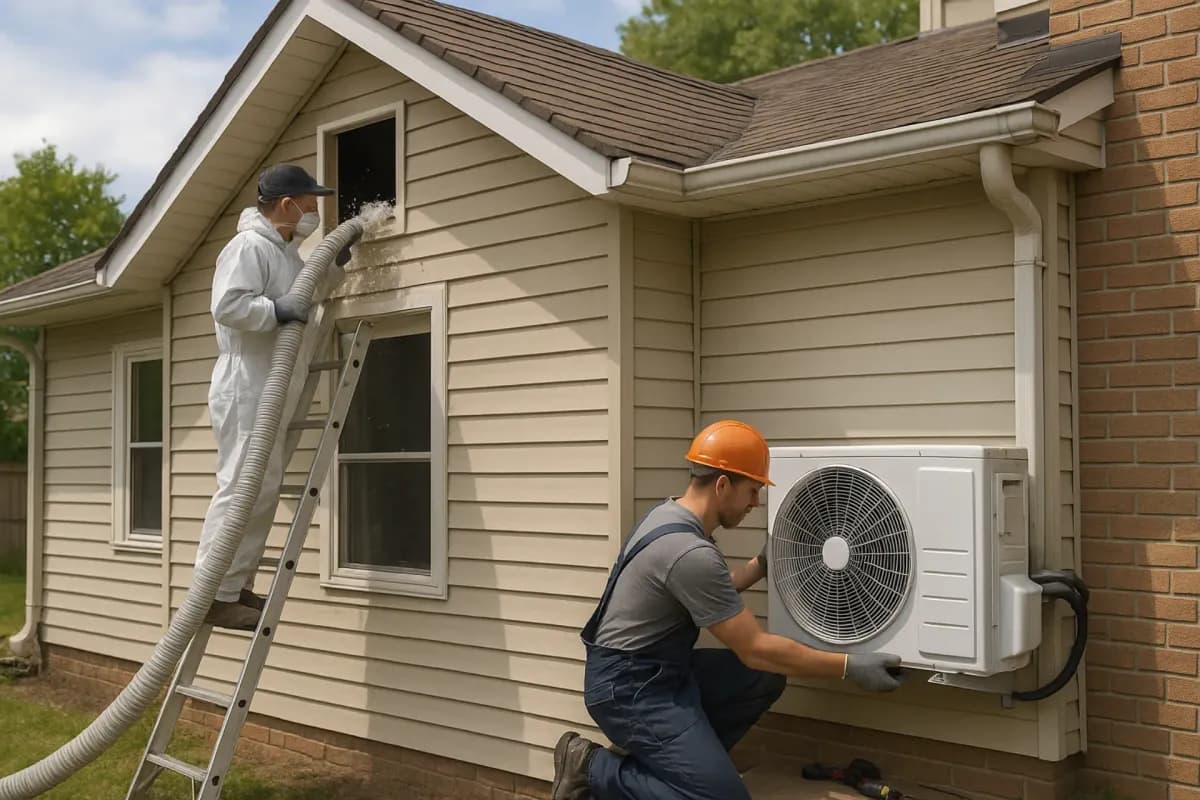

Insulate first, then install the heat pump. Air sealing and insulation reduce your home's heating load by 20-40%, which means you can install a smaller, less expensive heat pump that runs more efficiently.
Home Electrification Experts — Full-Service Design to Install, 9 States
Load Reduction
20–40%
from insulation + air sealing
Equipment Savings
$4,000–$7,000
smaller HP after insulation
Operating Savings
$300–$400/yr
ongoing electricity reduction
Blower Door Test
Free
via Mass Save/Energize CT
Should You Insulate First or Install a Heat Pump First?
This is one of the most important — and most misunderstood — questions in home electrification. The short answer: insulate first whenever possible.Air sealing and insulation reduce your home's heating load by 20-40%, which means you can install a smaller, less expensive heat pump that runs more efficiently. In many cases, the savings on equipment size alone cover the insulation cost. But the real world is more nuanced than the short answer suggests, and the best sequence depends on your home's current condition, your budget, and what programs are available in your state.
Here's the full analysis, with real numbers for New England homes.
Why Insulating First Saves You Money Twice
A heat pump is sized based on your home's peak heating load — the maximum amount of heat needed to maintain 70°F inside when it's 0°F (or whatever your design temperature is) outside. That load is determined by the building envelope: insulation levels, air leakage, window quality, and square footage.
An un-insulated 2,000 sqft 1960s Cape Cod in Massachusetts might have a peak heating load of 60,000-70,000 BTU/hr. After air sealing and insulating the attic, rim joists, and walls, that same home might have a load of 38,000-45,000 BTU/hr. That reduction matters enormously for heat pump sizing:
Before Insulation
$16,000–$20,000
Need 4-5 ton system to meet peak load
After Insulation
$11,000–$14,000
2.5-3 ton system handles reduced load
Equipment Savings
$4,000–$7,000
Less on heat pump system
And that's just the first savings. The second savings is ongoing: a well-insulated home loses heat more slowly, so the heat pump runs fewer hours at lower intensity. Annual electricity consumption for heating drops 25-35% compared to the same heat pump in an un-insulated home. At $0.33/kWh in Massachusetts, that's $300-$400/year in operating cost savings — every year, for the life of the system.
Cost-Benefit Comparison: Real Numbers
Scenario 1: Heat Pump Only (No Insulation)
Insulation
$0
HP Size
4 ton
HP Cost
$18,000
Total
$18,000
Annual heating cost: $1,600 | 10-year total: $34,000
Scenario 2: Insulate First + Smaller HP
Insulation*
$3,000
HP Size
2.5 ton
HP Cost
$12,000
Total
$15,000
Annual heating cost: $1,100 | 10-year total: $26,000 | Save $8,000 vs Scenario 1
Scenario 3: HP First, Insulate Later (Year 2)
Insulation* (yr 2)
$3,000
HP Size
4 ton
HP Cost
$18,000
Total
$21,000
Annual heating: $1,250 (after yr 2) | 10-year total: $32,850 | $6,850 more vs Scenario 2 (overpaid for capacity)
* After Mass Save subsidy (75-100% covered for income-eligible households). Without subsidy, insulation costs $5,000-$8,000. Connecticut and Rhode Island offer similar programs through Energize CT and RI Energy.
The Blower Door Test: Know Before You Decide
Before making any decisions, get a blower door test. This is the single most important diagnostic for your building envelope. A blower door depressurizes your home and measures how much air leaks through cracks, gaps, and penetrations. The result is expressed in ACH50 (air changes per hour at 50 pascals of pressure):
ACH50 > 10
Very Leaky
Insulate & air seal FIRST
HP will struggle, you'll overspend on equipment and operating costs
ACH50 7-10
Moderately Leaky
Insulation helps significantly
Ideally air seal before HP, but system can work if installed first
ACH50 3-7
Reasonably Tight
Modest gains from insulation
Can install HP first, insulate later without major penalty
ACH50 < 3
Tight Home
Insulation already good
Install heat pump and reap the savings
A blower door test costs $300-$500 as a standalone service, but it's freeas part of a Mass Save Home Energy Assessment, an Energize CT Home Energy Solutions visit, or equivalent programs in NH (NHSaves), VT (Efficiency Vermont), ME (Efficiency Maine), and RI (RI Energy). There's no reason to skip this step.
Building Envelope Assessment Checklist
Before your contractor gives you a heat pump quote, walk through this checklist. You can assess most of these yourself in 30 minutes:
- Attic insulation depth: Go into the attic with a ruler. If you can see the tops of the joists (less than 6 inches of insulation), you have R-19 or less. Code for New England is R-49 to R-60. This is priority #1.
- Basement/crawlspace rim joists: Look at the 2x10 or 2x12 boards sitting on top of the foundation wall. If they're bare wood with no insulation, you're losing significant heat. Spray foam or rigid foam here costs $500-$1,500 and has immediate impact.
- Wall insulation: Remove an electrical outlet cover on an exterior wall (turn off the breaker first). Look inside the cavity. If you see bare wood and no insulation, the walls are empty. Blown-in cellulose costs $2,000-$4,000 for a whole house.
- Windows: Single-pane? Double-pane but foggy? Or double/triple-pane in good condition? Windows are the lowest ROI insulation upgrade — $10,000-$25,000 for a whole house with modest energy savings. Do everything else first.
- Air sealing: On a windy day, hold your hand near electrical outlets, window frames, the attic hatch, and where pipes/wires penetrate the ceiling. Feel a draft? Those are air leaks that need caulk, spray foam, or weatherstripping.
- Ductwork (if applicable): If you have ducts running through unconditioned spaces (attic, crawlspace), check for disconnected joints, missing insulation, and visible air leaks. Leaky ducts can waste 20-30% of your heating and cooling.
Insulation Priority Order: Most ROI First
If budget forces you to do insulation work in stages, this is the optimal sequence based on cost-per-BTU-saved:
Air sealing (attic bypasses, rim joists, penetrations)
$500–$2,000
Biggest ROI by far. Can reduce heating load 15-25% alone. Often free through Mass Save, Energize CT.
Attic insulation to R-49 or R-60
$1,500–$3,500
Second-biggest impact. In typical Cape Cod, this alone reduces heating load 15-20%. Free through Mass Save.
Basement/crawlspace rim joists
$500–$1,500
Often overlooked. These uninsulated 2x10 boards are among coldest surfaces in house. Spray foam best approach.
Wall insulation (blown-in cellulose)
$2,000–$4,000
Significant impact in homes with empty wall cavities. Cellulose drilled through small holes, dense-packed.
Basement walls
$2,000–$5,000
Rigid foam or spray foam on foundation walls. Most impactful in finished basements or above-grade basements.
Window upgrades
$10,000–$25,000
Lowest priority unless single-pane or severely damaged. ROI is 15-20 years. Do everything else first.
Typical Renovation Sequence: A 1960s Cape Cod in Natick, MA
Typical Case: Two-Phase Envelope-First Approach
An 1,800 sqft Cape Cod built in 1962 in Natick, MA. Original oil boiler burning 1,000 gal/year at $4.20/gal = $4,200/year. Blower door test: ACH50 of 14.2 — extremely leaky.
Phase 1: Envelope Work (Spring 2025)
- • Mass Save assessment identified: no attic insulation beyond R-11, empty walls, unsealed attic bypasses
- • Air sealing + attic insulation to R-60: $0 after Mass Save (income-eligible)
- • Blown-in cellulose in walls: $0 after Mass Save
- • Rim joist spray foam: $800 (partially subsidized)
- • Post-work blower door: ACH50 dropped from 14.2 to 4.8
- • Heating load reduced from 62,000 BTU/hr to 36,000 BTU/hr
Phase 2: Heat Pump (Fall 2025)
- • Reduced load → needed only 2.5-ton ducted Mitsubishi system
- • Install cost: $12,500. Mass Save rebate: $8,500. Net: $4,000
- • Annual heating dropped from $4,200 (oil) to $980 (electricity)
- • Simple payback on out-of-pocket ($4,800 total): 1.5 years
If they had installed HP first without insulating: Would have needed 4-ton system at $18,000, paid $1,600/yr electricity, payback 4.1 years. By insulating first, saved $5,500 on equipment + $620/yr operating costs.
State Insulation Programs: What's Available
New England has some of the best insulation subsidy programs in the country. Taking advantage of these programs dramatically changes the insulate-first math:
- Mass Save (MA) — Free home energy assessment. 75-100% of insulation cost covered for most homeowners. Income-eligible households get 100% coverage. Over $2 billion in program funding through 2027. This is the most generous insulation program in the country.
- Energize CT (CT) — Home Energy Solutions visit for $50 (income-eligible: free). Covers 50-75% of insulation costs. Pairs well with heat pump rebates for a combined approach.
- RI Energy (RI) — Free home energy assessment. Insulation subsidized at 50-100% depending on income. Pairs with Clean Heat RI heat pump rebates.
- NHSaves (NH) — Subsidized Home Performance with ENERGY STAR audit. Rebates cover 50-75% of insulation costs. Income-qualified can receive 100% coverage.
- Efficiency Vermont (VT) — Free home energy visit. Insulation incentives cover 50-75% of costs. Efficiency Vermont also provides DIY weatherization kits at no cost.
- Efficiency Maine (ME) — Home energy assessments and insulation rebates available. Income-eligible households qualify for enhanced coverage through Maine Housing programs.
The common theme: every New England state offers subsidized or free insulation when paired with efficiency upgrades. Call your state's program before making any decisions — the out-of-pocket cost for insulation may be $0.
When It's OK to Install the Heat Pump First
The insulate-first rule has exceptions. Here's when it makes sense to install the heat pump before addressing the envelope:
Your furnace or boiler is dead
Need heat now, install HP now. Can always insulate later and adjust. Slightly oversized HP wastes some efficiency but still heats your home.
Home already reasonably insulated
Blower door under ACH50 of 5? Attic at R-38+? Incremental gains from more insulation are modest. Go ahead with HP.
Insulation program waitlist is long
Mass Save sometimes has 3-6 month waitlists. If old system is dying, don't wait. Install HP and schedule insulation when program can fit you in.
Supplemental install
Adding mini-splits to specific rooms (office, addition, sunroom) vs replacing whole system? Insulation sequence matters less. Size unit for room as-is.
Ready to Get a Heat Pump Quote?
Get a free, no-obligation quote from NuWatt Energy. We handle design, permits, and installation.
Note: Case scenarios in this article are typical examples drawn from installations across NuWatt's New England service area. Specific homeowner details have been generalized to protect privacy. Numbers are representative; actual results vary by home, blower-door results, fuel prices, and utility rates.
Frequently Asked Questions
How much does insulating first save on the heat pump?▼
Can I insulate and install a heat pump at the same time?▼
Continue Reading
Heat Pumps for Older Homes (Pre-1950): Upgrade Sequence That Works
The correct upgrade sequence for older homes is: air seal first, insulate second, then install the heat pump. Skipping air sealing means your heat pump is sized for a leaky house, costing you thousands in oversized equipment and wasted energy.

Manual J vs Rule-of-Thumb Sizing: Why 1 Ton per 500 sqft Fails
The 1-ton-per-500-sqft rule oversizes most homes by 30-50%. A Manual J load calculation accounts for insulation, windows, air sealing, and climate — producing a right-sized system that costs less and performs better.
Heat Pump ROI: Cost, Incentives, and Payback by State
Heat pump payback ranges from 2 years in Rhode Island (thanks to $11,500 in rebates) to 8+ years in Pennsylvania. This state-by-state breakdown shows exact costs, incentives, and timelines.