Loading NuWatt Energy...

We use your location to provide localized solar offers and incentives.
We serve MA, NH, CT, RI, ME, VT, NJ, PA, and TX
Loading NuWatt Energy...
NuWatt designs, installs, and manages solar, battery, heat pump, and EV charger systems across 9 states. One company, one warranty, one point of contact.
Get a Free Quote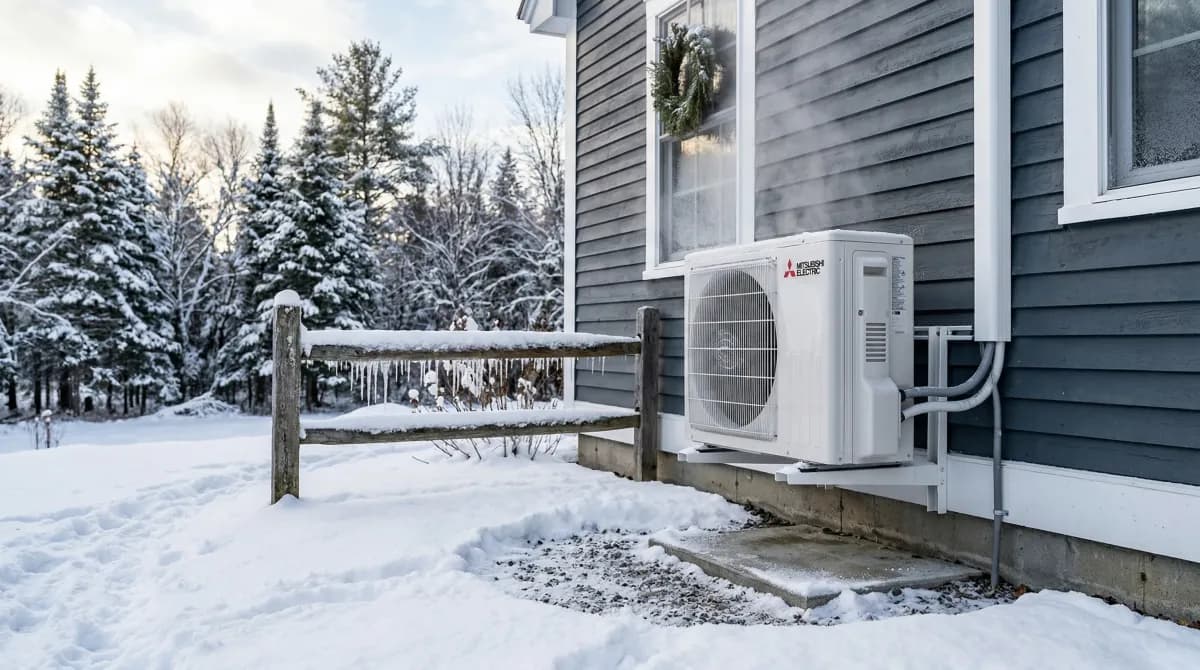
10 practical tips to get the most from your heat pump during New England winters. From defrost cycles to thermostat strategy, here's what actually matters.
Quick Answer
The most important heat pump winter tip: set your thermostat to 68-70F and leave it. Heat pumps work best at steady temperatures — avoid large setbacks. Keep the outdoor unit clear of snow (12" clearance), clean filters monthly, and never use Emergency Heat unless the outdoor unit is damaged. Modern cold-climate heat pumps work efficiently down to -13F and operate to -22F.
These tips apply to all mini-split and ducted heat pump systems — Mitsubishi, Fujitsu, Daikin, Bosch, and others. Follow them and your heating bills will be 10-20% lower.
Don't crank it up and down
Heat pumps work best at a steady temperature. Unlike a gas furnace, turning your thermostat up 5 degrees won't warm your home faster — the heat pump runs at optimal speed at its setpoint. If you need to change temperatures for sleep or away periods, adjust by only 2-3 degrees. Large setbacks (dropping 10 degrees at night) force the heat pump to work much harder to recover, potentially triggering expensive electric resistance backup heat.
Actionable tip: Set your heat pump to 68-70F and leave it. Aim for no more than a 2-3 degree setback at night.
12 inches of clearance on all sides
The outdoor unit needs airflow to extract heat from the air. Snow drifts, ice buildup, and debris block airflow and reduce efficiency. After a storm, check the unit and gently remove snow (never use a shovel against the unit — use a broom or your hands). Ensure 12 inches of clearance on all sides and above. If your unit is on the ground, consider a wall-mount bracket or a riser to elevate it 18-24 inches above typical snow accumulation.
Actionable tip: After every nor'easter, go outside and check your outdoor unit. 60 seconds of clearing can save hours of reduced performance.
Your heat pump is not broken
When temperatures hover around 30-40F with high humidity, frost builds on the outdoor coil. Your heat pump periodically reverses into cooling mode for 2-10 minutes to melt the frost — you may see steam rising from the outdoor unit. This is completely normal. The indoor unit may blow lukewarm or slightly cool air briefly during defrost. If the unit seems stuck in defrost mode (more than 15 minutes) or frost does not clear, call for service.
Actionable tip: Defrost cycles are most common at 30-40F with humidity, not at 0F. They're a sign the system is working correctly.
Let the heat pump decide
Auto mode lets the heat pump switch between heating and cooling as needed. In spring and fall, New England temperatures can swing 30+ degrees in a day — mornings at 28F, afternoons at 58F. Auto mode handles this seamlessly. Manual "Heat" mode works fine in deep winter, but Auto mode is simpler and the heat pump is smart enough to know what you need.
Actionable tip: Set to Auto mode and your desired temperature. The heat pump handles the rest.
It costs 2-3x more
Emergency Heat (sometimes labeled "EM Heat" or "Aux Heat") switches to pure electric resistance heating strips. These cost 2-3x more than the heat pump itself. A day on Emergency Heat can cost $30-$50 vs. $10-$15 for normal operation. Only use Emergency Heat if the outdoor unit is physically damaged, encased in ice that won't defrost, or being serviced. If you find yourself using Emergency Heat regularly, your system may be undersized or malfunctioning.
Actionable tip: Emergency Heat = emergency only. If you're using it more than once a winter, call your installer.
The single easiest maintenance task
Dirty filters restrict airflow, reduce efficiency by 5-15%, and can cause the indoor unit to freeze. In winter, when the system runs more hours per day, filters clog faster. Mini-splits have washable mesh filters that pull out of the indoor head — rinse under warm water and air dry. Ducted systems typically use standard disposable filters (MERV 8-11). Set a monthly reminder.
Actionable tip: First of every month: check and clean your heat pump filter. Two minutes, zero cost, 10% efficiency gain.
Reduce noise without reducing efficiency
Mini-split indoor units have adjustable fan speeds. On "Auto" or "High," the fan can produce noticeable white noise (30-40 dB). Setting the fan to "Low" or "Quiet" mode at night reduces noise to 19-24 dB (near-silent) while the compressor still runs at the outdoor unit. Heating output may decrease slightly, but most bedrooms maintain temperature fine at low fan speed overnight.
Actionable tip: Most remotes have a "Quiet" or "Sleep" mode. Use it from 10 PM to 6 AM.
Free heating from the sun
New England winter sun is lower in the sky and shines directly into south-facing windows. Open curtains and blinds on south-facing windows during sunny days — passive solar gain can contribute 1,000-3,000 BTU/hour to a room, reducing heat pump workload. Close curtains at night and on north-facing windows to add an insulating layer (R-value of 0.5-1.0) that reduces heat loss.
Actionable tip: South-facing curtains: open by 8 AM on sunny days, close at sunset. North-facing: keep closed in winter.
Heat pump + gas furnace coordination
If you have a dual-fuel system (heat pump + gas furnace backup), the switchover temperature determines when the gas furnace takes over. In New England, the optimal switchover is typically 15-25F, depending on your local electricity and gas rates. Below the switchover point, the gas furnace runs. Above it, the heat pump runs (cheaper and more efficient). If your gas rate is below $1.50/therm, the switchover may be higher. If gas is expensive ($2.00+/therm), let the heat pump run to lower temperatures.
Actionable tip: Ask your installer to calculate the optimal switchover point based on your specific utility rates.
Know your real-time efficiency
Most modern heat pumps connect to a smartphone app: Mitsubishi kumo cloud, Daikin One, Fujitsu FGLair, Bosch Connected Control. These apps show real-time power consumption, heating output, and effective COP (Coefficient of Performance). Monitoring your COP helps you understand when your system is running efficiently (COP 3.0+ at 30F) vs. working hard (COP 1.5-2.0 below 0F). If COP is consistently below expected values, it may indicate a refrigerant charge issue or airflow problem.
Actionable tip: Download your heat pump's app during installation. Check COP weekly in winter to learn your system's patterns.
Modern cold-climate heat pumps don't just survive New England winters — they thrive. Here's what the data shows.
At 32F (0C)
COP 3.0-3.5
Typical NE winter day
At 17F (-8C)
COP 2.3-2.8
Cold NE night
At 5F (-15C)
COP 1.8-2.2
Very cold snap
At -13F (-25C)
COP 1.3-1.5
Extreme (rare in NE)
What COP means in dollars: A COP of 2.5 means for every $1 of electricity, the heat pump delivers $2.50 worth of heating. Even at COP 1.5 (extreme cold), a heat pump is 50% more efficient than electric resistance baseboard heat. In New England, heat pumps outperform oil heat economically at any temperature above -15F, which covers 99.9% of winter hours.
For detailed cold-climate performance data, see our Heat Pumps Below Zero guide.
Most heat pump behavior in winter is normal. But these signs indicate a problem that needs professional attention.
If the outdoor unit is coated in thick ice and defrost cycles don't clear it within 30 minutes, the defrost control may be malfunctioning. Continuing to run with ice-clogged coils damages the compressor.
A slight whooshing during defrost is normal. Persistent grinding, buzzing, or metallic rattling from the outdoor unit may indicate a failing fan motor, loose component, or refrigerant issue.
If your heat pump runs 24/7 and the home stays 5+ degrees below the thermostat setting during moderate cold (above 20F), the system may be undersized, low on refrigerant, or have a ductwork issue.
Blinking lights or alphanumeric error codes on the indoor unit indicate a system fault. Note the code and call your installer — running the system with an active error code can cause further damage.
A burning or electrical smell from the indoor head or air handler is never normal. Turn off the system immediately and call for service. This could indicate an electrical fault or overheating component.
In heating mode, the indoor unit should not produce condensation. If water is dripping from the indoor head, the drain line may be frozen (common in uninsulated wall penetrations) or the unit may have a defrost issue.
Yes. Modern cold-climate heat pumps (Mitsubishi Hyper-Heat, Fujitsu XLTH, Daikin Aurora) maintain rated heating capacity down to -13F and continue operating to -22F. New England rarely drops below -10F for more than a few hours per year, well within their operating range. At 5F, a cold-climate heat pump still delivers a COP of 2.0 or higher — twice as efficient as electric resistance heat.
Cold-climate models operate to -22F (-30C), though capacity decreases below -13F. Standard (non-cold-climate) heat pumps may struggle below 25F. In New England, only cold-climate rated units should be installed. Even in northern Maine and New Hampshire, temperatures rarely drop below the -22F operating limit of modern units.
This is normal and by design. Unlike a furnace that cycles on-and-off with blasts of hot air, a heat pump runs at variable speed to maintain a steady temperature. Running at low speed for long periods is more efficient than cycling on and off. Think of it like a car on cruise control vs. stop-and-go driving. If your heat pump is running constantly AND your home is not reaching the setpoint, that may indicate an undersized unit or airflow issue — call for service.
Almost never. Emergency Heat (EM heat or Aux heat on some thermostats) activates pure electric resistance heating strips, which cost 2-3x more than heat pump operation. Emergency Heat should only be used if the outdoor unit is physically damaged, covered in ice that will not defrost, or under service repair. Running Emergency Heat for a day can cost $30-$50 vs. $10-$15 for normal heat pump operation.
At New England electric rates ($0.25-$0.32/kWh), a cold-climate mini-split heating a typical room costs $40-$80/month in winter. A whole-home ducted system costs $150-$250/month in the coldest months (December-February). This is typically 30-50% less than oil heat and roughly comparable to natural gas, depending on local gas rates. In Maine and New Hampshire with high electricity rates, heat pumps still save significantly vs. oil ($4.00+/gallon).
Yes, and you should. Heat pumps are most efficient when maintaining a steady temperature. Setting back the thermostat while you are away forces the heat pump to work harder to recover when you return, and may trigger expensive backup heat. If you want to save energy, lower the setpoint by only 2-3 degrees while away — not 10 degrees like you might with a furnace.
NuWatt installs cold-climate heat pumps across 9 states. Get a free sizing assessment and see which system fits your home.